

Should You Use AHA and Retinol Together in Your Routine?
You generally should not use AHAs and retinol at the same time. Both are cell-turnover accelerators, and stacking them raises your risk of redness, stinging, and a compromised skin barrier faster than either ingredient would alone. The safest, most evidence-backed approach is to alternate them by night or follow a rotational schedule, always with SPF the next morning.
- The verdict: skip simultaneous application unless you’re using a single product formulated specifically to combine both, or you’ve already built serious tolerance to each ingredient separately.
- The reason: AHAs and retinol both speed up how quickly your skin sheds and rebuilds cells, and that overlap compounds irritation.
- The fix: alternate nights, ramp up slowly, and never skip sunscreen the morning after either active.
Key Takeaways
Alternating AHA and retinol on separate nights, rather than layering them simultaneously, delivers both ingredients’ benefits while minimizing irritation and barrier damage.
| Point | Details |
|---|---|
| Avoid simultaneous use by default | Apply AHA and retinol on alternating nights unless using a single product formulated for both. |
| Ramp up slowly | Start with retinol once weekly for two to three weeks before introducing an AHA on off-nights. |
| Rotation beats single-active plateau | Clinical rotation trials showed sustained photoaging improvement without the plateau seen in single-ingredient use. |
| Watch for real irritation signs | Lingering redness, intensifying stinging, or patch peeling means cutting back or calling a dermatologist. |
| SPF is non-negotiable | Both actives increase photosensitivity, so daily sunscreen is required regardless of your schedule. |
| Start gentle with Cosmedica-skincare | The Super Serum Set and 2.5% Retinol Night Cream offer lower-strength, buffered options for building tolerance safely. |
Table of Contents
- How AHA and Retinol Work (and Why Combining Them Gets Tricky)
- What Are the Warning Signs You’re Overdoing It?
- Can You Safely Alternate AHA and Retinol on Different Nights?
- Which Routine Fits Your Skin Type?
- When Do Combined AHA and Retinol Products Make Sense?
- Why Trust This Guidance on Combining Actives?
- What the Rotational Evidence Actually Tells Us
- Where to Start if You Want to Try This Safely
- Sources
- FAQ
How AHA and Retinol Work (and Why Combining Them Gets Tricky)
AHAs, think glycolic acid and lactic acid, work on the surface. They dissolve the “glue” holding dead skin cells together, so your face sheds that dull outer layer faster and looks brighter almost immediately. Retinol works differently and deeper: it’s a vitamin A derivative that signals skin cells to turn over more quickly while also nudging fibroblasts to produce more collagen, which is why it’s the ingredient most linked to long-term wrinkle and texture improvement.
Here’s the overlap problem. AHAs primarily act on the epidermal surface layer, while retinoids work deeper, which explains why the two are complementary on paper but additive in practice when it comes to irritation. Use them on the same night before your skin has built tolerance, and you’re asking your barrier to handle two separate renewal processes at once.
- AHA: surface exfoliation, brightening, smoother texture, increased sun sensitivity.
- Retinol: deeper turnover, collagen support, best used at night, also increases photosensitivity.
- Combined: additive irritation risk, potential barrier compromise, no added benefit if your skin can’t tolerate the overlap.
Statistic Callout: A 12-week clinical trial of a double-conjugated retinoid and AHA cream found statistically significant improvements in skin clarity and pore appearance, with adverse events described as generally mild and short-lived. That’s a meaningful data point, but notice it came from a product engineered for this exact pairing, not two random bottles layered together on your bathroom counter.
What Are the Warning Signs You’re Overdoing It?
Your skin will tell you when it’s had enough, but the signals can be subtle at first. Some flaking after starting retinol is normal. Widespread peeling, burning that lingers past a few minutes, or a persistently tight, shiny look is not.
- Normal adjustment: mild dryness, occasional light flaking, a slight tingling that fades within 15 minutes of application.
- Overuse signs: redness that lasts into the next day, stinging that intensifies rather than fades, visible peeling in patches, or a rash-like breakout.
- Photosensitivity watch: AHAs measurably increase UV sensitivity, and retinol itself degrades in sunlight, which is why both belong at night with SPF as a non-negotiable morning follow-up.
- Absolute no-go zones: pregnancy and nursing rule out retinoids entirely, and active dermatitis or skin freshly treated with chemical peels or laser resurfacing should avoid both actives until fully healed.
If irritation persists beyond a week of easing back, dermatologists recommend reducing frequency or stopping altogether and checking in with a professional rather than pushing through it.
Can You Safely Alternate AHA and Retinol on Different Nights?
Yes, and this is the strategy dermatologists point to most often. Alternating nights lets each ingredient do its job without your skin trying to process two renewal signals simultaneously.
- Build tolerance first. Start retinol once weekly, let your skin adjust for two to three weeks, then add your AHA on the opposite nights. Clinical guidance backs this gradual ramp over jumping in with both actives at full strength.
- Try a simple weekly template. Monday and Thursday: retinol. Tuesday and Friday: AHA. Wednesday, Saturday, Sunday: hydration and repair only, no actives.
- Consider a rotational regimen. A controlled trial rotating acid-based and retinoid-based formulas showed superior improvements in photoaging markers and higher pro-collagen production compared with single actives used alone, and it avoided the plateau effect that often shows up with long-term single-ingredient use.
- Layer on the same night only if you’re already tolerant. Apply your AHA first, wait 20 to 30 minutes for your skin’s pH to normalize, then follow with retinol. Skipping that wait window is the most common irritation trigger among people who insist on same-night use.
- Patch-test every new product. Apply behind your ear or along your jaw for two nights before committing your whole face.
Pro Tip: If you’re not sure whether your skin has “earned” same-night layering, ask yourself this: has your skin gone a full month without flaking, redness, or that tight, sunburned feeling after retinol alone? If not, stick to alternating nights a little longer. Tolerance is built, not assumed.
Call a dermatologist if irritation lasts more than a week despite cutting back, or if you notice swelling, blistering, or a rash rather than ordinary dryness.

Which Routine Fits Your Skin Type?
Not every complexion should follow the same schedule, and matching the plan to your skin’s actual tolerance matters more than chasing the fastest results.
- Sensitive skin: introduce one active at a time. Start with retinol once weekly for a full month before adding any AHA, and lean on a rich moisturizer every single night, active or not.
- Normal or anti-aging focused skin: alternate nights (retinol Monday/Thursday, AHA Tuesday/Friday) or try a weekly rotation once you’ve built a baseline tolerance over four to six weeks.
- Acne-prone or resilient skin: a faster ramp is often possible, but do it with a clinician’s input. Pair a salicylic acid cleanser on non-retinol days rather than a separate AHA leave-on product, and consider targeted spot treatment with retinol rather than all-over application if breakouts are localized.
Whichever category fits you, the buffering step matters as much as the actives themselves. A hydrating layer of hyaluronic acid before or after retinol cuts down on the tightness and flaking that push people to quit too early.
When Do Combined AHA and Retinol Products Make Sense?
Pre-formulated products that pair an AHA and a retinoid in one bottle exist for a reason: chemists can balance pH and dial down individual concentrations so the combination is gentler than DIY-stacking two full-strength products. Combined formulas typically lower each active’s individual strength and add humectants or calming agents to offset the irritation that comes from higher single-ingredient doses.
- Check the label for a stated concentration range rather than a vague “with retinol” claim.
- Look for supportive ingredients like hyaluronic acid or glycerin listed near the top of the formula.
- Favor products that mention calming agents such as niacinamide or panthenol alongside the actives.
Statistic Callout: In the double-conjugated retinoid and AHA cream trial, improvements in clarity and pore appearance showed up early, within the 12-week window, while adverse events stayed mild and temporary. That combination of speed and tolerability is exactly what good formulation should deliver.
Why Trust This Guidance on Combining Actives?
This approach leans on rotational-regimen trial data and dermatologist consensus rather than guesswork, because active-ingredient advice only holds up if it’s grounded in how skin actually responds over weeks, not days.
- Cosmedica-skincare’s own guidance on layering hyaluronic acid with retinol walks through the same buffering principle referenced above.
- Products across the retinol collection are formulated at accessible strengths specifically so people new to actives can ramp up without a harsh introduction.
- Cruelty-free, dermatologist-tested formulations remain a consistent standard across Cosmedica-skincare’s product line, which matters when you’re trusting a brand with your skin barrier.
What the Rotational Evidence Actually Tells Us
The chemistry debate around AHA and retinol gets more attention than it deserves. People worry about acids “deactivating” retinol on contact, but that concern is largely overstated. The real issue is cumulative irritation, not a chemical reaction between the two ingredients.
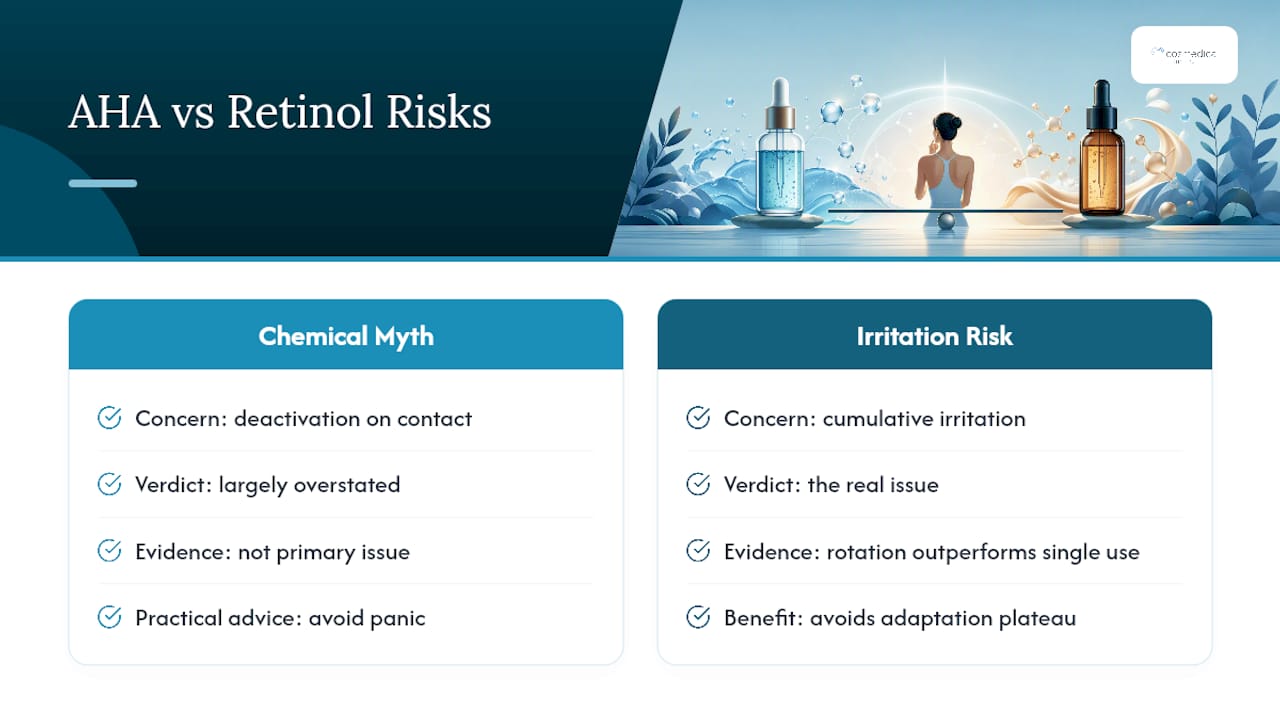
What the rotational trials actually show is more useful than any pH argument: alternating actives on a schedule outperformed single-ingredient use on photoaging markers, and it avoided the plateau that shows up when skin adapts to one active over months. That’s the piece conventional advice usually skips. Most guidance stops at “don’t combine them,” full stop, without offering a structured alternative that still gets you both benefits.
My take is that the schedule matters more than the ingredient list. A rigid “AHA in the morning, retinol at night, never the two shall meet” rule is safe advice for a beginner, but it undersells what four to six weeks of a genuine rotation can do for texture and tone. Prioritize slow tolerance-building first. Once that’s established, a structured rotation, not caution alone, is what gets you the collagen and clarity benefits both ingredients promise.
— Thomas
Where to Start if You Want to Try This Safely
If you’re ready to build a rotation without guessing at strengths or risking a reaction, starting with formulations designed for beginners makes the ramp-up far less stressful than mixing full-strength products from different brands. Cosmedica-skincare’s Super Serum Set pairs gentler active concentrations with hydrating support, which fits the alternate-night approach outlined above without forcing you to buy and calibrate separate bottles. For a dedicated retinol step, the 2.5% Retinol Night Cream is formulated at a strength suited to the slow ramp dermatologists recommend, rather than jumping straight to a harsher concentration.
Whichever you pick, patch-test first and give your skin two to three weeks on a single active before layering in anything else. Start with one application a week, watch how your skin responds, and only add frequency once flaking and redness have settled. That patience is what separates a routine that builds results from one that burns you out in the first month.
Sources
- AHAs/BHAs vs. Retinol: Dermatologists Explain When and How to Use Each — Byrdie
- What to Know Before Combining AHA and Retinol in Your Skin Care Routine — Healthline
- Novel rotational combination regimen of skin topicals improves facial photoaging — Frontiers in Medicine
- Efficacy and tolerability of a double-conjugated retinoid and alpha hydroxy acid cream — Journal of Drugs in Dermatology
FAQ
Can You Use AHA and Retinol Together?
Not at the same time in most cases. Dermatologists generally recommend alternating nights or using a single formulated product rather than layering separate AHA and retinol products together.
Should I Use AHA Before or After Retinol?
If you’re already tolerant and choose to layer on the same night, apply AHA first and wait 20 to 30 minutes before applying retinol so your skin’s pH normalizes and irritation risk drops.
How Long Should I Wait Between AHA and Retinol?
Waiting 20 to 30 minutes between applications is the general guidance for tolerant skin attempting same-night use. For most people, alternating entirely different nights remains the safer default.
Does Combining AHA and Retinol Cause Purging or Peeling?
Mild flaking is a normal adjustment response, but widespread peeling, burning, or lingering redness signals overuse and means you should cut back frequency.
Are There Pre-Formulated Products That Combine Both Safely?
Yes. Formulated combination products typically use lower concentrations of each active plus buffering ingredients, and a 12-week trial of one such formula showed meaningful improvement with mostly mild side effects.
Recommended
- Can You Use Hyaluronic Acid With Retinol Safely? – Cosmedica Skincare
- Hyaluronic Acid and Retinol: Can You Use Both? – Cosmedica Skincare
- Benefits of Using Hyaluronic Acid and Retinol Together – Cosmedica Skincare
- Retinol Or Hyaluronic Acid First? The Simple Order That Makes Sense – Cosmedica Skincare