

Perimenopause Skincare: A Doctor-Backed Routine That Works
Here’s the bottom line: prioritize barrier repair and daily SPF, simplify your active ingredients, and introduce retinoids slowly. That one shift does more for perimenopause skincare than any five-step trend you’ll find online. Your skin is losing moisture faster and rebuilding collagen slower than it used to, so the goal isn’t to fight harder. It’s to support what’s already struggling.
Two safety rules before anything else: pause actives the moment your skin feels raw, tight, or stings when you apply products, and never skip sunscreen, even on cloudy days.
Morning:
- Gentle, non-foaming cleanser
- Hydrating serum (hyaluronic acid or similar humectant)
- Ceramide-rich moisturizer
- Broad-spectrum SPF 30 or higher
Night:
- Gentle cleanser (same one, or a richer version)
- Targeted active, introduced two nights a week to start
- Barrier-repair moisturizer
Pro Tip: If a new product causes redness or a stinging sensation within the first few uses, stop immediately. Reintroduce it a week later at half the frequency once your skin calms down.
Key Takeaways
Perimenopause skincare works best when barrier repair and daily sunscreen come first, actives are introduced one at a time, and routines stay simple enough to sustain long term.
| Point | Details |
|---|---|
| Barrier repair comes first | Ceramides, ceramide moisturizers, and hydrating serums should anchor your routine before any active ingredient. |
| Retinoids need a slow ramp | Start two nights a week, buffer with moisturizer, and increase frequency every two to four weeks. |
| Pause at the first sign of irritation | Stop all actives immediately if skin stings or flakes, and rebuild with gentle products for one to two weeks. |
| Mixed dryness and acne need gentle actives | Azelaic acid and low-strength salicylic acid control breakouts without stripping the barrier further. |
| Cosmedica-skincare fits a phased approach | The Super Serum Set and moisturizer collection support a slow, one-product-at-a-time buildup for sensitive perimenopausal skin. |
Table of Contents
- What Happens to Skin During Perimenopause
- A Perimenopause-Friendly Skincare Routine, Step by Step
- How to Adjust for Dryness, Breakouts, and Uneven Tone
- Which Active Ingredients Actually Matter Right Now
- Beyond the Bathroom Cabinet: Sun, Sleep, and When to Call a Dermatologist
- Cosmedica-Skincare’s Practical Starting Point
- Your Next Step With Cosmedica-Skincare
- Sources
- FAQ
What Happens to Skin During Perimenopause
Your skin isn’t imagining it. Estrogen does a lot of quiet, unglamorous work: it helps regulate collagen production, keeps your skin’s oil levels balanced, and supports the barrier that locks moisture in. When estrogen starts fluctuating in your late 30s through your 40s and 50s, that support system gets shaky, and the effects show up on your face faster than almost anywhere else on your body.
The biggest mechanical change is a rise in transepidermal water loss, or TEWL, which is a fancy way of saying your skin loses water through its surface faster than it used to. At the same time, collagen and elastin production slows, which is why skin that used to bounce back now feels thinner and less resilient. Sebum production often drops too, which sounds like good news if you’ve dealt with oily skin your whole life, but usually just trades one problem (shine) for another (persistent dryness).
Here’s what that combination tends to look like in real life:
- Dryness that doesn’t respond to your usual moisturizer
- New sensitivity to products you’ve used for years without issue
- Breakouts along the jawline and chin, often alongside dry patches elsewhere
- Uneven pigmentation, especially on sun-exposed areas
- Thinner, more fragile skin that bruises more easily
- Slower wound healing and a duller overall complexion
By the numbers: clinical reviews of women attending menopause clinics find that up to 64% report skin problems tied to the hormonal transition, ranging from dryness and sensitivity to acne flares and pigment changes. That prevalence is exactly why “just moisturize more” rarely solves the whole picture. The changes are structural, not just surface level, and they call for a routine that repairs the barrier while quietly supporting collagen in the background.
A Perimenopause-Friendly Skincare Routine, Step by Step
Think of this as a two-part job: mornings are about protection, evenings are about repair. You don’t need ten products to do either well. Clinical guidance consistently points to barrier repair, gentle cleansing, and careful retinoid introduction as the core strategy, with sunscreen doing more heavy lifting than any serum on the shelf.
Morning routine:
- Cleanse gently. A cream or gel cleanser that doesn’t foam aggressively removes overnight buildup without stripping the lipids you’re trying to protect.
- Layer an antioxidant, if you use one. A vitamin C serum can help defend against environmental damage, though this step is optional if your skin is already reactive.
- Apply a hydrating serum. Look for hyaluronic acid or glycerin, both humectants that pull water into the skin.
- Seal with a ceramide moisturizer. Ceramides are the fats that hold your skin’s barrier together, and perimenopausal skin tends to run low on them.
- Finish with broad-spectrum SPF. This is the step you cannot skip. It’s the single most evidence-backed intervention for preventing further collagen breakdown and pigment changes.
Evening routine:
- Cleanse again, using the same gentle formula or a slightly richer version if your skin feels stripped by day’s end.
- Apply your targeted active, two to three nights a week when starting out.
- Follow with a repairing moisturizer, heavier than your morning one if your skin runs dry.
- Spot-treat as needed, using a targeted product on breakouts rather than treating your whole face like acne-prone skin.
Retinoids deserve their own conversation because they’re the ingredient most likely to trip people up. If you’re new to retinol or restarting after a break, start at two nights a week and add one more night every two to four weeks as your skin tolerates it. Buffering helps too: apply a layer of moisturizer before the retinoid and another after, which cuts down on irritation without diluting the benefit much.
Patch testing matters more now than it did in your 20s. Apply a new product to a small area, like your inner forearm or just behind your jaw, for three nights before committing your whole face to it. If you notice redness, flaking, or a burning sensation that doesn’t fade within twenty minutes of application, that product needs to wait.

Pro Tip: Keep a simple skin diary for the first month of any new routine. Note what you used and how your skin felt the next morning. Patterns show up faster than you’d expect, and it saves you from guessing which product caused a flare weeks later.
Dermatologists who specialize in menopausal skin tend to agree on one thing: consistency beats complexity. A clinician review in Clinical Dermatology puts it plainly. Consistency, not a packed product shelf, is what actually drives results, and pausing actives the moment skin looks inflamed prevents small irritations from becoming weeks-long setbacks.
How to Adjust for Dryness, Breakouts, and Uneven Tone
Perimenopausal skin rarely presents one problem at a time. You might have dry, flaking cheeks and a breakout on your chin in the same week, which makes it tempting to reach for products meant for two completely different skin types. Resist that urge. Here’s how to handle the most common combinations without one fix undoing the other.
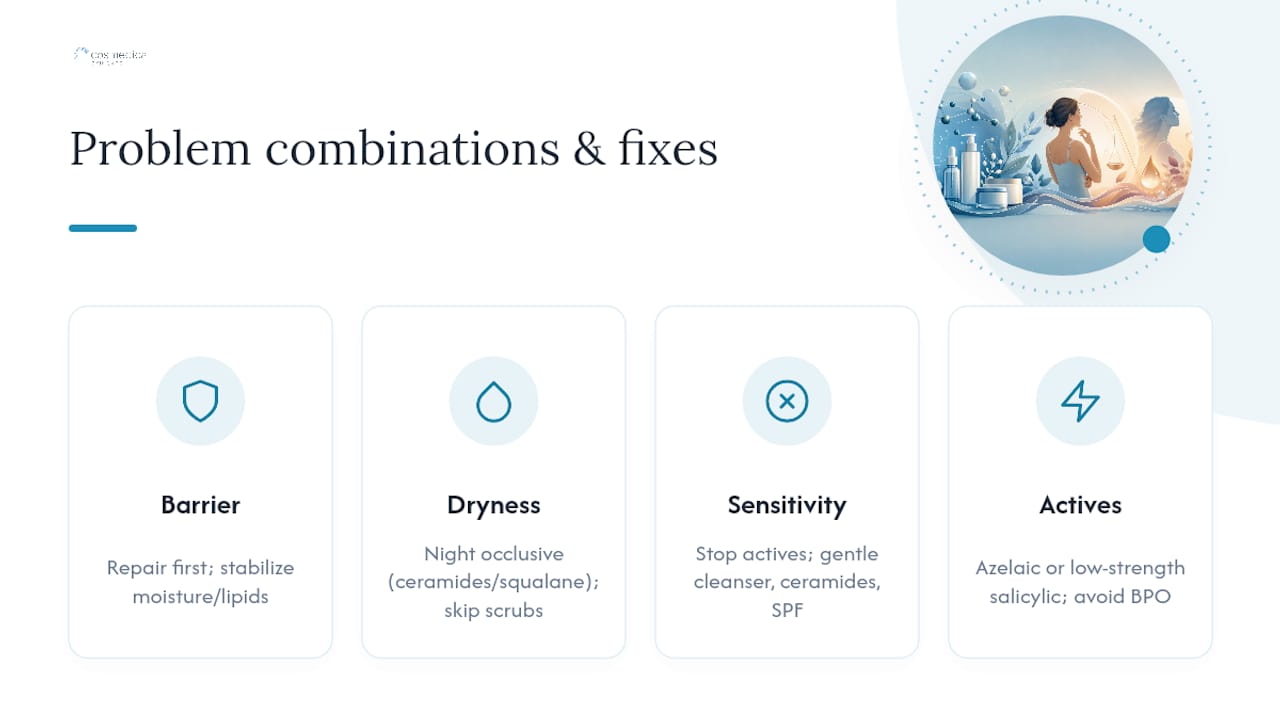
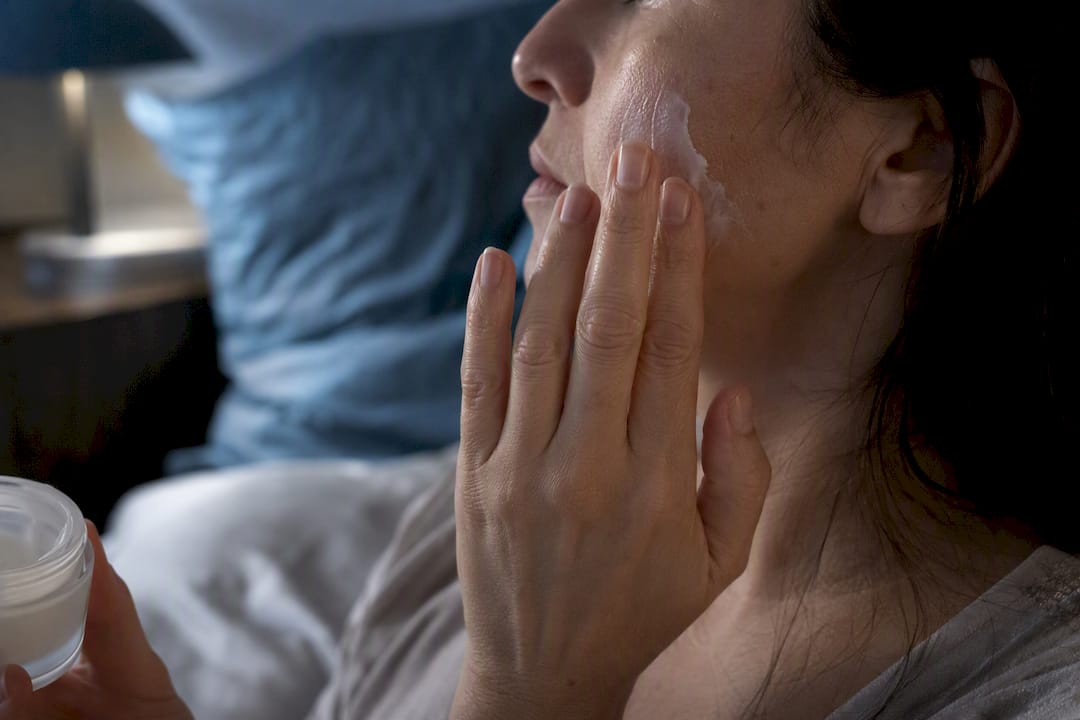
For dryness: switch to a richer occlusive moisturizer at night, one built around ceramides or squalane, and give your skin a dedicated barrier-repair night once or twice a week where you skip actives entirely. Skip physical scrubs altogether. They feel productive but tend to worsen the microscopic barrier damage that’s already causing the dryness.
For sudden sensitivity: stop all actives immediately. Switch to a bare-bones routine of gentle cleanser, ceramide moisturizer, and SPF until your skin calms down, which usually takes one to two weeks. Reintroduce one active at a time afterward, waiting several days between each addition so you can identify what your skin actually tolerates.
For hormonal breakouts alongside dryness: avoid the classic “adult acne” playbook of benzoyl peroxide and high-strength salicylic acid, since both strip the same barrier you’re trying to rebuild. A gentler approach using azelaic acid or low-strength salicylic acid tends to control breakouts without the collateral dryness.
For pigmentation: sunscreen and vitamin C or azelaic acid are your first line of defense, and they work best together rather than as standalone fixes. If dark spots persist after several months of consistent SPF use, that’s a reasonable point to ask a dermatologist about prescription options or in-office treatments.
Pro Tip: When two problems seem to contradict each other, like a dry patch right next to an active breakout, fix the barrier first. A stable, well-moisturized barrier makes every other treatment work better and reduces the risk of triggering more irritation on top of what you’re already dealing with.
Which Active Ingredients Actually Matter Right Now
Not every ingredient on a skincare label deserves your money or your patience. These are the ones with real backing for perimenopausal skin, and how to use them without a setback.
- Retinoids carry the strongest evidence for stimulating collagen production, but perimenopausal skin usually needs a lower starting concentration and slower frequency than skin in your 20s or 30s tolerated.
- Peptides offer gentler collagen support and layer easily under moisturizer, making them a reasonable alternative on nights when retinol feels like too much.
- Ceramides and hyaluronic acid form the hydration and barrier foundation everything else builds on. Skip these and your other actives will underperform.
- Niacinamide calms inflammation and helps even out tone, making it one of the few actives gentle enough for daily use even on sensitive weeks.
- Azelaic acid pulls double duty on hyperpigmentation and hormonal breakouts, which makes it particularly useful for the dry-and-breaking-out combination so many women experience during this transition.
- Phytoestrogens and peptide-based bioactives are emerging as non-hormonal cosmeceutical options that support dermal renewal for women who aren’t using topical hormone treatments.
Layer from thinnest to thickest: hydrating serums first, then treatment actives, then moisturizer to seal everything in. Save retinoids and vitamin C for separate times of day (retinol at night, vitamin C in the morning) since they can otherwise cancel each other out or increase irritation.
Beyond the Bathroom Cabinet: Sun, Sleep, and When to Call a Dermatologist
Sunscreen remains the highest-return habit you can build, full stop. No serum undoes what unprotected UV exposure does to collagen and pigment over time.
- Sleep and stress management support the same repair processes your skin is trying to run overnight.
- Quitting smoking and moderating alcohol both reduce oxidative stress that accelerates visible aging.
- A nutrient-dense diet with adequate protein gives your skin the raw materials it needs to rebuild collagen.
Hormone replacement therapy is worth a conversation with your doctor if skin changes are significant, since research shows HRT can increase dermal collagen and reduce TEWL in some women, though topical estrogen results remain inconsistent for facial skin specifically. See a dermatologist if you notice severe cystic acne, a rash that won’t resolve, or any new lesion that looks suspicious. Procedural options like microneedling or laser treatments can complement a solid topical routine but shouldn’t replace it, and any systemic treatment decision belongs in a conversation with a qualified clinician.
Cosmedica-Skincare’s Practical Starting Point
You don’t need to overhaul your entire cabinet overnight. If you’re building a perimenopause routine from scratch, start with a hydrating serum for humectant support, add a ceramide moisturizer next, then bring in a gentle retinol once your barrier feels stable. Daily SPF rounds out the essentials. Layer new products one at a time, roughly two to three weeks apart, so you can actually tell what’s working.
— Thomas
Your Next Step With Cosmedica-Skincare
Perimenopausal skin doesn’t need a bigger routine. It needs the right few products used consistently, which is exactly where Cosmedica-skincare focuses its formulations: cruelty-free, dermatologist-tested, and priced so you can build a routine in phases instead of gambling on one expensive jar. If you’re starting from the basics outlined above, the Super Serum Set bundles hydrating and barrier-supporting formulas together, which takes the guesswork out of sequencing your first few weeks. For the ceramide moisturizer step, browse the moisturizer collection to find a texture that matches how dry or reactive your skin feels right now. Add one product, give it two to three weeks, then decide what comes next. Start with the serum set today and build outward from there.
Sources
- Emerging cosmeceutical approaches for dermal support (Springer, 2025)
- Menopause, skin and common dermatoses. Part 2: skin disorders - PMC
- Managing Menopausal Skin: A Clinician’s Review (EMJ Reviews, 2025)
- What should a perimenopausal skincare routine look like? (RTE, 2026)
FAQ
What Is the Best Skincare for Perimenopause?
The most effective approach combines a gentle cleanser, ceramide-based moisturizer, hydrating serum, and daily broad-spectrum SPF, with retinoids or azelaic acid introduced gradually once the barrier feels stable.
What Skincare Should a 45-Year-Old Woman Use?
At this stage, prioritize barrier-repair moisturizers, a hydrating serum with hyaluronic acid, and a well-tolerated retinoid started at low frequency, paired with daily sunscreen to protect against further collagen loss.
What Should You Avoid During Perimenopause Skincare?
Avoid harsh, drying acne treatments like high-strength benzoyl peroxide, physical exfoliating scrubs, and stacking multiple new actives at once, since perimenopausal skin tolerates aggressive routines poorly.
What Do Dermatologists Recommend for Menopausal Skin?
Dermatologists consistently recommend gentle cleansing, ceramide and hyaluronic acid based hydration, cautious retinoid introduction, and diligent daily sunscreen use as the foundation of any effective routine.
When Should I See a Dermatologist for Perimenopausal Skin Changes?
See a dermatologist for severe or persistent acne, a rash that doesn’t resolve with gentle care, or any new skin lesion that looks unusual, since these warrant professional evaluation beyond an at-home routine.