

The Real Benefits of Collagen Supplements for Your Skin
Three topical actives reliably support your skin’s collagen: vitamin C, retinoids (including retinol), and peptides. Used consistently, they deliver firmer, more elastic skin, better hydration, and visibly reduced fine lines. The evidence is solid, not hand wavy. Clinical trials on topical vitamin C at 3–12% concentrations show measurable improvement after roughly 12 weeks of continuous use, and retinol has decades of peer-reviewed backing for boosting collagen synthesis. Cosmedica-skincare formulates both into dermatologist-tested serums, which means you don’t have to guess your way through ingredient labels to get results.
Here’s the quick version before we get into the science:
- Firmer, springier skin from increased collagen and elastin production
- Better hydration as skin barrier function improves
- Smoother texture and fewer visible fine lines over 8 to 12 weeks
- Brighter tone when antioxidants like vitamin C are part of the mix
Key Takeaways
Vitamin C, retinol, and peptides support your skin’s own collagen production directly, and consistent use over 8 to 12 weeks delivers the most reliable improvements in firmness and hydration.
| Point | Details |
|---|---|
| Vitamin C concentration | Use 3–12% formulas continuously for at least 12 weeks to see visible firmness and brightness changes. |
| Retinol builds real collagen | Clinical trials show retinoids increase collagen I formation by up to 80% over vehicle in photodamaged skin. |
| Peptides work as support | Peptides offer modest, real benefits for hydration and texture, best paired with retinol or vitamin C. |
| Sequence actives to avoid irritation | Use vitamin C in the morning with SPF and retinol at night, introducing one active at a time. |
| Cosmedica-skincare matches the evidence | Its Vitamin C Super Serum and retinol treatments are formulated within clinically studied concentration ranges. |
Table of Contents
- What Are the Benefits of Collagen Supplements for Skin?
- Vitamin C: The Concentration That Actually Moves the Needle
- Retinol and Retinoids: The Gold Standard for Collagen Synthesis
- Peptides: What They Can (and Can’t) Do for Your Skin
- Building a Routine: Sequencing Your Actives Without Irritation
- How Long Until You See Results?
- How Cosmedica-skincare Approaches These Actives
- Collagen Supplement Types: Why Topical Actives Are the Practical Choice
- Why Absorption Matters More Than the Ingredient Name
- Side Effects and Who Should Be Cautious
- Who Sees the Biggest Difference From These Actives
- Topical Actives vs. Other Collagen-Support Approaches
- Why Consistency Beats Ingredient Hype
- Ready to Build Your Collagen-Support Routine?
- Sources
- FAQ
What Are the Benefits of Collagen Supplements for Skin?
Think of collagen as the scaffolding that holds your skin’s shape — to understand why this scaffolding weakens over time, see why collagen decreases with age: the science explained. When production slows (which starts happening gradually as you age), that scaffolding sags a little, and skin loses its bounce. Topical actives don’t replace lost collagen directly. Instead, they nudge your skin into making more of its own, and that’s a meaningfully different (and more sustainable) mechanism than just slapping collagen molecules on the surface, which are too large to penetrate the skin barrier anyway.
- Firmness and structural support. More collagen means more structural integrity, so skin holds its shape instead of drooping under gravity.
- Hydration and plumping. Some actives plump skin almost immediately by drawing in moisture, while collagen-driven firmness builds over weeks.
- Smoother texture, fewer fine lines. As collagen fibers rebuild, the surface of your skin literally becomes less crinkled.
- Brighter tone. Antioxidant actives like vitamin C fight the free radical damage that breaks down collagen in the first place, which shows up as a more even, luminous complexion.
Vitamin C: The Concentration That Actually Moves the Needle
Vitamin C isn’t just a brightening ingredient, it’s a genuine collagen cofactor. Your body needs vitamin C to activate the enzymes (prolyl and lysyl hydroxylase) that stabilize collagen’s molecular structure. Without it, collagen production stalls at the cellular level. Topically applied, vitamin C also stabilizes collagen mRNA and helps reduce the fiber damage caused by UV exposure and everyday oxidative stress.
Statistic Callout: A 2026 clinical study found that a 12% pure vitamin C serum increased epidermal thickness by 16.4% after 84 days, with more than half of participants showing improved collagen fiber synthesis and cross-linking.
That 84-day figure lines up with the broader research consensus: continuous use for at least 12 weeks at concentrations between 3% and 12% is what it takes to see visible change. Here’s how to choose the right formulation:
- New to vitamin C? Start around 10% to build tolerance before moving higher.
- Experienced users can typically handle formulas closer to 12% without irritation.
- Look for stable forms in airless, opaque packaging, since vitamin C degrades quickly when exposed to light and air.
- Low pH formulas (below 3.5) tend to absorb better through the skin barrier.
One caveat worth knowing: if your diet is already rich in vitamin C, the marginal benefit of topical application may be smaller, since your baseline collagen support is already covered from the inside. Most people, though, still see a visible lift in tone and firmness from a well-formulated serum. If you’re just starting out, our guide to a vitamin C skincare routine walks through pairing it with sunscreen for daytime use.
Retinol and Retinoids: The Gold Standard for Collagen Synthesis
If vitamin C is the cofactor, retinoids are the direct instruction. Retinol and its stronger cousin, tretinoin, bind to receptors in skin cells and essentially tell fibroblasts to ramp up collagen production. Research shows topical retinol at 0.4% increases epidermal thickness and stimulates fibroblasts through the TGF-β/CTGF pathway, a mechanism that also boosts elastin and fibronectin. In one landmark trial, tretinoin produced an 80% increase in collagen I formation compared to a vehicle cream in photodamaged skin.
That’s not a marginal effect. It’s one of the strongest pieces of evidence in all of skincare science for a topical ingredient rebuilding collagen rather than just masking its absence.
Getting there safely takes patience:
- Start with a lower concentration two to three nights a week, not nightly.
- Buffer with a moisturizer applied before or after the retinol if you notice flaking or redness.
- Increase frequency gradually over four to six weeks as tolerance builds.
- Always pair with sunscreen the next morning, since retinoids increase photosensitivity.
Pro Tip: If your skin feels tight or flaky after starting retinol, that’s your skin telling you to slow down, not push through. Cut back to twice a week and let your barrier catch up before increasing frequency again.
Peptides: What They Can (and Can’t) Do for Your Skin
Peptides get marketed like miracle molecules, but the honest picture is more nuanced. Signal peptides, like palmitoyl pentapeptide-4, work by essentially messaging fibroblasts to increase production of collagen types I, III, and VI, along with elastin and fibronectin. Carrier peptides, such as GHK-Cu, ferry trace minerals like copper into skin cells to support repair processes.
The evidence here is real but more modest than vitamin C or retinoids. A 2026 systematic review of 19 randomized controlled trials found peptides improve hydration and brightness with only modest wrinkle reduction, and topical peptide studies are fewer and show smaller effects than oral formulations.
- Peptide molecules are often too large to penetrate deep into skin without formulation help like conjugation or carrier systems.
- Delivery technology matters more than the peptide’s name on the label.
- Peptides work best as an adjunct alongside vitamin C or retinol, not as a standalone fix.
Cleveland Clinic researchers note that peptides perform best as part of a broader routine rather than a lone hero ingredient, which matches what the clinical data actually shows.
Building a Routine: Sequencing Your Actives Without Irritation
Combining these three actives works better than using any one alone, but the order and timing matter more than people assume.
- Morning: Vitamin C serum, followed by moisturizer, then SPF 30 or higher. The antioxidant protects against daytime oxidative stress while the SPF prevents new collagen damage.
- Evening: Retinol, followed by a moisturizer to buffer any dryness.
- Peptides: Can go morning or evening depending on the formula. Peptide sprays layer well under either routine.
- Introduce one active at a time. Add retinol first, wait two weeks, then layer in vitamin C if you’re not already using it, adjusting for any irritation before adding more.
Patch-test any new active on your inner arm for 48 hours before applying it to your face. If you experience intense redness, burning, or peeling that doesn’t calm down within a few days, pause everything and consult a dermatologist, especially if you’re pregnant, breastfeeding, or using prescription-strength retinoids alongside over-the-counter actives.
Pro Tip: Never apply vitamin C and retinol in the same application if your skin is sensitive. Splitting them between morning and evening, as outlined above, gets you the benefits of both without the irritation of stacking them together.
How Long Until You See Results?
Patience pays off here, but not indefinitely. Hydration and a brighter tone often show up within the first few weeks, since these are surface-level barrier improvements. Collagen-driven changes, like firmness and wrinkle reduction, take longer because your skin has to physically rebuild its structural fibers.
Statistic Callout: Clinical trials on retinol and vitamin C consistently show that meaningful collagen and wrinkle changes require 8 to 12 weeks of continuous use, with more pronounced results appearing between three and six months.
Your results depend heavily on three factors: how much sun damage you’re starting with, how consistently you apply your actives, and whether you’re protecting your investment with daily SPF. Skipping sunscreen while using retinol or vitamin C is a bit like renovating a house with the windows left open during a storm. If you notice zero change in texture or tone after three months of consistent use, that’s a signal to reassess your formulation or concentration, not necessarily the active itself.
How Cosmedica-skincare Approaches These Actives
Cosmedica-skincare builds its formulations directly around the evidence covered here. The Vitamin C Super Serum is formulated within the clinically studied concentration range, packaged to protect against the oxidation that degrades weaker serums on store shelves. The retinol treatments follow the same philosophy: dermatologist-tested formulations dosed to deliver results without unnecessary irritation for first-time users.
- Vitamin C and retinol products formulated at concentrations that match published clinical research
- Educational blog content covering vitamin C and collagen restoration written to help you match ingredients to your actual skin concerns
- Cruelty-free, vegan formulations designed to be accessible without cutting corners on active ingredient concentrations
Collagen Supplement Types: Why Topical Actives Are the Practical Choice
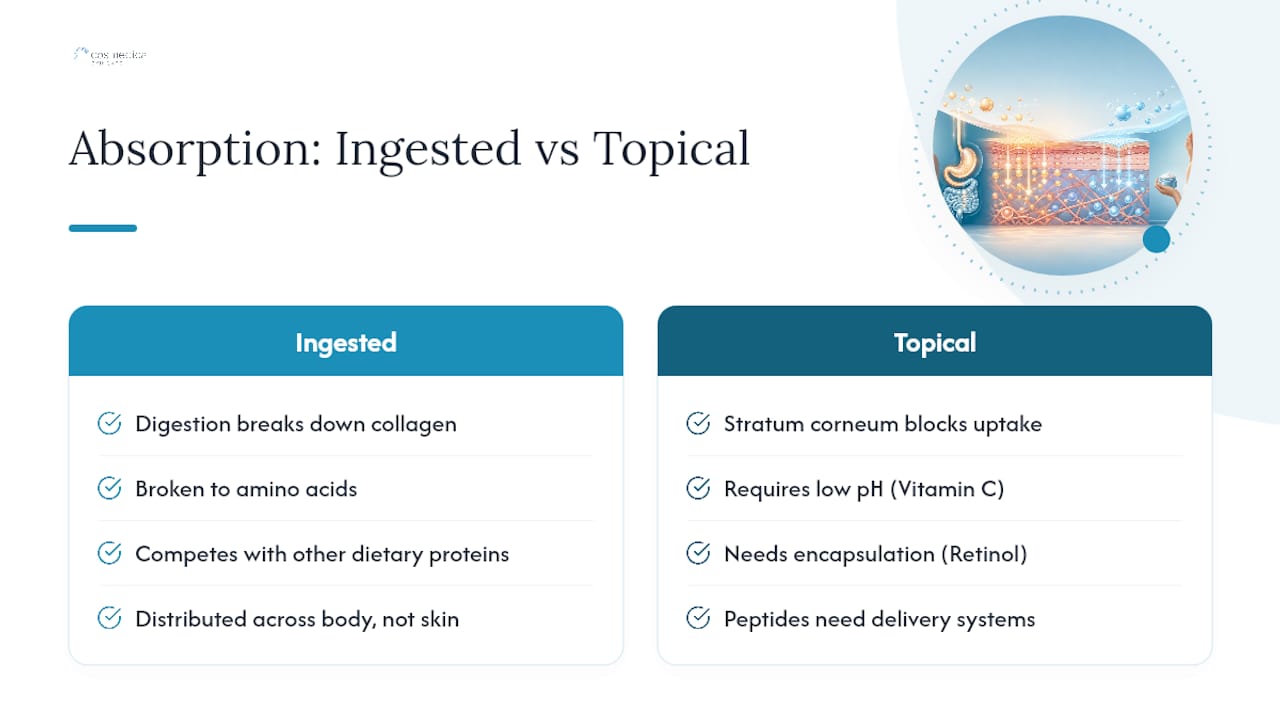
You’ve probably seen collagen powders, capsules, and drinks marketed as skin fixes, often broken down into categories like hydrolyzed collagen peptides, undenatured collagen, and marine versus bovine sourcing. Here’s the thing worth understanding: ingested collagen molecules get broken down into amino acids during digestion, the same way any protein does. Your body doesn’t ship those amino acids directly to your face and reassemble them into facial collagen. It redistributes them wherever they’re needed most, which might be your joints, your gut lining, or nowhere skin-related at all.

That’s a fundamentally different mechanism than what vitamin C, retinol, and peptides do topically. These actives work directly at the skin level, either supplying a cofactor your collagen-building enzymes need (vitamin C) or directly signaling fibroblasts to ramp up production (retinoids and peptides). There’s no digestive detour and no competition with other tissues for the raw materials.
This doesn’t mean nutrition is irrelevant to skin health. A diet adequate in protein and vitamin C supports your body’s baseline collagen-building capacity. But when your goal is specifically visible, measurable change in facial firmness and fine lines within a defined timeframe, targeting the skin directly with clinically studied topical actives gives you a more predictable and traceable path to results than hoping ingested collagen fragments end up exactly where you want them.
Why Absorption Matters More Than the Ingredient Name
Absorption is where a lot of skincare marketing quietly falls apart. Any ingredient, whether ingested or applied topically, only works if it actually reaches the tissue where it’s needed in a usable form. Ingested collagen and its amino acid building blocks travel through digestion, get broken down, and then compete with every other protein source in your diet for distribution throughout your body. Your skin is not first in line.
Topical actives face a different obstacle: your skin’s outer barrier (the stratum corneum) is specifically built to keep things out, which is generally good for keeping bacteria and pollutants at bay, but it also blocks a lot of well-intentioned skincare ingredients from penetrating deep enough to matter. This is exactly why formulation science matters so much more than ingredient lists alone. Vitamin C needs a low pH environment to absorb effectively. Retinol needs proper encapsulation to avoid breaking down before it reaches active skin cells. Peptides often need to be conjugated or carried by delivery systems to get past the surface layer at all.
The practical takeaway: two products with the same active ingredient at the same percentage can perform completely differently based on pH, packaging, and delivery technology. This is also why buying a serum from a brand that publishes its formulation reasoning, rather than just a percentage on a label, tends to get you better real-world absorption and results.
Side Effects and Who Should Be Cautious
None of these actives are risk-free, and matching the right one to your skin’s tolerance matters as much as picking the right concentration.
Retinol and retinoids carry the most well-documented side effect profile: dryness, peeling, redness, and increased sun sensitivity are common during the first few weeks of use. Prescription-strength tretinoin can intensify these effects. Retinoids are not recommended during pregnancy or breastfeeding due to potential risks to fetal development, and anyone using prescription acne medications should check with a dermatologist before adding an over-the-counter retinol on top.
Peptides have the mildest side effect profile of the three, with occasional mild irritation in sensitive individuals, but they’re rarely the cause of a reaction on their own.
If you’re on prescription retinoids, certain acne medications, or undergoing any dermatological treatment (chemical peels, laser resurfacing), talk to your dermatologist before layering additional actives. The same goes if you notice persistent burning, swelling, or a rash that doesn’t resolve within a few days of stopping use.
Who Sees the Biggest Difference From These Actives
Age and skin condition both shape how visible your results will be. People in their late 20s through 40s, when natural collagen decline is accelerating but skin cells are still highly responsive, tend to see the clearest improvement in firmness and texture. Those with visible photodamage (sun spots, fine lines from UV exposure) often see more dramatic change simply because there’s more damage to reverse.
Skin type matters too. Oily and combination skin generally tolerates retinol and higher vitamin C concentrations better than dry or highly reactive skin, which may need a slower introduction schedule and lower starting percentages.
Who might see less dramatic results? People with minimal existing sun damage and already-firm skin have less room for visible improvement, since there’s less collagen depletion to reverse. Similarly, anyone applying these actives inconsistently, using them a few times a month instead of as a steady routine, is unlikely to see meaningful change. Adherence is one of the biggest predictors of perceived failure: even a clinically proven active won’t do much if it sits in the cabinet more than it sits on your skin.
Topical Actives vs. Other Collagen-Support Approaches
Compared to other approaches marketed for collagen support, topical actives offer something distinct: direct, traceable action at the site where you want results. Vitamin C and retinol both have decades of peer-reviewed clinical trials measuring actual skin biopsies, procollagen levels, and epidermal thickness, giving you a level of evidence specificity that’s hard to match with any other category of collagen-focused product.
The tradeoff is that topical results require consistency and patience, typically 8 to 12 weeks minimum before visible change, and they work best alongside sun protection rather than as a substitute for it. There’s no shortcut that bypasses your skin’s own biology. But for readers specifically looking for visible improvement in firmness, hydration, and fine lines on their face, targeting the skin directly with evidence-backed actives remains the most direct and well-documented path available.
Why Consistency Beats Ingredient Hype
The biggest misconception in this whole category is that some single miracle ingredient will out-perform a boring, consistent routine. It won’t. The data on retinol and vitamin C is compelling precisely because it’s measured over months of continuous use, not single applications. Peptides get sold with the loudest marketing claims relative to their actual evidence, which is exactly why they belong in a supporting role, not the leading one.
What the conventional advice gets wrong is treating these actives as interchangeable or as a “pick one” decision. They’re not competing products, they’re complementary tools that work through different biological pathways. Vitamin C supplies a cofactor your enzymes need. Retinol directly signals fibroblasts to build more collagen. Peptides support the broader repair process. Skipping sunscreen while using any of them is the single most common way people undermine months of consistent effort.
If you’re prioritizing anything first, prioritize adherence over ingredient sophistication. A basic vitamin C and retinol routine used every day for three months will outperform an elaborate seven-step regimen used sporadically for three weeks.
Ready to Build Your Collagen-Support Routine?
You’ve read the mechanisms, the study timelines, and the safety guidance. What you need now is a formulation that actually matches the concentrations this research points to, without spending hours cross-referencing ingredient labels yourself. Cosmedica-skincare formulates its vitamin C and retinol lines within those clinically studied ranges, so the guesswork of matching a percentage to a published trial is already done for you. Every formula is cruelty-free, vegan, and dermatologist-tested, which matters if you’re introducing a new active and want to minimize irritation risk while you build tolerance.
If hydration is part of your goal alongside firmness, the Intense Hydration Kit pairs well with a retinol or vitamin C routine to support the skin barrier while your collagen-building actives do their work underneath. Browse the complete routine collection to build out a regimen suited to your skin type and start seeing the kind of change the research actually supports.
Sources
- Vitamin C and skin health | Linus Pauling Institute
- Peptide-related clinical evaluations (signal peptides) — PubMed
- Molecular basis of retinol anti-ageing properties in naturally aged human skin in vivo — PubMed
- Tretinoin increases collagen I formation in photodamaged skin — NEJM
- Clinical efficacy of a 12% pure vitamin C serum — Dermatology and Therapy (Springer)
FAQ
How Long Does It Take to See Results From Topical Collagen-Boosting Actives?
Hydration and brightness often improve within a few weeks, but collagen-driven firmness and wrinkle reduction typically require 8 to 12 weeks of consistent use, with more noticeable results at three to six months.
Can I Use Vitamin C and Retinol Together?
Yes, but apply vitamin C in the morning and retinol at night to avoid irritation, especially if you have sensitive skin or are new to either active.
Do Topical Collagen Creams Work the Same Way as Ingested Collagen?
No. Topical actives like vitamin C and retinol work directly on skin cells to stimulate your own collagen production, while ingested collagen gets broken down into amino acids during digestion and distributed throughout the body, not specifically to your face.
What Vitamin C Concentration Should Beginners Start With?
Are Peptides Worth Adding to My Routine?
Peptides offer modest but real benefits for hydration and texture and work best as a supporting ingredient alongside vitamin C or retinol rather than as a standalone treatment.