

The Role of Squalane: How It Hydrates and Repairs Skin
Squalane’s main job in skin care is simple: it’s a lightweight emollient that mimics your skin’s own sebum, locks in moisture, and helps your barrier hold itself together. That’s the whole story in one sentence, but here’s who should actually care.
- Dry, sensitive, or post-procedure skin benefits most, since squalane resists oxidation and calms rather than provokes.
- Acne-prone skin does fine with it too. Pure squalane is noncomedogenic for most users, unlike its unstable cousin, squalene.
- The caution: don’t confuse squalane with squalene. Oxidized squalene byproducts can irritate skin, which is exactly why the stable, saturated version took over the shelf.
Key Takeaways
Squalane works by mimicking your skin’s natural sebum, which lets it seal in hydration and reinforce the barrier without clogging pores or destabilizing on the shelf.
| Point | Details |
|---|---|
| Squalane is stable, squalene isn’t | Hydrogenation removes squalene’s reactive double bonds, preventing the oxidation that can irritate skin. |
| Hydration is well-documented | Squalane reduces water loss and reinforces the skin barrier, backed by CIR safety review data. |
| Hair benefits are real but topical | It coats the hair shaft to reduce breakage and add shine rather than penetrating the cortex. |
| Safety is strong, with caveats | CIR ruled it safe at typical concentrations; patch test first and watch for rare contact dermatitis. |
| Cosmedica-skincare offers a vetted option | Their plant-derived, dermatologist-tested squalane oil follows the exact layering guidance covered here. |
Table of Contents
- What Is Squalane, and Where Does Squalane’s Role Come From?
- Squalane vs. Squalene: Why One Letter Changes Everything
- What Are the Proven Skin Benefits of Squalane?
- Can Squalane Help Your Hair, Too?
- Is Squalane Safe? What Are the Side Effects?
- How to Add Squalane to Your Skin Care Routine
- How Do You Choose a Good Squalane Product?
- What Does the Research Actually Say About Squalane?
- Why the Squalane Hype Undersells the Science
- Try a Dermatologist-Tested, Plant-Derived Squalane Oil
- Sources
- FAQ
What Is Squalane, and Where Does Squalane’s Role Come From?
Squalane is squalene’s more stable sibling. Manufacturers hydrogenate squalene, a lipid your skin already produces, adding hydrogen atoms to eliminate the double bonds that make the original molecule prone to breaking down. That single chemical tweak is why squalane sits in your serum for two years instead of going rancid in two weeks.
Most cosmetic squalane today comes from plants rather than the shark liver oil that once dominated the supply chain. Common sources include:
- Sugarcane (currently the most widely used commercial source)
- Olives
- Amaranth seed
- Wheat germ
Sugarcane-derived and fermentation-based squalane have largely replaced shark-liver squalene in reputable formulations, which matters both for reef and marine ecosystems and for consistency. Plant fermentation yields a purer, more uniform oil batch after batch. If a label doesn’t specify the source, that’s worth a second look before you buy.
Squalane vs. Squalene: Why One Letter Changes Everything
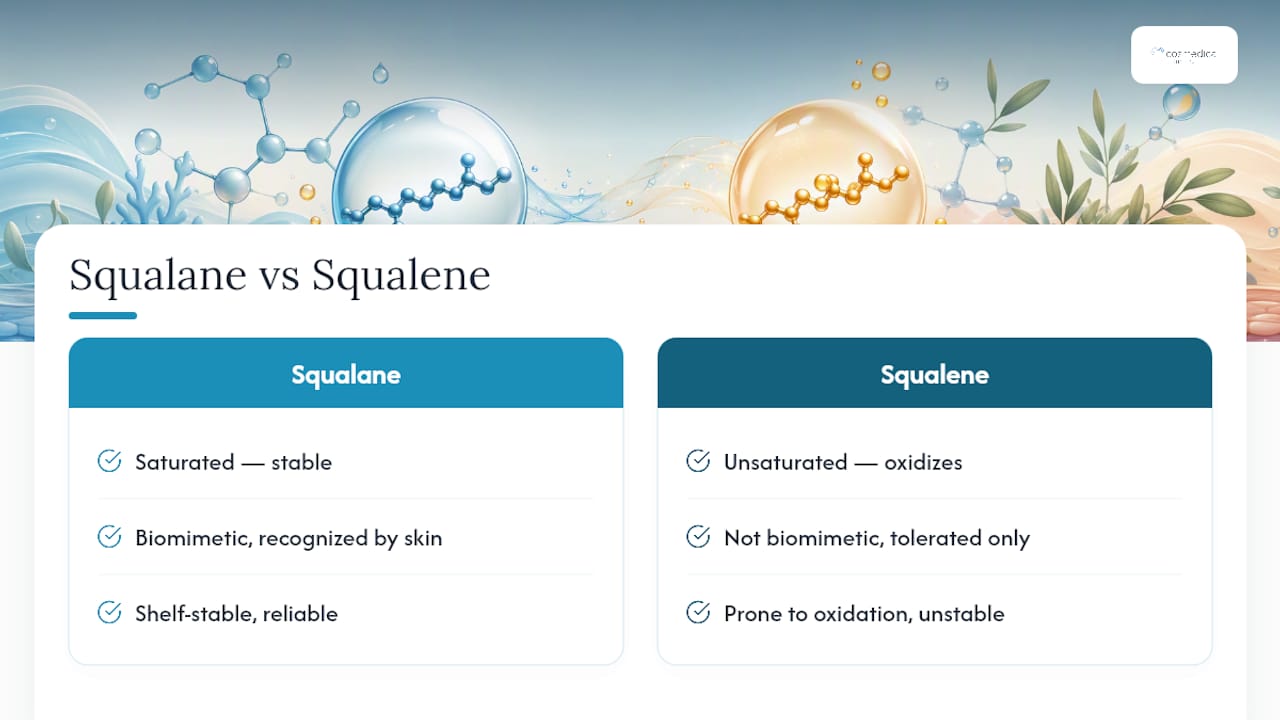
The molecular difference comes down to saturation. Squalene, found naturally in human sebum and shark liver, has six double bonds that make it chemically reactive. Squalane has none. That’s not a technicality. It’s the reason one ingredient sits stably in a bottle and the other doesn’t.
- Squalene oxidizes on exposure to air and UV light, forming peroxides that can trigger inflammatory responses in keratinocytes and are experimentally linked to comedogenicity and acne flare-ups.
- Squalane resists that same oxidation, which is exactly why it dominates modern formulations instead of raw squalene.
Pro Tip: If a product’s ingredient sourcing feels vague, look for “squalane” specifically on the INCI list, check for a dark or opaque bottle, and see whether the formula includes an antioxidant like vitamin E to back it up.
What Are the Proven Skin Benefits of Squalane?
The research on squalane skin hydration is genuinely solid, not marketing spin. Here’s what the evidence actually shows:
- Hydration and moisture retention: Squalane reduces transepidermal water loss by forming a breathable film, functioning as an emollient and mild occlusive without the greasy finish of heavier oils.
- Barrier support: Since squalane already resembles a lipid your skin makes naturally, it slots into the barrier structure rather than sitting as a foreign layer.
- Anti-inflammatory action: Cleveland Clinic notes that squalane’s anti-inflammatory properties may help with both acne and eczema, calming rather than clogging.
- Antioxidant, cytoprotective effects: In lab studies on human dermal fibroblasts, plant-derived squalane at concentrations as low as 0.005 to 0.015 percent reduced UVA-induced reactive oxygen species and apoptotic markers, suggesting real protective potential against sun-related cellular stress.
Dry, sensitive, and compromised barriers respond especially well, and it’s a common pick for post-procedure skin recovering from peels or lasers. For acne-prone skin, the picture is nuanced: pure squalane itself doesn’t clog pores, but oxidized squalene (the unstable cousin, not squalane) has been tied to breakouts in lab models. That distinction is worth remembering the next time someone tells you “oils cause acne.”
Can Squalane Help Your Hair, Too?
Squalane doesn’t just sit on skin. On hair, it coats the shaft rather than penetrating deep into the cortex, smoothing the cuticle and adding shine without weighing strands down. Healthline reports it can reduce breakage, tame split ends, and soothe dry, flaky scalps.
- Dry ends or frizz: warm two to three drops between palms and smooth through mid-lengths.
- Dry scalp: massage a few drops directly into the scalp before shampooing, then rinse.
Pro Tip: Fine or thin hair needs far less. Start with a single drop, since too much squalane can leave lightweight strands looking flat rather than glossy.
Is Squalane Safe? What Are the Side Effects?
The safety consensus here is unusually strong for a cosmetic ingredient. The Cosmetic Ingredient Review panel concluded that squalane and squalene are safe for use in current cosmetic practices and concentrations, and usage has climbed dramatically, appearing in thousands of reported formulations by 2019, up from hundreds in 2001.
That doesn’t mean zero risk. A few things to watch for:
- Allergic contact dermatitis is rare but possible, especially with impure or poorly sourced oils.
- Photo-oxidation byproducts, which form when squalene (not squalane) breaks down under UV exposure, can trigger inflammation and are experimentally linked to acne pathogenesis.
- Comedogenicity confusion: pure squalane rarely clogs pores; oxidized squalene is the actual culprit in most reported cases.
- Pregnancy: plant-derived squalane is generally considered a low-risk topical ingredient, though anyone pregnant or nursing should run new products past their OB-GYN or dermatologist first.
If you notice persistent redness, itching, or a rash that doesn’t fade within a day or two of introducing a new squalane product, stop using it and see a dermatologist rather than pushing through.
Always patch test on your inner forearm for 24 to 48 hours before applying anything new to your face.
How to Add Squalane to Your Skin Care Routine
Squalane works best as a sealant, not a first step. Here’s the order that actually makes sense biochemically:
- Cleanse with a gentle formula suited to your skin type.
- Apply water-based humectants first, like hyaluronic acid or glycerin, to draw moisture in.
- Layer any treatment serums or actives (vitamin C in the morning, retinol at night).
- Finish with two to four drops of squalane to seal everything underneath.
- In the morning, follow with sunscreen as your final step.
For your face, two to three drops is plenty. Squalane’s molecular structure also makes it a smart buffer for retinoids, AHAs, and BHAs, since mixing a drop in with a harsher active can ease irritation without diluting the active’s effectiveness.
Pro Tip: After a chemical peel or in-office procedure, skip actives entirely for a few days and use squalane alone. It helps rebuild the barrier while the skin is at its most vulnerable.

How Do You Choose a Good Squalane Product?
Not all bottles labeled “squalane oil” deliver the same quality. Run through this checklist before buying:
- Ingredient list position: squalane should appear near the top if it’s marketed as a standalone facial oil.
- Source transparency: look for “plant-derived” or “sugarcane-derived” rather than an unlisted or ambiguous origin.
- Packaging: dark glass bottles with droppers protect against light degradation better than clear containers.
- Antioxidant support: formulas that pair squalane with vitamin E tend to hold up longer once opened.
- Purity vs. blends: decide whether you want 100 percent squalane oil or a blended serum with other actives, since both have a place depending on your routine.
Store your bottle in a cool, dark spot, away from direct sunlight or a steamy bathroom shelf, and try to recap tightly after each use to limit air exposure.
What Does the Research Actually Say About Squalane?
The evidence base here spans several tiers, and it’s worth knowing which claims rest on the strongest ground.
- Well-supported: safety at typical cosmetic concentrations, backed by the CIR’s formal review; moisturizing and occlusive effects, backed by decades of biological and clinical literature documenting antioxidant, emollient, and wound-healing activity.
- Promising but early-stage: the antioxidant, UVA-protective effects shown in fibroblast cell studies are compelling, but they’re in vitro findings, not large-scale human trials.
- Mixed or preliminary: squalene’s broader role in oxidative stress and cardiovascular health remains genuinely unsettled, with some research pointing to benefits and other findings suggesting a more complicated picture depending on context and dose.
The gap between “safe and effective as a topical emollient” and “systemically protective compound” is wide, and squalane’s cosmetic reputation rests solidly on the former, not the latter.
Why the Squalane Hype Undersells the Science
Most skin care content treats squalane as an interchangeable “hydrating oil,” lumped in with argan or jojoba without distinction. That undersells it. Squalane isn’t just moisturizing, it’s biomimetic, meaning your skin barrier recognizes it as a lipid it would have made itself. That’s a meaningfully different mechanism than an oil your skin merely tolerates.
The bigger blind spot, though, is the squalane versus squalene confusion. Plenty of buyers still assume “natural squalene” sounds purer than “processed squalane,” when the opposite is closer to true for shelf-stable skin care. Stability isn’t a marketing compromise here. It’s the entire reason squalane works reliably where its unsaturated parent molecule can backfire.
If there’s a real recommendation buried in the research, it’s this: reach for plant-derived squalane, patch test anything new, and don’t assume every oil claiming antioxidant benefits is backed by the same caliber of evidence. Some are. Squalane, largely, is.
Try a Dermatologist-Tested, Plant-Derived Squalane Oil
If you’re ready to put the science into practice, Cosmedica-skincare’s squalane oil is formulated from plant-derived sources, cruelty-free, and dermatologist-tested for exactly the kind of lightweight barrier support this article covers. Two to three drops warmed between your palms and pressed into clean skin is enough, applied after your serums and before sunscreen in the morning, or as your last step at night. It layers cleanly under makeup and works equally well smoothed through dry ends. For a full routine built around barrier repair and hydration, the Super Serum Set pairs actives with the same sealing step, giving you a complete system rather than a single bottle guessing game.
Sources
- Squalane: What It Is and Benefits - Cleveland Clinic Health Essentials
- The Mechanism of Protective Action of Plant-Derived Squalane Against UVA Radiation-Induced Apoptosis in Human Dermal Fibroblasts (MDPI Antioxidants)
- Photo-oxidized squalene and keratinocyte responses (PLOS ONE)
- SQUALANE and SQUALENE CONCLUSION - Cosmetic Ingredient Review (CIR) report summary
- Squalane: What It Is and How It Benefits Skin and Hair
- Biological importance and applications of squalene and squalane (PubMed listing)
FAQ
Is Squalane Oil Safe to Use During Pregnancy?
Plant-derived squalane is generally considered a low-risk topical ingredient, but anyone pregnant or nursing should check with an OB-GYN or dermatologist before adding any new product to their routine.
Is Squalane Better Than Retinol?
They’re not interchangeable. Retinol actively drives cell turnover and targets fine lines, while squalane is a barrier-supporting emollient. Many routines use both, applying squalane after retinol to buffer irritation.
Which Is Better, Squalane or Niacinamide?
They solve different problems. Niacinamide regulates oil production and brightens tone, while squalane hydrates and seals moisture, and the two layer well together rather than competing.
Does Squalane Clog Pores?
Pure squalane is noncomedogenic for most people. The comedogenicity concerns you may have read about trace back to oxidized squalene, not the stable, hydrogenated squalane used in modern formulations.
How Often Should I Use Squalane?
Once or twice daily works for most skin types, applied as the final step after serums in the morning and evening, right before sunscreen during the day.