

Refillable Skincare: Decide by Frequency, Mechanism, Checkout Cost
Refillable skincare earns its keep when you’re buying the same cleanser or moisturizer every month, but it can be a wash for products you only use occasionally. A price study of 30 U.S. starter and refill pairs found a median unit saving, though the savings ranged widely. For frequent-use staples with a well-designed refill system, go for it. For sensitive actives or once-in-a-blue-moon buys, a fresh bottle usually makes more sense. Skip ahead to the buying checklist and cost math if you want the specifics before you decide.
TL;DR:
- Refillable skincare systems work best for products used frequently, such as cleansers and basic moisturizers, where savings in packaging and cost per use are significant.
- Sealed pods are ideal for sensitive ingredients like retinol or vitamin C, as they protect formulas from air and light, unlike pour-in pouches that expose products to oxygen.
- The actual savings depend on refill size, frequency of use, and long-term commitment, with some large refills costing more overall despite lower unit prices.
- Compatibility, clear labeling, and stable, long-term availability of refills are crucial factors when choosing refillable products to avoid disappointment.
- Buying outright may be more practical for occasional use or testing new formulas, especially when refill SKU availability or savings are uncertain.
Table of Contents
- How Refillable Skincare Works and the Formats You’ll See
- Which Product Categories Are Best Suited to Refills (and Which Aren’t)
- Cost and Sustainability Trade-Offs: What Studies and Price Checks Show
- Shopping Checklist: How to Evaluate a Refillable Product Before You Buy
- Where to Buy and Retailer Programs to Know About
- Cosmedica Skincare’s Perspective and What to Look For in Sustainable Skincare
- Why “Refillable” Isn’t the Same as “Sustainable”
- An Alternative: Shop Cosmedica Skincare’s Cruelty-Free, Eco-Conscious Products
- Sources
- FAQ
How Refillable Skincare Works and the Formats You’ll See
Think of refillable skincare like a coffee pod machine for your bathroom shelf. You buy the durable base once (the machine), and then you just keep buying the coffee (the refill) instead of the whole appliance over and over. That’s the entire premise, and it’s why the format matters so much more than most shoppers assume.
Most systems pair one long-lasting primary container (glass, aluminum, or heavy-duty plastic) with a refill that comes in one of a few shapes. Sealed pods snap or twist into the base and stay closed until you’re ready to use them, which protects the formula from air and light. Drop-in inserts sit loosely inside the outer shell, similar to a cartridge in a printer. Flexible pouches, the kind you see with body wash and hand soap, pour directly into the original bottle and typically use less plastic than the pods do.
The format you pick affects more than convenience. A sealed pod keeps oxygen and light away from a formula until the moment you crack it open, which matters enormously for “spicy” ingredients like retinol or vitamin C that break down fast once exposed. A pour-in pouch, by contrast, exposes the product to air the second you start refilling, so it works best for stable, low-sensitivity formulas like a basic moisturizer or a gentle cleanser.
A well-designed refill system usually shows a few tells:
- The refill is made from a single material (mono-material pouches, for instance) rather than a mixed-plastic laminate that’s hard to recycle.
- The brand states clear compatibility information: which starter kit the refill fits, and for how long that refill SKU will stay available.
- The refill mechanism doesn’t require you to touch the product directly, reducing contamination risk.
- The packaging discloses recycling stream guidance instead of a vague “recyclable” label with no instructions.
Design research on refill-at-home formats backs this up directly: sealed pods, clear labeling, and guaranteed availability are the features that actually drive people to refill instead of tossing the base container in a drawer.
Which Product Categories Are Best Suited to Refills (and Which Aren’t)
Not every product in your routine belongs in a refill system, and pretending otherwise is how people end up disappointed. The category that makes the most sense is the one you buy on autopilot.
- Daily cleansers, body wash, and hand soap top the list. You use these fast, the formulas are generally stable at room temperature, and the sheer frequency of repurchase means the refill container earns its environmental cost quickly.
- Staple moisturizers come in a close second. A basic daily lotion or cream doesn’t usually contain fragile actives, so it tolerates the extra air exposure that comes with pouring a refill.
- Serums, oils, and targeted treatments sit in borderline territory. These only make sense as refills when the system is sealed or airless, because a vitamin C serum left open to oxygen for even a few minutes starts losing potency. If a serum refill isn’t a sealed pod, treat it with more skepticism than a moisturizer refill.
- Small-batch actives and short-shelf-life treatments are poor fits. Anything you’d normally keep in the fridge, use sparingly, or finish within a few weeks of opening rarely justifies a refill mechanism. The packaging complexity outweighs the benefit when the product itself doesn’t stick around long enough to need a second fill.
- Household or shared products amplify the case for refills. A bottle of hand soap that three or four people use daily burns through product fast enough that the refill pays for itself, both financially and environmentally, in a fraction of the time a single person’s nightly serum would take.
The pattern here isn’t complicated once you see it: frequency and formula stability decide whether refills make sense, not marketing language. A brand can call any product “refillable,” but if you’re only replacing it twice a year, you’re paying for a reusable container you’ll barely reuse. Everyday staples like cleansers and moisturizers are exactly where that math works in your favor, because you’re already restocking often enough for the system to matter.
Where things get genuinely tricky is with anything advertised as a “gentle refill” for a sensitive or reactive skin treatment. If a product already needs airless packaging to stay effective in its original form, a pour-in pouch refill undoes the whole point of that packaging design. Read the fine print before assuming a refill preserves the same stability as the original bottle.
Cost and Sustainability Trade-Offs: What Studies and Price Checks Show
Here’s the part that trips up even careful shoppers: a cheaper unit price doesn’t always mean a cheaper cart. Larger refill pouches often lower your cost per milliliter while raising the total dollar amount you hand over at checkout, since you’re buying more volume in one purchase. That’s the cash-flow catch, and it’s easy to miss if you only glance at the “per ounce” label on the shelf.
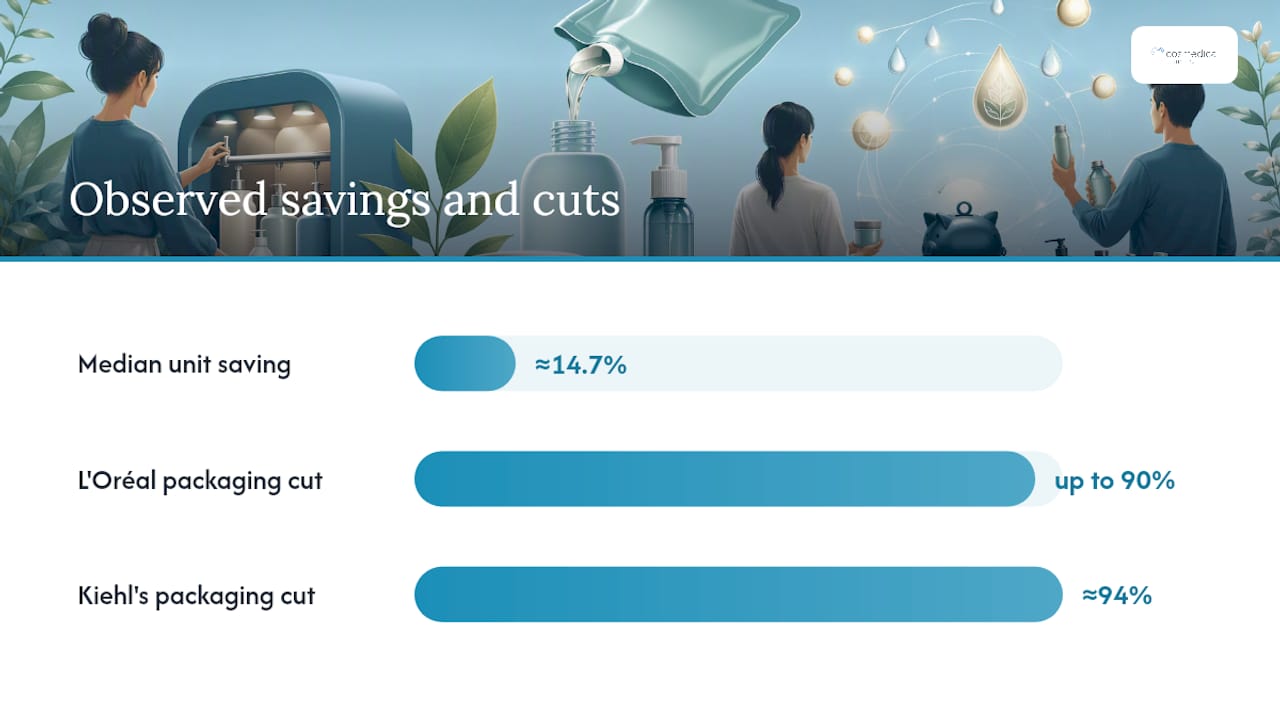
By the Numbers: A sampled comparison of 30 U.S. skincare starter and refill systems found a median unit saving of roughly 14.7% when switching to a refill. But the range was wide. One example saved a notable percentage per milliliter on paper, yet the actual checkout total was higher than buying a fresh unit, simply because the refill size was larger.
That gap between “cheaper per unit” and “more expensive per purchase” matters if you’re budgeting month to month rather than thinking in cost-per-ounce spreadsheets. A refill that saves you money over a year might still strain your wallet the week you buy it.
Material savings tell a similarly nuanced story. L’Oréal has reported that certain refill formats cut packaging material by as much as 90% or more for specific products, including a Kiehl’s cream refill said to save around 94% of packaging versus buying a new jar every time. Numbers like that sound decisive, but they only apply once you’ve actually committed to refilling repeatedly. A single refill purchase that then gets abandoned doesn’t come close to those savings, since most of the environmental cost sits in manufacturing the durable base container in the first place.
That’s the refill threshold in a nutshell: you need enough repeat refills to offset the extra material and energy that went into making the sturdier original container. Skip that threshold, and you’ve essentially bought a fancier version of a single-use product.
A few rules keep this math honest:
- Always compare per-unit cost in the same measurement (ml to ml, oz to oz), never the sticker price alone.
- Confirm the refill actually fits your current container before assuming compatibility.
- Estimate how many times you’ll realistically refill over the next year, not just whether the first refill looks like a deal.
- Watch for promotional bundling or subscription discounts that make a one-time refill purchase look better than the steady-state price.
Shopping Checklist: How to Evaluate a Refillable Product Before You Buy
Before you add a refill to your cart, run through this list. It takes about the same time as reading a product description, and it saves you from the most common refill mistakes.
- Confirm exact compatibility. Match the starter kit model number to the refill SKU. Brands sometimes redesign pumps or pods, and an older base container may not accept a newer refill, a risk packaging guides flag repeatedly.
- Compare per-unit price against checkout total. If the refill is a larger size than the original, redo the math instead of trusting the “% savings” banner.
- Check the refill material and your local recycling rules. Mono-material pouches, glass, aluminum, and steel tend to have the widest recycling acceptance; mixed-material laminates often don’t.
- Assess how the refill actually works. Snap-in pods are simplest, twist pods come next, and pour pouches require the most careful handling to avoid spills or contamination.
- Check the brand’s track record on refill availability. A refill SKU that’s been on shelves for two years is a safer long-term bet than one launched last quarter as a limited pilot.
Pro Tip: Before you buy your first refill, check whether the brand’s website lists the refill as a permanent SKU or a “limited edition” release. A refill you can’t find again in six months isn’t really a refill system, it’s a one-time gimmick.
Where to Buy and Retailer Programs to Know About
Retailers increasingly stock refillable skincare as its own category, but the way it’s listed online can be confusing if you’re not looking closely. Starter kits and refills usually appear as separate product listings, sometimes under the same brand page and sometimes filed under an entirely different section of the site. Before buying, check the product description for the specific base model the refill is designed to fit, not just the brand name.
Sephora has built out one of the more visible refill and recycling programs in U.S. beauty retail, expanding its assortment of refillable SKUs while also partnering on take-back and recycling efforts for empty packaging. That said, Sephora generally doesn’t refill your personal jar in-store. Hygiene and liability concerns keep most retailers from doing hands-on refilling at the counter, so the “refill” you’re buying is almost always a new, sealed refill unit rather than a top-up service.
That distinction separates two different models worth knowing:
- Refill-at-home systems ship you a sealed pouch or pod you install yourself, which is the format most major skincare brands use.
- In-store refill stations exist in some specialty and zero-waste shops, letting you dispense product into your own container, though availability is far more limited and varies by region.
- Take-back programs let you return empty packaging (sometimes for a small credit) without requiring the store to physically refill anything.
When in doubt, buy from the brand’s official page and double-check the SKU number rather than assuming two similar-looking bottles are interchangeable.
Cosmedica Skincare’s Perspective and What to Look For in Sustainable Skincare
We build our lineup around cruelty-free, affordable formulas that put real ingredients front and center, whether that’s a hydrating serum, a peptide spray, or a retinol treatment aimed at fine lines. We don’t run a refill program today, but the same transparency principles that make refillable skincare trustworthy apply to any product you’re considering, refillable or not.
Look for brands that list full ingredient decks, not vague “proprietary blend” language, and that disclose whether formulas have been dermatologist tested. Those two signals tell you more about long-term trustworthiness than a “sustainable” badge ever will.
Whether you’re refilling a moisturizer or restocking a fresh bottle, the questions stay the same: does the brand tell you what’s inside, and does the formula hold up over repeated use?
Why “Refillable” Isn’t the Same as “Sustainable”
The conventional advice on refillable skincare treats every refill purchase as an automatic win for the planet and your wallet. That’s backwards. A refill only pays off environmentally once you’ve used it enough times to offset the extra material that went into the sturdier starter container, and it only pays off financially when you actually check the checkout total instead of trusting a percentage-off banner.
What gets overlooked is how much this depends on habit, not intention. Buying one refill pouch because it felt like the responsible choice, then reverting to a new bottle next time, accomplishes almost nothing. The real payoff shows up for people who refill the same cleanser or moisturizer month after month without thinking twice about it.
Prioritize frequency first, refill mechanism second, and price only after you’ve confirmed both. Skip the guilt over serums and treatments that don’t fit the refill model. Save your effort for the products you’re buying anyway.
— Thomas
An Alternative: Shop Cosmedica Skincare’s Cruelty-Free, Eco-Conscious Products
If compatibility headaches, discontinued refill SKUs, or the “will this actually save me money” math sound like more hassle than you want, buying a new, thoughtfully made product outright is a completely reasonable call. That’s especially true when you’re testing a new formula for the first time or you only replace a product once or twice a year, situations where a refill system’s long-term savings never really kick in anyway.
Cosmedica-skincare’s cruelty-free, dermatologist-tested formulas give you that option without the guesswork of matching a refill pod to the right base container. Our moisturizers collection covers the hydration staples worth restocking regularly, and the Super Serum Set is a solid starting point if you want to trial a few targeted treatments, like vitamin C and retinol, before committing to a full routine. Browse either page and see which one matches what your skin needs right now.
Sources
- Do skincare refills save money? 30 U.S. skincare starter and refill systems compared
- The Latest Findings on Consumer Expectations for Refill-At-Home Packaging Formats
- L’Oréal relaunches refill pouches under new consumer awareness campaign
FAQ
Which Skincare Brands Offer Refills?
Several major skincare and beauty brands, including Kiehl’s and L’Oréal-owned labels, now sell refill pouches or pods alongside their standard packaging, and Sephora carries an expanding assortment of refillable SKUs across brands.
Does Sephora Do Refills?
Sephora sells refillable products and supports recycling and take-back partnerships, but it generally doesn’t refill your personal jar in-store due to hygiene and safety constraints.
What Is the 1% Rule in Skincare?
The “1% rule” isn’t a formally defined refill standard; when people reference it, they usually mean starting new active ingredients like retinol at low concentrations and increasing gradually, which is a separate concept from packaging or refill systems.
What Is the 4-2-4 Rule in Skincare?
There’s no widely established, consistent definition of a “4-2-4 rule” in dermatology or skincare industry standards, so treat any claim that names it as a formal guideline with caution.
Are Refillable Moisturizers Actually Worth It?
Refillable moisturizers tend to be worth it if you repurchase the same product often, since frequent use lets you clear the refill threshold where material savings outweigh the extra manufacturing cost of the durable base container.