

10% L Ascorbic Acid: How to Choose Vitamin C During Pregnancy
The main caveats: stick to lower-strength formulas, patch test anything new, and stop immediately if you notice irritation. The American Academy of Dermatology and MotherToBaby both back this up.
TL;DR:
- Topical vitamin C during pregnancy remains low risk due to minimal systemic absorption and no known fetal harm signals; oral vitamin C should stay within recommended dietary limits.
- Use formulations with around 10% L-ascorbic acid or lower, preferring derivatives like magnesium or sodium ascorbyl phosphate to reduce irritation risk.
- During early pregnancy and breastfeeding, opt for conservative, patch-tested routines, applying once daily in the morning, and avoid strong actives like retinoids and hydroquinone.
- Vitamin C pairs well with supportive ingredients such as hyaluronic acid, which helps offset potential dryness and is safe during pregnancy.
- Always check ingredient lists for additional actives and consult your healthcare provider before stacking supplements or trying new formulations.
Table of Contents
- Why Dermatologists Consider Vitamin C During Pregnancy Low Risk
- What Concentration and Formula Should You Look For?
- How Should You Adjust Vitamin C by Trimester?
- How Do You Apply Vitamin C Safely While Pregnant?
- Which Skincare Ingredients Should You Avoid While Pregnant?
- Cosmedica Skincare’s Approach to Pregnancy-Safe Formulation
- What Are the Benefits of Vitamin C During Pregnancy?
- How Much Dietary Vitamin C Do You Need During Pregnancy?
- Can You Take Too Much Vitamin C While Pregnant?
- Does Vitamin C Interact With Prenatal Vitamins?
- Does Vitamin C Affect Preeclampsia or Gestational Diabetes Risk?
- The Real Gap in Most Pregnancy Skincare Advice
- Our Pick for Pregnancy-Safe Vitamin C
- Sources
- FAQ
Why Dermatologists Consider Vitamin C During Pregnancy Low Risk
Here’s the thing about topical skincare that a lot of people don’t realize: your skin is picky about what it actually absorbs. Vitamin C applied as a serum works mostly on the surface layers, and only a small fraction makes it into your bloodstream. That’s the whole reason dermatologists treat topical products differently from oral supplements.
MotherToBaby’s fact sheet on vitamin C draws exactly this line. Oral vitamin C has an upper daily limit, and the group recommends staying within the standard recommended dietary allowance if you’re taking it as a supplement. But topical exposure is evaluated separately, and the available research doesn’t show a fetal-harm signal from applying it to your skin. The AAD goes a step further and actually recommends topical vitamin C during pregnancy, specifically to help prevent and treat melasma, the patchy skin discoloration that shows up in a lot of pregnancies thanks to hormonal shifts.
We want to be upfront about something: this article is about vitamin C serums, creams, and treatments you put on your skin. It is not about vitamin C supplements you swallow. That’s a separate conversation with a separate set of dosing questions, and your OB or midwife is the right person to have it with.
Quick safety snapshot:
- Topical vitamin C: low systemic absorption, no known fetal-harm signal
- Oral vitamin C: has its own daily upper limit, discuss dosing with your provider
- Evidence base: reviews describe topical antioxidant benefits with minimal systemic exposure, though pregnancy-specific trial data is still limited
The precautionary approach still makes sense even with reassuring data, mostly because large, pregnancy-specific safety trials on cosmetic ingredients are hard to run for ethical reasons. That’s why the guidance leans toward “keep it simple and low-strength” rather than “anything goes.”
What Concentration and Formula Should You Look For?
Not all vitamin C serums are built the same, and during pregnancy, the formula matters more than the marketing on the bottle. Think of it like picking a workout intensity. You want enough to make a difference, but not so much that you’re sore for a week.
Here’s a simple way to sort what’s on the shelf:
- Stick to around 10% L-ascorbic acid or lower. Clinical dermatology guidance points to concentrations above this range as having a higher irritation risk, and pregnancy skin tends to be more reactive to begin with, thanks to increased sensitivity that dermatologists commonly flag.
- Consider a gentler derivative first. Magnesium ascorbyl phosphate, sodium ascorbyl phosphate, and ascorbyl glucoside are stable, less acidic cousins of pure L-ascorbic acid. Dermatology practice guidance suggests starting sensitive clients on a derivative before moving to a stronger acid form if your skin tolerates it.
- Favor supportive, calming co-ingredients. Hyaluronic acid pairs beautifully with vitamin C. It’s a humectant, which basically means it acts like a sponge that pulls water into your skin, so it helps offset any dryness the vitamin C might cause. Is hyaluronic acid safe during pregnancy? Yes, it’s considered one of the safer hydrating ingredients out there, and it doesn’t carry the irritation risk that stronger acids do.
If a product checks four out of five, it’s worth a patch test.*
Formulation flags worth favoring beyond concentration:
- Fragrance-free or lightly scented with no added essential oils
- A low-irritant preservative system rather than a long list of unfamiliar actives
- Packaging that protects vitamin C from oxidizing (dark glass, airless pumps), since oxidized vitamin C turns brown and loses potency
How Should You Adjust Vitamin C by Trimester?
Your skin’s sensitivity shifts as pregnancy progresses, and your routine can shift with it.
First trimester: This is when nausea, fatigue, and skin reactivity tend to peak for a lot of people, so go conservative. Start with a lower-concentration formula, apply once daily, and patch test before you commit to daily use.
Breastfeeding: Topical vitamin C is generally considered low risk while nursing, since absorption into breast milk from skin application is minimal. One practical note: avoid applying strong actives, including vitamin C serums, directly on or near the nipple and areola area, simply to keep that skin free of anything a nursing baby might contact.
When to pause: Stop use if you notice:
- Persistent redness that doesn’t fade within a day
- Any broken skin, cracking, or peeling
- Swelling around the application area
- Guidance from your provider to hold off
How Do You Apply Vitamin C Safely While Pregnant?
Getting the technique right matters almost as much as picking the right product. Here’s a straightforward sequence to follow.
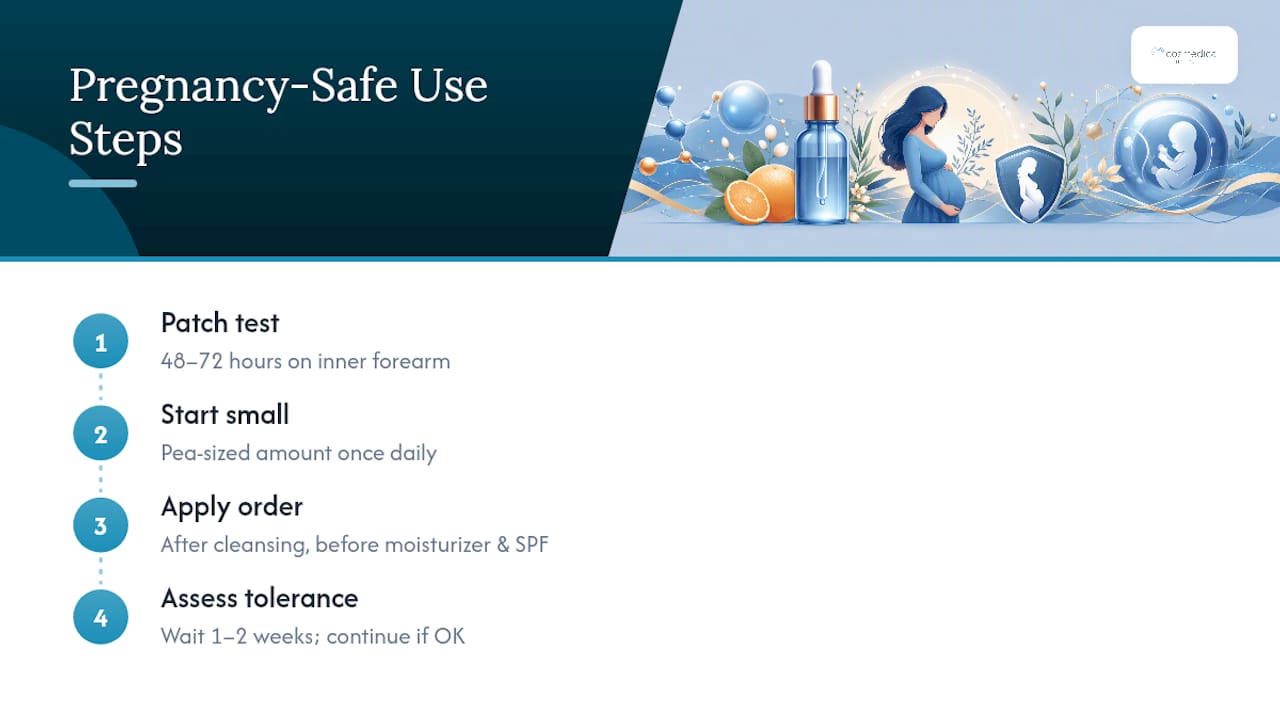
- Patch test first. Apply a small amount to your inner forearm and wait 48 to 72 hours. Dermatology guidance on patch testing notes that mild, brief tingling is common, but persistent redness or swelling means the product isn’t a match for your skin right now.
- Start with a pea-sized amount, once a day. Morning application makes the most sense here, since vitamin C’s antioxidant properties work alongside sunscreen to help fend off environmental stress on your skin.
- Layer it correctly. Apply vitamin C serum after cleansing, then follow with moisturizer, then sunscreen. Skip pairing it with strong exfoliants (physical scrubs or high-percentage acids) in the same routine to avoid compounding irritation.
- Ramp up gradually. If your skin tolerates daily use for a week or two without redness or stinging, you’re in a good spot. If not, drop back to every other day.
Pro Tip: If irritation shows up, don’t panic and don’t stack more products to “fix” it. Stop the vitamin C, apply a bland moisturizer for a few days, and reintroduce it slowly once your skin calms down. If redness or discomfort is severe or doesn’t resolve, check in with your dermatologist or OB.
Which Skincare Ingredients Should You Avoid While Pregnant?
Vitamin C tends to get a green light, but plenty of other actives sitting on the same shelf don’t. Knowing what to skip protects you from bigger risks than a little tingling.
Ingredients to leave out of your routine for now:
- Retinoids (tretinoin, and oral retinoids in particular): clinical guidance flags these as higher concern, and if you were already using a retinol before finding out you were pregnant, it’s worth reading up on what steps to take next.
- Hydroquinone: flagged for higher systemic absorption compared to most topical actives.
- High-dose salicylic acid, particularly in leave-on, high-percentage formats rather than a rinse-off cleanser.
- Essential oils and untested herbal extracts: many haven’t been studied for pregnancy safety at all, so there’s just not enough data to call them low risk.
When you’re standing in the skincare aisle (or scrolling a product page), scan the full ingredient list, not just the front-of-bottle claim. A “Vitamin C Serum” can still contain retinyl palmitate, a fragrance blend, or a salicylic acid boost buried further down the list. If a product stacks several active ingredients together, that’s your cue to run it by your provider before adding it to your routine.
Cosmedica Skincare’s Approach to Pregnancy-Safe Formulation
We built our approach to skincare around one idea: effective doesn’t have to mean aggressive. That matters a lot when you’re formulating for skin that’s more reactive than usual, which is exactly what happens during pregnancy.
Good pregnancy skincare isn’t about finding the strongest ingredient. It’s about finding the formula that does its job without asking your skin to work overtime to tolerate it.
Cosmedica Skincare specializes in cruelty-free, affordable skincare built around natural, dermatologist-tested formulations, including a dedicated line of vitamin C treatments. Our blog also covers pregnancy-specific skincare routines and vitamin C serum benefits in more depth, if you want to dig further into either topic before you shop.
What Are the Benefits of Vitamin C During Pregnancy?
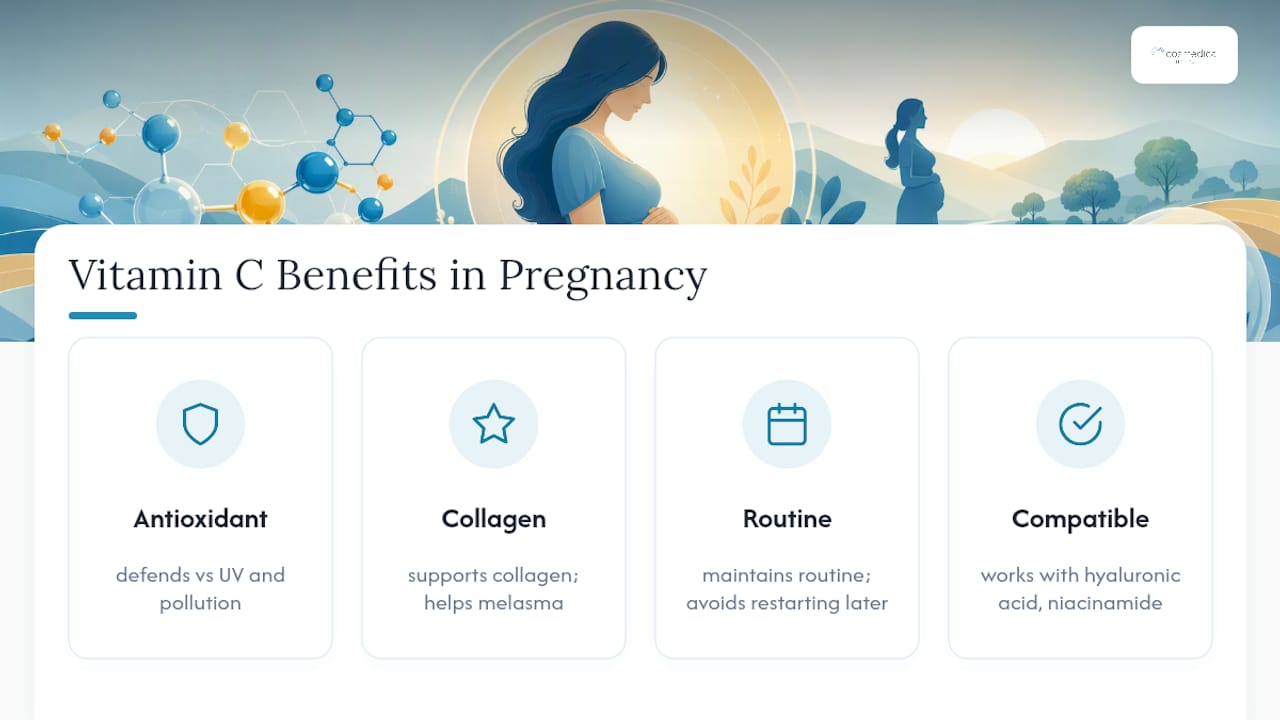
Vitamin C earns its spot in a pregnancy skincare routine for a few concrete reasons, not just because it’s trendy. As an antioxidant, it helps your skin defend against environmental stressors like UV exposure and pollution, working alongside (never instead of) your daily sunscreen.
It also plays a real role in collagen support and skin brightening, which matters more than usual during pregnancy since hormonal shifts often trigger melasma, the blotchy pigmentation sometimes called the “mask of pregnancy.” Vitamin C is one of the few actives dermatologists actively recommend for managing that discoloration while you’re expecting, since stronger options like hydroquinone and tretinoin are generally avoided.
There’s a comfort factor here too. A lot of pregnant skincare users end up pausing their entire routine out of caution, worried that everything is off limits. That’s not necessary, and it can actually backfire, since skipping antioxidant protection leaves your skin more exposed to the kind of damage that shows up later as uneven tone or premature aging. Keeping a gentle vitamin C serum in rotation lets you maintain some consistency in your routine instead of starting from zero once the baby arrives.
One more upside worth mentioning: vitamin C plays well with most other pregnancy-safe ingredients, including hyaluronic acid and niacinamide, so it’s rarely the ingredient causing conflicts in a simplified routine.
How Much Dietary Vitamin C Do You Need During Pregnancy?
This is where we need to be clear about scope: dietary and supplement intake of vitamin C is a separate topic from the topical skincare focus of this guide, and it comes with its own recommended dietary allowance set by nutrition authorities. MotherToBaby’s fact sheet notes that pregnant people should generally aim to stay within the standard RDA range for their age group rather than exceeding it through high-dose supplements.
Most prenatal vitamins already include a dose of vitamin C calibrated to typical dietary needs, which is one reason healthcare providers often prefer you get your intake through food and a standard prenatal, rather than stacking on a separate high-dose vitamin C supplement without asking first.
If you’re unsure whether your current prenatal already covers your needs, that’s a quick, worthwhile question for your OB or midwife at your next visit rather than something to guess at from a supplement label.
Can You Take Too Much Vitamin C While Pregnant?
Excess vitamin C intake is almost always a supplement and diet question, not a topical skincare one, since so little of a topical serum reaches your bloodstream in the first place.
On the oral side, MotherToBaby’s guidance notes there’s a daily upper limit for vitamin C intake, and going well beyond it through high-dose supplementation isn’t recommended without medical guidance. Symptoms of excessive oral intake in the general population tend to include digestive upset like stomach cramping or diarrhea, though pregnancy-specific research on very high doses is limited.
The practical takeaway: if you’re using a topical vitamin C serum as part of your skincare routine, you’re not meaningfully adding to your oral intake, so there’s little overlap to worry about. Where it does matter is if you’re independently taking a vitamin C supplement on top of your prenatal vitamin. Stacking supplements without checking total daily intake is the scenario worth avoiding, and it’s a conversation for your provider, not your skincare shelf.
Does Vitamin C Interact With Prenatal Vitamins?
Vitamin C doesn’t create the kind of dangerous interaction with prenatal vitamins that some supplement combinations do, but “no interaction” doesn’t mean “add as much as you want” either.
Most prenatal vitamins already include a measured dose of vitamin C as part of a broader nutrient profile, calculated against the recommended dietary allowance for pregnancy. Layering a separate high-dose vitamin C supplement on top of that prenatal, without accounting for the combined total, is how people accidentally approach or exceed the upper daily limit MotherToBaby references.
Vitamin C can also affect how your body absorbs other nutrients, most notably increasing iron absorption when taken together, which is actually a helpful interaction for pregnant people managing iron levels. Taking your prenatal with a vitamin C rich food, like a piece of fruit, is a common and reasonable strategy.
If you’re using a topical vitamin C serum, none of this applies to you directly, since so little of it enters your bloodstream. It only becomes relevant if you’re considering an oral vitamin C supplement in addition to your prenatal, in which case running the combined total by your OB or a pharmacist is the smart move before adding anything new.
Does Vitamin C Affect Preeclampsia or Gestational Diabetes Risk?
There’s ongoing research interest in whether antioxidants like vitamin C play a role in pregnancy conditions such as preeclampsia and gestational diabetes, since both involve oxidative stress as part of their underlying biology. That said, the evidence on oral vitamin C supplementation specifically preventing or treating these conditions is mixed and not conclusive enough to support a general recommendation to supplement for that purpose.
This is squarely an oral supplementation and nutrition question, sitting outside the scope of topical skincare that this guide focuses on. If you have risk factors for preeclampsia or gestational diabetes, or you’ve already been diagnosed with either, your OB is the right person to discuss whether any supplement adjustments make sense for your specific situation. Self-directing high-dose vitamin C supplementation based on a general interest in antioxidants isn’t a substitute for that conversation.
What we can say with more confidence: your topical skincare choices, including a gentle vitamin C serum, have essentially no bearing on either condition, since topical absorption is too minimal to influence systemic processes like blood sugar regulation or blood pressure. Your skincare routine and your medical management of these conditions are separate tracks that don’t need to intersect.
The Real Gap in Most Pregnancy Skincare Advice
Most pregnancy skincare guidance falls into one of two unhelpful camps: either “avoid everything, just in case,” or a vague “vitamin C is fine” with zero detail on concentration or formulation. Neither actually helps someone standing in front of a shelf of serums trying to make a decision.
The judgment the evidence actually supports sits in the middle, and it’s more specific than either camp lets on. Topical vitamin C at a reasonable concentration, in a clean formulation, is a low-risk, genuinely useful addition to a pregnancy routine.
What we’d prioritize first, if you only do one thing from this entire guide: read the full ingredient list, not the front label. Concentration and co-ingredients matter more than whether “Vitamin C” appears in the product name. That single habit will do more for your skin, and your peace of mind, than any single product recommendation ever could.
— Thomas
Our Pick for Pregnancy-Safe Vitamin C
If you’re shopping for a pregnancy-safe vitamin C serum and want a formula that matches the checklist we’ve laid out, the Cosmedica Skincare Vitamin C Super Serum is worth a look. It’s formulated to be fragrance-free with supportive, hydrating ingredients like hyaluronic acid alongside vitamin C, aligning with the low-irritant, humectant-supported profile dermatologists tend to favor during pregnancy. As with any active ingredient, we’d still recommend checking the specific concentration against your own sensitivity level and running it by your provider if you have any doubts.
To work it into a pregnancy-safe routine: patch test on your inner forearm for 48 to 72 hours first, then start with a pea-sized amount once daily, applied after cleansing and before moisturizer and sunscreen. If your skin tolerates it well after a week or two, you can keep it in daily rotation through the rest of your pregnancy. Our vitamin C skincare collection has additional formulation options if you want to compare strengths and textures before committing. Ready to start? The Super Serum Set is available now, with everything you need to build a gentle, effective routine in one place.
This article is general information, not a substitute for advice from a qualified doctor. Consult a qualified healthcare professional about your own circumstances before acting on anything here.
Sources
Getting vitamin C through food is generally the most straightforward way to meet your daily needs without worrying about supplement stacking. Citrus fruits like oranges and grapefruit are the classic go-to, but they’re far from the only option.
Bell peppers, particularly red ones, actually pack more vitamin C per serving than most citrus. Strawberries, kiwi, broccoli, and Brussels sprouts round out a solid rotation, and all of them bring fiber and other nutrients along for the ride, which oral supplements don’t offer.
A few practical notes on getting the most from food sources:
- Dermatologist-approved pregnancy skin care – AAD
- Vitamin C fact sheet – MotherToBaby
- Use of oral and topical agents for acne in pregnancy – J Am Acad Dermatol (PMC)
- Safety and formulation notes in clinical dermatology review (2026)
Most people who eat a reasonably varied diet during pregnancy meet their vitamin C needs through food alone, with their prenatal vitamin filling in any gaps. That’s part of why healthcare providers rarely recommend a dedicated high-dose vitamin C supplement on top of a standard prenatal unless there’s a specific medical reason for it.
FAQ
Is Vitamin C Serum Safe During Pregnancy?
Yes, most dermatologists consider topical vitamin C safe during pregnancy at conservative concentrations, typically 10% L-ascorbic acid or lower, according to AAD guidance.
Is Hyaluronic Acid Safe During Pregnancy?
Yes, hyaluronic acid is widely considered one of the safer hydrating ingredients during pregnancy and pairs well with vitamin C in a simplified routine.
How Much Vitamin C Should I Use During Pregnancy?
For topical use, a pea-sized amount once daily is standard; for dietary intake, MotherToBaby recommends staying within the standard RDA rather than high-dose supplementation unless your provider advises otherwise.
What Skincare Ingredients Should I Avoid While Pregnant?
Avoid retinoids like tretinoin, hydroquinone, high-dose salicylic acid, and untested essential oils, since clinical guidance flags these as higher concern compared to topical vitamin C.
Can I Use Vitamin C Serum While Breastfeeding?
Yes, topical vitamin C is generally considered low risk while breastfeeding, though it’s best to avoid applying it directly on or near the nipple and areola area.