

What Is Topical Hyaluronic Acid for Your Skin?
TL;DR:
- Topical hyaluronic acid attracts and retains water in the skin’s surface layers, providing immediate hydration and plumping. Its effectiveness depends on molecular weight, with low weights penetrating deeper and high weights hydrating the surface, and it works best when applied on damp skin followed by a moisturizer. This ingredient supports all skin types, enhances absorption of other actives, and improves skin barrier health, but it does not replace dermal fillers or address deep wrinkles independently.
If you’ve been trying to figure out what is topical hyaluronic acid and why it shows up in nearly every serum and moisturizer on the market right now, you’re in the right place. Topical hyaluronic acid is a water-attracting molecule applied directly to the skin’s surface to pull in and hold moisture. It’s not a trend. Your body already produces it naturally in connective tissues and the deeper layers of your skin, but levels drop with age. That’s where skincare steps in, and understanding how it actually works will change the way you shop and layer your products.
Table of Contents
- Key Takeaways
- What is topical hyaluronic acid and how it works
- Benefits and uses for all skin types
- Using topical hyaluronic acid in your routine
- Realistic expectations and limitations
- My honest take on this ingredient
- Explore Cosmedica-skincare’s hyaluronic acid lineup
- FAQ
Key Takeaways
| Point | Details |
|---|---|
| HA is a natural humectant | It holds moisture by binding up to 1,000 times its weight in water, plumping skin fast. |
| Molecular weight determines depth | Low molecular weight penetrates deeper; high molecular weight hydrates the surface for instant smoothness. |
| Apply to damp skin only | Applying to dry skin can backfire, drawing moisture from deeper layers instead of the environment. |
| It works best as a team player | HA preps skin for better absorption of retinoids, antioxidants, and other actives. |
| It hydrates, not volumizes | Topical HA smooths and plumps temporarily but does not replicate the structural effects of injectable fillers. |
What is topical hyaluronic acid and how it works
Think of hyaluronic acid as a sponge for your skin. It’s classified as a humectant, which means its job is to attract water molecules and keep them close. What makes it remarkable is the sheer capacity: topical HA binds up to 1,000 times its weight in water, delivering that immediate plumping effect you notice minutes after applying a serum.
Here’s where the science gets genuinely interesting. Not all hyaluronic acid molecules are the same size, and molecular weight changes everything about what it can do.
- High molecular weight HA sits on the skin’s surface, forming a film that locks in moisture and creates that instant, dewy smoothness. It doesn’t penetrate far, but the surface hydration is noticeable right away.
- Low molecular weight HA is smaller, so it can travel deeper into the epidermis. Once there, it may stimulate fibroblasts, the cells responsible for producing collagen and elastin, which supports skin firmness over time.
- Mixed molecular weight formulas give you both. You get the immediate surface glow and longer-term support deeper in the skin. This is what to look for when reading a product label.
Understanding these types of hyaluronic acid helps you make smarter choices when browsing serums. A product that only contains one size is leaving benefits on the table.
Now, here’s something people don’t always hear: topical HA draws moisture from its surrounding environment. If that environment is your bathroom air at 20% humidity in January, it will pull water from your own skin’s deeper layers if there’s nothing available externally. That’s why application technique matters so much.
Pro Tip: Apply your hyaluronic acid serum immediately after cleansing, while your skin is still slightly damp. Follow immediately with a moisturizer to seal everything in. This two-step combination is what actually delivers lasting hydration.
One more thing worth being clear about: topical hyaluronic acid is not the same as a hyaluronic acid dermal filler. Injectable HA is placed beneath the skin to add structural volume. Topical HA works at the surface and upper layers of the epidermis. Both use the same molecule, but the delivery method and the depth of action are entirely different. The topical version is genuinely powerful for hydration. Just don’t expect it to fill in deep hollows under your eyes.
Benefits and uses for all skin types
One of the most refreshing things about topical hyaluronic acid uses is that they cover almost every skin concern and every skin type. This is not a niche ingredient. It’s foundational.
Here are the real, researched benefits worth knowing:
-
Immediate hydration boost. A 2011 clinical trial showed significant improvements in both skin hydration and elasticity after just 8 weeks of consistent daily use. The surface moisture effect is visible even faster, often the same day.
-
Suitability for every skin type. HA is non-comedogenic and non-irritating, meaning it won’t clog pores or trigger sensitivity reactions. Oily skin, dry skin, combination, sensitive, and acne-prone skin can all benefit safely.
-
Reduced oil overproduction. This one surprises people. When oily skin is dehydrated, it compensates by producing more sebum. Hydrated skin is less likely to overproduce oil, which means HA can actually help control shine and breakouts over time. The idea that oily skin should skip moisturizers is a myth HA directly challenges.
-
Support for skin conditions. Dermatologists use HA therapeutically for xerosis (chronic dry skin), atopic dermatitis, and post-procedure recovery. The ingredient reinforces the lipid barrier and reduces transepidermal water loss, which is the medical term for moisture evaporating out of your skin.
-
Better absorption of other actives. This is where HA becomes a true team player. Hydrated, plumped skin absorbs other ingredients more efficiently. HA preps the skin so that retinoids, vitamin C, and peptides can penetrate more effectively while experiencing less irritation during the process.
-
Subtle plumping and smoothing. Skin looks fuller and fine lines appear softened when skin is well-hydrated. This isn’t permanent structural change, but it is a real and visible effect that many people notice quickly.
You can explore the full range of HA benefits to see how different skin types respond and which concerns the ingredient addresses most directly.
One myth worth debunking directly: people often assume that because HA is a humectant, it’s only useful in humid climates. While humidity helps maximize the effect, a well-formulated product with an occlusive moisturizer on top recreates that moisture-retaining environment even in dry conditions. You don’t need to live near the ocean for this to work.
Using topical hyaluronic acid in your routine
Knowing how does hyaluronic acid work is only useful if you apply it correctly. The application order and technique make or break your results, and this is where most people quietly go wrong.
The golden rule of skincare layering is thinnest to thickest consistency. HA serums are water-based and light, so they go on early, right after cleansing on damp skin. After that, you layer heavier products like moisturizers, facial oils, or SPF on top.
- Step 1: Cleanse your face and pat it gently, leaving the skin slightly damp rather than completely dry.
- Step 2: Apply your HA serum while the skin still has that light moisture on it. Press it gently into the skin rather than rubbing.
- Step 3: Follow immediately with a moisturizer to seal the hydration. This step is non-negotiable. Without an occlusive or emollient layer on top, HA can pull moisture from your skin in dry environments and actually leave it drier. This is applying HA to dry skin behavior to always avoid.
- Step 4: In the morning, finish with SPF. Hydrated skin is still vulnerable to UV damage, and sun protection prevents the collagen breakdown that accelerates visible aging.
Layering HA with other actives is simpler than people think. It plays well with retinoids because it counteracts the dryness and irritation that retinol commonly causes. Apply HA first, let it absorb for 60 seconds, then apply your retinol on top. With vitamin C serums, you can layer them in either order, though vitamin C typically goes first since it’s also a water-based active.
Pro Tip: If you’re new to retinol and dealing with flaking or tightness, sandwiching it between two thin layers of HA serum, one before and one after, can significantly reduce irritation without compromising the retinol’s effectiveness.
For optimal skincare layering with HA, consistency is the other key variable. Visible improvements, including reduced texture, softened fine lines, and more even tone, come from using the ingredient daily. A single application gives you immediate hydration, but the long-term skin health benefits build over weeks and months.
Realistic expectations and limitations
Let’s be honest about what topical hyaluronic acid can and cannot do. Understanding the real scope of this ingredient means you’ll never be disappointed and you’ll know exactly when you need to look to other treatments.
| What topical HA does | What topical HA does not do |
|---|---|
| Boosts surface and epidermal hydration | Replace the volume of injectable dermal fillers |
| Temporarily plumps and smooths fine lines | Permanently reverse deep wrinkles or loss of facial volume |
| Supports barrier function and reduces water loss | Rebuild collagen at the same depth as laser or RF treatments |
| Offers gentle, subtle lip plumping via hydration | Replicate the dramatic results of volumizing lip fillers |
| Enhances absorption of anti-aging actives | Act as a standalone anti-aging treatment |
The lip plumping question deserves a specific mention because it’s one of the most common points of confusion. Topical HA on lips does create a subtle fullness by drawing moisture into the lip tissue and causing mild hydration-induced swelling. It’s real, but it’s gentle. This is not the same as what lip fillers do, and it’s also different from the tingly plumping glosses that use irritants like capsaicin or cinnamon to swell the lips through a mild inflammatory response.
Topical HA hydrates and smooths, but it does not reverse deep structural aging. For someone in their 30s trying to maintain skin health and prevent moisture loss, it’s a powerhouse. For someone hoping to address significant volume loss or deep folds, topical HA alone won’t get there. Those goals call for injectables, laser treatments, or other clinical options.
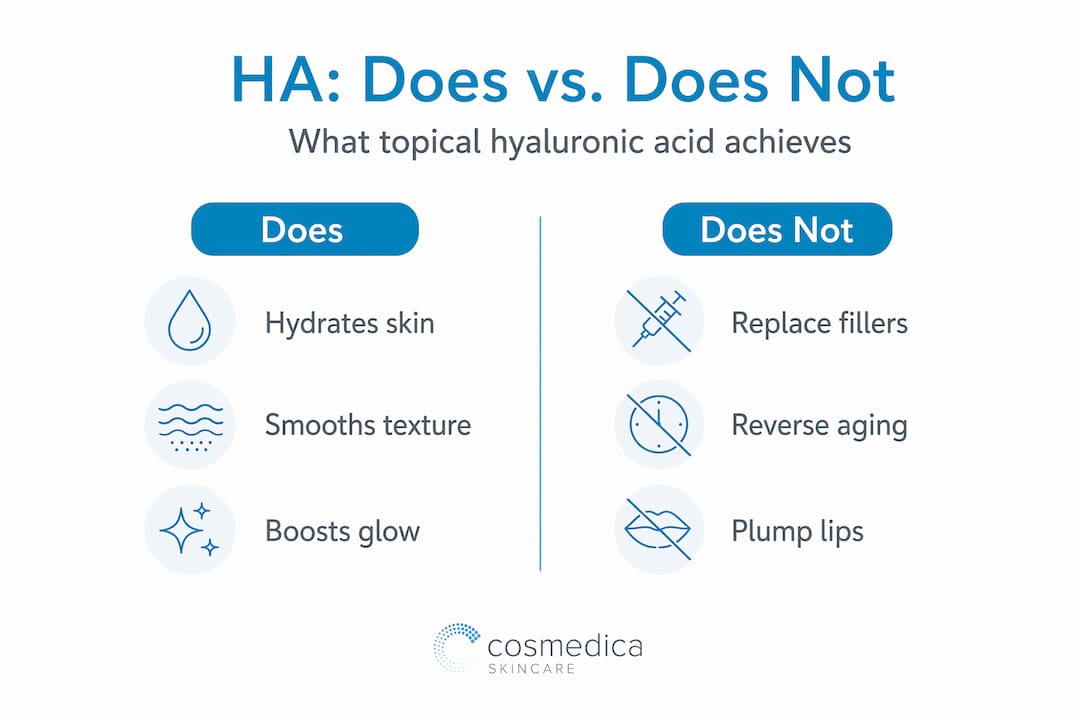
The important takeaway here is that hydration is foundational, not a complete anti-aging strategy. Think of HA as the base layer that makes everything else work better, not the single solution that does it all.
My honest take on this ingredient
I’ve spent years watching people approach hyaluronic acid with one of two mindsets. Either they dismiss it as just “another moisturizing ingredient,” or they expect it to function like a topical facelift. Both miss the point entirely.
In my experience, the biggest mistake I see is applying HA serum to completely dry skin and then walking out the door without moisturizer. People do this because they’re in a rush, or because the packaging makes the serum sound like it’s enough on its own. It’s not. The occlusive step is what converts HA from a temporary hit of moisture into actual sustained hydration.
What I genuinely believe about this ingredient is that it’s the most underrated foundation in skincare. Not because it’s dramatic, but because it makes everything else perform better. I’ve seen routines with expensive serums fall flat because the skin barrier was compromised and dehydrated. Add a well-formulated HA serum in the right spot, and suddenly those other products start delivering the results they promised. Hydration is infrastructure. HA builds it.
The other thing I’d push back on is the idea that oily skin doesn’t need this. Some of the most reactive and congested skin I’ve seen has been dehydrated underneath. When you give that skin the hydration it’s been compensating for, the oiliness settles down on its own. It takes a few weeks, but it works.
Skincare science around molecular weights and HA delivery systems keeps advancing, and the products available now are genuinely better than what existed five years ago. Finding a formula with mixed molecular weights, like the kind that combine low and high molecular weight HA, is worth prioritizing. You feel the difference.
— Thomas
Explore Cosmedica-skincare’s hyaluronic acid lineup
At Cosmedica-skincare, we’ve built our hydration range around exactly what the science supports: well-formulated, cruelty-free HA products that work in the context of a full routine, not just as a standalone fix. The Hyaluronic Acid + Vitamin B5 Serum combines HA with Vitamin B5 for a hydration and repair formula that suits every skin type, including sensitive and acne-prone. For those who want a more layered approach, our serums collection pairs HA-based formulas with antioxidants, retinol, and vitamin C options so you can build a complete, effective routine without guesswork. Every product is dermatologist-tested and affordable enough to use consistently, which, as we’ve covered, is what actually drives results. For an all-in-one start, check out the Super Serum Set to experience multiple actives working together around an HA foundation.
FAQ
What does topical hyaluronic acid actually do for skin?
Topical hyaluronic acid draws water into the upper layers of the skin and holds it there, creating visible hydration, reduced fine line appearance, and a smoother, plumper surface. Results are visible immediately after application and build with consistent daily use.
Is hyaluronic acid good for oily or acne-prone skin?
Yes. HA is non-comedogenic and non-irritating, making it safe for acne-prone skin. Because hydrated skin produces less compensatory oil, regular use of HA can actually help reduce excess shine over time.
How does hyaluronic acid work differently than a dermal filler?
Topical HA works at the skin’s surface and upper epidermis to hydrate and smooth. Injectable fillers place HA beneath the skin to add structural volume. Both use the same molecule, but the results, depth, and duration of effect are entirely different.
Can I use hyaluronic acid with retinol or vitamin C?
Absolutely. HA pairs well with both. Apply it before retinol to buffer irritation, or layer it alongside vitamin C for enhanced hydration and absorption. HA’s role as a base layer improves other actives’ efficacy by keeping skin receptive.
How quickly does topical hyaluronic acid show results?
You’ll notice immediate surface hydration and plumping within minutes of your first application. Deeper, sustained improvements in elasticity and texture typically develop over 8 weeks of daily use based on clinical research.