

Acid Serum Guide: Glow Safely With the Right Acids
TL;DR:
- Acid serums are leave-on exfoliants that dissolve dead skin and boost collagen production for healthier skin. Choosing the right acid depends on skin type, with AHAs suited for dry skin, BHAs for oily skin, and PHAs for sensitive skin. Proper application, layering with certain ingredients, and sun protection are essential for safe, effective use.
Acid serums are defined as leave-on chemical exfoliants that dissolve dead skin cells, unclog pores, and signal the skin to produce fresh collagen. This guide to using acid serums covers the three main acid families, AHAs, BHAs, and PHAs, and explains exactly how to pick, apply, and layer them for healthier, glowing skin. We know the category can feel like a chemistry class, so we have broken it down into plain language with clear steps you can follow starting tonight. Cosmedica-skincare formulates acid serums at clinically relevant concentrations, making it easier to get real results without guessing at percentages or pH levels.
Guide to using acid serums: choosing the right acid for your skin
The single most important decision in any acid routine is matching the acid’s chemistry to your skin type. Get that right, and everything else falls into place.
How AHAs, BHAs, and PHAs work differently
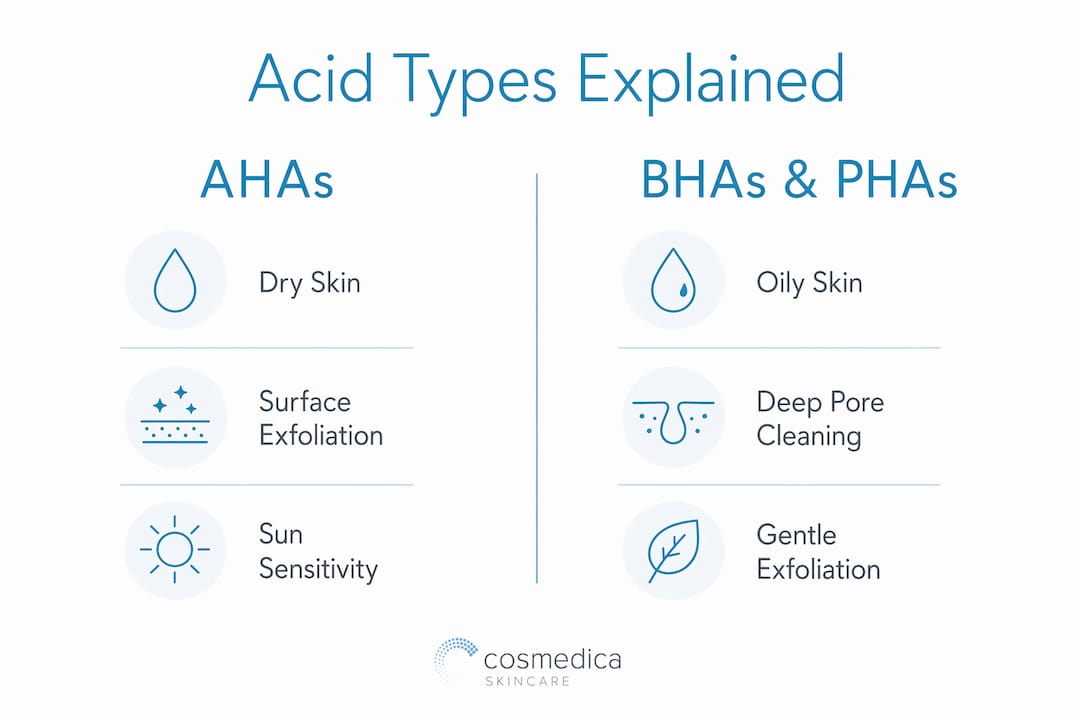
AHAs like glycolic acid are water-soluble, which means they work on the skin’s surface to smooth texture and fade discoloration. BHAs like salicylic acid are lipid-soluble, so they cut through sebum and travel deep into pores. PHAs have larger molecules that stay on the surface, exfoliate gently, and pull moisture into the skin at the same time. Think of AHAs as a broom sweeping the top layer, BHAs as a drain cleaner clearing the pipes, and PHAs as a broom with a built-in humidifier.
That chemistry difference determines which acid fits your skin. Dry or mature skin benefits most from AHAs because surface exfoliation accelerates cell turnover and brightens dull tone. Oily, acne-prone skin responds better to BHAs because salicylic acid dissolves the sebum plugs that cause breakouts. Sensitive skin and rosacea-prone skin do best with PHAs because the larger molecule size limits how deep the acid penetrates, reducing the chance of irritation.
What to check before you pick an acid
Before selecting any acid serum, run an honest skin audit. Redness, tightness, or flaking signals a compromised barrier that needs repair before you introduce any exfoliant. Adding an acid to already-stressed skin is like scrubbing a sunburn. Stabilize first with a gentle moisturizer and a fragrance-free cleanser for one to two weeks, then reassess.
Pro Tip: Take a photo of your bare skin in natural light before starting any acid. Compare it weekly. Visual evidence beats memory every time, and it helps you catch early warning signs before they become real problems.
The table below summarizes the key differences to guide your choice.
| Acid type | Best for | Key benefit | Sun sensitivity |
|---|---|---|---|
| AHA (glycolic, lactic) | Dry, dull, aging skin | Surface exfoliation, brightening | Increases. Use SPF daily. |
| BHA (salicylic) | Oily, acne-prone, congested | Pore clearing, anti-inflammatory | Mild increase. Use SPF daily. |
| PHA (gluconolactone) | Sensitive, rosacea-prone | Gentle exfoliation, hydration | Does not increase sensitivity. SPF still required. |
How to safely apply acid serums step by step
Proper application is what separates a glowing result from a raw, irritated one. The steps below reflect current best practices for introducing acids without damaging the skin barrier.
The application sequence
- Cleanse your face with a gentle, low-pH cleanser. Avoid anything with physical scrub beads on acid days.
- Pat skin dry completely. Damp skin dilutes the acid and can push it deeper than intended, raising irritation risk.
- Apply the acid serum in a thin, even layer. Avoid the eye area and the corners of the nose.
- Wait 10–15 minutes. Waiting after acid application allows the pH to normalize and the active to absorb fully before you layer anything on top.
- Apply a hydrating serum such as hyaluronic acid to replenish moisture. This step is non-negotiable, not optional.
- Follow with moisturizer to seal the barrier. A good moisturizer after an acid is like a protective coat over fresh paint.
- Apply broad-spectrum SPF 30 or higher every morning without exception. Acids increase the skin’s vulnerability to UV damage, so sunscreen is the final, mandatory step in any AM routine.
How often to use acid serums
Start with one session per week. That frequency gives your skin time to adjust without overwhelming it. After two to four weeks with no irritation, move to twice weekly. Most people find two to three times per week is the sweet spot for ongoing maintenance. Daily acid use is appropriate only for very low-concentration formulas and well-conditioned skin.
For a deeper look at how serums fit into a full routine, the step-by-step serum guide from Cosmedica-skincare walks through layering order for every skin type.
Application best practices
- Always patch test for 24–72 hours on the inner arm or behind the ear before applying to the full face.
- Never apply acid serum to broken, sunburned, or actively inflamed skin.
- Use clean fingertips or a cotton pad. Avoid rubbing; press and glide instead.
- Store acid serums away from direct sunlight and heat to preserve potency.
- Do not use acid serums immediately before or after waxing, threading, or laser treatments.
Pro Tip: If your skin feels tight or slightly sensitive the morning after an acid session, that is your signal to skip the next scheduled application and add an extra layer of moisturizer instead. Listening to that signal early prevents weeks of barrier recovery later.
How to combine acid serums with other skincare ingredients
Layering actives is where most people run into trouble. The good news is that the rules are straightforward once you understand why they exist.
Which combinations work and which ones do not
pH is the controlling factor. Acids work best at a low pH, typically between 3.0 and 4.5. Vitamin C (L-ascorbic acid) also functions at a low pH, so applying both in the same session is technically possible but often too stimulating for most skin. The safer approach is to use vitamin C in the morning and your acid serum at night.
Niacinamide is one of the friendliest partners for acid serums. Apply the acid first, wait the 10–15 minutes, then layer niacinamide on top. Niacinamide calms redness and supports the barrier, which makes it a natural follow-up to exfoliation. Peptides work well in the same way. Apply them after the acid has absorbed and they will do their repair work without interference.
Retinol and acid serums are the combination that needs the most care. Stacking AHAs and BHAs in the same session already carries a medium risk of over-exfoliation in a meaningful share of routines. Adding retinol to that mix raises the stakes further. The standard approach is to alternate: use your acid serum on Monday, Wednesday, and Friday, and use retinol on Tuesday and Thursday. That schedule keeps both actives effective without stacking their irritation potential.
Day vs. night layering strategy
| Time | Recommended actives | What to avoid |
|---|---|---|
| Morning | Vitamin C, niacinamide, hyaluronic acid, SPF | AHAs (increase photosensitivity), retinol |
| Evening | AHA or BHA acid serum, niacinamide, peptides, retinol (alternate nights) | Mixing retinol and acid in the same session |
| Sensitive skin AM | PHA serum, niacinamide, SPF | High-concentration AHAs |
| Sensitive skin PM | PHA serum, calming moisturizer | Retinol on the same night as any acid |
Pairings to use and pairings to skip
Pairings that work well:
- AHA or BHA + hyaluronic acid (apply hyaluronic acid after the acid wait period)
- BHA + niacinamide (reduces post-exfoliation redness)
- PHA + peptides (gentle exfoliation with active repair)
- Lactic acid + ceramide moisturizer (exfoliation plus barrier support)
Pairings to avoid in the same session:
- AHA + BHA together (over-exfoliation risk)
- Any acid + retinol on the same night
- AHA + vitamin C in the same step (pH conflict and potential irritation)
- Multiple high-concentration acids in one routine
For a focused comparison of two of the most popular acids, the glycolic vs. salicylic breakdown from Cosmedica-skincare is worth reading before you commit to one.
What to do when acid serums cause problems
Even a well-chosen acid can cause issues if the timing or frequency is off. Knowing the difference between a normal adjustment and a real reaction saves your skin and your confidence.
Normal adjustment vs. a real reaction
Mild tingling during the first few uses is normal. Your skin is adjusting to a new active, and a slight sensation means the acid is working. What is not normal is intense burning, stinging that lasts more than a few minutes, or redness that is still visible the next morning. Those symptoms mean the skin barrier is overwhelmed, and the correct response is to stop acids immediately.
If you hit that point, shift your routine to barrier repair mode. Use a fragrance-free, ceramide-rich moisturizer twice daily. Add a calming ingredient like centella asiatica or panthenol. Skip all actives, including vitamin C and retinol, for at least one week. The guide to soothing sensitive skin from Cosmedica-skincare covers this recovery process in detail.
The five most common acid serum mistakes
- Using too much, too soon. Starting at three or four times per week before the skin has adapted is the fastest route to irritation.
- Skipping sunscreen. AHAs increase photosensitivity. Skipping SPF after an acid routine undoes the brightening work and risks hyperpigmentation.
- Layering multiple acids. AHA and BHA stacking shows up as a medium-risk conflict in a significant share of analyzed routines. One acid at a time is the rule.
- Applying to damp skin. Wet skin drives actives deeper and raises irritation risk. Always dry fully before applying.
- Introducing too many actives at once. Introducing one active at a time with a 2–4 week observation window is the approach that delivers the best results and makes it easy to identify what caused any reaction.
Pro Tip: The “rule of one” is your best friend when building an acid routine. Add one new active, wait a full month, then decide whether to add another. It feels slow, but it is the only way to know exactly what your skin loves and what it does not.
When symptoms are severe, persistent, or accompanied by swelling, consult a board-certified dermatologist. Some reactions require prescription intervention, not just a routine tweak.
Key takeaways
Matching the right acid to your skin type and applying it on clean, dry skin with a 10–15 minute wait period before layering other products is the foundation of a safe and effective acid serum routine.
| Point | Details |
|---|---|
| Match acid to skin type | AHAs suit dry or aging skin; BHAs suit oily or acne-prone skin; PHAs suit sensitive skin. |
| Audit your barrier first | Redness, tightness, or flaking means your barrier needs repair before you introduce any acid. |
| Follow the application sequence | Apply on dry skin, wait 10–15 minutes, then layer hydrating serums and moisturizer. |
| Avoid stacking AHAs and BHAs | Combining both acid types in one session raises over-exfoliation risk significantly. |
| Use the rule of one | Introduce a single active at a time and observe for 2–4 weeks before adding another. |
What I have learned from years of watching people use acids wrong
The most common mistake I see is impatience. Someone reads about glycolic acid, buys a 10% formula, and uses it every night from day one. By week two, their skin is raw, tight, and reactive. They blame the acid when the real issue was the schedule.
Skin tolerance for acids builds over months, not days. I have watched people with genuinely sensitive skin work up to three-times-weekly AHA use over six months with zero irritation because they were patient and methodical. The same concentration that wrecked someone else’s barrier became their best skin tool.
The other thing I feel strongly about is the sunscreen step. People treat it as optional. It is not. Consistent sunscreen use is non-negotiable with acid use because exfoliated skin is genuinely more vulnerable to UV damage. Skipping SPF while using AHAs is a contradiction. You are brightening with one hand and creating new damage with the other.
My honest advice: start with a PHA or a low-concentration lactic acid. Both are forgiving, and lactic acid has the added benefit of being a mild humectant, so it hydrates while it exfoliates. Read the lactic acid benefits guide if you want a gentle entry point into chemical exfoliation. Build from there. The people who get the best long-term results are the ones who treat their routine like a slow experiment, not a race.
— Thomas
Cosmedica-skincare’s acid serum collection for every skin type
Cosmedica-skincare offers a range of cruelty-free, dermatologist-tested acid serums designed to fit the gradual introduction approach described throughout this article. Whether you are starting with a gentle PHA or ready to try a targeted lactic acid treatment, the formulas are built for real skin at accessible price points. The 5% Lactic Acid Treatment + Hylasyn pairs exfoliation with built-in hydration, making it a strong first acid for beginners. For a curated set that covers multiple skin concerns, the Super Serum Set gives you a practical starting point without the guesswork of building from scratch.
FAQ
What is the best acid serum for beginners?
PHAs and low-concentration lactic acid serums are the best starting point for beginners. They exfoliate gently, carry a lower irritation risk, and lactic acid also hydrates as it works.
How often should you use an acid serum?
Start with once per week and increase to two or three times per week over four to six weeks if your skin shows no signs of irritation or barrier compromise.
Can you use an acid serum every day?
Daily use is appropriate only for very low-concentration formulas on well-conditioned skin. Most people do best at two to three sessions per week to avoid over-exfoliation.
Do you need sunscreen after using an acid serum?
Yes, sunscreen is required every morning when using any exfoliating acid. AHAs increase photosensitivity, and even PHAs, which do not raise sun sensitivity on their own, leave skin more vulnerable to environmental damage.
Can you layer two different acid serums together?
Stacking AHAs and BHAs in the same session raises over-exfoliation risk and is not recommended. Use one acid at a time and alternate types on different nights if you want to address multiple concerns.