

How to Use Facial Serums: 2026 Step-by-Step Guide
TL;DR:
- Facial serums are concentrated treatments that penetrate deeper into the skin than moisturizers. Using the correct application technique and choosing the right serum for your skin concern maximize visible results and minimize irritation. Layer serums from thinnest to thickest, apply after cleansing, and always complete with moisturizer and sunscreen in the morning.
Facial serums are defined as lightweight, concentrated treatments that deliver active ingredients deeper into the skin than a standard moisturizer can. Knowing how to use facial serums correctly is the difference between wasted product and real, visible results. At Cosmedica-skincare, we see this question come up constantly, and it makes sense. Serums are the most potent step in any routine, which means the stakes for getting the technique right are higher. This guide covers everything from choosing the right serum for your skin concern to layering multiple actives without irritation.
What types of facial serums should you use?
Facial serums fall into six main categories, and picking the wrong one for your skin concern is the most common reason people feel like serums “don’t work.” Think of each type as a targeted tool, not a one-size-fits-all solution.
Here is a breakdown of the main serum types and what they do:
- Hydrating serums use humectants like hyaluronic acid to pull moisture into the skin. The Cosmedica-skincare Pure Hyaluronic Acid Serum is a classic example. Hyaluronic acid binds up to 1,000 times its weight in water, making it ideal for dry or dehydrated skin types.
- Brightening serums typically rely on vitamin C (L-ascorbic acid) or niacinamide to fade dark spots and even skin tone.
- Anti-aging serums use peptides, retinoids, or growth factors to support collagen production and reduce the appearance of fine lines.
- Exfoliating serums contain AHAs like glycolic or lactic acid to resurface the skin and improve texture over time.
- Barrier repair serums feature ceramides, niacinamide, or panthenol to strengthen the lipid barrier and calm sensitivity.
- Antioxidant serums combine ingredients like vitamin C, vitamin E, and ferulic acid to protect against environmental damage.
Matching serum to skin concern
The table below maps common skin concerns to the best serum type and key active ingredients to look for.
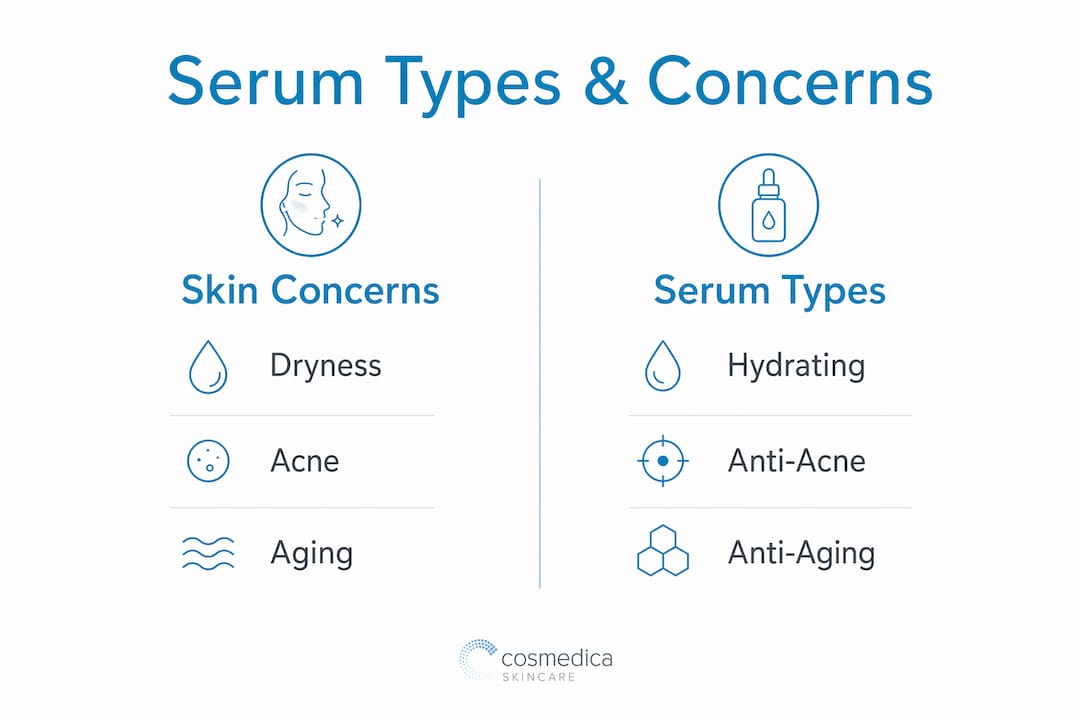
| Skin Concern | Best Serum Type | Key Active Ingredients |
|---|---|---|
| Dryness or dehydration | Hydrating | Hyaluronic acid, glycerin, vitamin B5 |
| Dullness or uneven tone | Brightening | Vitamin C, niacinamide, kojic acid |
| Fine lines and wrinkles | Anti-aging | Retinol, peptides, growth factors |
| Acne and oiliness | Exfoliating or barrier repair | Niacinamide, salicylic acid, zinc |
| Sensitivity or redness | Barrier repair | Ceramides, panthenol, centella asiatica |
One more thing worth knowing: water-based serums absorb faster and work best under moisturizer, while oil-based serums are better suited as the last step before sunscreen or as a nighttime treatment. Packaging matters too. Vitamin C serums degrade quickly in air and light, so look for opaque or airless pump bottles to preserve potency.
How to apply facial serums for maximum absorption
The order and technique of facial serum application matters as much as the serum itself. A well-formulated product applied in the wrong sequence can underperform significantly. Here is the step-by-step routine we recommend.
- Cleanse thoroughly. Start with a gentle cleanser to remove makeup, sunscreen, and surface debris. Serums penetrate best on clean skin, and leftover residue creates a physical barrier.
- Tone (optional). If you use a toner, apply it now. A hydrating toner preps the skin and slightly dampens the surface, which actually helps humectant serums like hyaluronic acid absorb more effectively.
- Apply your serum. Dispense 2–4 drops into your palm or directly onto fingertips. Press and pat the serum gently into the skin rather than rubbing. Rubbing creates friction and can push product off the skin before it absorbs. Cover your face, neck, and décolleté for full coverage.
- Wait 30 seconds. Give the serum time to settle before moving to the next step. Pilling occurs when you layer products too quickly, and even 30 seconds makes a meaningful difference.
- Apply moisturizer. Seal the serum in with a moisturizer. This locks in active ingredients and prevents moisture loss through the epidermis.
- Finish with SPF (morning only). Sunscreen is non-negotiable in the morning, especially when using brightening or exfoliating serums that increase photosensitivity.
Morning vs. evening: which serums go when?
Timing is not arbitrary. Vitamin C, hyaluronic acid, and niacinamide are best used in the morning because they provide antioxidant protection and hydration throughout the day. Retinoids and glycolic acid belong in your evening routine. Retinol is photolabile, meaning it breaks down in sunlight and can cause irritation when skin is exposed to UV rays after application.

Vitamin C serums work best in the morning because they reinforce your sunscreen’s protective effect. Think of them as a backup shield for your skin. Retinoids, on the other hand, do their best work overnight when skin is in repair mode and you are not exposing it to light.
Pro Tip: Apply your serum to slightly damp skin, not soaking wet. Damp skin helps humectants draw moisture in from the surface, but too much water dilutes the active concentration.
For frequency, most mild serums like hyaluronic acid are safe for daily morning and evening use. Potent actives like retinoids should start at 2–3 times per week and increase gradually as your skin builds tolerance. This approach prevents the redness and flaking that comes from jumping in too fast.
How to layer serums without causing irritation
Layering multiple serums is where most people either get great results or accidentally irritate their skin. The good news is that a few clear rules make this much easier to manage.
The golden rule of serum layering is simple: apply from thinnest to thickest consistency. Watery serums go first, followed by gel-based formulas, and then thicker, more viscous treatments. This sequence allows lighter molecules to penetrate the skin before heavier ones create a film on the surface.
Ingredient compatibility: what to avoid pairing
Not all actives play nicely together. Here is a quick reference for what to combine and what to keep separate.
| Combination | Compatible? | Notes |
|---|---|---|
| Vitamin C + Hyaluronic Acid | Yes | Great morning pairing for hydration and protection |
| Vitamin C + Retinol | No | Conflicting pH levels; use vitamin C in AM, retinol in PM |
| Niacinamide + Hyaluronic Acid | Yes | Excellent for calming and hydrating simultaneously |
| AHAs + Retinol | No | Over-exfoliation risk; alternate evenings or use on different nights |
| Peptides + Vitamin C | Generally yes | Some formulas work well together; patch test first |
When you need to use two low-pH actives like L-ascorbic acid and an AHA, wait 15–20 minutes between applications. This gives your skin’s acid mantle time to re-equilibrate before you introduce the next product. Skipping this wait is one of the most common causes of unexpected redness and sensitivity.
Blending and beginner tips
If you use two serums with compatible ingredients and similar consistencies, you can blend them in your palm before applying. This saves time and can actually improve how evenly the products distribute across the skin. Just make sure there is no pH conflict before mixing.
For beginners, the single most protective habit is to introduce one new active at a time. Your skin needs time to adjust, and adding three new actives in one week makes it impossible to identify which one caused a reaction. Start with a hydrating serum like the Hyaluronic Acid + Vitamin B5 Serum from Cosmedica-skincare, get comfortable with that, and then layer in a vitamin C or niacinamide formula.
Pro Tip: If you want to use retinol but find it drying, apply your hydrating serum first, wait for it to absorb, and then apply retinol on top. Retinol applied after hydrating serums penetrates more gently and causes less irritation than applying it to completely bare skin.
A sample layering routine for combination skin might look like this: hyaluronic acid serum in the morning, followed by a vitamin C serum after it absorbs, then moisturizer and SPF. In the evening, a niacinamide serum first, then retinol three nights per week, then a richer night cream to seal everything in.
What are the most common serum mistakes?
Even experienced skincare users make these errors. Knowing them upfront saves you weeks of troubleshooting.
- Applying moisturizer before serum. Moisturizer creates a physical barrier on the skin’s surface. If you apply it first, your serum cannot penetrate the epidermis effectively. Serum always goes before moisturizer.
- Skipping sunscreen with photosensitizing serums. Vitamin C, retinoids, AHAs, and lactic acid all increase your skin’s sensitivity to UV radiation. Skipping SPF while using these actives accelerates the exact damage you are trying to reverse.
- Over-layering products. Pilling is caused by applying too many layers or not waiting long enough between steps. More than four product layers in one routine is where most people start experiencing balling and product waste.
- Using retinoids too frequently too soon. Starting retinol every night is a fast track to flaking, redness, and a compromised skin barrier. Begin at 2–3 times per week and only increase frequency once your skin has clearly adapted.
- Ignoring skin reactions. Mild tingling with an AHA is normal. Burning, persistent redness, or breakouts are not. Those are signals to reduce frequency or discontinue use.
“Personalization of serum layering and use frequency based on skin type, climate, and product tolerance is key to an effective routine.” — HealthShots
If irritation persists after reducing frequency and simplifying your routine, consult a dermatologist. Some active ingredients are not appropriate for every skin type at every concentration, and a professional can help you identify the right formulation. The science behind skin serums is nuanced, and there is no shame in getting expert guidance.
Key takeaways
Facial serums deliver maximum results when applied in the correct order, at the right time of day, with compatible ingredients and enough absorption time between layers.
| Point | Details |
|---|---|
| Apply serums in the right order | Always apply serum after cleansing and before moisturizer for full absorption. |
| Match serum type to skin concern | Use hyaluronic acid for dryness, vitamin C for brightness, and retinol for anti-aging. |
| Layer from thin to thick | Apply the lightest consistency first and wait 30 seconds between each layer. |
| Separate conflicting actives | Use vitamin C in the morning and retinoids or AHAs in the evening to avoid irritation. |
| Introduce new actives slowly | Add one new active ingredient at a time and start potent serums at 2–3 times per week. |
What i’ve learned after years of watching serum routines go wrong
The biggest shift I have seen in skincare over the past few years is not a new ingredient. It is the move toward multi-serum layering. People are stacking vitamin C, niacinamide, retinol, and AHAs all in one routine and then wondering why their skin is angry. The ingredient science has gotten sophisticated, but the application habits have not always kept up.
What I keep coming back to is this: a simpler routine done consistently outperforms a complex one done inconsistently. I have seen people get genuinely impressive results from just a hyaluronic acid serum and a vitamin C serum used correctly every day. No stacking, no conflicts, no pilling. Just clean skin, correct order, and patience.
The other thing I want to push back on is the idea that more potent always means more effective. Retinol at 2.5% used twice a week on well-prepped skin will outperform the same formula used nightly on a compromised barrier. Context matters more than concentration. Your skin’s tolerance is the real variable, not the percentage on the label.
If you are just starting out, pick one concern, one serum, and give it six weeks. Skin cell turnover takes roughly 28 days, so you need at least that long to see meaningful change. Resist the urge to add more products before you have real data on how your skin is responding. That patience is, honestly, the best skincare advice I can give.
— Thomas
Find the right serum for your skin with Cosmedica-skincare
Cosmedica-skincare offers a full range of serums designed to address every concern covered in this guide, from deep hydration to targeted anti-aging and brightening. Every formula is cruelty-free, dermatologist-tested, and built for real results across all skin types. Whether you are building your first routine or refining an existing one, the complete serums collection is a great place to start. If you want a curated starting point, the Trio Facial Serum Kit pairs three complementary serums selected to work together without conflict. It takes the guesswork out of layering and gives you a proven foundation to build from.
FAQ
How many drops of serum should i apply?
Use 2–4 drops per application, which is enough to cover the face, neck, and décolleté without overloading the skin. More product does not mean better results and can contribute to pilling.
Can i use a facial serum every day?
Hydrating serums like hyaluronic acid are safe for daily morning and evening use. Potent actives like retinoids and AHAs should start at 2–3 times per week and increase only as your skin adapts.
Should i apply serum before or after moisturizer?
Serum always goes before moisturizer. Applying moisturizer first creates a barrier that blocks serum absorption and reduces its effectiveness significantly.
Can i mix two serums together?
You can blend compatible serums with similar consistencies in your palm before applying, but only when there is no pH conflict between the actives. Never mix vitamin C with retinol or AHAs.
What serum is best for dry skin?
Hyaluronic acid serums are the top choice for dry skin because hyaluronic acid draws moisture into the skin and supports the skin barrier. A formula like the Cosmedica-skincare Hyaluronic Acid + Vitamin B5 Serum combines both hydrating and barrier-supporting ingredients for maximum effect.