

One Combination Skin Routine That Replaces Two Product Sets
The best combination skin routine follows one simple order: cleanse, treat, hydrate, and protect with SPF in the morning, then remove makeup, cleanse, treat, and moisturize at night. The core principle is hydrate first, always, then target the oily T-zone with a BHA or spot treatment while keeping cheeks well moisturized with a gel-cream formula. Combination skin is a stable, manageable skin type, not a condition to cure, and a dermatologist visit only becomes necessary if breakouts or dryness turn severe or won’t respond to changes.
TL;DR:
- Using a BHA spot treatment on the T-zone two to three times a week helps control oil without over-drying cheeks or causing breakouts.
- Maintaining hydration across all zones with humectants like hyaluronic acid prevents unnecessary oil production and reduces flaking.
- Switching to lighter, gel-based sunscreens and moisturizers suited for combination skin improves comfort and prevents midday shine or dryness.
- Exfoliating no more than two to three times weekly prevents barrier damage that can trigger increased oiliness on the T-zone.
- Tailoring active ingredients like niacinamide or acids to specific zones boosts their effectiveness without disrupting overall skin balance.
Table of Contents
- Your Morning Combination Skin Routine, Step by Step
- Your Evening Combination Skin Routine for Repair
- Which Active Ingredients Work Best, and Where
- What to Choose and What to Skip on the Label
- Adjusting Your Routine by Season
- How Cosmedica-skincare Sees Personalization and Balance
- Figuring Out Your Specific Type of Combination Skin
- Spot Treatments: T-Zone Breakouts vs. Cheek Dryness
- Adapting to Climate and Humidity, Not Just the Season
- Common Mistakes That Undo a Good Combination Skin Routine
- Why the One-Routine Approach Actually Wins
- Building Your Routine with Cosmedica-skincare
- Sources
- FAQ
Your Morning Combination Skin Routine, Step by Step
Mornings set the tone for how your skin behaves all day, and combination skin rewards a light hand here. The goal is hydration without heaviness, plus sun protection that won’t clog your T-zone by lunchtime.
- Cleanse gently. Skip the foaming, squeaky-clean feeling. A creamy or gel cleanser removes overnight buildup without stripping your barrier, and that matters more than people realize.
- Apply a hydrating toner or serum. Look for humectants like hyaluronic acid, which pulls water into the skin without adding oil. Think of it as topping off a glass before you seal it.
- Layer in an antioxidant, if you use one. Vitamin C or niacinamide both work well in the morning, and niacinamide has the added bonus of helping regulate oil production over time.
- Moisturize with a gel-cream. Apply a thin layer across the T-zone and a slightly fuller layer on the cheeks. One product, two application weights.
- Finish with broad-spectrum SPF protection appropriate for your skin and exposure. This step is not optional. Choose a fluid or gel-based sunscreen, since thick, creamy formulas tend to sit heaviest exactly where you don’t want them.
If your T-zone gets shiny by mid-morning even in cooler months, that’s your cue to reach for an oil-control cleanser or work a leave-on BHA into that zone only, rather than switching your whole face to oily-skin products.
Pro Tip: Keep sunscreen in the fridge during summer. The cooling effect makes application feel less greasy, and it genuinely helps the product sit better under makeup.
Your Evening Combination Skin Routine for Repair
Night is when your skin does its repair work, and this is also when active ingredients get their best shot at working without sun exposure undoing the benefits.
- Remove makeup or sunscreen first. If you wore either, a double cleanse (an oil or balm cleanser followed by your regular one) clears residue that a single wash leaves behind.
- Cleanse again with your gentle, everyday formula. This second pass is about the skin itself, not what’s on top of it.
- Exfoliate or treat, but only 2 to 3 times a week. Research on combination skin routines consistently points to this frequency as the sweet spot between clearing congestion and preserving the skin barrier. On off nights, skip straight to moisturizer.
- Apply targeted serums. Retinol or other actives go on clean, dry skin. If you’re new to retinol, start two to three nights a week and build tolerance slowly.
- Moisturize, weighting the product toward your dry patches. A richer cream on the cheeks and jaw, a lighter gel on the forehead, nose, and chin.
Overdoing exfoliation is the single fastest way to throw combination skin further out of balance. Stripping cleansers and daily acids don’t just dry out your cheeks. Studies on skin barrier disruption show that damaging the barrier this way can actually trigger your oil glands to produce more sebum, making your T-zone worse, not better.
Which Active Ingredients Work Best, and Where
Not every active belongs on every part of your face, and that’s really the whole secret to managing combination skin without owning two separate medicine cabinets.
- Salicylic acid (BHA): Best for the T-zone, where it dissolves oil and unclogs pores. Two to three applications a week at 1 to 2% is plenty for most people.
- Glycolic or lactic acid (AHA): Better suited to flaky or textured cheeks, since these acids exfoliate the surface without the oil-clearing action a BHA provides.
- Niacinamide: Works everywhere. It calms redness, supports the barrier, and helps balance oil production, which makes it one of the few ingredients combination skin never really needs to zone.
- Hyaluronic acid: A humectant that hydrates without adding shine, ideal as a base layer before moisturizer on both dry and oily areas.
- Retinoids: Start low (0.25 to 0.3%) and apply everywhere unless your cheeks are unusually reactive, in which case a thinner layer or buffer with moisturizer on those spots first.
Pro Tip: Never stack a strong AHA and retinoid on the same night. Alternate them, and always follow any exfoliating acid with sunscreen the next morning, since exfoliated skin burns more easily.
What to Choose and What to Skip on the Label
Combination skin punishes both extremes. Too rich, and your T-zone breaks out. Too stripping, and your cheeks flake.
Choose:
- Humectants like hyaluronic acid and glycerin
- Ceramides to reinforce the barrier
- Niacinamide for oil balance
- Gel-cream moisturizers labeled non-comedogenic
- Lightweight, fluid, or gel-based sunscreens
Skip:
- Coconut oil and cocoa butter, both notoriously pore-clogging on oily zones
- Heavy occlusive balms as an all-over moisturizer
- Alcohol-heavy toners, which dry out cheeks fast
- Sulfates in cleansers, which strip the exact oils your skin needs to stay balanced
- Products with strong added fragrance if you notice any sensitivity
Read labels for “non-comedogenic” and “oil-free,” but treat those claims as a starting point rather than a guarantee. Always patch test a new product on your inner arm or jawline for a few days before applying it to your whole face, especially anything with a new active ingredient.
Adjusting Your Routine by Season
Combination skin shifts with the weather more than other skin types, since it’s already straddling two conditions at once.
- Winter: Switch to a richer moisturizer, cut exfoliation back to once a week, and add barrier-supporting ingredients like ceramides to prevent cheeks from cracking.
- Summer: Go lighter across the board, lean into oil control on the T-zone, and choose a matte or gel sunscreen so heat and humidity don’t turn your midday shine into a slip-and-slide.
- Red flags: Persistent severe acne, sudden barrier breakdown, or irritation that won’t calm down with gentler products all warrant a dermatologist visit. Clinics can offer professional skin mapping to pinpoint what’s actually happening zone by zone.
Before booking that appointment, keep a two-week product diary. Note what you used, when, and how your skin responded. It gives a dermatologist far more to work with than “my skin’s been weird.”
How Cosmedica-skincare Sees Personalization and Balance
We built our approach around one idea: combination skin doesn’t need two routines, it needs one smart one. The formulations are cruelty-free and dermatologist-tested, which matters because balancing oily and dry zones safely takes formulations that won’t tip either side too far.
A simple starting point:
- A gentle, non-stripping cleanser
- One humectant serum, applied everywhere
- A gel-cream moisturizer, weighted thinner on the T-zone and fuller on the cheeks
- One new active introduced at a time, so you can actually tell what’s working
Our Skin Quiz maps your specific zones and concerns to a routine that fits, rather than asking you to guess.
Figuring Out Your Specific Type of Combination Skin
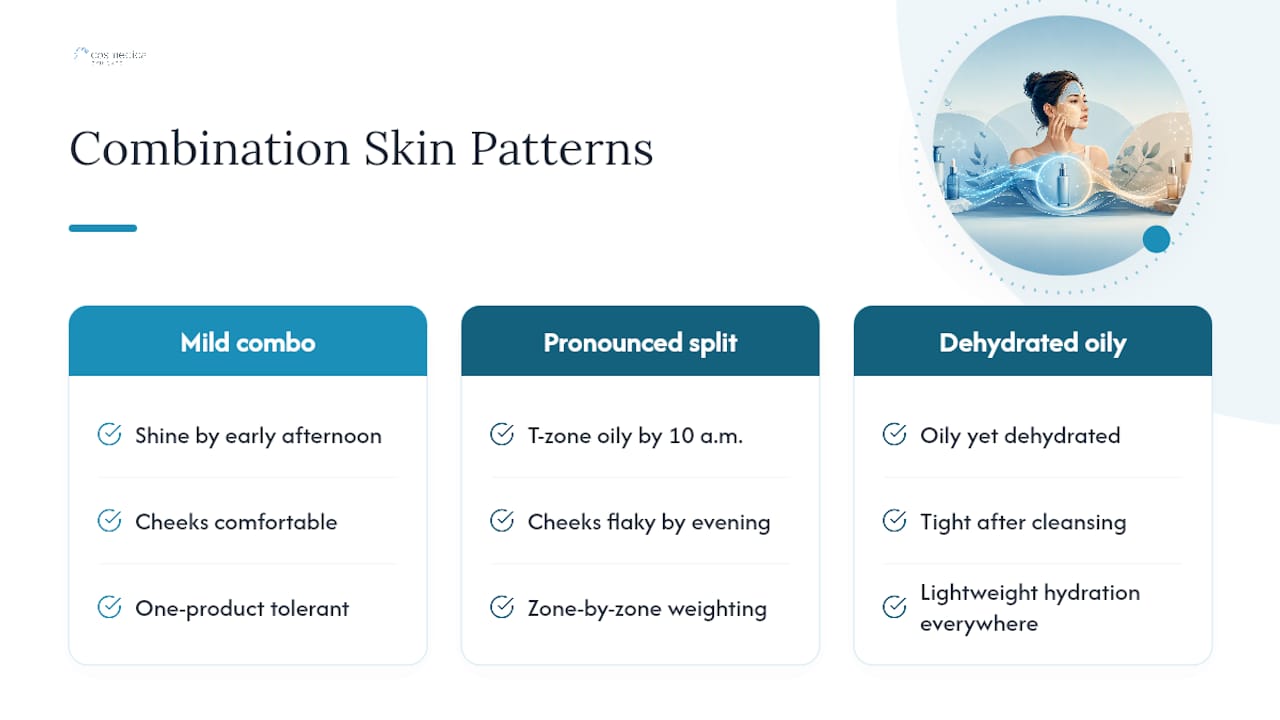
Combination skin isn’t one fixed pattern, and knowing your version changes how you should build the routine. Some people run oily through the entire T-zone with genuinely dry cheeks. Others have an oily nose and chin but only mildly dry, never flaky, cheeks. Some notice their combination pattern flips seasonally, oily everywhere in July and closer to normal-to-dry by January.
Spend a week paying attention without changing products. Note where shine shows up by early afternoon and where your skin feels tight after cleansing. If your forehead and nose get shiny within two to three hours of moisturizing but your cheeks stay comfortable most of the day, you likely have a mild combination pattern that tolerates most one-product routines easily. If your cheeks flake or feel raw by evening while your T-zone is visibly oily by 10 a.m., you have a more pronounced split that benefits from more deliberate zone-by-zone product weighting, not necessarily more products.
This mapping exercise also reveals whether what you’re calling “combination skin” is actually dehydrated oily skin, a common mix-up. Oily skin that’s lacking water can look and feel a lot like true combination skin, but it responses better to consistent lightweight hydration everywhere rather than drying treatments on the T-zone.
Spot Treatments: T-Zone Breakouts vs. Cheek Dryness
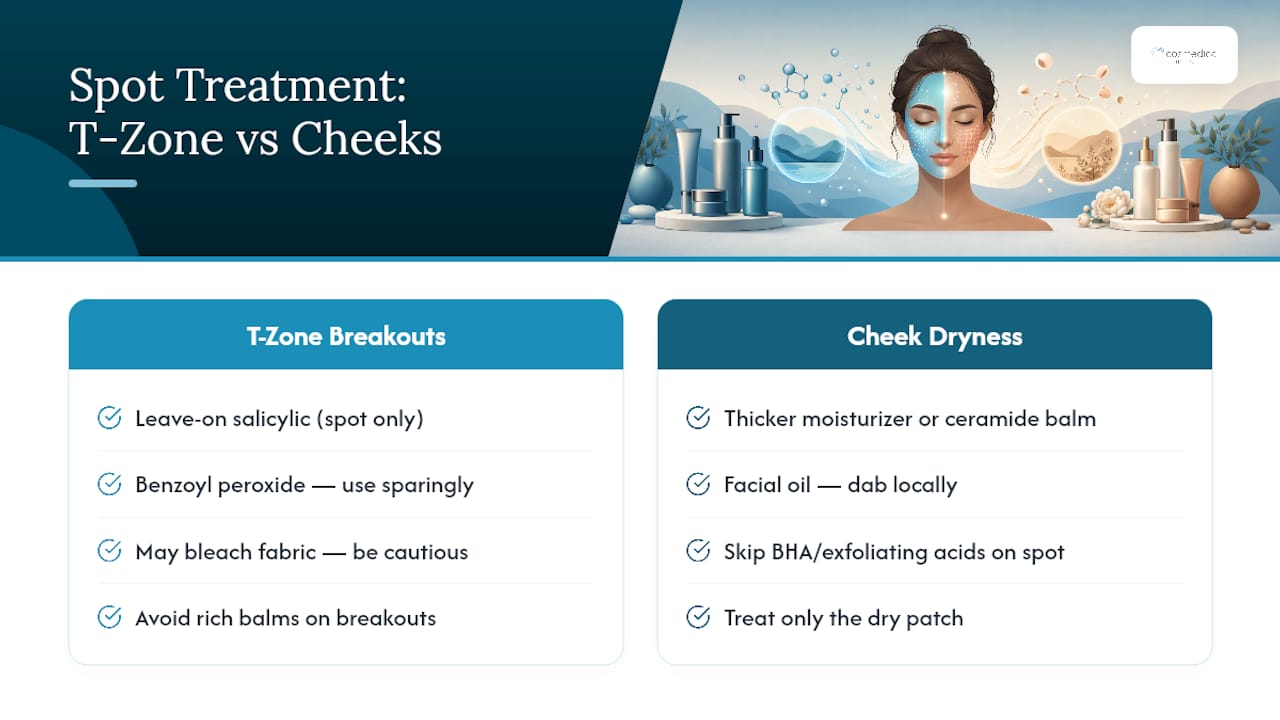
Combination skin rarely acts up uniformly, so your spot-treatment strategy shouldn’t either. A breakout on the forehead or chin and a dry, flaky patch on the cheek call for genuinely different responses, even though they might show up the same week.
For T-zone breakouts, a leave-on salicylic acid spot treatment applied directly to the blemish, not the whole zone, clears congestion fast without over-drying skin around it. Benzoyl peroxide works too, but use it sparingly since it can bleach fabric and irritate surrounding skin if applied too broadly.
For dry, flaky patches on the cheeks, skip exfoliating acids on that specific spot and instead pat on a thicker layer of your regular moisturizer, or a dedicated barrier balm with ceramides. Some people find that a few drops of a facial oil, dabbed only where the dryness is, softens flaking overnight without adding shine to the rest of the face.
The mistake most people make is treating both problems with the same product because it’s simpler. It isn’t more effective. A BHA spot treatment on a dry cheek patch will only make the flaking worse, and a rich balm smeared across an active T-zone breakout can make it linger longer.
Adapting to Climate and Humidity, Not Just the Season
Season and climate aren’t the same thing, and combination skin responds to humidity levels almost as much as temperature. Someone living somewhere humid will deal with a very different T-zone than someone in a dry climate, even at the same time of year.
In high humidity, oil production on the T-zone tends to increase regardless of season, since sweat and moisture in the air both stimulate sebaceous activity. Lean harder into oil-control cleansers and mattifying, oil-free sunscreens, and consider skipping a heavy moisturizer on the T-zone entirely in favor of a hydrating serum alone.
In dry climates, especially at higher altitudes or in air-conditioned or heated indoor air, cheeks dehydrate faster and the T-zone may actually calm down some of its oiliness. This is when a humectant serum under a slightly richer moisturizer across the whole face, not just the cheeks, makes sense, since dry air pulls moisture out of oily zones too. If you travel between climates often, keep two moisturizer weights on hand rather than trying to force one formula to do both jobs.
Common Mistakes That Undo a Good Combination Skin Routine
Most combination skin frustration traces back to a handful of repeatable errors rather than bad luck or bad genetics.
- Using two entirely separate routines. Splitting your face into an “oily skin regimen” and a “dry skin regimen” usually means over-treating one zone while under-treating the other, and it’s more product than most people can sustain.
- Skipping moisturizer on the T-zone. Oily skin still needs hydration. Skip it and oil production often increases to compensate.
- Over-exfoliating because the T-zone still looks dull. More acid isn’t the answer if you’re already at 2 to 3 times a week; that’s a moisturizer or hydration problem, not an exfoliation one.
- Choosing products by skin type label alone. A product marketed “for oily skin” applied to your whole face will dry out your cheeks fast.
- Skipping sunscreen because it feels heavy. This is the most common reason people abandon a good routine. A better sunscreen texture solves this more reliably than skipping the step.
- Introducing multiple new actives at once. When irritation shows up, you won’t know which product caused it.
Why the One-Routine Approach Actually Wins
Most skincare advice still treats combination skin like it’s two separate problems living on one face, and that framing is exactly why so many people end up with a bathroom shelf full of half-used products. The research and practical guidance both point the same direction: one adaptable routine, applied with different weight across zones, outperforms running dual regimens that fight each other by lunchtime.
What’s underrated here is restraint. The instinct when your T-zone breaks out is to add another product, and the instinct when your cheeks flake is to add a different one. Usually the fix is adjusting how much of what you already have goes where, not buying more. A single well-chosen gel-cream moisturizer, applied thin in some spots and thick in others, does more for combination skin than a five-step system split down the middle of your face.
If you take one thing from this, prioritize hydration consistency over active-ingredient variety. Get that right first, and the rest of the routine gets a lot more forgiving.
— Thomas
Building Your Routine with Cosmedica-skincare
You don’t need to buy separate product lines for your T-zone and your cheeks to get this right. Cosmedica-skincare formulates cruelty-free, dermatologist-tested products designed to work as a single adaptable system, not a divided one, which is exactly what combination skin actually needs.
Start with a hydrating cleanser, then build your serum layer from our collection of humectant and treatment serums, including hyaluronic acid and niacinamide options. If you want the lowest-friction way to try a balanced routine, the Trio Facial Serum Kit bundles hydrating and brightening serums so you can test how your skin responds before committing to full sizes. Pair it with a gel-cream moisturizer applied thin on your T-zone and fuller on your cheeks.
Take our Skin Quiz first to map your specific zones, then introduce one new active at a time so you can actually tell what’s working for your skin.
Sources
- The Ultimate Skin Care Routine for Combination Skin — Healthline
- PubMed indexed dermatology research (mechanisms of skin barrier disruption and effects)
- When to see a dermatologist — University of Utah Health
FAQ
What skincare routine is best for combination skin?
The best routine cleanses gently, hydrates with a humectant like hyaluronic acid, applies a gel-cream moisturizer weighted by zone, and finishes with daily sunscreen. Target the T-zone with a BHA a few times weekly rather than running a completely separate regimen.
What is the 4-2-4 rule in skincare?
The 4-2-4 method is a popular double-cleansing technique: massage an oil cleanser for 4 minutes, follow with a second cleanser for 2 minutes, then a hydrating step for 4 minutes. It’s a consumer beauty trend rather than a dermatologist-established protocol, so treat it as optional rather than essential.
Which products are best for combination skin?
Look for gentle cleansers, hyaluronic acid or niacinamide serums, and non-comedogenic gel-cream moisturizers, all of which are formulated specifically to work across both oily and dry zones. Lightweight, oil-free sunscreen rounds out a routine that won’t overwhelm either skin type.
What should combination skin avoid?
Avoid heavy occlusives like coconut oil and cocoa butter, alcohol-heavy toners, sulfate-based cleansers, and over-exfoliating beyond 2 to 3 times weekly. Stripping cleansers in particular can backfire, since damaging the skin barrier tends to increase oil production rather than reduce it.