

Ingredient First Fragrance-Free Moisturizer Benefits for Sensitive Skin
Choose fragrance-free moisturizers if you want to lower your risk of irritation and allergic flare-ups. Dermatology guidance and clinical research back this up: fragrance-free formulas mean less redness and itching, steadier barrier repair when paired with humectants and lipids, and fewer eczema or rosacea flares. The American Academy of Dermatology recommends fragrance-free moisturizers specifically for people with eczema, rosacea, or a known fragrance allergy.
TL;DR:
- Fragrance-free moisturizers reduce the risk of irritation and allergic reactions, especially for skin conditions involving barrier problems like eczema and rosacea.
- The term “unscented” often still contains masking fragrances, so checking ingredient lists for scent-related chemicals is essential to confirm true fragrance-free status.
- Removing fragrance from skincare formulas supports calmer skin, better barrier repair, and increases the likelihood of consistent moisturizer use.
- Look for formulas with ceramides, glycerin, hyaluronic acid, and niacinamide, and avoid products with any fragrance, essential oils, or botanical extracts added for scent.
- Patch testing new products on the inner forearm for three to five days helps prevent reactions and ensures safety before use on sensitive facial skin.
Table of Contents
- What “Fragrance-Free” Actually Means (and Why the Label Trips People Up)
- The Real Skin-Health Benefits of Going Fragrance-Free
- What Dermatologists and Clinical Research Actually Say
- How to Choose a Fragrance-Free Moisturizer (Practical Checklist)
- “Unscented” and “Natural” Don’t Mean Safe
- Getting the Most Out of Your Fragrance-Free Routine
- Why We Build Every Formula Fragrance-Free From the Start
- A Fragrance-Free Option Worth Trying
- Sources
- FAQ
What “Fragrance-Free” Actually Means (and Why the Label Trips People Up)
“Unscented” is a different animal entirely. Unscented products often still contain a masking fragrance added specifically to cancel out the smell of raw ingredients, so the product ends up with fragrance chemicals anyway. In the United States, there’s no single legal definition governing either term, which means front-of-package marketing can’t always be trusted at face value, per the FDA’s guidance on cosmetic allergens.
The only reliable check is the ingredient list. Watch for:
- “Fragrance” or “parfum” listed as a standalone ingredient
- Essential oil names (lavender, citrus, tea tree, eucalyptus)
- Botanical extracts added for scent rather than skin benefit
- Vague catch-alls like “aroma” or “natural fragrance”
If any of these appear, the product isn’t truly fragrance-free, no matter what the label claims. Our guide on what fragrance-free actually means for sensitive skin walks through more label-reading examples.
The Real Skin-Health Benefits of Going Fragrance-Free
Fragrance is one of the most common triggers of skin reactions, and the mechanism is straightforward: fragrance compounds are small molecules that can penetrate skin and trigger an immune response, causing irritation or a true allergic reaction. For skin that’s already compromised, that reaction is faster and harder to calm down.
Here’s what switching to fragrance-free formulas tends to change:
- Fewer irritant and allergic reactions. Removing fragrance removes the single biggest chemical trigger for contact dermatitis in moisturizers.
- Calmer eczema, rosacea, and acne-prone skin. These conditions already involve a compromised barrier, so an added irritant load makes flares more frequent and more severe.
- Better barrier repair. When a formula isn’t spending ingredient space on scent, it can lean harder on humectants like glycerin and hyaluronic acid plus lipids like ceramides. That’s the combination your skin barrier actually needs to rebuild.
- More consistent routine use. Skin that doesn’t sting or flush after application is skin you’ll actually keep moisturizing. Consistency, more than any single ingredient, is what drives long-term improvement.
A patch-testing analysis of 3,539 dermatitis patients found fragrance contact allergy in roughly 13% of that clinical population, a large enough share that dermatologists treat fragrance as a default suspect whenever a moisturizer causes trouble. The same research noted that standard screening mixes miss some fragrance-allergic patients entirely, because individual allergens react differently than the mixes used to test for them. That’s a meaningful detail: even people who’ve passed a general “fragrance mix” patch test can still react to one specific compound within it.
Separately, a study comparing SLS-free aqueous cream against a standard formula found the irritant-free version caused measurably less irritation while still hydrating just as well. It’s a small but telling example of a bigger principle: subtracting known irritants from a formula doesn’t weaken it. It just removes the risk.
What Dermatologists and Clinical Research Actually Say
The clinical consensus is consistent, even if the marketing language around it isn’t. The AAD’s moisturizer guidance points people with eczema, rosacea, or known allergies toward fragrance-free products as a default, not an upgrade. StatPearls’ clinical overview of moisturizers echoes this, noting that fragrance-free and hypoallergenic formulas reduce the odds of an allergic reaction for anyone with reactive skin.
Fragrance allergy shows up in roughly 13% of patients tested in dermatitis clinics, and standard allergen screening mixes can still miss individual cases. For sensitive skin, that’s not a rare edge case. It’s a real, quantifiable slice of the population.
A handful of practical points fall out of this evidence:
- There’s no U.S. federal standard defining “fragrance-free,” so ingredient lists are the only dependable verification.
- Fragrance allergens are common enough that dermatology guidance treats fragrance avoidance as first-line advice, not a niche precaution.
- Even “clean” or minimal-ingredient products can carry fragrance if a botanical extract was added for smell.
The takeaway isn’t that fragrance is dangerous for everyone. It’s that if your skin is already reactive, fragrance is the easiest variable to remove and one of the most likely culprits when a product doesn’t agree with you.
How to Choose a Fragrance-Free Moisturizer (Practical Checklist)
Once you know what to look for, picking a safer moisturizer gets a lot faster. Prioritize these ingredient categories:
- Ceramides to reinforce the lipid barrier that keeps moisture in and irritants out
- Glycerin and hyaluronic acid as humectants that pull water into the skin
- Niacinamide to support barrier function and calm redness
- Occlusives like squalane or shea butter to lock hydration in without clogging pores
Avoid or scrutinize:
- Fragrance, parfum, or essential oils listed anywhere on the label
- High-allergen botanicals (common offenders include certain florals and citrus extracts)
- Preservatives with a known sensitization history, if you’ve reacted to products before
Trust signals like “dermatologist-tested” and “non-comedogenic” aren’t guarantees, but they suggest the formula was built with reactive skin in mind. Products recognized by the National Eczema Association carry a similar level of intent. For deeper ingredient breakdowns, our piece on barrier repair ingredients like ceramides is worth a look.
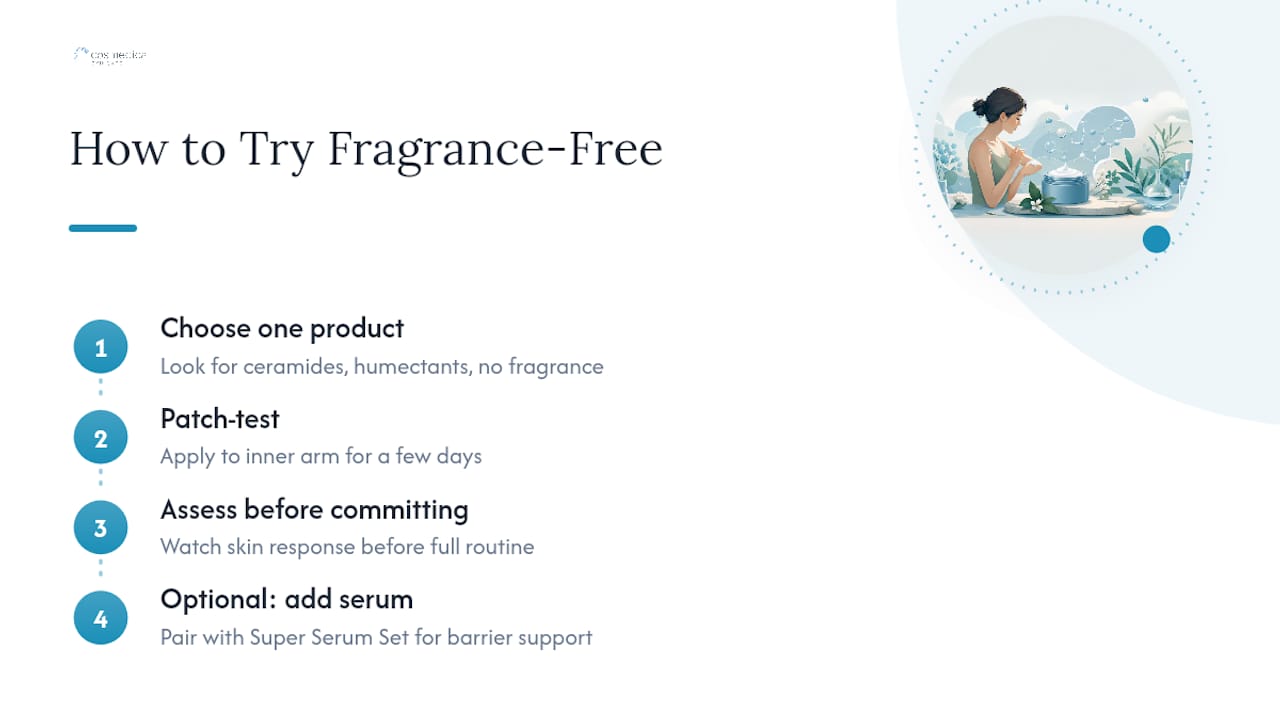
Pro Tip: Before committing to a full-size product, apply a small amount to your inner forearm twice daily for three to five days. If you see no redness, itching, or bumps, it’s reasonably safe to try on your face. If irritation shows up anywhere along the way, stop and see a dermatologist, especially if it spreads or doesn’t calm down within a day or two.
“Unscented” and “Natural” Don’t Mean Safe
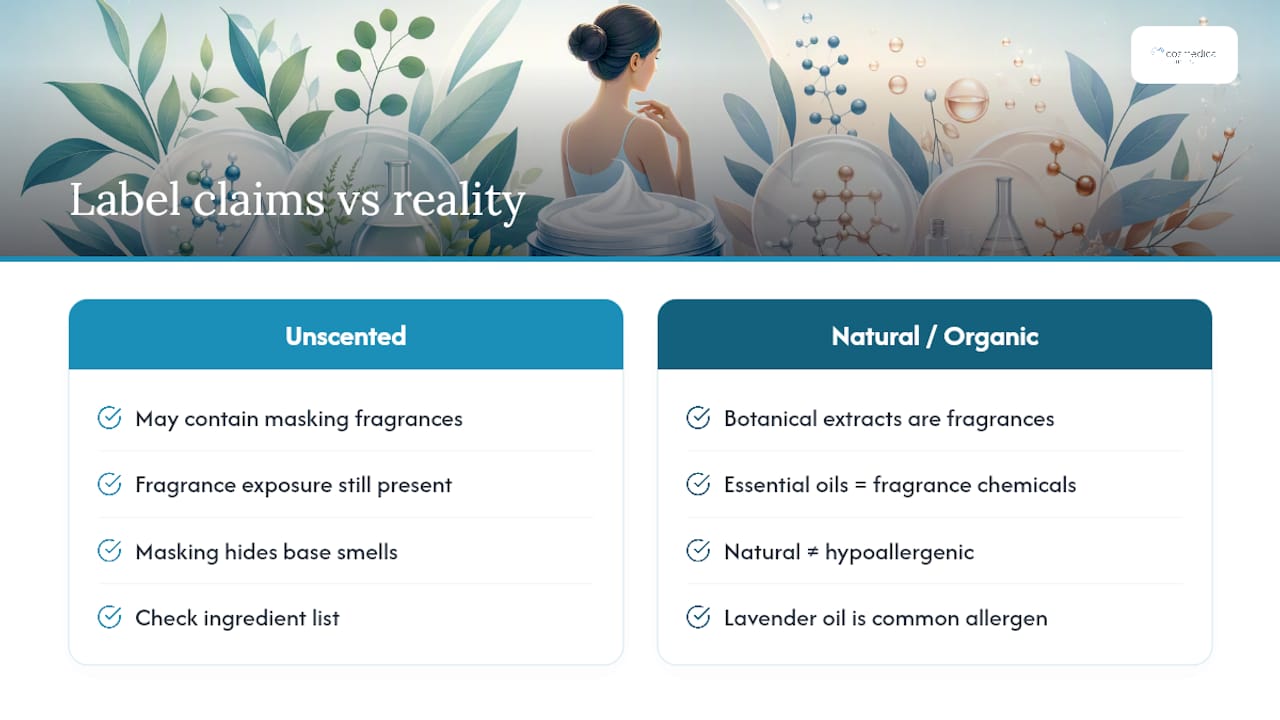
This is where a lot of sensitive-skin routines quietly go wrong. “Unscented” products can still contain masking fragrances added to neutralize base ingredient smells, so the fragrance exposure is still there, just disguised. “Natural” and “organic” labels are just as misleading in a different direction: botanical extracts and essential oils are still fragrance chemicals, and the AAD notes that natural doesn’t equal hypoallergenic. Lavender oil is natural. It’s also a common allergen.
The rule of thumb: don’t judge by what you smell or by the word “natural” on the front. Judge by what’s actually printed in the ingredient list.
Getting the Most Out of Your Fragrance-Free Routine
Getting real results from a fragrance-free moisturizer comes down to how and when you use it, not just which one you pick.
- Apply to damp skin right after cleansing. This traps water at the surface instead of letting it evaporate, which is when moisturizer does its best work.
- Layer moisturizer after serums, before sunscreen. Thinner, active-rich products go on first; moisturizer seals them in; sunscreen goes last during the day.
- Introduce new actives one at a time. Add a single new product every one to two weeks so you can pinpoint the cause if a reaction shows up.
- During an active flare, simplify. Drop actives temporarily and use a plain, occlusive-heavy fragrance-free moisturizer to calm things down. If redness, swelling, or itching doesn’t improve within a few days, see a dermatologist rather than experimenting further on your own.
Why We Build Every Formula Fragrance-Free From the Start
Fragrance-free isn’t an afterthought bolted onto a scented line. It’s a formulation starting point, built around dermatologist-tested, cruelty-free ingredients meant to support the same barrier function this article has walked through. If you’re on the fence, a small patch test on your arm before applying anything new to your face is always the right first move, and our guide to calming sensitive, reactive skin covers what else belongs in that kind of routine.
A Fragrance-Free Option Worth Trying
Everything in this article points to the same short list: ceramides, humectants, no added fragrance, no unnecessary botanicals. Cosmedica-skincare’s fragrance-free moisturizer collection is built around exactly that criteria, formulated with barrier-supporting ingredients and dermatologist-tested standards, without perfume added for scent. Nothing here requires a leap of faith. Start with a single product, patch-test it on your inner arm for a few days the way we outlined above, and see how your skin responds before committing to a full routine. If you want to pair it with a treatment step, the Super Serum Set is a straightforward way to add barrier support without introducing a new fragrance risk. Either way, the ingredient list is still your best evidence, on our products or anyone else’s.
This article is general information, not a substitute for advice from a qualified doctor. Consult a qualified healthcare professional about your own circumstances before acting on anything here.
Sources
- How to pick the right moisturizer for your skin — American Academy of Dermatology
- Moisturizers — StatPearls / NCBI Bookshelf
- Prevalence and clinical characteristics of fragrance contact allergy — PubMed Central
FAQ
What is the best fragrance-free moisturizer for aging skin?
Look for a fragrance-free formula combining ceramides, hyaluronic acid, and niacinamide, since these support barrier repair and hydration without the irritation risk that fragrance adds. There’s no single universal “best” pick. The right one depends on your skin’s specific dryness and sensitivity level.
What is the best fragrance-free moisturizer overall?
The strongest choice for most sensitive skin is a short-ingredient formula built on ceramides, glycerin, and hyaluronic acid with zero added fragrance or masking scent. Checking the full ingredient list matters more than any single brand recommendation, since labeling terms alone aren’t regulated in the U.S.
Is fragrance-free or unscented better for sensitive skin?
Fragrance-free is the safer choice, since it means no fragrance chemicals were added at all. Unscented products can still contain masking fragrances used to cancel out the smell of other ingredients, which means hidden fragrance exposure is still possible.
Why should you avoid fragrance in skincare?
Fragrance compounds are among the most common triggers of allergic contact dermatitis, showing up in about 13% of tested dermatitis patients in one clinical series. For skin that’s already prone to eczema, rosacea, or reactivity, fragrance adds an unnecessary irritation risk without any skin-health benefit.