

Best Eye Creams With Peptides: 2026 Buyer's Guide
The fastest way to address under-eye fine lines, crepiness, and dullness is a well-formulated peptide eye cream used consistently. Our top pick for daily use is the Cosmedica Skincare Brightening Eye Treatment Gel: a peptide-forward brightening gel that combines humectants with peptide actives, is dermatologist-tested, and suits even sensitive skin. For shoppers with specific needs, here are three runner-up categories:
- Best for dry or mature skin: A derm-backed multi-peptide advanced eye cream with a richer texture targets deep expression lines and very dry under-eyes.
- Best for dark circles: A peptide-plus-brightener eye gel pairs peptides with brightening actives to address pigmentation and sluggish microcirculation.
- Best for sensitive skin: A soothing, fragrance-free peptide cream with carrier peptides focuses on barrier repair for reactive periorbital skin.
Expect hydration within a few days of starting any well-formulated peptide eye treatment. Visible textural improvement typically takes about four weeks, while meaningful structural changes — the kind backed by clinical data showing a measurable decrease in fold depth with palmitoyl pentapeptide-4 — require 8–12 weeks of twice-daily use. Formulation stability and a dermatologist-tested claim matter as much as the peptide name on the label.
Table of Contents
- How do the top peptide eye creams compare at a glance?
- Quick reviews of each shortlisted peptide eye treatment
- How do peptides actually work around the eyes?
- How to choose the right peptide eye cream for your concern
- How to apply peptide eye cream for best results
- Which peptide eye cream works best for your age group?
- Key Takeaways
- The case for patience with peptide eye products
- The Cosmedica Skincare Brightening Eye Treatment Gel is worth trying
- Sources and further reading
- FAQ
How do the top peptide eye creams compare at a glance?
| Product | Best for | Key peptides / actives | Texture | Price tier | Sensitive skin | Results timeline | U.S. availability |
|---|---|---|---|---|---|---|---|
| Cosmedica Skincare Brightening Eye Treatment Gel | Brightening, mild crepiness, daily maintenance | Peptide actives + humectants | Lightweight gel | Budget–mid | Yes (dermatologist-tested) | Hydration in days; texture in 4 weeks | cosmedica-skincare.com |
| Derm-backed multi-peptide advanced eye cream | Mature skin, deep expression lines | Multi-peptide blend (signaling + carrier) | Rich cream | Premium | Moderate | Structural gains, including measurable wrinkle reduction and improved firmness, seen after 4 weeks | Specialty retailers, online |
| Peptide + brightener eye gel | Dark circles (pigmentation, microcirculation) | Peptides + niacinamide / caffeine | Lightweight gel | Budget | Yes | 4–8 weeks | Mass-market retail, online |
| Soothing peptide cream for sensitive skin | Extremely sensitive, eczema-prone periorbital skin | Carrier peptides (GHK-Cu) + barrier lipids | Soft cream | Mid | Yes (fragrance-free) | 4–8 weeks | Online, specialty |
| SkinCeuticals A.G.E. Advanced Eye | Glycation-related aging, crow’s feet | Proxylane, blueberry extract | Cream | Premium | Moderate | Structural gains typically observed after 4 or more weeks | Dermatologist offices, SkinCeuticals.com |
| SkinMedica TNS Eye Repair | Advanced aging, multiple concerns | Growth factors + peptides | Cream | Premium | Moderate | Structural gains typically observed after 4 or more weeks | Physician dispensed, online |
| Paula’s Choice Pro-Collagen Peptide Firming Eye Gel | Firming, fine lines | Palmitoyl peptides + retinol | Gel | Mid–premium | Moderate | Texture improvement typically seen after 2–4 weeks | paulaschoice.com, Amazon |
| Beauty of Joseon Revive Eye Serum | Lightweight hydration, early aging | Ginseng + peptides | Serum | Budget | Yes | Texture improvement typically seen after 2–4 weeks | Amazon, Target |
| Then I Met You Snail Mucin Eye Cream | Barrier repair, hydration | Snail secretion filtrate + peptides | Cream | Mid | Yes | Texture improvement typically seen after 2–4 weeks | thenimetyou.com, Amazon |
A quick note on how we picked: every option here was evaluated on dermatologist-tested or clinically studied claims, named peptide ingredients (not just “peptide complex”), texture suitability for the thin periorbital area, sensitivity tolerance, and realistic U.S. price-to-size value.
Quick reviews of each shortlisted peptide eye treatment
Cosmedica Skincare Brightening Eye Treatment Gel
This is our featured pick for good reason. The gel combines peptide actives with moisturizing humectants to address hydration, brightness, and mild crepiness in one lightweight step. It’s dermatologist-tested, cruelty-free, and vegan — which matters when you’re applying something twice daily to the most delicate skin on your face.
Pros:
- Lightweight gel absorbs quickly without pilling under makeup
- Peptide actives support collagen signaling and hydration simultaneously
- Dermatologist-tested; suitable for sensitive skin
- Affordable price point relative to clinical-grade alternatives
Cons:
- Lighter texture may not satisfy those with very dry or mature under-eyes seeking a richer cream
- Brightening results are gradual, not overnight
Key actives: Peptide actives, humectants Texture: Lightweight gel Price tier: Budget–mid Sensitive skin: Yes

Derm-backed multi-peptide advanced eye cream
A richer-textured cream that layers multiple peptide families — signaling peptides to stimulate collagen and carrier peptides to support repair. A controlled clinical trial of a multi-peptide eye serum showed statistically significant reductions in wrinkle number, depth, and volume after 28 days of twice-daily use, alongside improved elasticity. Products in this category lean on that clinical positioning.
Pros:
- Multi-peptide strategy addresses several aging mechanisms at once
- Richer texture works well for dry or mature skin
- Often supported by short clinical trials
Cons:
- Premium price point
- Heavier texture can feel occlusive in warm weather or on oily skin
Key actives: Palmitoyl pentapeptide-4, acetyl hexapeptide-8, carrier peptides Texture: Rich cream Price tier: Premium Sensitive skin: Moderate tolerance

Peptide + brightener eye gel (value pick)
Think of this as the “do more with less” option. A lightweight gel that pairs peptides with brightening agents like niacinamide or caffeine to target under-eye shadowing and morning puffiness. It won’t match a premium multi-peptide cream on depth of anti-aging action, but for dark circles driven by pigmentation or poor microcirculation, the combination is genuinely useful.
Pros:
- Lower price point with real peptide support
- Caffeine and niacinamide address puffiness and pigmentation directly
- Gel texture layers well under SPF
Cons:
- Peptide concentration typically lower than premium options
- Less effective for deep structural aging
Key actives: Peptides + niacinamide, caffeine Texture: Lightweight gel Price tier: Budget Sensitive skin: Generally yes
Soothing peptide cream for sensitive skin
This one is built for people who have tried other eye creams and reacted. A minimalist formula centered on carrier peptides like copper peptide (GHK-Cu) and barrier-repair lipids, with no fragrance and low irritant potential. Peptides are notably well-tolerated compared with high-percentage retinoids, making them the preferred anti-aging choice for reactive periorbital skin.
Pros:
- Fragrance-free, low-irritant formulation
- Carrier peptides support skin repair and barrier function
- Works for eczema-prone periorbital skin
Cons:
- Minimalist formula means fewer brightening or firming actives
- Results timeline is gradual
Key actives: Copper peptide (GHK-Cu), barrier lipids Texture: Soft cream Price tier: Mid Sensitive skin: Yes
SkinCeuticals A.G.E. Advanced Eye
Targets glycation-related aging (the kind that makes skin look dull and stiff over time) with Proxylane and blueberry extract alongside peptides. Sold primarily through dermatologist offices and the brand’s own site, so it carries a clinical positioning that justifies its premium price. Best suited to those in their 40s and beyond dealing with crow’s feet and loss of firmness.
Key actives: Proxylane, blueberry extract, peptides Texture: Cream | Price tier: Premium | Sensitive skin: Moderate
SkinMedica TNS Eye Repair
A physician-dispensed formula that combines growth factors with peptides for a multi-mechanism approach to advanced aging. The growth-factor component is what sets it apart from a standard peptide cream, though it also makes it the priciest option on this list. Typically available through dermatologist and plastic surgeon offices.
Key actives: Growth factors, peptides Texture: Cream | Price tier: Premium | Sensitive skin: Moderate
Paula’s Choice Pro-Collagen Peptide Firming Eye Gel
Paula’s Choice is transparent about its ingredient lists, which is a real advantage when you’re trying to verify that palmitoyl peptides are actually present at meaningful levels. This gel also includes a low concentration of retinol, which adds firming action but means it’s better suited to PM use and may not be ideal for very sensitive skin.
Key actives: Palmitoyl peptides, retinol Texture: Gel | Price tier: Mid–premium | Sensitive skin: Moderate (retinol-containing)
Pro Tip: If you’re new to retinol around the eyes, use this one every other night for the first two weeks before going daily.
Beauty of Joseon Revive Eye Serum
A lightweight, budget-friendly serum from a Korean beauty brand that has earned a loyal following for its clean, gentle formulations. Ginseng extract pairs with peptides for antioxidant support and early-stage firming. It won’t address deep structural aging, but for someone in their 20s or early 30s starting a preventive routine, it’s a smart, affordable entry point.
Key actives: Ginseng, peptides Texture: Serum | Price tier: Budget | Sensitive skin: Yes
Then I Met You Snail Mucin Eye Cream
Snail secretion filtrate is a barrier-repair powerhouse, and pairing it with peptides makes this cream particularly good for under-eyes that feel dry, tight, or compromised. The texture is richer than a gel but not heavy. A solid choice for anyone whose primary concern is hydration and barrier health rather than deep wrinkle correction.
Key actives: Snail secretion filtrate, peptides Texture: Cream | Price tier: Mid | Sensitive skin: Yes
How do peptides actually work around the eyes?
Peptides are short chains of amino acids — think of them as tiny messengers that tell your skin cells what to do. Around the eyes, where skin is about 40% thinner than on the rest of your face, that signaling function is especially valuable because aggressive actives like high-percentage retinoids can cause irritation. Peptides support skin machinery without forcing exfoliation, making them a preferred anti-aging choice for the periorbital area.
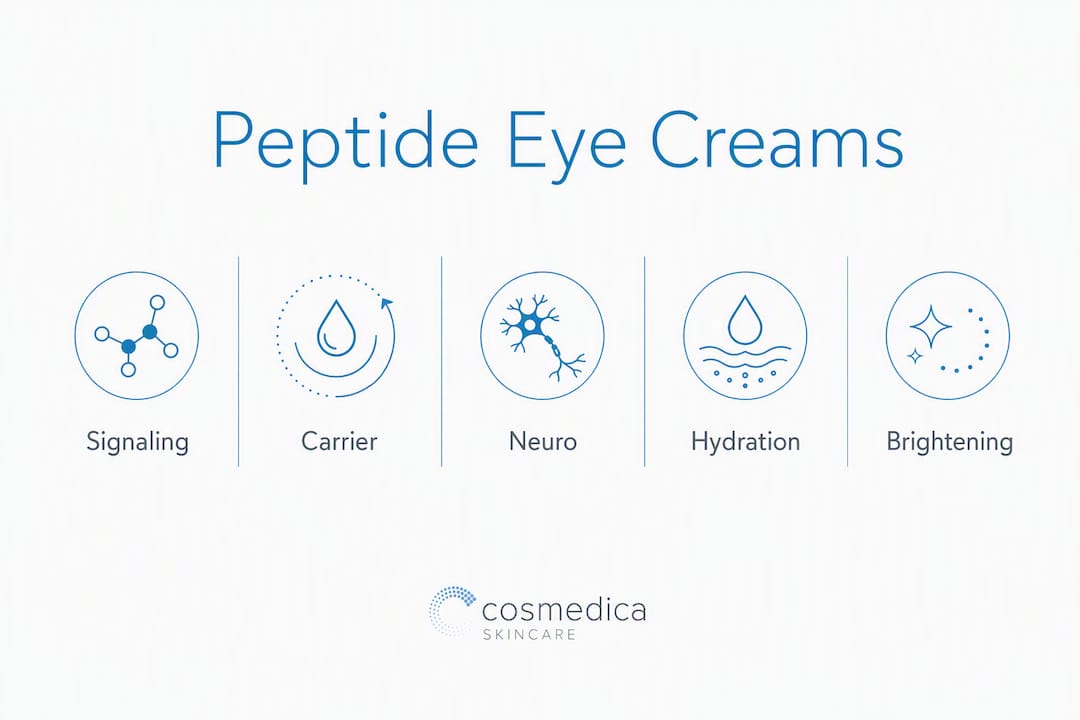
Here’s a breakdown of the main peptide families and what each targets:
- Signaling peptides (e.g., palmitoyl pentapeptide-4 / Matrixyl): Tell fibroblasts to produce more collagen and elastin. Best for firming and reducing fine lines. A 28-day study found an 18% decrease in fold depth and a 21% improvement in skin firmness with palmitoyl pentapeptide-4.
- Carrier peptides (e.g., copper peptide / GHK-Cu): Deliver trace minerals to the skin to support wound healing and collagen repair. Best for barrier-compromised or sensitive skin.
- Neurotransmitter-inhibiting peptides (e.g., acetyl hexapeptide-8): Temporarily reduce muscle micro-contractions that deepen expression lines. Best for crow’s feet.
- Enzyme-inhibiting peptides: Block enzymes that break down collagen, preserving existing structure. Best for prevention and early aging.
Cosmetic chemists emphasize that “peptide” is an umbrella term — matching the peptide family to your specific concern is what drives results. A product labeled “contains peptides” without naming the peptide family is a yellow flag.
What the timeline actually looks like
| Timeframe | What you can expect |
|---|---|
| A few days | Improved hydration; skin feels plumper and less tight |
| Weeks 2–4 | Visible textural improvement; mild reduction in fine lines |
| Weeks 4+ | Measurable improvements — including up to an 18% decrease in fold depth and 21% increase in firmness with certain peptides |
| 12+ weeks | Cumulative improvement with consistent twice-daily use |
Peptides can also improve puffiness and the appearance of dark circles by supporting microcirculation and skin structure over time, though results depend on the underlying cause. Structural issues like herniated fat pads won’t respond to topicals and typically require in-office treatment.
How to choose the right peptide eye cream for your concern
Not every peptide eye cream is built the same way, and formulation quality determines whether peptides are effectively delivered or simply sit on the skin surface. Here’s how to match what’s on the label to what you actually need.
Criteria to check before you buy
- Primary concern alignment: Firming needs signaling peptides; barrier repair needs carrier peptides; expression lines need neurotransmitter-inhibiting peptides. Check the ingredient list, not just the marketing copy.
- Named peptides on the label: If the product says “peptide complex” without listing individual peptide names (palmitoyl pentapeptide-4, GHK-Cu, acetyl hexapeptide-8), you can’t verify what you’re getting.
- Delivery system and stability: Peptides degrade in poorly formulated products. Look for opaque or airless packaging and a stable pH range. Avoid products that list peptides last in a long ingredient deck.
- Supporting actives: Hyaluronic acid boosts hydration; niacinamide addresses pigmentation; caffeine targets puffiness. These work alongside peptides, not instead of them.
- Dermatologist-tested or clinically studied claim: Not a guarantee, but a meaningful signal that the formula was evaluated for safety and efficacy.
- Price-to-size ratio: Premium price doesn’t always mean more peptides. Compare the ingredient list, not the packaging.
Red flags to avoid
- “Proprietary peptide blend” with no named peptides listed
- High fragrance or alcohol content in an eye-area product
- Claims that a topical product delivers “injectable-like results” without clinical data
- Unstable packaging (clear jar, no airless pump) for a peptide-forward formula
Questions to ask before you buy: Which peptide families are listed by name? Is the product dermatologist-tested or backed by a clinical study? What is the texture, and will it layer under your SPF or over your retinol without pilling?
For a deeper look at how to choose peptide skincare products, Cosmedica-skincare’s guide walks through the selection logic by skin concern.
How to apply peptide eye cream for best results
Getting the application right matters almost as much as choosing the right formula. Here’s the step-by-step:
- Cleanse and tone first. Apply eye cream to clean skin so peptides aren’t competing with residue or sunscreen from the previous step.
- Use a pea-sized amount for both eyes. A thin, even layer is enough — more product doesn’t mean faster results.
- Tap, don’t rub. Use your ring finger (it applies the least pressure) to gently tap the product along the orbital bone, from the inner corner outward. Never drag the skin.
- AM routine: Apply after serum, before moisturizer and SPF. Peptides pair well with antioxidants like vitamin C — the combination protects existing collagen while signaling new production.
- PM routine: Apply after any treatment serums. If you use retinol, apply it first and let it absorb for a few minutes before layering your peptide eye cream. If irritation occurs, alternate nights rather than combining.
- Patch test first. Apply a small amount to the inner arm for 24–48 hours before using near the eyes, especially if your skin is reactive.
Pro Tip: Pair your peptide eye cream with a broad-spectrum SPF 30+ every morning. UV exposure degrades collagen faster than almost any other factor, so protecting what your peptides are building is non-negotiable.
For a full eye care routine that layers products correctly, Cosmedica-skincare’s guide covers timing, product order, and what to avoid stacking.
Expect to test a product for at least 4 weeks before evaluating texture changes, and 8–12 weeks before judging structural improvement. Hydration benefits can appear within days, but collagen synthesis is a slow, cumulative process. Consistency beats intensity every time.
Which peptide eye cream works best for your age group?
Peptide needs shift as skin changes, so the “best” formula at 28 looks different from the one that makes sense at 52.
In your 20s: Prevention is the goal. A lightweight peptide serum or gel like the Beauty of Joseon Revive Eye Serum or the Cosmedica Skincare Brightening Eye Treatment Gel gives you antioxidant support and early collagen signaling without overloading thin skin. Signaling peptides at this stage are more about maintaining what you have than reversing damage.
In your 30s: Fine lines around the eyes start to set in, especially crow’s feet from repeated expression. This is the right time to add a product with named signaling peptides (palmitoyl pentapeptide-4) and consider pairing with a low-concentration retinol in the PM. The Cosmedica Brightening Eye Treatment Gel works well as a daily AM option; a retinol-containing gel like Paula’s Choice Pro-Collagen Peptide Firming Eye Gel can complement it at night.
In your 40s: Skin loses elasticity more noticeably, and crepiness becomes a real concern. A richer multi-peptide cream that combines signaling and carrier peptides addresses both collagen loss and barrier thinning. Products in the derm-backed multi-peptide category or SkinCeuticals A.G.E. Advanced Eye are built for this stage.
In your 50s and beyond: Deep expression lines, significant laxity, and dark circles from structural volume loss all come into play. A premium formula with growth factors and multiple peptide families (like SkinMedica TNS Eye Repair) or a physician-recommended option makes sense here. Topicals won’t correct structural hollowing, but they can meaningfully improve texture, firmness, and hydration with consistent use.
Key Takeaways
Peptide eye creams work best when the peptide family matches your specific concern and you apply them consistently for at least 4–12 weeks.
| Point | Details |
|---|---|
| Match peptide type to concern | Signaling peptides firm, carrier peptides repair, neurotransmitter-inhibiting peptides soften expression lines. |
| Clinical evidence supports results | A 28-day study showed an 18% decrease in fold depth and a 21% improvement in skin firmness with palmitoyl pentapeptide-4; multi-peptide trials show wrinkle reduction after 28 days. |
| Realistic timeline | Hydration improves within days; visible texture changes take 4 weeks; measurable structural gains may occur as early as 4 weeks, with continued improvement over 8–12 weeks of twice-daily use. |
| Protect what you build | Daily SPF paired with a peptide eye cream prevents UV from degrading new collagen. |
| Cosmedica-skincare’s pick | The Cosmedica Skincare Brightening Eye Treatment Gel is the recommended daily-use option for brightening, mild crepiness, and sensitive skin. |
The case for patience with peptide eye products
There’s a tendency in the skincare world to chase the most aggressive active available — high-percentage retinoids, strong acids, injectable-adjacent claims. Around the eyes, that logic often backfires. The periorbital skin is thin, reactive, and quick to show irritation, and a product that causes inflammation is actively working against the collagen you’re trying to build.
What the clinical data actually shows is that peptides, used consistently, produce real and measurable improvements. In clinical studies, users experienced an 18% reduction in fold depth and a 21% improvement in firmness after 28 days — real, tangible changes that take consistent use to achieve. The mistake most people make isn’t choosing the wrong peptide — it’s abandoning a product after two weeks because they don’t see immediate results.
The other thing worth saying plainly: no topical peptide cream corrects structural anatomy. If you have significant tear trough hollowing or herniated fat pads, that’s a conversation for a dermatologist or plastic surgeon, not a skincare product. Peptides are genuinely useful for texture, firmness, hydration, and mild dark circles — and that covers the majority of what most people are actually dealing with.
My selection criteria for this article: dermatologist-tested or clinically studied claims, named peptide ingredients on the label, texture suitability for periorbital skin, sensitivity tolerance, and realistic U.S. availability and pricing. This article is published on Cosmedica-skincare’s site, and the Cosmedica Skincare Brightening Eye Treatment Gel is featured as a recommended option. It earned that position on formulation merits, not just brand affiliation.
The Cosmedica Skincare Brightening Eye Treatment Gel is worth trying
If you want a peptide eye treatment that covers the basics well without a premium price tag, the Cosmedica Skincare Brightening Eye Treatment Gel is the place to start. It’s formulated with peptide actives and moisturizing humectants, dermatologist-tested, cruelty-free, and lightweight enough for daily AM and PM use. It’s designed for brightening, mild crepiness, and sensitive skin — which describes most people’s primary under-eye concerns.
For those who want to build a fuller hydration-focused routine alongside their eye treatment, the Intense Hydration Kit pairs well with peptide eye products for dehydration-prone skin. Shop the Brightening Eye Treatment Gel directly at cosmedica-skincare.com.
Sources and further reading
- Palmitoyl pentapeptide-4 clinical findings (PMC) — Peer-reviewed data on fold depth reduction and firmness improvement; the primary clinical citation for signaling peptide efficacy.
- Peptides and skin tolerability review (PMC) — Reviews why peptides are preferred for sensitive periorbital skin compared with stronger actives.
- Multi-peptide eye serum clinical trial (JOCD) — Controlled trial showing statistically significant wrinkle and firmness improvements after 28 days of twice-daily use.
- Peptides for skin care — Cleveland Clinic — Explains formulation quality and why delivery system matters for peptide penetration.
- Types of peptides in skincare — Marie Claire — Cosmetic chemist explainer on peptide families and how to match them to skin concerns.
- Can peptides help with undereye bags? — Vogue — Consumer-facing coverage of peptide benefits for puffiness, dark circles, and firmness; includes realistic expectations.
- Wrinkle reduction using Tetrapeptide-68 — PubMed — 12-week randomized double-blind study on periorbital wrinkle reduction with a newer peptide; useful for understanding the range of peptide research.
- What is peptide in skincare? — Cosmedica-skincare — Accessible primer on peptide classes and how each affects skin; good starting point for readers new to the ingredient.
- Peptides for skin benefits and hydration — Cosmedica-skincare — Covers the hydrating benefits of peptide products and how they complement other actives.
FAQ
Are peptides good for eye cream?
Yes. Peptides are well-tolerated around the thin periorbital skin and support collagen production, firmness, and hydration without the irritation risk of stronger actives like retinoids.
What is the best peptide eye cream?
For daily use on sensitive or normal skin, the Cosmedica Skincare Brightening Eye Treatment Gel is a strong starting pick. For mature skin with deeper expression lines, a derm-backed multi-peptide cream with palmitoyl pentapeptide-4 and acetyl hexapeptide-8 is worth the investment.
Which peptide is best for the eye area?
Palmitoyl pentapeptide-4 (a signaling peptide) has the strongest clinical backing for firming and fold-depth reduction. Copper peptide (GHK-Cu) is the top carrier peptide for barrier repair and sensitive skin. Acetyl hexapeptide-8 targets expression lines specifically.
Is peptide or collagen better for under-eyes?
Peptides. Topical collagen molecules are too large to penetrate the skin, while signaling peptides like palmitoyl pentapeptide-4 actually stimulate your skin’s own collagen production from within, producing measurable structural improvements over 8–12 weeks.