

Fragrance Free Skincare: What It Means for Sensitive Skin
TL;DR:
- Fragrance free skincare products contain no added fragrance chemicals or masking agents, reducing irritation risks.
- The terms “unscented” and “hypoallergenic” are not interchangeable with fragrance free and can still contain allergens.
Fragrance free skincare is defined as products formulated without any added fragrance chemicals, masking scents, or perfume compounds. If your skin flushes, itches, or breaks out after using a new moisturizer or serum, fragrance is often the culprit. The term “fragrance free” gets used loosely across the beauty industry, and that creates real confusion for people with sensitive or allergy-prone skin. Understanding what fragrance free skincare actually means, and how it differs from “unscented” or “hypoallergenic,” is the first step toward building a routine that genuinely protects your skin. We put this guide together to cut through the label noise and give you clear, practical answers.
What is fragrance free skincare, exactly?
Fragrance free skincare means a product contains no added fragrance ingredients. That includes synthetic perfumes, essential oils added for scent, and masking agents designed to cover up the natural smell of raw ingredients. The industry term you will see on ingredient lists is “parfum” or “fragrance,” and a truly fragrance free product will not list either.

Here is where it gets tricky. No global standardized legal definition exists for “fragrance free,” which means brands can use the label without meeting a universal standard. Regulatory oversight varies by region, and as of 2026, no binding global rule governs the claim. That gap gives some manufacturers room to include botanical extracts or plant-derived scent compounds while still printing “fragrance free” on the front of the bottle.
Products labeled fragrance free may still carry a faint natural aroma from raw ingredients like shea butter or oat extract. That natural scent is not the same as an added fragrance chemical. The distinction matters because it is the added fragrance compounds, not the inherent smell of an ingredient, that typically trigger irritation and allergic reactions.
People with sensitive skin benefit most from fragrance free formulations. That group includes anyone managing eczema, rosacea, allergic contact dermatitis, or general skin reactivity. Fragrance free products are also the go-to choice after cosmetic procedures, laser treatments, or any time the skin barrier is compromised.
How does fragrance free differ from unscented and hypoallergenic?
These three terms sound interchangeable. They are not, and mixing them up is one of the most common skincare mistakes people with reactive skin make.
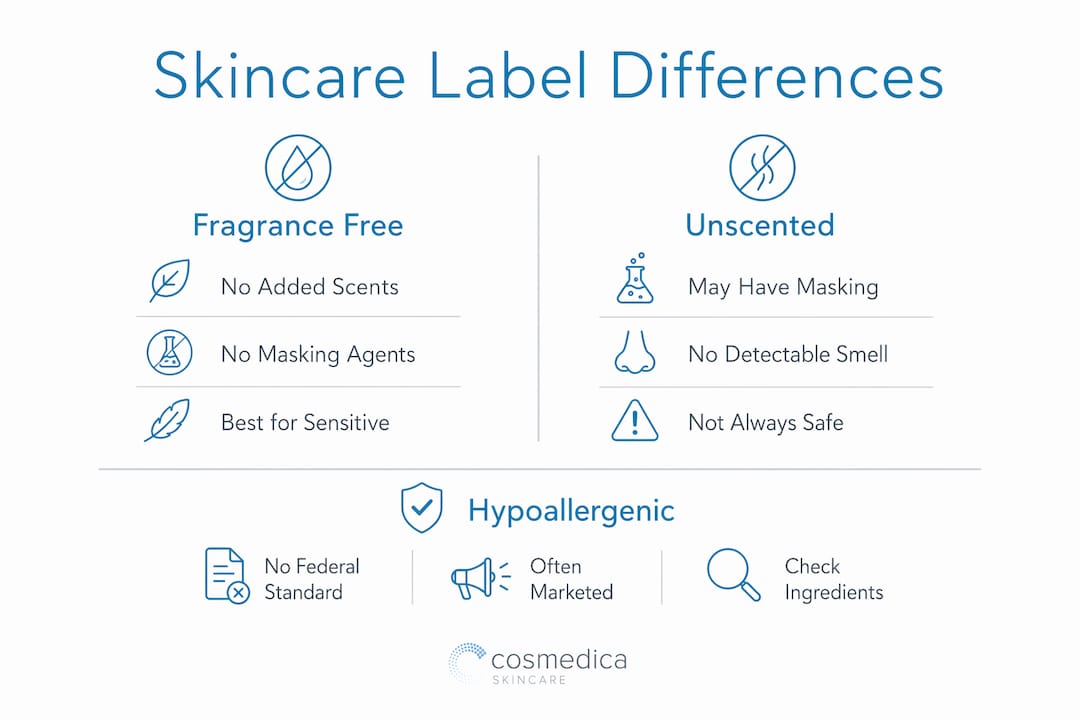
Fragrance free means no fragrance ingredients were added to the formula. The product may still have a faint natural scent from its base ingredients, but nothing was added to create or mask a smell.
Unscented does not mean fragrance free. Unscented products may contain masking fragrances that neutralize the natural odor of other ingredients. Those masking agents are still fragrance chemicals. They carry the same allergens as added perfumes and can trigger contact dermatitis in sensitive skin. Think of it like this: the product smells like nothing, but it got there using chemicals your skin may still react to.
Hypoallergenic is the loosest claim of all. The FDA states no federal standards exist for “hypoallergenic” in cosmetic labeling. A brand can call any product hypoallergenic without removing fragrance or proving reduced allergen risk. The label signals marketing intent, not a verified formulation standard.
| Label | Contains added fragrance? | Contains masking agents? | Federally regulated? |
|---|---|---|---|
| Fragrance free | No | No | No universal standard |
| Unscented | Possibly | Often yes | No |
| Hypoallergenic | Possibly | Possibly | No |
The American Academy of Dermatology recommends fragrance free products specifically for people with eczema and allergic contact dermatitis. The AAD guidance is explicit: “fragrance free” is the preferred label, not “unscented” or “hypoallergenic.”
Pro Tip: When shopping for sensitive skin, flip the bottle and read the INCI ingredient list before trusting any front-label claim. The ingredient list is the only reliable source of truth.
Why do fragrance free skincare benefits matter for sensitive skin?
Fragrance is one of the most common causes of allergic contact dermatitis in cosmetic products. When fragrance compounds contact reactive skin, they can trigger redness, itching, swelling, and a breakdown of the skin’s lipid barrier. That barrier is your skin’s first line of defense against environmental irritants and moisture loss. Damage it repeatedly, and your skin becomes more reactive over time, not less.
Fragrance free skincare avoids both synthetic and natural scent additives to minimize irritation and support the skin barrier. Products built on this principle typically feature soothing, barrier-supporting ingredients like ceramides and niacinamide instead of volatile fragrance compounds. Ceramides replenish the lipid layer that holds moisture in. Niacinamide calms redness and strengthens the barrier over time.
The benefits of fragrance free skincare for sensitive or allergy-prone skin include:
- Reduced redness and flushing. Removing fragrance eliminates a primary chemical trigger for vascular reactions in reactive skin.
- Less itching and stinging. Fragrance compounds are among the most common contact allergens, and cutting them out lowers the overall allergen load on your skin.
- Improved skin barrier function. Without repeated chemical insults from fragrance, the lipid barrier can repair and maintain itself more effectively.
- Lower risk of sensitization. Repeated exposure to fragrance chemicals can cause your immune system to develop a new allergy over time. Fragrance free products reduce that cumulative risk.
- Safer post-procedure use. After chemical peels, laser treatments, or microneedling, the skin barrier is temporarily compromised. Fragrance free formulas are the safest choice during recovery.
“Fragrance can improve sensory experience and adherence to a skincare routine, but it is not advisable for compromised or sensitive skin due to cumulative irritation risks. The trade-off between enjoyment and physiological safety is real, and for reactive skin, safety wins.”
Dermatologist perspective via Vogue
The key insight here is that fragrance serves your nose, not your skin. For people without skin sensitivities, that trade-off may feel acceptable. For anyone managing a reactive skin condition, it is a trade-off worth skipping entirely.
How do you identify truly fragrance free skincare products?
Reading the front label is not enough. Because no binding global standard defines “fragrance free,” the only reliable method is reading the full INCI ingredient list on the back of the product. Reading the full INCI list is the most reliable way to verify a product is genuinely fragrance free.
Here is a step-by-step approach to checking any product before you buy:
- Flip to the ingredient list. The INCI list is your primary tool. Front-label claims are marketing. The ingredient list is the formula.
- Search for “parfum” or “fragrance.” These are the two most common ways added fragrance appears on an ingredient list. Either word is a red flag for sensitive skin.
- Check for essential oils. Key fragrance-related ingredients include lavender oil, limonene, linalool, geraniol, and citronellol. These are naturally derived but still act as fragrance allergens. A product can be labeled fragrance free and still contain lavender oil.
- Watch for botanical extracts added for scent. Rose water, jasmine extract, and ylang-ylang are common examples. They smell pleasant and appear natural, but they carry fragrance compounds that can irritate reactive skin.
- Look up unfamiliar ingredient names. Databases like the EWG Skin Deep database or the CosDNA ingredient analyzer let you search any INCI name and see its known allergen or irritant flags.
- Cross-reference with a dermatologist-approved list. If you have a diagnosed condition like eczema or contact dermatitis, ask your dermatologist for a list of approved fragrance-free formulas. The AAD publishes general guidance on safe ingredient categories.
Pro Tip: Some fragrance compounds hide under the label “aroma” in natural or organic products. If you see “aroma” on an ingredient list, treat it the same way you would treat “parfum” and investigate further before using the product.
One more nuance worth knowing: a product can smell completely neutral and still contain masking fragrances. Masking fragrances in unscented products can trigger allergic contact dermatitis in the same way scented perfumes do. The absence of a noticeable smell does not confirm the absence of fragrance chemistry. This is why the INCI list check is non-negotiable for anyone with reactive skin. You can also find helpful guidance on avoiding harmful ingredients more broadly to build a safer routine from the ground up.
How to choose fragrance free products and build a sensitive skin routine
Choosing fragrance free products is the right starting point. Integrating them into a consistent routine is what actually moves the needle for your skin health.
Start by prioritizing fragrance free over unscented or hypoallergenic when those are your only options. If a product claims all three, verify the ingredient list anyway. Once you have confirmed a product is genuinely fragrance free, patch test it before applying it to your full face. Apply a small amount to the inside of your wrist or behind your ear, wait 24–48 hours, and check for any reaction. This step takes patience, but it saves you from a full-face flare-up.
When selecting fragrance free formulas, look for these skin-supporting ingredients:
- Ceramides. These lipids replenish the skin barrier and lock in moisture. They are especially valuable for eczema-prone skin.
- Niacinamide. A form of vitamin B3 that calms redness, reduces pore appearance, and strengthens the barrier. Cosmedica-skincare’s 10% Niacinamide + Zinc Treatment Serum is a good example of a targeted, fragrance free treatment built around this ingredient.
- Hyaluronic acid. A humectant that draws moisture into the skin. Think of it as a big drink of water for your epidermis. It works without any need for added fragrance.
- Colloidal oatmeal. Clinically proven to soothe irritated skin and reduce itching. A staple in fragrance free formulations for reactive skin types.
- Allantoin. A gentle skin-conditioning agent that promotes healing and reduces sensitivity.
Fragrance free formulas are available across every product category you need for a complete routine:
- Cleansers and micellar waters
- Toners and essences
- Serums and treatment concentrates
- Moisturizers and barrier creams
- Sunscreens (mineral formulas in particular)
- Eye creams and targeted treatments
- Face masks and overnight treatments
For anyone managing a reactive skin condition, a practical daily guide for sensitive skin can help you sequence these products correctly and avoid common layering mistakes that amplify irritation.
Key Takeaways
Fragrance free skincare is the most reliable choice for sensitive or allergy-prone skin because it removes the most common chemical trigger for contact dermatitis and barrier damage.
| Point | Details |
|---|---|
| Fragrance free means no added scent | No parfum, masking agents, or essential oils added for fragrance are present in the formula. |
| “Unscented” is not the same | Unscented products often contain masking fragrances that can still trigger allergic reactions. |
| “Hypoallergenic” has no legal standard | The FDA sets no federal requirement for this label, so it does not guarantee fragrance-free formulation. |
| Read the INCI list every time | Front-label claims are marketing. The ingredient list is the only reliable way to verify a product. |
| Barrier-supporting ingredients matter | Look for ceramides, niacinamide, and hyaluronic acid in fragrance free formulas to actively support skin health. |
Why I think most people are still getting this wrong
I have spent years watching people with genuinely reactive skin switch to “unscented” products and wonder why their skin is still flaring. The misunderstanding runs deep, and the beauty industry does not help. Brands know that “fragrance free” sounds clinical and “unscented” sounds clean and pleasant. So they lean into the latter, even when it is the worse choice for sensitive skin.
The part that surprises most people is the natural fragrance loophole. Someone with eczema switches to a “clean beauty” product packed with lavender oil, rose extract, and ylang-ylang. The label says no synthetic fragrance. Their skin still reacts. They blame their skin instead of the formula. Natural does not mean non-irritating. Limonene and linalool, both found in citrus and lavender, are among the most documented fragrance allergens in dermatology literature.
My honest advice: stop trusting the front of the bottle entirely. The INCI list is the only document that tells you what is actually in the product. If you cannot find it on the packaging, look it up on the brand’s website or a third-party ingredient database before you buy. This habit takes about 90 seconds and saves you weeks of skin recovery.
The other thing I want to push back on is the idea that fragrance free skincare has to feel boring or clinical. A well-formulated fragrance free serum or moisturizer can feel luxurious, absorb beautifully, and deliver real results. The absence of fragrance does not mean the absence of quality. It just means the formula is doing the work for your skin, not your nose.
— Thomas
Fragrance free skincare options from Cosmedica-skincare
Cosmedica-skincare formulates products with sensitive and reactive skin in mind. The range includes serums, moisturizers, and targeted treatments built around ingredients like niacinamide, hyaluronic acid, and ceramide-supporting compounds, without added fragrance chemicals. If you are building or refreshing a fragrance free routine, the fragrance free moisturizers collection is a practical starting point for daily hydration and barrier support. For a complete routine in one place, the full product range covers every step from cleansing to treatment. And if you are shopping for a gift for someone with sensitive skin, the skincare gift sets collection features curated options that take the guesswork out of finding safe, skin-friendly formulas.
FAQ
What does fragrance free mean on a skincare label?
Fragrance free means the product contains no added fragrance chemicals, including synthetic perfumes, essential oils used for scent, and masking agents. The product may still have a faint natural aroma from its base ingredients.
Is fragrance free better than unscented for sensitive skin?
Yes. The American Academy of Dermatology recommends fragrance free products over unscented ones for sensitive and eczema-prone skin because unscented products often contain masking fragrances that can still trigger allergic reactions.
Can a fragrance free product still irritate my skin?
Yes. A product labeled fragrance free may still contain botanical extracts or essential oils that carry fragrance compounds. Always read the full INCI ingredient list and patch test any new product before full use.
What ingredients should I avoid in fragrance free skincare?
Watch for “parfum,” “fragrance,” “aroma,” lavender oil, limonene, linalool, geraniol, and citronellol on ingredient lists. These are common fragrance allergens that can appear even in products marketed as fragrance free or natural.
Is hypoallergenic the same as fragrance free?
No. The FDA sets no federal standard for “hypoallergenic,” so the label does not guarantee a product is fragrance free or allergen-reduced. Always verify by reading the ingredient list directly.