

What Is Paraben Free Skincare? A Clear Guide
TL;DR:
- Paraben-free skincare products are formulated without synthetic preservatives like methylparaben, propylparaben, butylparaben, and ethylparaben. While parabens are considered safe at approved levels, some consumers prefer avoiding them due to concerns about hormone disruption and skin sensitivity, especially for reactive skin types. Choosing a safe paraben-free product requires understanding alternative preservatives and reviewing full ingredient lists for formula quality and transparency.
Paraben-free skincare is defined as cosmetic and personal care products formulated without synthetic parabens, the family of chemical preservatives that includes methylparaben, propylparaben, butylparaben, and ethylparaben. These four compounds have been the workhorses of cosmetic preservation for decades, keeping your moisturizer mold-free and your serum shelf-stable. Consumers increasingly seek out paraben-free products as a precautionary preference, even though the scientific evidence on hormone disruption remains inconclusive. Understanding what that label actually means, and what it does not mean, is the smartest first step you can take before rebuilding your routine.
What is paraben free skincare and why does it matter?
Paraben-free skincare refers specifically to formulas that exclude the synthetic paraben family as preservatives. The term is not a regulated safety certification. It is a formulation choice, and the quality behind that choice depends entirely on the manufacturer’s rigor.
Parabens appear on ingredient labels under names like methylparaben, propylparaben, butylparaben, and ethylparaben. The FDA requires explicit label listing of each paraben by its common name, so you can always spot them if you know what to look for. That transparency is genuinely useful.
The paraben-free movement grew out of a 2004 study that detected parabens in breast tissue samples. That finding triggered widespread concern about parabens acting as endocrine disruptors, meaning they might mimic estrogen in the body. The science since then has been mixed, and no regulatory body has banned parabens from cosmetics. Still, millions of consumers decided the precautionary principle was worth following, and the market responded.
Today, brands from large conglomerates to small indie labs market paraben-free lines. Cosmedica-skincare is one example of a brand that has built its entire formulation philosophy around clean, transparent ingredient lists. Understanding the science behind the label helps you shop with confidence rather than anxiety.
Why were parabens used in skincare products?
Parabens became the cosmetic industry’s default preservative for a straightforward reason: they work extremely well at very low concentrations. Think of them as a security system for your moisturizer, quietly blocking bacterial and fungal growth so the product stays safe from the day it is manufactured to the day you finish the jar.
Here is what parabens actually do inside a formula:
- Broad-spectrum protection: Parabens inhibit a wide range of bacteria, yeasts, and molds simultaneously.
- Low effective concentration: They work at concentrations as low as 0.01–0.3%, meaning formulators use very little to achieve full protection.
- Formula compatibility: Parabens are water-soluble and chemically stable across a wide pH range, making them easy to incorporate into serums, creams, and lotions.
- Long safety record: Parabens have been used safely as preservatives in cosmetics for over 80 years at regulated concentrations.
- Cost efficiency: They are inexpensive to produce, which historically kept product prices lower.
The FDA’s regulatory stance is that parabens are permissible in cosmetics at established concentrations. The agency does not classify them as hazardous at typical use levels. That 80-year track record is not nothing. It means generations of people used paraben-preserved products without documented systemic harm at the concentrations found in cosmetics.
The catch is that “no documented harm” is not the same as “proven completely safe for every individual.” Some people genuinely react to parabens with contact dermatitis or skin sensitivity. That distinction matters a lot when you are choosing products for reactive or compromised skin.
Are parabens actually harmful? what the science says
The honest answer is: it depends on who you ask and what kind of harm you mean. The FDA states there is no documented negative health effect in humans from parabens in cosmetics at approved concentrations. That is the regulatory bottom line, and it is based on decades of toxicology data.
The endocrine disruption concern centers on parabens’ weak estrogenic activity. In lab studies, parabens can bind to estrogen receptors, but their estrogenic potency is estimated to be 10,000 to 100,000 times weaker than the body’s own estrogen. That gap is significant. Eating a serving of flaxseeds exposes you to phytoestrogens with far stronger estrogenic activity than the parabens in your face cream.
“The greatest risk in paraben-free products is often not the absence of parabens themselves, but the potential for inadequate preservation when alternative systems are not properly validated.” — Dermatologist perspective via SANE MD
Where parabens do cause real, documented problems is in skin sensitivity and allergic contact dermatitis. A subset of people, particularly those with eczema, rosacea, or already-compromised skin barriers, react to parabens with redness, itching, or flare-ups. For these individuals, avoiding parabens is a practical, evidence-based decision rather than a precautionary one.
The National Eczema Association advises that people with eczema or rosacea should focus on the overall gentleness of a formula rather than fixating on any single ingredient. That is genuinely good advice. A paraben-free product loaded with fragrance, alcohol, or harsh exfoliants can be far more irritating than a well-formulated paraben-preserved cream.
Pro Tip: If you suspect parabens are triggering your skin reactions, do a structured elimination test. Remove one product at a time for two weeks and document your skin’s response. This is more reliable than switching your entire routine at once.
What do paraben-free products use instead?
All skincare products require preservatives to prevent contamination. Paraben-free does not equal preservative-free. That distinction is one of the most misunderstood points in the clean beauty conversation. A product without preservatives is not safer. It is a petri dish waiting to happen.
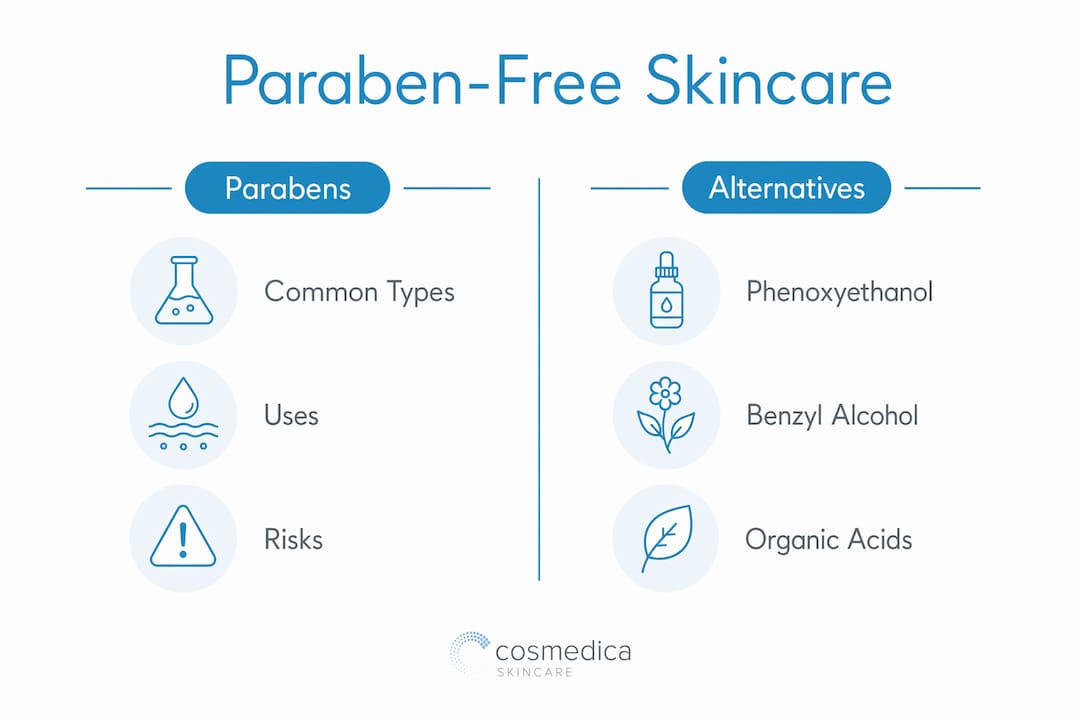
Common alternatives to parabens include phenoxyethanol, benzyl alcohol, and organic acids like sorbic acid and benzoic acid. Each comes with its own profile of benefits and potential drawbacks.
| Preservative | Efficacy | Safety Data History | Sensitization Risk |
|---|---|---|---|
| Methylparaben | High, broad-spectrum | 80+ years | Low to moderate |
| Phenoxyethanol | High, broad-spectrum | 30+ years | Low to moderate |
| Benzyl alcohol | Moderate | 40+ years | Moderate, especially at higher concentrations |
| Sorbic acid | Moderate, best at low pH | 50+ years | Low, but can cause reactions in some |
| Sodium benzoate | Moderate, pH-dependent | 50+ years | Low |
A few things stand out in that comparison. Phenoxyethanol is now the most common paraben replacement, and it performs well. But it has a shorter toxicology history than parabens, and some individuals with sensitive skin react to it. Switching to paraben-free products requires understanding that alternative preservatives may lack equally extensive toxicology data and could cause sensitivity in some users.
Here is what to watch for when evaluating paraben alternatives:
- Phenoxyethanol is generally well-tolerated but should be used at concentrations below 1%. Above that threshold, irritation risk increases.
- Benzyl alcohol can be drying and sensitizing at higher concentrations, particularly around the eye area.
- Organic acids like sorbic acid work best in acidic formulas. They lose effectiveness at higher pH levels, which limits their use in certain product types.
- Preservative blends often combine two or three agents at lower individual concentrations, which can reduce irritation risk while maintaining broad-spectrum protection.
Pro Tip: When you pick up a “natural” or “clean” product, check whether it contains a recognized preservative system. If the ingredient list has no preservative at all and the product is water-based, that is a red flag for microbial safety, not a green flag for purity.
Proper preservation science underpins all cosmetic safety, regardless of preservative type. Inadequate preservation poses the largest risk for skin irritation and health, not the presence of a well-studied preservative like methylparaben.
How to choose safe and effective paraben-free skincare
Choosing the right paraben-free products is less about avoiding one ingredient family and more about reading the full formula with informed eyes. Here is a practical, step-by-step approach.
-
Read the full ingredient list, not just the front label. The “paraben-free” claim on the front tells you what is absent. The ingredient list tells you what is present. Look for a recognized preservative system, quality active ingredients, and the absence of known irritants like synthetic fragrance or high-concentration alcohol.
-
Identify parabens by their chemical names. The FDA mandates explicit ingredient listing, so methylparaben, propylparaben, butylparaben, and ethylparaben will always appear by name if present. No guesswork required.
-
Match the formula to your skin type. Someone with oily, acne-prone skin needs a different preservative-free formula than someone with dry, sensitive skin. A lightweight niacinamide serum suits oily skin. A richer, ceramide-based cream suits dry or eczema-prone skin.
-
Patch test every new product. Apply a small amount to the inside of your wrist or behind your ear for 48–72 hours before using it on your face. This catches contact reactions before they become full-face flare-ups. Dermatologists recommend patch testing and gradual elimination for anyone with consistent skin reactions.
-
Introduce one new product at a time. Adding three new products simultaneously makes it impossible to identify which one caused a reaction. Wait two weeks between introductions.
-
Prioritize formula gentleness over preservative type. For eczema or rosacea, the National Eczema Association’s guidance is clear: overall formula gentleness matters more than the specific preservative used. A fragrance-free, dye-free, low-irritant formula is the goal, regardless of whether it contains parabens.
-
Look for brands with formulation transparency. Reputable paraben-free skincare brands publish their full ingredient lists, explain their preservation approach, and ideally have dermatologist-tested claims backed by clinical data. Cosmedica-skincare, for example, publishes complete ingredient lists and emphasizes cruelty-free, dermatologist-tested formulations across its product line. You can review our formulation philosophy to understand exactly what goes into each product.
-
Do not neglect sun protection. No preservative choice, paraben or otherwise, matters as much as daily broad-spectrum SPF. Sun damage is the leading driver of premature skin aging, and it is entirely preventable. A well-preserved paraben-free moisturizer with SPF 30 beats an unpreserved “clean” cream every single time.
Key takeaways
Paraben-free skincare is a formulation choice, not a safety guarantee, and the best products combine transparent ingredient lists with a validated, effective preservation system.
| Point | Details |
|---|---|
| Definition is specific | Paraben-free means no methylparaben, propylparaben, butylparaben, or ethylparaben in the formula. |
| FDA finds parabens safe | No documented negative health effects exist at approved cosmetic concentrations, per FDA guidance. |
| Alternatives carry trade-offs | Phenoxyethanol and benzyl alcohol replace parabens but have shorter safety histories and their own sensitization risks. |
| Preservation is non-negotiable | Every water-based skincare product needs a preservative system; paraben-free does not mean preservative-free. |
| Sensitive skin needs full-formula review | People with eczema or rosacea should prioritize overall formula gentleness, not just one ingredient’s absence. |
The paraben debate deserves more nuance than it gets
Here is my honest take after years of following ingredient science and watching the clean beauty conversation evolve: the paraben-free label has done more to generate anxiety than to improve skin health for most people.
Parabens are not the villain they were made out to be in the mid-2000s. The endocrine disruption concern was real enough to investigate, and scientists did investigate it. The conclusion, consistently, is that parabens at cosmetic concentrations do not pose a meaningful hormonal risk to humans. The estrogenic activity is too weak. The exposure is too low. The FDA’s position reflects that evidence, not industry lobbying.
What I find genuinely concerning is the opposite problem: products marketed as “clean” or “natural” that skip proper preservation entirely or use inadequate preservative systems. A contaminated moisturizer can cause serious skin infections. That risk is concrete and documented. The paraben risk, for most people, is theoretical.
That said, I do not dismiss individual sensitivity. If your skin consistently reacts to paraben-preserved products and clears up when you switch, that is real data about your skin. Personal reactivity is a legitimate reason to choose paraben-free formulas. It is just not a universal reason.
My advice: stop reading the front of the label and start reading the back. A product that says “paraben-free” in bold but lists synthetic fragrance as the fourth ingredient is not a skin health upgrade. Look for clean, well-formulated options that are transparent about their full ingredient list, not just the one thing they left out.
The best skincare routine is one built on stable, well-preserved formulas suited to your specific skin type, with daily SPF as the non-negotiable anchor. Whether those formulas contain parabens or not is, for most people, a secondary consideration.
— Thomas
Explore cosmedica-skincare’s paraben-free collection
Cosmedica-skincare formulates every product with full ingredient transparency and a commitment to cruelty-free, dermatologist-tested quality. Our paraben-free line covers everything from daily hydration to targeted treatments, all designed to work for sensitive, reactive, and all skin types. Whether you are looking for a paraben-free moisturizer to anchor your routine or a high-performance serum to address specific concerns, we have options built on real preservation science, not just clean-label marketing. Explore our complete product collection to find formulas that match your skin’s needs and your ingredient standards.
FAQ
What does “paraben-free” mean on a skincare label?
Paraben-free means the product contains none of the synthetic paraben preservatives, specifically methylparaben, propylparaben, butylparaben, or ethylparaben. The FDA requires these ingredients to be listed by name, so you can always verify the claim by reading the full ingredient list.
Is paraben-free skincare actually safer?
Not automatically. The FDA has found no documented negative health effects from parabens at approved cosmetic concentrations. Paraben-free products can still contain other preservatives that cause sensitivity, and poorly preserved products carry their own microbial risks.
What preservatives do paraben-free products use instead?
The most common alternatives are phenoxyethanol, benzyl alcohol, and organic acids like sorbic acid and sodium benzoate. Each has a different efficacy profile and sensitization risk, so no single alternative is universally superior to parabens.
Should people with eczema avoid parabens?
The National Eczema Association advises focusing on overall formula gentleness rather than avoiding any single ingredient. If your skin consistently reacts to paraben-containing products, switching makes sense, but fragrance and harsh actives are more common eczema triggers than parabens.
How do i spot parabens on an ingredient label?
Look for any ingredient ending in “-paraben,” such as methylparaben, propylparaben, butylparaben, or ethylparaben. The FDA mandates explicit listing by common name, so there is no hidden labeling to decode.