

Hydrate Oily Skin in 4–8 Weeks: Hyaluronic Acid That Adds No Oil
Hyaluronic acid is genuinely good for oily skin, as long as you reach for a lightweight, water-based formula and apply it the right way. It doesn’t add oil; it works as a humectant that pulls water into the skin, which is exactly what dehydrated, shine-prone skin is usually missing. The American Academy of Dermatology recommends moisturizing even oily, acne-prone skin, and that’s a habit worth borrowing.
TL;DR:
- Hyaluronic acid should be applied to damp skin after cleansing and followed by a lightweight moisturizer to maximize hydration and prevent tightness or tackiness.
- High molecular weight hyaluronic acid provides immediate surface plumping, while low molecular weight penetrates deeper for longer-lasting moisture; blends optimize both effects.
- Hyaluronic acid is non-comedogenic and unlikely to clog pores, but heavy oils or improper application can cause breakouts or irritation, especially if used on completely dry skin.
- Pair hyaluronic acid with niacinamide, ceramides, or glycerin for a hydrating, barrier-strengthening routine suited for oily skin, and skip heavy, oil-based products.
- Most effective routines involve lightweight serums, water-gel formulas, and non-oil sunscreens, with consistent use leading to hydration improvements within four to eight weeks.
Table of Contents
- Why Oily Skin Gets Dehydrated (Even Though It Looks Slick)
- How Do You Use Hyaluronic Acid on Oily Skin?
- Does Hyaluronic Acid Clog Pores or Cause Breakouts?
- What Pairs Well With Hyaluronic Acid for Oily Skin?
- What Does the Clinical Research Actually Show?
- Gel, Serum, or Cream: Which HA Formula Fits Oily Skin?
- Can Hyaluronic Acid Cause Side Effects on Acne-Prone Skin?
- Hyaluronic Acid vs. Other Hydrators: What Works Best for Oily Skin?
- Building a Complete Oily-Skin Routine Around Hyaluronic Acid
- A dermatology-minded approach to hyaluronic acid and oily skin
- Cosmedica-Skincare Options Built for Oily, Hydration-Hungry Skin
- Sources
- FAQ
Why Oily Skin Gets Dehydrated (Even Though It Looks Slick)
Here’s the thing nobody tells you at the beauty counter: oil and water are two totally different systems in your skin, and one can run dry while the other runs wild. Sebum is oil, produced by glands to protect your skin’s surface. Hydration is water, held mostly in the epidermis by natural humectants like hyaluronic acid. You can absolutely have plenty of one and not enough of the other.
When oily skin gets stripped of water (harsh cleansers, over-exfoliating, skipping moisturizer entirely), your skin doesn’t just sit there dry. It often ramps up oil production to compensate, a cycle sometimes called rebound oiliness. Dermatologists at Harvard Health note that treating this underlying dehydration with hyaluronic acid can calm inflammation and, indirectly, take some pressure off breakout-prone skin.
Hyaluronic acid works as a humectant, meaning it acts like a sponge that grabs water molecules from the air and deeper skin layers and holds them at the surface. It doesn’t moisturize by sealing in oil the way a heavy cream does. It hydrates by attracting and trapping water, which is why it layers so well under other products without feeling greasy.
Molecular weight matters here more than most product labels admit:
- High molecular weight HA sits on the surface, plumps skin instantly, and creates that immediate “bounce back” feel.
- Low molecular weight HA penetrates deeper into the epidermis for longer-lasting hydration.
- Multi-weight HA blends combine both effects, which is why many serums list several types of hyaluronic acid on the label.
This guide focuses on topical hyaluronic acid, the kind you apply directly to skin. Oral hyaluronic acid supplements exist and one 12-week trial reported improved hydration and reduced sebum with oral sodium hyaluronate compared to placebo, but that’s a separate evidence stream with its own dosing questions, not what this article covers.
How Do You Use Hyaluronic Acid on Oily Skin?
Getting the order and timing right matters more than the product itself. Apply hyaluronic acid to damp skin, not dry skin, and not sopping wet skin either. The AAD’s own guidance on applying moisturizer to damp skin explains that this traps water at the surface instead of letting it evaporate, which is the whole point of using a humectant in the first place.
Here’s a simple, repeatable sequence:
- Cleanse with a gentle, oil-free cleanser. Skip anything that leaves your skin feeling tight or squeaky.
- Tone (optional) if you use a hydrating or balancing toner.
- Apply hyaluronic acid to damp skin, right after cleansing, while there’s still a little moisture on the surface.
- Follow with a lightweight moisturizer to lock the hydration in. This step is not optional for oily skin, even though it feels backward.
- Apply sunscreen in the morning as your final step.
Morning routine: cleanse, hyaluronic acid on damp skin, lightweight gel moisturizer, oil-free sunscreen.
Evening routine: cleanse (double cleanse if you wore sunscreen or makeup), any treatment actives like retinol or a spot treatment, hyaluronic acid on damp skin, lightweight moisturizer.
A few practical notes on frequency and amount: most people do fine using hyaluronic acid serum once or twice daily, morning and night. A pea-sized amount is enough for the whole face. There’s no benefit to piling it on, and applying too much to already-dry skin can occasionally leave a slightly tacky feel until it’s sealed in with moisturizer.
Patch-test any new serum on your inner forearm for 24 hours before applying it to your face, especially if you’re also using acne treatments like benzoyl peroxide or prescription retinoids, since combining actives can sometimes increase sensitivity.

Pro Tip: If your HA serum ever feels sticky or tight instead of dewy, your air is probably too dry for it to pull moisture from. Mist your face with water first, then apply the serum while skin is still damp, and seal it with moisturizer right after.
For a deeper walkthrough of layering order, how to use hyaluronic acid for maximum results covers the nuances that matter most for hydration-focused routines.
Does Hyaluronic Acid Clog Pores or Cause Breakouts?
Short answer: no, not on its own. Hyaluronic acid has no known mechanism for blocking pores, and clinical literature describes it as well tolerated and non-irritating even in people with sensitive or acne-prone skin. If you’ve broken out after starting an HA serum, the actual culprit is usually somewhere else in the bottle.
Common real causes of clogged pores that get blamed on hyaluronic acid:
- Heavy oils or occlusive waxes blended into the same serum or moisturizer.
- Fragrance or comedogenic thickeners used as filler ingredients.
- Not cleansing thoroughly enough before layering multiple products.
- Applying HA to already very dry skin without sealing it with moisturizer, which can temporarily worsen tightness.
Overuse is rare but real. Applying too much serum in a very dry climate, or skipping the moisturizer step, can pull water toward the skin surface and then let it evaporate right back out, leaving skin feeling worse than before. Humidity levels genuinely affect how HA performs. In a dry room or during winter, it needs a moisturizer on top to function properly.
If breakouts continue after a few weeks despite ruling out other products, or if you notice persistent redness, stinging, or bumps, stop use and check in with a board-certified dermatologist rather than guessing. Our breakdown of whether hyaluronic acid causes acne digs deeper into the evidence if you want the full picture.
What Pairs Well With Hyaluronic Acid for Oily Skin?
Hyaluronic acid does one job exceptionally well: hydration. It’s not designed to control oil, so pairing it with actives that address sebum and texture rounds out an oily-skin routine.
Niacinamide is the standout partner. Clinical and practitioner guidance describes niacinamide and HA as complementary rather than competing, with niacinamide supporting oil balance and barrier strength while HA handles water content. Other useful additions include:
- Ceramides, which reinforce the skin barrier without adding heaviness.
- Glycerin, a lighter secondary humectant that boosts HA’s water-holding power.
- Dimethicone, a silicone that gives a smooth, mattified finish without clogging pores.
What to skip, at least during the day: heavy plant oils, thick occlusive balms, and anything marketed as “ultra-nourishing” without an oil-free label. Check ingredient lists for “oil-free” and “non-comedogenic,” and treat those two phrases as your baseline filter when shopping.
Two formulation types work particularly well for oily skin:
- Water-gel formulas, which feel almost weightless and absorb in seconds.
- Gel-creams, slightly richer than a pure gel but still oil-free, good for combination skin that gets dry in patches.
A simple integrated routine might look like this: cleanse, apply an HA serum on damp skin, follow with a niacinamide-infused water-gel moisturizer, then sunscreen in the morning. That’s three steps doing three separate jobs: cleansing, hydrating, and balancing, without a single heavy or pore-clogging step in the mix.
What Does the Clinical Research Actually Show?
The American Academy of Dermatology advises moisturizing even when skin is oily or acne-prone, because appropriate, oil-free, non-comedogenic moisturizers can reduce acne severity within four to eight weeks by preventing the rebound oil production that happens when skin gets stripped and overcompensates.
The clinical data on topical HA backs this up with real numbers. A 2024 study on topical nano-hyaluronic acid found consistent use produced hydration improvements of up to 96% after eight weeks, with no signs of irritation or pore obstruction.
By the numbers: In an open-label multicenter evaluation of a topical high-molecular-weight HA serum, researchers documented statistically significant improvements (p < 0.0001) in hydration, texture, and redness at both the four-week and eight-week marks, with zero reported HA-related adverse events.
That timeline matters for setting expectations. Most people notice a hydration difference within days, but visible improvements to texture and tone build over four to eight weeks of consistent use, which lines up almost exactly with how long dermatologists say it takes non-comedogenic moisturizers to calm oily, acne-prone skin.
Gel, Serum, or Cream: Which HA Formula Fits Oily Skin?
Formulation matters as much as the ingredient list. Not every “hyaluronic acid product” is built the same way, and oily skin responds very differently to each texture.
Serums are the most concentrated delivery method and usually the best starting point. A water-based hyaluronic acid face serum absorbs quickly, layers under other products without pilling, and typically skips the heavier emollients found in creams.
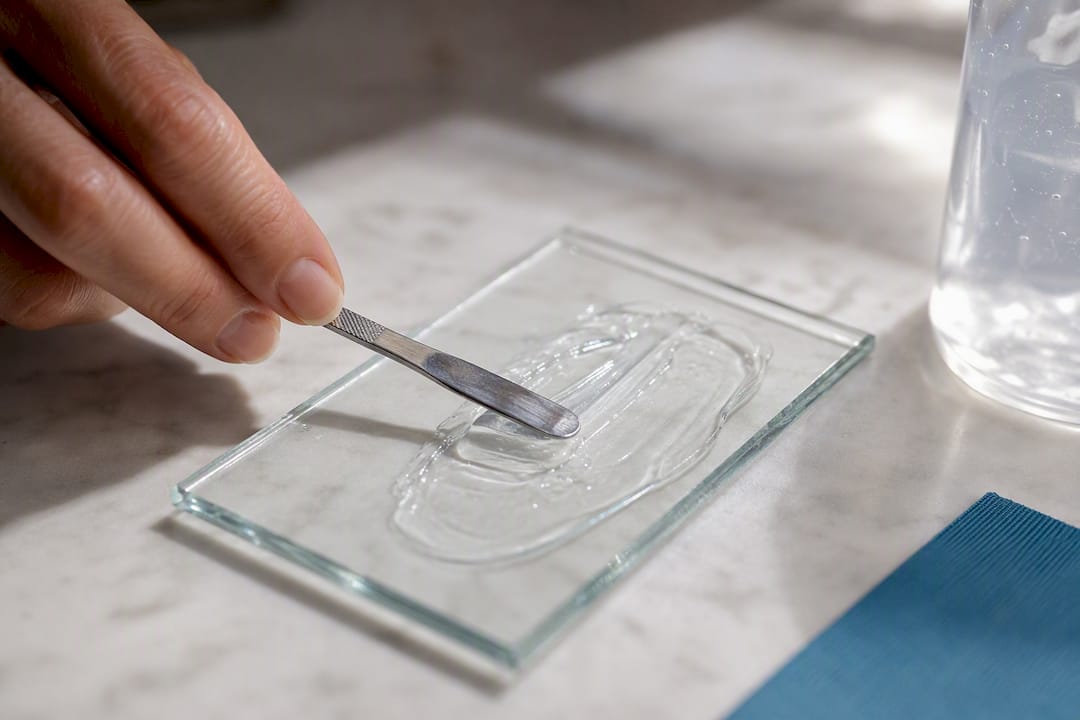
Gels take that a step further with an even lighter, almost bouncy texture. Water-gel HA products are popular in humid climates or for anyone who breaks out easily, since they tend to contain fewer thickening agents.
Creams, even hyaluronic acid ones, usually include added emollients or occlusives to create that creamy texture, which is exactly the trait oily skin wants to avoid during the day. A cream-based HA product can still work at night, especially in a dry climate or during winter months when skin needs more support.
A quick way to shop: check the ingredient list for where hyaluronic acid falls relative to oils and butters. If shea butter, mineral oil, or heavy plant oils rank high on the list, that product is built for dry skin, not yours. Look instead for labels that explicitly say “oil-free,” “non-comedogenic,” or “for oily/combination skin,” and favor water or gel as the first listed ingredient over oil-based bases.
Can Hyaluronic Acid Cause Side Effects on Acne-Prone Skin?
Hyaluronic acid itself has one of the cleanest safety profiles of any hydrating ingredient, but that doesn’t mean every reaction you might experience is unrelated to the product.
Mild tackiness right after application is the most common complaint, and it usually means the serum was applied to dry skin without a moisturizer on top to seal it. Redness or stinging is less common and more often traced to a different ingredient in the formula, like fragrance, alcohol, or an acid pairing (glycolic, salicylic) used too aggressively alongside HA.
Breakout flare-ups are almost never caused by hyaluronic acid directly, since it has no comedogenic mechanism. They’re far more likely tied to layering too many active ingredients at once, which can compromise the skin barrier and trigger congestion that looks like an HA reaction but isn’t.
If you’re using prescription treatments like tretinoin or oral isotretinoin, hyaluronic acid is generally considered safe to layer underneath, since it helps offset the dryness those treatments cause. Still, introduce it gradually. Add hyaluronic acid to your routine once daily for a week before moving to twice-daily use, and always patch-test a new formula for 24 hours first. If irritation persists past two weeks, that’s your signal to stop and check with a dermatologist rather than push through it.
Hyaluronic Acid vs. Other Hydrators: What Works Best for Oily Skin?
Hyaluronic acid isn’t the only hydrating ingredient on the shelf, and knowing how it stacks up against the alternatives helps you build a smarter routine instead of a crowded one.
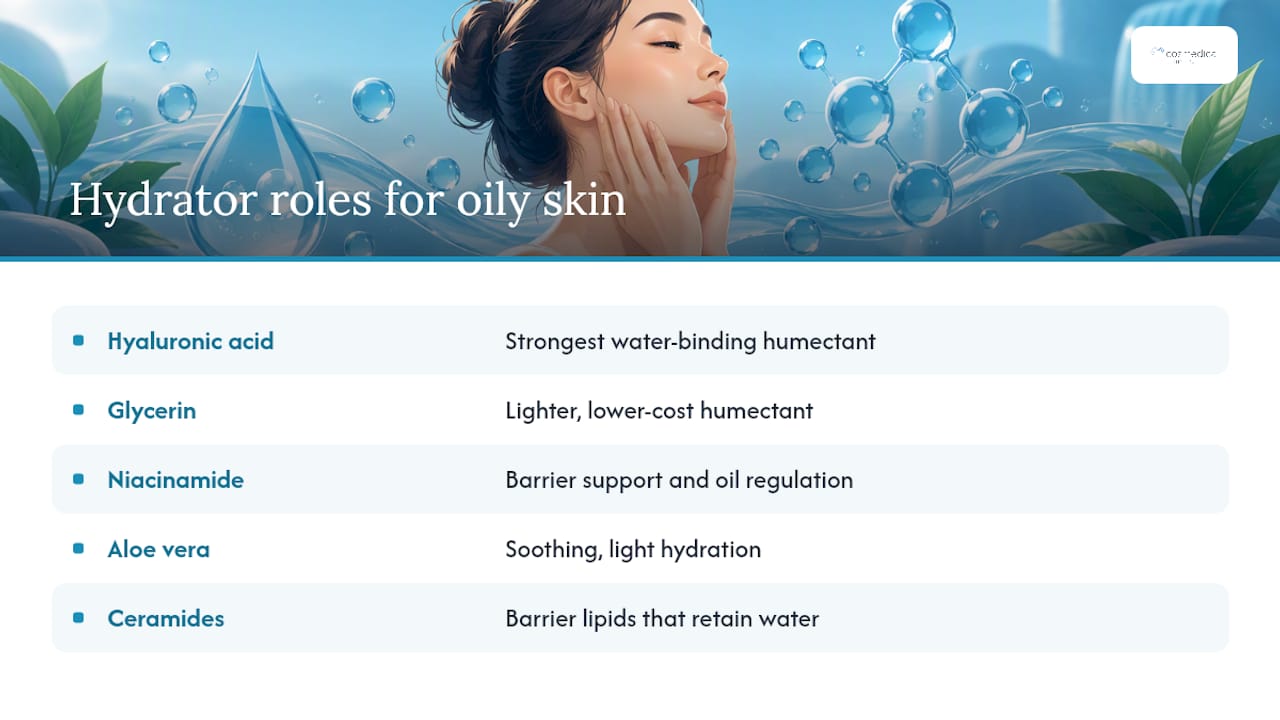
Glycerin is a smaller, lighter humectant that works similarly to HA but at a lower cost and with a slightly different feel. It’s often used as a supporting ingredient rather than the star.
Niacinamide isn’t a humectant at all. It’s a vitamin B3 derivative that supports the skin barrier and helps regulate oil production, which is exactly why it’s a better oil-control tool than a hydration one. Most dermatology-aligned guidance treats HA and niacinamide as teammates rather than rivals, since one hydrates and the other balances.
Aloe vera offers light, soothing hydration and works well for sensitive or irritated oily skin, though its water-holding capacity is nowhere near HA’s.
Ceramides aren’t humectants either; they’re barrier-repair lipids that help skin hold onto the water HA pulls in. Using ceramides without a humectant is like building a wall with nothing behind it.
If you’re choosing one ingredient to build a routine around, hyaluronic acid remains the strongest option purely for water-binding capacity. The smartest oily-skin routines don’t pick one winner. They pair HA’s hydration with niacinamide’s oil regulation and a touch of ceramide for barrier support.
Building a Complete Oily-Skin Routine Around Hyaluronic Acid
Hyaluronic acid works best as the middle step in a routine, not a stand-alone fix. Cleansing, exfoliating, and moisturizing all affect how well it performs.
Start with a gentle, oil-free cleanser both morning and night. Avoid anything that strips skin to the point of feeling tight, since that tightness often triggers the oil rebound cycle mentioned earlier. Exfoliation matters too, but timing is everything: use a chemical exfoliant like salicylic acid two to three times a week, on nights when you’re not also introducing a new active, and never apply hyaluronic acid immediately after a strong acid exfoliant without giving skin a few minutes to settle.
A realistic full routine looks like this:
- Morning: oil-free cleanser, hyaluronic acid serum on damp skin, lightweight moisturizer, oil-free sunscreen.
- Evening (exfoliation night): double cleanse, salicylic acid exfoliant, wait 10 to 15 minutes, hyaluronic acid on damp skin, lightweight moisturizer.
- Evening (non-exfoliation night): double cleanse, treatment serum if used, hyaluronic acid on damp skin, lightweight moisturizer.
This structure keeps hydration constant while giving exfoliation and treatment actives their own space to work without overwhelming the skin barrier. For more on where HA fits relative to wet or dry application, see this breakdown of applying hyaluronic acid on damp skin.
A dermatology-minded approach to hyaluronic acid and oily skin
We’d rather you treat your skin like a small experiment than a guessing game. Patch-test any new hyaluronic acid product, introduce it once daily for about a week, and only then move to twice-daily use once you know how your skin responds.
Some hyaluronic acid serums are formulated to be lightweight and dermatologist-tested, designed for a controlled, gradual approach rather than a “more is better” mindset.
[author_bio placeholder] [brand_signal placeholder]
— Thomas
Cosmedica-Skincare Options Built for Oily, Hydration-Hungry Skin
If you’ve read this far, you already know the real goal isn’t finding the “strongest” hyaluronic acid product. It’s finding one light enough to layer without feeding the oil cycle you’re trying to break. That’s the gap Some skincare lineups for oily skin are built to close this gap: formulas made to hydrate without heavy, pore-clogging bases found in richer creams.
The lineup includes lightweight hyaluronic acid serums, water-gel moisturizers built for combination and oily skin, and oil-free sunscreens to round out a morning routine. Every product is cruelty-free, dermatologist-tested, and formulated to be non-comedogenic, so you’re not trading hydration for congestion.
If you want to test the full routine at once rather than buying pieces separately, the Super Serum Set bundles complementary serums together at a lower combined cost than buying each on its own. Browse the full Cosmedica-skincare lineup to find the combination that fits your skin’s current needs, and start with one new product at a time so you can actually see what’s working.
This article is general information, not a substitute for advice from a qualified doctor. Consult a qualified healthcare professional about your own circumstances before acting on anything here.
Sources
- Moisturizer: Why you may need it if you have acne — American Academy of Dermatology
- Multicenter evaluation of a topical hyaluronic acid serum — PubMed
- Benefits of topical hyaluronic acid for skin quality and signs of skin aging: From literature review to clinical evidence — PMC
- Randomized trial evaluating oral sodium hyaluronate effects on skin parameters — PubMed
FAQ
Which is better for oily skin, hyaluronic acid or niacinamide?
They solve different problems, so “better” depends on your goal. Hyaluronic acid hydrates by pulling in water, while niacinamide helps regulate oil and support the skin barrier, and dermatology-aligned guidance treats them as complementary rather than competing ingredients. Most oily-skin routines benefit from using both together.
Is hyaluronic acid good for oily, acne-prone skin?
Yes. Hyaluronic acid is non-comedogenic and well tolerated even in acne-prone skin, and the AAD specifically recommends moisturizing oily, acne-prone skin to prevent the rebound oiliness that happens when skin gets stripped. Choose an oil-free, non-comedogenic formula and apply it on damp skin for the best results.
Can you overuse hyaluronic acid on your face?
You can use more than your skin needs, though true overuse is rare. Applying too much in a dry environment without a moisturizer on top can pull moisture to the surface and let it evaporate, leaving skin feeling tighter than before. A pea-sized amount once or twice daily, sealed with a lightweight moisturizer, is enough for most people.
What type of acid is good for oily skin?
Hyaluronic acid is the go-to hydrating acid because it adds water without oil, while salicylic acid is the preferred exfoliating acid because it gets into pores and helps clear excess oil and dead skin cells. Using both, hyaluronic acid for hydration and salicylic acid two to three times a week for exfoliation, covers the two biggest needs oily skin has.
Does Cosmedica-skincare make hyaluronic acid products for oily skin?
Yes. Cosmedica-skincare offers lightweight, oil-free hyaluronic acid serums and water-gel moisturizers formulated to be non-comedogenic and dermatologist-tested. Current pricing and product details are available on the Cosmedica-skincare site.