

Oily Skin Routine: AM & PM Steps That Reduce Shine
A solid oily skin routine looks like this: AM — gentle foaming or gel cleanser → lightweight treatment serum (niacinamide or low-dose salicylic acid) → oil-free, non-comedogenic moisturizer with broad-spectrum SPF 30+. PM — gentle cleanser → targeted active (salicylic acid, retinoid, or benzoyl peroxide) → lightweight moisturizer. That’s it. No complicated 10-step system required.
The dermatologist-recommended actives worth knowing:
- Salicylic acid (BHA): exfoliates inside pores, reduces blackheads and surface oil
- Niacinamide: regulates sebum, calms redness, strengthens the skin barrier
- Benzoyl peroxide: kills acne-causing bacteria, best for inflammatory breakouts
- Retinoids: normalize cell turnover, reduce comedones, improve texture over time
- Azelaic acid: targets post-acne marks and works well for sensitive oily skin
Look for labels that say non-comedogenic, oil-free, and fragrance-free when shopping. The American Academy of Dermatology (AAD) and PubMed clinical reviews back the steps and actives covered throughout this guide.
Key Takeaways
A consistent oily skin routine built around gentle cleansing, a niacinamide or salicylic acid treatment, and a non-comedogenic SPF moisturizer delivers visible shine reduction within days and meaningful acne improvement within 8–12 weeks.
| Point | Details |
|---|---|
| AM routine core | Gentle cleanser, niacinamide serum, and oil-free SPF 30+ moisturizer every morning. |
| PM routine core | Cleanse, then apply salicylic acid or retinoid; follow with a lightweight moisturizer. |
| Top actives | Niacinamide, salicylic acid, benzoyl peroxide, and retinoids are the most evidence-backed choices. |
| Timeline to results | Shine control can improve relatively quickly; acne clearance generally requires several weeks of consistent use. |
| Cosmedica-skincare fit | Cruelty-free serums, gel moisturizers, and face masks map directly to each routine step. |
Table of Contents
- What does a morning oily skin routine actually look like?
- How should your nighttime routine for oily skin be structured?
- What if you have acne on top of oily skin?
- Which ingredients actually work for oily and acne-prone skin?
- What common mistakes make oily skin worse?
- How long does it take to see results, and what does a basic routine cost?
- Why does oily skin happen, and what does the science say?
- What we’ve learned from years of formulating for oily skin
- Cosmedica-skincare products that complete your oily skin routine
- Sources
- FAQ
What does a morning oily skin routine actually look like?
The AM routine has one job: control oil production before it starts, protect your barrier, and lock in SPF without clogging pores. Here’s how each step earns its place.
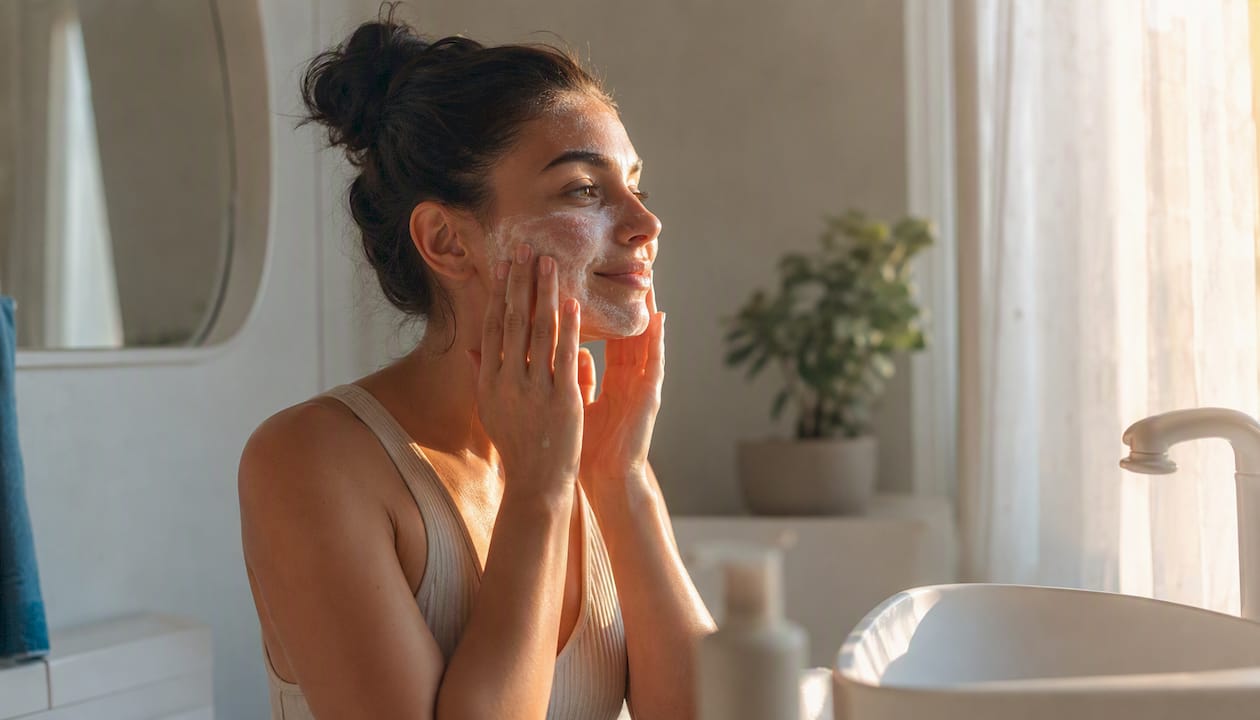
Step 1: Cleanse (60 seconds, fingertips only)
Reach for a gentle foaming or gel cleanser. Avoid anything with gritty beads or a “deep-cleaning” scrub texture. The AAD specifically warns that harsh, stripping cleansers can trigger compensatory oil production and inflammation, making shine worse by midday. Lukewarm water, fingertips, 60 seconds — that’s the formula.
Step 2: Toner (optional but useful)
If you use a toner, keep it alcohol-free. Alcohol-based toners strip the barrier and cause the same rebound oiliness problem as harsh cleansers. A gentle, alcohol-free toner with niacinamide or witch hazel extract can help tighten the look of pores and prep skin for the next step without irritating it.
Step 3: Treatment serum
This is where niacinamide shines.
Step 4: Moisturizer with SPF 30+
Skipping moisturizer because your skin is already oily is one of the most common mistakes we see. When your skin is dehydrated, it produces more sebum to compensate. Choose a water-based gel or fluid formula labeled non-comedogenic. For daytime, a moisturizer that includes broad-spectrum SPF 30+ is ideal. If you prefer a separate sunscreen, mineral formulas (zinc oxide, titanium dioxide) tend to sit matte on oily skin.
Apply about a nickel-sized amount of sunscreen to your face and neck. If you’re outdoors, reapply every two hours. A mattifying primer over SPF can extend that matte finish through the day.
Pro Tip: For midday shine control, press a blotting paper against oily areas and hold for a few seconds. Don’t rub or wipe — that spreads oil and bacteria to cleaner areas of your face. A light dusting of translucent powder over blotted skin works even better.
Seasonal note: In humid climates, a lightweight gel moisturizer with SPF is usually enough. In dry, cold weather, you may need a slightly richer (but still non-comedogenic) formula to prevent the barrier from drying out and triggering more oil.
How should your nighttime routine for oily skin be structured?
The PM routine is where the real work happens. Actives like retinoids and chemical exfoliants work best overnight, and your skin’s repair cycle peaks while you sleep. Follow this order:
- Remove makeup first. Use a gentle micellar water or cleansing balm to dissolve makeup before your main cleanse. Never go to sleep with makeup on — it mixes with sebum and clogs pores overnight.
- Cleanse with your gentle gel or foaming cleanser. Same product as the morning, same fingertip technique. Washing more than twice a day strips the barrier and worsens oil production.
-
Apply your targeted active. This is the step that changes based on your skin’s needs and where you are in your routine:
- Salicylic acid (BHA): Use 2–3 times per week if you’re new to it, or daily at a low dose (0.5%) once your skin is comfortable. It dissolves the oil and dead skin inside pores.
- AHAs (glycolic or lactic acid): Best for surface texture and post-acne marks. Use 1–2 times per week, not on the same nights as salicylic acid at first.
- Retinoid: Start with a low-strength retinol (0.025–0.1%) two nights per week. Apply a thin layer to dry skin. If irritation appears, “buffer” it by applying your moisturizer first, then the retinoid on top.
- Apply a lightweight moisturizer. Even with actives in play, your skin needs hydration at night. A gel-cream or water-gel formula with hyaluronic acid or ceramides works well without adding heaviness.
Combining actives safely: Don’t layer benzoyl peroxide and a retinoid on the same night when you’re just starting out. They can deactivate each other and cause significant irritation. Alternate nights until your skin has adjusted over four to six weeks.
Patch test everything new. Apply a small amount to your inner arm or behind your ear for 24–48 hours before using it on your face. If you notice redness, burning, or peeling beyond mild flaking, scale back frequency before stopping entirely.
What if you have acne on top of oily skin?
Oily skin and acne often travel together, but they need slightly different treatment strategies. Here’s how to think about adding acne-specific actives to your routine.
Benzoyl peroxide is the go-to for inflamed, red pimples. Lower concentrations of benzoyl peroxide can be effective with potentially reduced irritation compared to higher strengths. Use it as a spot treatment or thin layer on breakout-prone areas in your PM routine.
Topical retinoids are the workhorse for comedonal acne (blackheads and whiteheads). They normalize how skin cells shed, preventing the buildup that clogs pores. AAD guidance confirms that retinoids, benzoyl peroxide, and topical antibiotics are among the most effective options, with visible improvement typically taking several weeks to a few months of consistent use.
Salicylic acid handles pore exfoliation and is a solid daily option at low doses.
Topical antibiotics (like clindamycin) are only appropriate under a clinician’s guidance. They’re typically paired with benzoyl peroxide to reduce the risk of antibiotic resistance.
Pro Tip: Take a photo of your skin in the same lighting every two weeks. Progress with acne treatments is slow and easy to miss day-to-day. Photos make the improvement visible and help you decide whether to stay the course or consult a dermatologist.
When to see a dermatologist: If your acne is leaving scars, involves deep painful cysts, or hasn’t improved after 10–12 weeks of consistent OTC treatment, book an appointment. Prescription options like spironolactone, oral contraceptives, or isotretinoin can significantly reduce sebum and clear acne, but they require clinician oversight because each carries a distinct side-effect profile. A broad review of treatment options confirms that systemic and procedural treatments exist and work, but choosing among them needs professional input.
Which ingredients actually work for oily and acne-prone skin?
Here’s a practical reference you can use while reading product labels. Each ingredient below targets a specific problem, and knowing when to use it saves you from buying things that overlap or conflict.
| Ingredient | Primary action | When to use |
|---|---|---|
| Salicylic acid (BHA) | Exfoliates inside pores, reduces blackheads | AM or PM, 2–3x/week to daily (low dose) |
| Niacinamide | Regulates sebum, calms redness, strengthens barrier | AM and/or PM, daily |
| Benzoyl peroxide | Kills acne bacteria, reduces inflammatory lesions | PM, 2–3x/week or as spot treatment |
| Retinoids (retinol/tretinoin) | Normalizes cell turnover, reduces comedones | PM only, 2–3x/week to start |
| Azelaic acid | Fades post-acne marks, gentle for sensitive oily skin | AM or PM, daily |
| AHAs (glycolic, lactic acid) | Surface exfoliation, improves texture | PM, 1–2x/week |
| Clay/charcoal (masks) | Absorbs excess surface oil, draws out impurities | Weekly mask, not daily |
| Hyaluronic acid | Lightweight humectant, draws water into skin | AM and PM, daily |
Label-reading shortcuts:
- Non-comedogenic means the formula was tested to minimize pore-clogging. It’s not a regulated term, but it’s still a useful filter when comparing products.
- Oil-free means no added oils in the formula. Good for moisturizers and sunscreens on oily skin.
- Fragrance-free matters if your skin is reactive. Synthetic fragrance is one of the most common irritants in skincare.
What to avoid in toners: alcohol denat (ethanol listed high in the ingredients) strips the barrier fast. Witch hazel extract in low concentrations is generally fine; pure alcohol is not.
Heavy occlusives like petrolatum or mineral oil sit on top of the skin and can trap sebum in pores. Save those for very dry patches or lip care, not your full face.
Cosmedica-skincare’s serum collection includes niacinamide and lightweight hydrating serums that map directly to the treatment step in both the AM and PM routines.
What common mistakes make oily skin worse?
A few habits that seem logical actually backfire badly on oily skin. Here’s what to stop doing, and what to do instead.
- Over-washing your face. Washing three or four times a day strips your barrier, which signals your sebaceous glands to produce more oil. Twice daily is the sweet spot, per AAD behavioral guidance.
- Using abrasive scrubs. Physical scrubs with rough particles increase inflammation in oily and acne-prone skin, which worsens both conditions. Chemical exfoliants (salicylic acid, AHAs) do the job without the mechanical damage. For guidance on gentle exfoliation that won’t aggravate breakouts, look for enzyme-based or low-acid options.
- Skipping moisturizer. Already covered above, but worth repeating: dehydrated skin produces more oil, not less.
- Sleeping in makeup. Makeup mixed with overnight sebum is a reliable recipe for clogged pores and breakouts. Remove it every single night.
- Using heavy, oil-based creams. Rich creams formulated for dry skin can sit on oily skin and block pores. Stick to gel-creams, water-gels, or fluid lotions.
- Picking or squeezing breakouts. This pushes bacteria deeper, increases inflammation, and raises the risk of scarring.
Hair and makeup tips: Keep hair clean, especially if it’s naturally oily. Hair touching your face transfers oil and product residue to your skin. For makeup, choose water-based or powder foundations labeled non-comedogenic. Remove makeup with a gentle micellar water before cleansing, never with a rough wipe or scrubbing motion.
How long does it take to see results, and what does a basic routine cost?
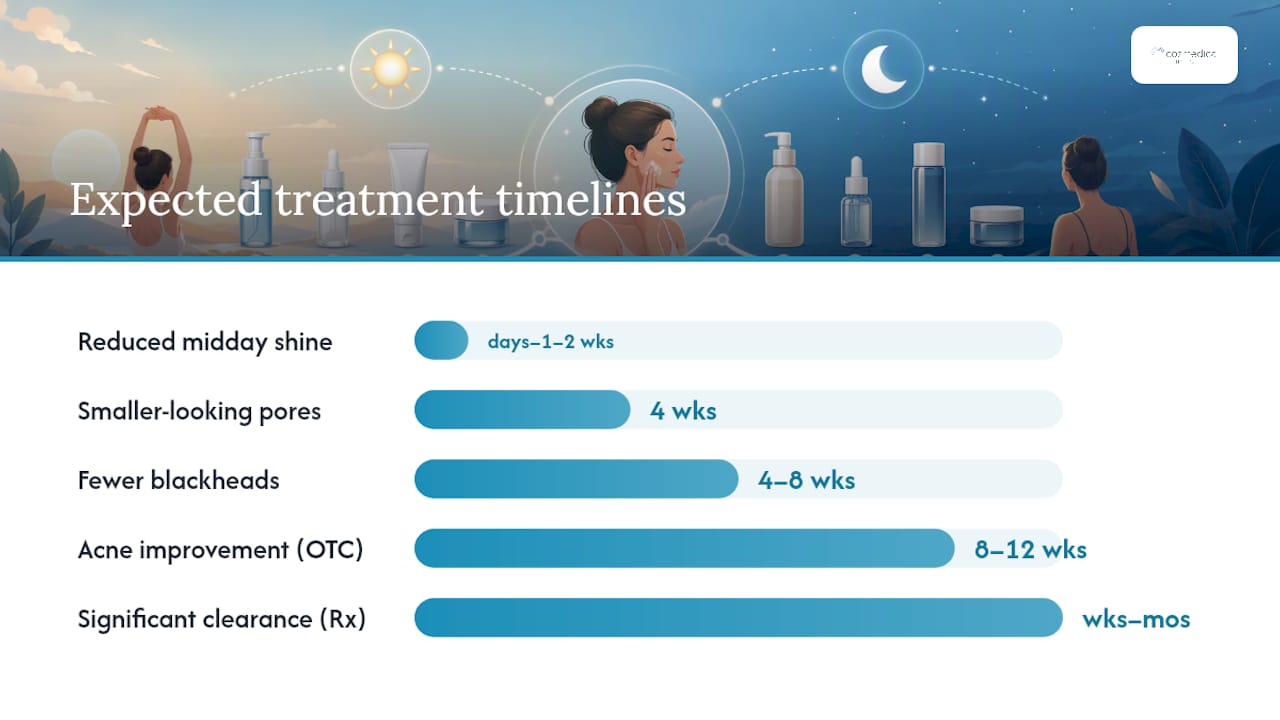
Realistic expectations matter here. Shine control happens relatively quickly; acne clearance takes longer.
| Goal | Expected timeline |
|---|---|
| Reduced midday shine | Days to 1–2 weeks |
| Smaller-looking pores | 4 weeks with consistent niacinamide use |
| Fewer blackheads | 4–8 weeks with regular BHA use |
| Acne improvement (OTC) | 8–12 weeks of consistent use |
| Significant acne clearance (prescription) | Several weeks to a few months |
For cost, a basic OTC starter kit (gentle cleanser, niacinamide serum, oil-free moisturizer with SPF) typically runs $30–$70 depending on the brands you choose. Adding a dedicated sunscreen and a salicylic acid treatment brings the total to roughly $50–$100. Dermatologist visits vary widely by location and insurance, but an initial consultation without insurance often falls in the $100–$300 range. Prescription treatments like tretinoin or spironolactone add to that cost, though many are available as generics.
Consistency is the single biggest variable. AAD acne treatment guidance is clear: topical regimens need weeks to months of regular use before you can fairly judge whether they’re working. Switching products every two weeks is one of the most common reasons people feel like “nothing works.”
Why does oily skin happen, and what does the science say?
Sebum production is regulated by a surprisingly complex system. Androgens (testosterone and its derivatives) are the primary drivers, stimulating sebaceous glands to produce more oil. But research published on PubMed shows that metabolic hormones like insulin and IGF-1 also play a role, which is why diet and hormonal health can influence how oily your skin is. Topical routines manage what’s on the surface; they can’t fully override internal hormonal signals.
This matters because it explains why some people need more than a topical routine. If your oil production is driven by hormonal fluctuations (common in PCOS, puberty, or perimenopause), a dermatologist may recommend systemic options alongside topical care.
Barrier health is the other piece that often gets overlooked. When the skin barrier is compromised, transepidermal water loss increases, and the skin can respond by ramping up sebum production. This is especially relevant for oily sensitive skin, where high-potency actives may need to be introduced more slowly and at lower concentrations to avoid worsening barrier dysfunction.
Clinical tips for introducing actives safely: start one new active at a time, wait two to four weeks before adding another, track changes with photos, and escalate to a dermatologist if irritation is severe or acne is worsening despite consistent treatment.
What we’ve learned from years of formulating for oily skin
Here’s an honest take: the skincare industry tends to overcomplicate oily skin. You’ll find 12-step routines, stacked actives, and products that promise to “eliminate” oil entirely. None of that is realistic, and some of it actively makes things worse.
Sebum is not your enemy. It’s part of your skin’s natural defense system. The goal of a well-designed routine isn’t to strip oil away — it’s to regulate production, keep pores clear, and maintain a healthy barrier so your skin isn’t constantly trying to compensate. That’s a fundamentally different framing than “dry out the oil.”
What actually works, based on the evidence: a gentle cleanser used twice daily, a niacinamide serum to regulate sebum and reinforce the barrier, a non-comedogenic moisturizer with SPF in the morning, and a targeted active (salicylic acid or retinoid) in the evening. That’s four products. Everything else is optional.
The part most people underestimate is the timeline. Eight to twelve weeks feels like a long time when your skin is breaking out. But that’s genuinely how long it takes for cell turnover to normalize and for actives like retinoids to show their full effect. Patience, combined with a consistent routine, outperforms any product-switching strategy.
At Cosmedica-skincare, we formulate with this philosophy in mind: cruelty-free, dermatologist-tested ingredients at concentrations that are effective without being unnecessarily aggressive. Our daily skincare routine guide walks through how to layer products for both AM and PM, which is a useful companion to the steps above.
Cosmedica-skincare products that complete your oily skin routine
Putting together a routine that actually works doesn’t have to mean buying from five different brands. Cosmedica-skincare’s catalog maps cleanly to each step in the routine above, with formulas built for oily and acne-prone skin.
Here’s how the lineup fits:
- Cleanser step: Look for a gentle, non-abrasive gel cleanser from the complete-the-routine collection — formulated to remove excess oil without stripping the barrier.
- Treatment serum step: The serum collection includes niacinamide and lightweight hydrating serums that sit comfortably under SPF without pilling or adding shine.
- Moisturizer step: The moisturizer collection features water-based, non-comedogenic formulas in gel and fluid textures — exactly what oily skin needs for hydration without heaviness.
- Weekly treatment: A purifying clay or charcoal mask from the face mask collection works as a once-a-week oil-absorbing reset.
All Cosmedica-skincare products are cruelty-free, vegan, and dermatologist-tested. Free shipping and easy returns make it low-risk to try the routine one step at a time. Browse the full oily-skin-friendly lineup and build your routine at Cosmedica-skincare.
Sources
- How to control oily skin
- Oily sensitive skin: A review of management options
- Sebum regulation and biology (PubMed review)
- Review of treatment options for sebum and oily skin (PubMed)
This article is general information, not a substitute for advice from a qualified doctor. Consult a qualified healthcare professional about your own circumstances before acting on anything here.
FAQ
What is the best cleanser type for oily skin?
A gentle foaming or gel cleanser used twice daily is the AAD-recommended choice. Avoid anything with abrasive particles or high alcohol content, as these strip the barrier and trigger more oil production.
Should people with oily skin use a moisturizer?
Yes, every day. Skipping moisturizer causes dehydration, which prompts the skin to produce more sebum. Choose a water-based, non-comedogenic formula to hydrate without adding shine.
How often should you exfoliate oily skin?
AHAs work well 1–2 times per week. Physical scrubs are generally not recommended for oily or acne-prone skin.
How long before an oily skin routine shows results?
Shine control often improves within days to two weeks. Acne improvement with consistent OTC treatment typically takes 8–12 weeks, per AAD guidance. Prescription options may work faster but require a dermatologist’s oversight.
When should you see a dermatologist about oily or acne-prone skin?
Book an appointment if acne is leaving scars, involves deep cystic lesions, or hasn’t improved after 10–12 weeks of consistent OTC treatment. Systemic options like spironolactone or isotretinoin are effective but need clinician management.