

What Is Slow Aging? Your Guide to Preventing Skin Damage
Slow aging, when it comes to your skin, means using a preventive topical routine, sunscreen, targeted actives, and consistent daily habits, to delay the fine lines, sagging, and discoloration that show up over time. It’s not about stopping the clock (nobody can do that) or chasing surgical-level results with a jar of cream. It’s about giving your skin the tools to age on the slowest, gentlest curve possible.
If you only take one thing from this article, take this: daily broad-spectrum sunscreen with SPF 30 or higher is the single most important thing you can do. UV exposure is the primary driver of collagen breakdown and pigmentation, and dermatologists agree that reapplying every two hours outdoors matters as much as putting it on in the first place.
Here’s what else backs up that priority:
- Oxidative stress from UV rays and pollution breaks down collagen faster than almost anything else.
- Antioxidants like vitamin C help neutralize that damage when layered under sunscreen.
- Moisturizer and sunscreen together are considered the two most effective anti-aging products you can buy, before you even add specialty serums.
Key Takeaways
Slow aging works when daily sunscreen, layered antioxidants, and gradually introduced actives like retinoids are applied consistently over months, not days.
| Point | Details |
|---|---|
| Sunscreen comes first | Daily broad-spectrum SPF 30+ is the single highest-impact step, reapplied every two hours outdoors. |
| Order your actives correctly | Vitamin C belongs in your AM routine under sunscreen; retinoids work best applied at night. |
| Introduce one active at a time | Wait one to two weeks between new products to identify irritation and confirm what’s working. |
| Set a realistic timeline | Expect visible tone and texture changes around three months, with collagen-driven change closer to six months. |
| Start simple with Cosmedica-skincare | Cosmedica-skincare’s vitamin C serums, retinol-friendly night products, and ceramide-rich moisturizers map directly onto this AM/PM framework. |
Table of Contents
- What Does an AM and PM Slow Aging Routine Look Like?
- Which Anti-Aging Ingredients Actually Work?
- How Long Does It Take to See Results?
- What Lifestyle Habits Speed Up or Slow Down Aging?
- When Should You Consider In-Office Procedures?
- Where Cosmedica Skincare Fits Into Your Routine
- Sources
- FAQ
What Does an AM and PM Slow Aging Routine Look Like?
You don’t need twelve steps. You need the right steps in the right order, done consistently. Think of your routine less like a chemistry set and more like a short, repeatable ritual, one you can actually stick with on a Tuesday morning when you’re already running late.
Morning routine:
- Cleanse gently, or just splash with water if your skin isn’t oily overnight.
- Apply a vitamin C serum to protect against daytime oxidative stress.
- Layer on a moisturizer, look for one with hyaluronic acid or ceramides if your skin runs dry.
- Finish with broad-spectrum SPF 30+ as your last step, always.
Evening routine:
- Remove sunscreen and makeup with a proper cleanse (double cleansing works well here).
- Apply your targeted active, this is when a retinoid works its magic.
- Follow with a hydrating serum containing hyaluronic acid.
- Seal it all in with a richer night moisturizer.
A few ground rules keep this from going sideways:
- Don’t layer vitamin C and retinoids in the same session, they can cancel each other out or irritate skin. Vitamin C belongs in the AM, retinoids in the PM.
- A pea-sized amount of retinoid is plenty for your whole face.
- Start retinoids two to three nights a week, not nightly, until your skin adjusts.
Pro Tip: If your skin feels tight or flaky after starting a new active, you’re probably overdoing it. Less product, applied consistently, beats a heavy layer applied sporadically every time.
For a fuller walkthrough of product order and timing, this step-by-step anti-aging skincare routine breaks down each step in more depth.
Which Anti-Aging Ingredients Actually Work?
Not every ingredient on a label deserves shelf space. A handful of them, though, have real evidence behind them, and dermatology consensus groups keep landing on the same short list.
- Retinoids and retinol boost cell turnover and stimulate collagen production. Start low and slow, a few nights a week at first, and skip them entirely if you’re pregnant.
- Vitamin C (L-ascorbic acid or a stable derivative) is your morning antioxidant. It works best layered under SPF, and it’s sensitive to light and air, so look for opaque, airtight packaging.
- Niacinamide supports your skin barrier and calms inflammation. It’s remarkably well tolerated across skin types and pairs easily with both retinoids and vitamin C.
- Hyaluronic acid, ceramides, and peptides hydrate and reinforce the barrier rather than stimulate deep change. Think of them as support staff, not the star player.
- AHAs and BHAs smooth texture and tone but carry a real risk of post-inflammatory hyperpigmentation for darker Fitzpatrick skin types. Always pair exfoliants with diligent sun protection.
An expert consensus process actually mapped this out into what’s called a skin health pyramid: photoprotection and barrier repair form the base, with renewal and stimulation steps built on top.
Sunscreen, antioxidants, and barrier repair aren’t the exciting part of a routine. They’re the part that makes everything else you spend money on actually work.
Curious about the vitamin C options that fit this framework? Browse the vitamin C serums built around stable, well-packaged formulas.
How Long Does It Take to See Results?
Patience is the underrated ingredient in every anti-aging routine. Here’s a realistic on-ramp so you don’t quit right before things start working.
- Week 1: Introduce one new active, and only one. Give your skin one to two weeks before adding another, so you can tell what’s actually causing a reaction.
- Weeks 2 to 4: Ramp up retinoid frequency gradually, from twice a week to nightly, as tolerance builds.
- Around 3 months: Expect visible improvement in tone and texture from vitamin C and retinoids.
- 6 months and beyond: Collagen-driven changes, firmer, smoother skin, show up on this longer timeline, not the three-month mark.
A little redness or peeling in the first couple of weeks (often called “retinization”) is normal. Ongoing burning, swelling, or breakouts that don’t settle are not.
- Buffer irritation by applying moisturizer before or after your retinoid.
- Cut back to every third night if your skin feels raw.
- See a dermatologist if irritation persists past two to three weeks or you notice unusual pigment changes.
What Lifestyle Habits Speed Up or Slow Down Aging?
Your skincare products are only half the equation. Skip these habits and even a great routine underperforms.
- Sun exposure happens through car and office windows, not just at the beach, so a hat, sunglasses, and shade during peak hours matter more than most people realize.
- Smoking and poor sleep both accelerate visible aging by starving skin of oxygen and disrupting repair cycles.
- Chronic stress and dehydration show up on your face faster than you’d think, drink water, and don’t skip your hydrating serum.
- Diet rich in antioxidants (berries, leafy greens, colorful vegetables) gives your skin raw material to fight oxidative stress from the inside.
- Pollution exposure calls for a thorough night cleanse and a daytime antioxidant serum as your defense line.
Pro Tip: Reapplying sunscreen is the habit almost everyone skips. Keep a stick or powder SPF in your bag for touch-ups; it takes ten seconds and it’s the difference between protected skin and wasted effort. For sun protection formulated with a wider shade range in mind, Black Girl Sunscreen SPF 30 is worth a look.
When Should You Consider In-Office Procedures?
Topicals and lifestyle habits are your prevention layer. In-office procedures are correction, for concerns that have already progressed past what a serum can reverse.
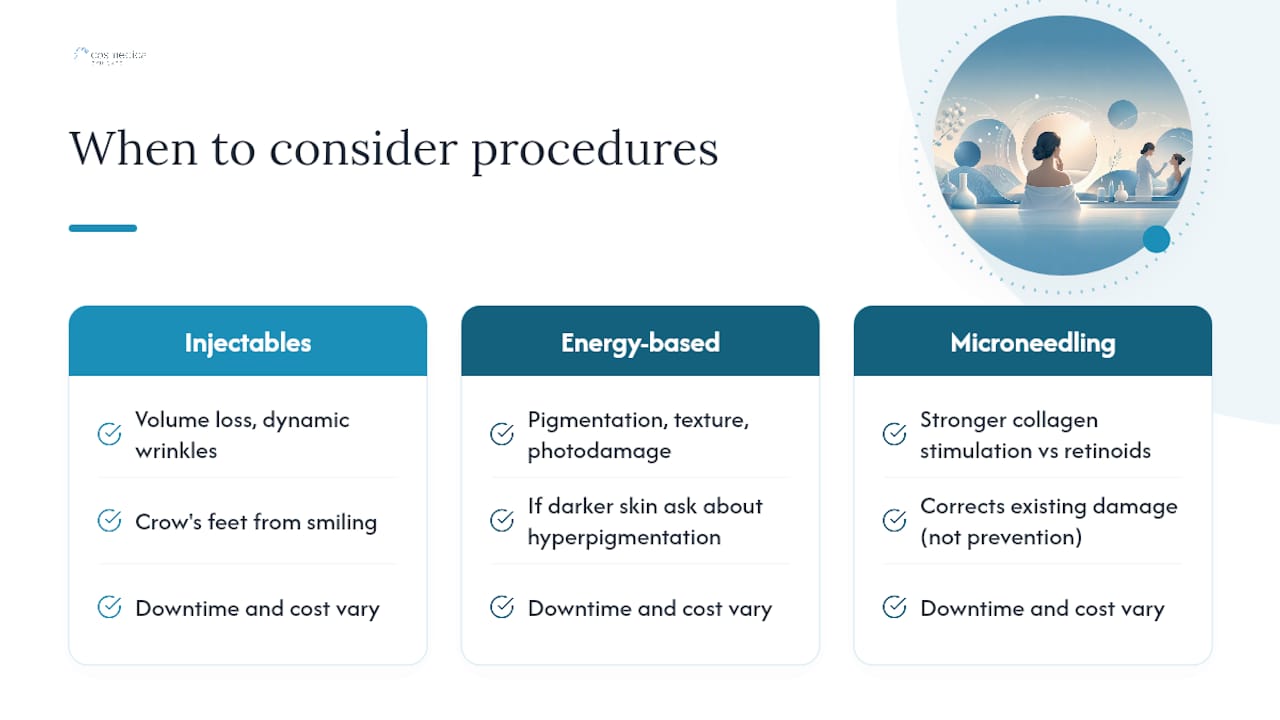
Injectables like fillers and neuromodulators address volume loss and dynamic wrinkles (think crow’s feet from years of smiling). Energy-based treatments, lasers in particular, target pigmentation, texture, and broader photodamage. Microneedling stimulates collagen production more aggressively than any topical retinoid can on its own.
None of these are decisions to make casually. Consult a board-certified dermatologist or plastic surgeon, and if you have a darker Fitzpatrick skin type, ask directly about post-inflammatory hyperpigmentation risk before any energy-based treatment. Downtime and cost vary widely, and expectations matter as much as the procedure itself.
None of this replaces your daily habits. Procedures correct what’s already visible; sunscreen, antioxidants, and consistent actives are what keep new damage from showing up in the first place.
Where Cosmedica Skincare Fits Into Your Routine
You don’t need a dozen brands to build the routine outlined above, you need a few dermatologist-tested formulas that hit the right steps. Cosmedica-skincare focuses on exactly that: cruelty-free, affordable formulations built around the actives that actually move the needle, vitamin C for your morning antioxidant step, retinol-friendly night treatments for collagen support, and moisturizers built with hyaluronic acid and ceramides for the hydration layer your barrier depends on.
If you’re rebuilding a routine around hydration first (a smart place to start if your skin feels tight or dull), the Intense Hydration Kit covers that foundational layer in one step. And if you’re wondering whether topical skincare can realistically deliver visible change, Cosmedica-skincare’s take on anti-aging expectations lays out what’s achievable and what isn’t. Start there, build one active at a time, and let your routine do the slow, steady work.
Sources
- Health
- International Consensus on Anti-Aging Dermocosmetics and Skin Care for Clinical Practice — Journal/DOI
- Wrinkle creams: In-depth — Mayo Clinic
FAQ
What Is Slow Aging in Skincare?
Slow aging means using a preventive topical routine, daily sunscreen, antioxidants, and actives like retinoids, to delay visible signs of skin aging such as fine lines and discoloration, rather than reversing biological aging.
What Is the Most Important Anti-Aging Product?
Broad-spectrum sunscreen with SPF 30 or higher applied daily and reapplied every two hours outdoors is considered the single most important step.
When Should I Start Using Retinol?
Many dermatologists recommend starting in your mid-20s to early 30s, when natural collagen production begins declining, using a low frequency at first to build tolerance.
How Long Until I See Results From a Slow Aging Routine?
Expect early hydration improvements within days, tone and texture changes from vitamin C and retinoids around three months, and collagen-driven firmness changes closer to six months or beyond.
Can Exfoliants Cause Dark Spots?
Yes, AHAs and BHAs can trigger post-inflammatory hyperpigmentation, particularly in darker Fitzpatrick skin types, so pair any exfoliating routine with strict daily sunscreen use.
Do I Need Professional Treatments Alongside Skincare?
Not always. Topicals and lifestyle habits are your prevention base; procedures like fillers, lasers, or microneedling only become worth considering for concerns that have already progressed beyond what topical actives can correct.