

The Role of Antioxidants in Skincare Explained
TL;DR:
- Antioxidants defend skin by neutralizing free radicals that cause aging and damage.
- They support hydration, repair the skin barrier, and work best when combined and used consistently.
Antioxidants are molecules that defend your skin by neutralizing reactive oxygen species (ROS), the unstable free radicals that break down collagen, disrupt your skin barrier, and accelerate visible aging. The role of antioxidants in skincare goes well beyond basic protection. Compounds like vitamin C, vitamin E, and ferulic acid work at the cellular level to restore balance, support hydration, and reduce UV damage. Think of them as your skin’s personal security team, working around the clock to intercept threats before they cause lasting harm. We put together this guide to help you understand exactly how they work, what the science says, and how to use them well.
How do antioxidants protect skin at the biological level?
Free radicals are not inherently evil. At low levels, ROS actually regulate important transcription factors like NF-κB, Nrf2/KEAP1, AP-1, p53, and HIF-1 that keep skin functioning normally. The problem starts when ROS production outpaces your skin’s natural defenses, a state called oxidative stress. That imbalance triggers collagen degradation, chronic inflammation, and barrier breakdown.
Antioxidants step in to restore redox balance rather than wipe out all ROS entirely. That distinction matters. Eliminating all free radicals would actually disrupt the signaling your skin needs to repair itself. The goal is balance, not total suppression.
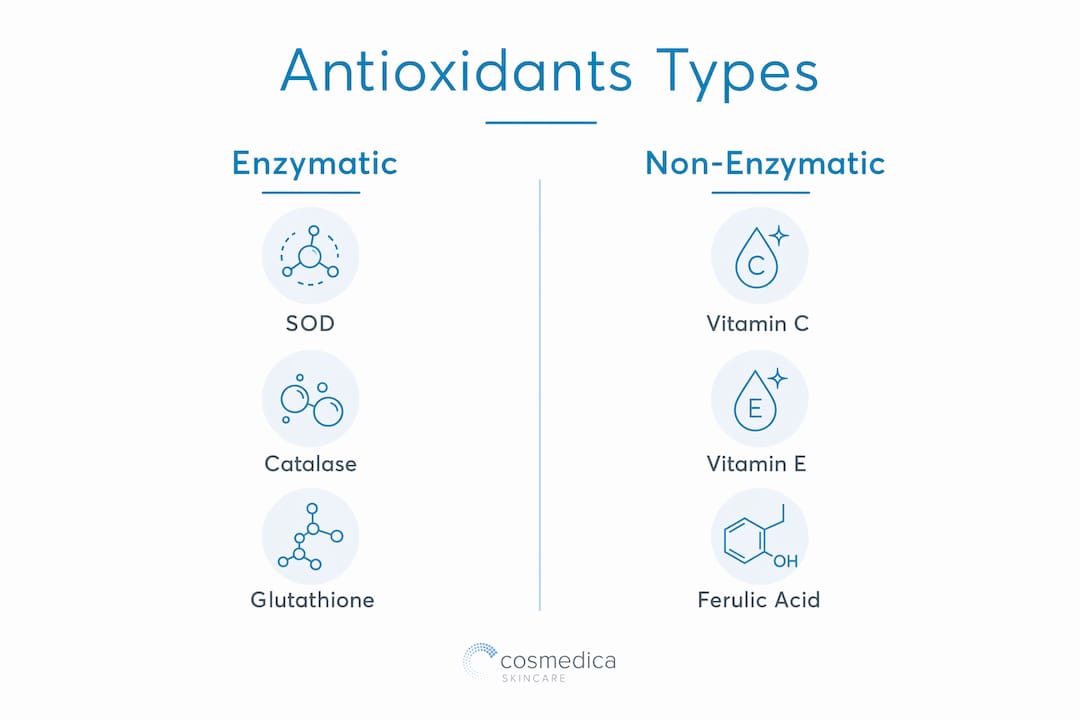
Skincare antioxidants fall into two broad categories. Enzymatic antioxidants include superoxide dismutase (SOD), catalase (CAT), and glutathione peroxidase (GPx), which your body produces naturally. Nonenzymatic antioxidants are the ones you apply topically, including vitamin C, vitamin E, resveratrol, and coenzyme Q10. These two groups work together to cover different threats.
Hydrophilic (water-soluble) antioxidants like vitamin C protect the watery environment inside and between cells. Lipophilic (fat-soluble) antioxidants like vitamin E protect cell membranes and lipid-rich skin layers. When you combine both types, you get multi-target antioxidant protection that covers more ground than any single ingredient can.
Beyond scavenging free radicals, antioxidants also modulate stress signaling pathways, support extracellular matrix (ECM) repair, and strengthen the skin barrier. That multi-pathway action is exactly why dermatologists and formulators keep coming back to antioxidant combinations rather than single-ingredient solutions.
Pro Tip: If you want to understand which vitamins support antioxidant activity in your routine, the role of vitamins in skincare guide from Cosmedica-skincare breaks it down clearly.
What does the clinical evidence say about antioxidant benefits for skin?
The science behind antioxidants for anti-aging and skin health is not just theoretical. Clinical and preclinical research now offers measurable proof of what these ingredients actually do.
A systematic review and meta-analysis found that antioxidant-rich interventions improve hydration significantly, with pooled effect sizes of Hedges’ g = 1.75 in preclinical studies and a mean difference of 2.12 in clinical trials. That is a strong signal. Skin that holds onto moisture more effectively also shows better barrier function, which means less irritation, fewer breakouts, and slower visible aging.
The same analysis found that trans-epidermal water loss (TEWL), the rate at which water escapes through your skin, decreased with antioxidant use. Preclinical studies showed a Hedges’ g of −2.15, and clinical trials showed a mean difference of −0.68. Lower TEWL means your skin barrier is doing its job. Think of it like patching the holes in a water tank.
| Outcome | Preclinical Effect Size | Clinical Effect Size |
|---|---|---|
| Skin hydration improvement | Hedges’ g = 1.75 | Mean difference = 2.12 |
| TEWL reduction | Hedges’ g = −2.15 | Mean difference = −0.68 |
| UV erythema reduction | Up to 300% at 2× MED | Significant vs. control |
UV protection is another area where antioxidants deliver real results. An advanced antioxidant serum reduced UV-induced erythema by 72% at 1× MED and by 300% at 2× MED compared to encapsulated vitamin C and a control. The serum also reduced biomarkers of DNA damage including thymine dimers, sunburn cells, and MMP9. That is not just cosmetic improvement. That is measurable protection at the cellular level.
“Antioxidants target multiple overlapping pathways that cause extrinsic skin aging rather than a single mechanism, which explains the value of multi-antioxidant approaches.” — Natural Product Modulation of Oxidative Stress in the Treatment of Extrinsic Skin Aging
Vitamin C deserves its own spotlight here. It supports collagen synthesis, photoprotection, and melanogenesis modulation, making it one of the most clinically studied antioxidants in skincare. Research shows measurable improvements in skin elasticity, wrinkle depth, and hyperpigmentation with consistent use. The catch is that vitamin C requires cellular transport via SVCT1/2 receptors to work effectively, which means formulation quality directly affects results.
Antioxidants also help people managing inflammatory skin conditions. Curcumin supplementation, for example, increased levels of SOD, CAT, and GPx while reducing symptom scores in atopic dermatitis and psoriasis patients. The barrier and inflammation benefits extend well beyond anti-aging, making antioxidants relevant for a wide range of skin concerns.
Vitamin C vs. vitamin E vs. ferulic acid: how do popular antioxidants compare?
Not all antioxidants work the same way. Knowing their differences helps you choose products that actually match your skin goals.
Vitamin C (ascorbic acid) is water-soluble and works in the aqueous layers of skin. It is the gold standard for brightening, collagen support, and UV damage repair. The downside is instability. Pure ascorbic acid oxidizes quickly when exposed to light and air, turning orange and losing potency. Stable derivatives like sodium ascorbyl phosphate and ascorbyl glucoside address this, though they may be less potent than pure L-ascorbic acid. Advanced delivery systems including nanoparticles and encapsulation now help improve bioavailability and shelf life significantly.
Vitamin E (tocopherol) is fat-soluble, which means it works in cell membranes and lipid-rich skin layers where vitamin C cannot reach. It protects against lipid peroxidation, the process where free radicals attack and break down the fats in your skin barrier. Vitamin E also regenerates vitamin C after it has neutralized a free radical, making the two a natural pairing.
Ferulic acid is a plant-derived antioxidant that does something remarkable: it stabilizes both vitamin C and vitamin E. A well-known combination of 15% vitamin C, 1% vitamin E, and 0.5% ferulic acid has been studied in clinical trials and shown to deliver synergistic antioxidant effects that outperform any single ingredient alone. That trial showed greater improvements in skin elasticity and pigmentation at four weeks compared to laser treatment alone.
| Antioxidant | Solubility | Primary benefit | Key consideration |
|---|---|---|---|
| Vitamin C (ascorbic acid) | Water-soluble | Collagen synthesis, brightening | Unstable; requires proper formulation |
| Vitamin E (tocopherol) | Lipid-soluble | Membrane protection, barrier repair | Works best paired with vitamin C |
| Ferulic acid | Both | Stabilizer, synergy enhancer | Boosts efficacy of C and E |
| Niacinamide | Water-soluble | Anti-inflammatory, pore reduction | Gentle; suits sensitive skin |
| Resveratrol | Lipid-soluble | Sirtuin activation, UV defense | Emerging evidence; good in serums |
| Coenzyme Q10 | Lipid-soluble | Mitochondrial support, fine lines | Declines with age in skin |
Niacinamide (vitamin B3) is technically not a classic antioxidant, but it supports antioxidant defenses by reducing inflammation and strengthening the skin barrier. It pairs well with most antioxidants and suits sensitive or acne-prone skin particularly well.
Resveratrol and coenzyme Q10 are worth knowing about. Resveratrol activates sirtuin pathways linked to cellular longevity. Coenzyme Q10 naturally declines with age in skin tissue, so replenishing it topically supports mitochondrial function and reduces fine lines. Both work best in serums with lipid-soluble delivery systems.
- Vitamin C and E together outperform either ingredient alone
- Ferulic acid locks in that synergy and extends product shelf life
- Niacinamide layers well with all of the above without causing irritation
- Resveratrol and CoQ10 add depth to a mature or advanced routine
How to incorporate antioxidants into your skincare routine
Getting the most from antioxidants comes down to three things: choosing the right ingredients for your skin, applying them in the right order, and using them consistently enough to see results.
-
Match antioxidants to your skin concern. If brightening and collagen support are your goals, vitamin C is your starting point. For barrier repair and dryness, vitamin E and niacinamide work well. For UV defense and anti-aging, the vitamin C, E, and ferulic acid trio is the most clinically supported combination. If you have sensitive or reactive skin, niacinamide is the gentlest entry point.
-
Apply antioxidant serums in the morning. Antioxidants neutralize UV-triggered free radicals in real time, so morning application gives you the most protection during sun exposure. Apply your antioxidant serum after cleansing and toning, before moisturizer and SPF. This layering order keeps the active ingredients close to the skin surface where they work best.
-
Pair antioxidants with SPF, not instead of it. Antioxidants reduce UV-induced oxidative damage, but they are not a substitute for sunscreen. Think of SPF as your first line of defense and antioxidants as your backup system, catching the free radicals that slip through.
-
Avoid mixing vitamin C with certain actives. Pure L-ascorbic acid can destabilize when combined with niacinamide at high concentrations or with alkaline formulas. Use them at different times of day if you notice flushing or reduced efficacy. Stable vitamin C derivatives are generally more forgiving.
-
Store products correctly. Vitamin C oxidizes when exposed to light, heat, and air. Keep serums in a cool, dark place and close caps tightly after use. If your vitamin C serum has turned orange or brown, it has oxidized and lost most of its potency.
Pro Tip: Consistent use over 8–12 weeks is where antioxidant benefits really show up. Skin turnover takes time, and so does collagen remodeling. Patience is part of the formula.
For a deeper look at how vitamin C specifically fits into a complete routine, the vitamin C skincare guide from Cosmedica-skincare covers formulation types, concentrations, and layering strategies in detail.
Key Takeaways
Antioxidants protect skin most effectively when combined strategically, applied consistently, and formulated for stability and bioavailability.
| Point | Details |
|---|---|
| Redox balance, not elimination | Antioxidants restore balance between harmful and beneficial ROS rather than removing all free radicals. |
| Clinical hydration benefits | Studies show antioxidant use significantly improves skin hydration and reduces trans-epidermal water loss. |
| Vitamin C, E, and ferulic acid synergy | This trio outperforms single ingredients by covering both water-soluble and lipid-soluble skin compartments. |
| Formulation quality matters | Stability and delivery systems directly affect whether antioxidants reach the skin layers where they work. |
| Morning application maximizes protection | Applying antioxidant serums before SPF gives real-time defense against UV-triggered oxidative damage. |
What I’ve learned after years of watching antioxidant trends come and go
The antioxidant conversation in skincare has matured a lot. When I first started paying close attention to ingredient science, vitamin C was being sold as a miracle cure and most products were poorly formulated. Bottles turned orange within weeks. People gave up and concluded vitamin C “didn’t work for them.” The ingredient was fine. The formulation was not.
What I find genuinely exciting now is the shift toward synergy and delivery science. The research on the vitamin C, E, and ferulic acid combination is not new, but the industry is finally catching up with products that actually stabilize these ingredients together. Encapsulation and nanoparticle delivery are no longer just lab concepts. They show up in real products and produce measurable results.
The part that still frustrates me is the marketing around single-ingredient antioxidant products. Resveratrol serums, CoQ10 creams, astaxanthin capsules. Each one gets positioned as the next big thing. But the science consistently points to multi-antioxidant approaches covering both hydrophilic and lipophilic compartments as the most effective strategy. No single molecule covers all the bases.
My honest advice: do not chase the newest antioxidant. Build a routine around a well-formulated vitamin C serum in the morning, paired with vitamin E and ferulic acid if possible, and add niacinamide if your skin is sensitive or prone to redness. Then protect that work with SPF every single day. Antioxidants and sunscreen are not competing priorities. They are partners. And if you want to understand how antioxidants connect to your skin’s hydration and barrier health, the aging skin hydration guide from Cosmedica-skincare is worth reading alongside this one.
— Thomas
Antioxidant skincare worth trying from Cosmedica-skincare
We at Cosmedica-skincare formulate with the science in mind. Our Super Serum Set combines key antioxidants designed to work together, covering multiple skin concerns in one routine. For vitamin C specifically, our Vitamin C Super Serum uses a stabilized formula that delivers real brightening and collagen support without the oxidation issues that plague poorly made products. Every formula is cruelty-free, dermatologist-tested, and built for all skin types. If you want to put the science from this article to work, our vitamin C skincare collection is a practical starting point.
FAQ
What is the role of antioxidants in skincare?
Antioxidants neutralize reactive oxygen species (free radicals) that damage collagen, disrupt the skin barrier, and accelerate aging. They also support hydration, reduce UV-induced inflammation, and help maintain the skin’s natural repair processes.
Which antioxidant is best for anti-aging?
The most clinically supported combination for anti-aging is 15% vitamin C, 1% vitamin E, and 0.5% ferulic acid. This trio covers both water-soluble and lipid-soluble skin compartments and has shown measurable improvements in elasticity and pigmentation in clinical trials.
Can antioxidants replace sunscreen?
Antioxidants reduce UV-triggered oxidative damage but do not block UV rays the way sunscreen does. Use both together: apply your antioxidant serum first, then SPF, for the strongest protection against photoaging.
How long does it take to see results from antioxidant skincare?
Consistent use over 8–12 weeks is typically needed to see visible improvements in skin tone, texture, and fine lines. Collagen remodeling and skin turnover take time, so daily application matters more than occasional use.
Why does my vitamin C serum turn orange?
Vitamin C (ascorbic acid) oxidizes when exposed to light, heat, or air, turning orange or brown and losing its potency. Store serums in a cool, dark place and look for products with encapsulated or stabilized vitamin C derivatives for longer shelf life.