

Why Aging Skin Needs Hydration: Science-Backed Guide
TL;DR:
- Aging skin experiences barrier weakening that accelerates water loss, dryness, and visible aging signs. Consistent use of layered moisturizers with humectants, lipids, and occlusives can effectively restore hydration and slow this process. Starting proper hydration habits in your 30s provides a proactive approach to maintaining healthy, youthful skin long-term.
Aging skin is defined by a progressively weakening moisture barrier that accelerates water loss, dryness, and visible signs of aging. This is why aging skin needs hydration more urgently than younger skin. Starting in your 30s, your skin’s natural moisturizing factors (NMFs), collagen production, and lipid matrix all begin to decline. The result is skin that feels tighter, looks duller, and develops fine lines faster than it should. The good news is that the right hydration strategy, grounded in recent clinical research, can meaningfully slow these changes and keep your skin looking and feeling healthy for years to come.
How does aging affect skin’s moisture barrier and hydration capacity?
The skin’s outermost layer, the stratum corneum, acts like a brick-and-mortar wall. The “bricks” are dead skin cells, and the “mortar” is a lipid matrix made up of ceramides, fatty acids, and cholesterol. This structure holds moisture in and keeps irritants out. As we age, the mortar starts to crumble. The lipid matrix thins, ceramide production drops, and the barrier becomes increasingly porous.
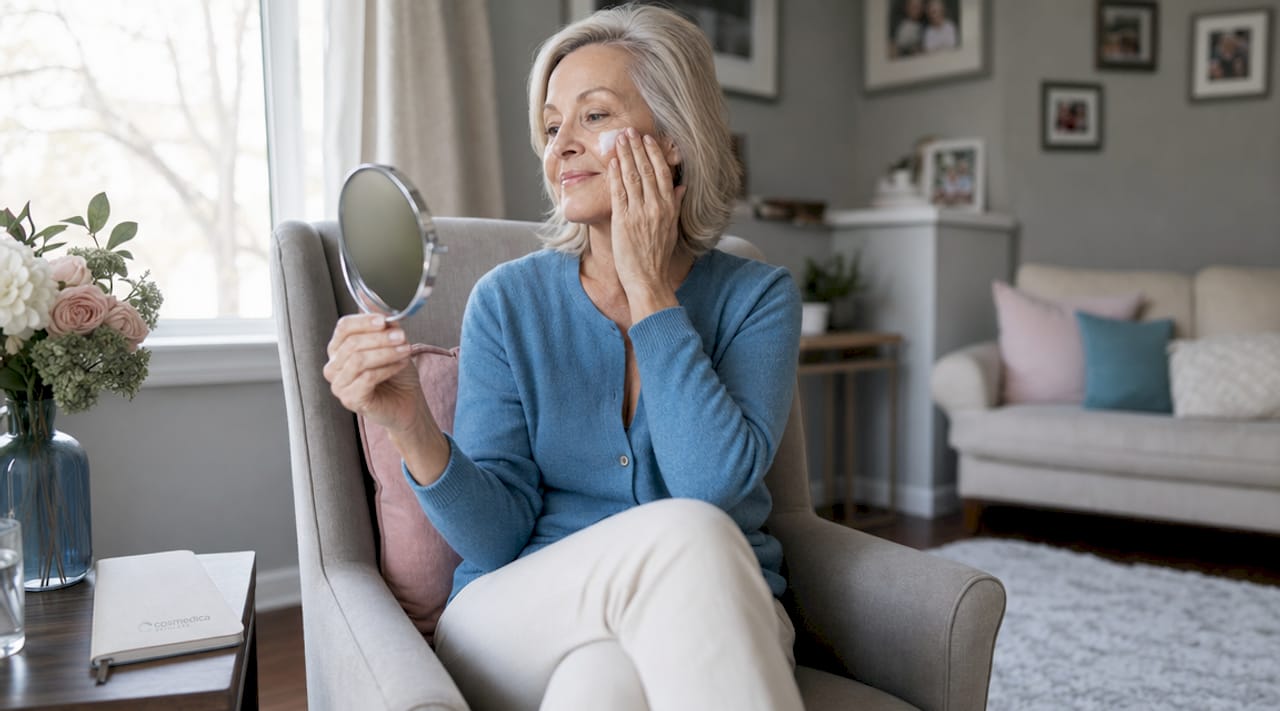
The clinical term for what happens next is transepidermal water loss (TEWL), which is the rate at which water evaporates through the skin. A weakened epidermal barrier directly increases TEWL, leaving skin drier, more fragile, and more reactive. Think of it like a cracked water bottle. No matter how much water you pour in, it keeps leaking out faster than you can refill it.
Dr. Saranya Wyles of the Mayo Clinic identifies hydration loss as the earliest sign of skin aging, appearing even before visible wrinkles form. This matters because most people wait until they see lines before acting. By then, the barrier has already been compromised for years.
Several structural changes drive this process:
- Natural moisturizing factors (NMFs) like amino acids and urocanic acid decrease, reducing the skin’s ability to attract and hold water.
- Collagen and elastin fibers thin and fragment, reducing the skin’s plumpness and snap-back ability.
- Sebaceous gland activity slows, cutting the skin’s natural oil supply that normally seals in moisture.
- Cell turnover slows down, meaning dead, dry cells linger longer on the surface.
Pro Tip: Apply your moisturizer within 60 seconds of washing your face. This “damp skin” window locks in residual water before TEWL can pull it away.
Together, these changes create a feedback loop. Drier skin is more easily damaged, damaged skin loses more water, and the cycle continues. Understanding this loop is the first step toward breaking it.
What role do moisturizers and ingredients play in preserving hydration?
Moisturizers are not just comfort products. They are functional skincare tools that work at a biochemical level to restore what aging skin loses. A 2026 dermatological review confirms that topical moisturizers combine humectants, occlusives, and physiological lipids to reduce moisture evaporation and restore barrier lipids. Each ingredient class does a different job, and the best moisturizers for aging skin use all three together.
Think of it like a three-layer system. Humectants are the sponges. Occlusives are the seal. And emollients plus ceramides are the repair crew.
Here is how each category works:
| Ingredient class | Examples | Primary function |
|---|---|---|
| Humectants | Hyaluronic acid, glycerin, sodium PCA | Draw water from the environment and deeper skin layers into the stratum corneum |
| Occlusives | Petrolatum, squalane, beeswax | Form a physical film on the skin surface to slow water evaporation |
| Emollients | Shea butter, jojoba oil, dimethicone | Smooth and soften skin by filling gaps between skin cells |
| Physiological lipids | Ceramides, cholesterol, fatty acids | Replenish the lipid matrix to structurally repair the barrier |
| Multifunctional actives | Niacinamide, panthenol | Reduce inflammation, support barrier synthesis, and improve water retention |
Hyaluronic acid deserves special mention here. It is a humectant that can hold up to 1,000 times its weight in water, making it one of the most effective water-attracting ingredients available. You can read more about how hyaluronic acid works for mature skin to understand why it appears in so many top-rated formulas.
Niacinamide (vitamin B3) and panthenol (provitamin B5) are worth highlighting because they do more than hydrate. Niacinamide strengthens the barrier by stimulating ceramide synthesis, while panthenol accelerates skin repair and reduces water loss. Neither ingredient gets as much attention as hyaluronic acid, but both are workhorses in any well-formulated moisturizer.
A 2026 review in the Journal of Skin and Sexually Transmitted Diseases explains that moisturizers restore the skin barrier through a four-step process: film formation, moisture diffusion, lipid synthesis, and improved water retention. This is why a single-ingredient product rarely delivers the same results as a well-layered formula.
Pro Tip: Layer your products from thinnest to thickest consistency. Apply a hyaluronic acid serum first, then follow with a ceramide-rich moisturizer, and finish with a facial oil or occlusive cream at night to lock everything in.
What does scientific research show about hydration and aging skin?
The clinical evidence for hydration’s impact on aging skin has grown significantly in recent years, and the findings are genuinely encouraging. A 2025 randomized controlled trial published in Scientific Reports studied 150 participants taking oral sodium hyaluronate over 12 weeks. The results showed measurable improvements in facial hydration, reduced TEWL, enhanced skin elasticity, and decreased wrinkle depth. This study is significant because it demonstrates that hydration benefits extend beyond topical application.
A separate 2026 clinical study published in MDPI Cosmetics focused on topical application. Women aged 36 to 65 used a multi-ingredient collagen peptide serum lotion for four weeks. The results were striking: dryness decreased by up to 93.7%, skin hydration increased by 72.5%, and measurable improvements in TEWL, skin texture, and wrinkle appearance were recorded using objective measurement tools.
Here is a summary of what the key studies found:
| Study | Duration | Key outcome |
|---|---|---|
| Oral sodium hyaluronate (2025, Scientific Reports) | 12 weeks | Improved hydration, reduced TEWL, enhanced elasticity, reduced wrinkle depth |
| Collagen peptide serum lotion (2026, MDPI Cosmetics) | 4 weeks | 93.7% dryness reduction, 72.5% hydration increase, improved TEWL and texture |
One measurement that appears in both studies is TEWL. Researchers use TEWL as a clinical marker because it directly reflects how well the skin barrier is functioning. When TEWL decreases, it means the barrier is holding water more effectively. This is a more precise measure than simply asking participants if their skin feels better.
The timeline question is one we hear often: how long before you see results? The honest answer is that hydration gains typically require several weeks of consistent use before they become visible. The 2025 sodium hyaluronate trial ran for three months, and improvements continued to build throughout. This is not a quick fix. It is a gradual, biological process that rewards consistency. Building a science-backed skincare routine around daily hydration is the most reliable path to visible results.
How can you effectively hydrate aging skin every day?
Knowing the science is one thing. Putting it into practice is another. The good news is that an effective hydration strategy for mature skin does not require a 12-step routine or expensive treatments. It requires the right habits, applied consistently.
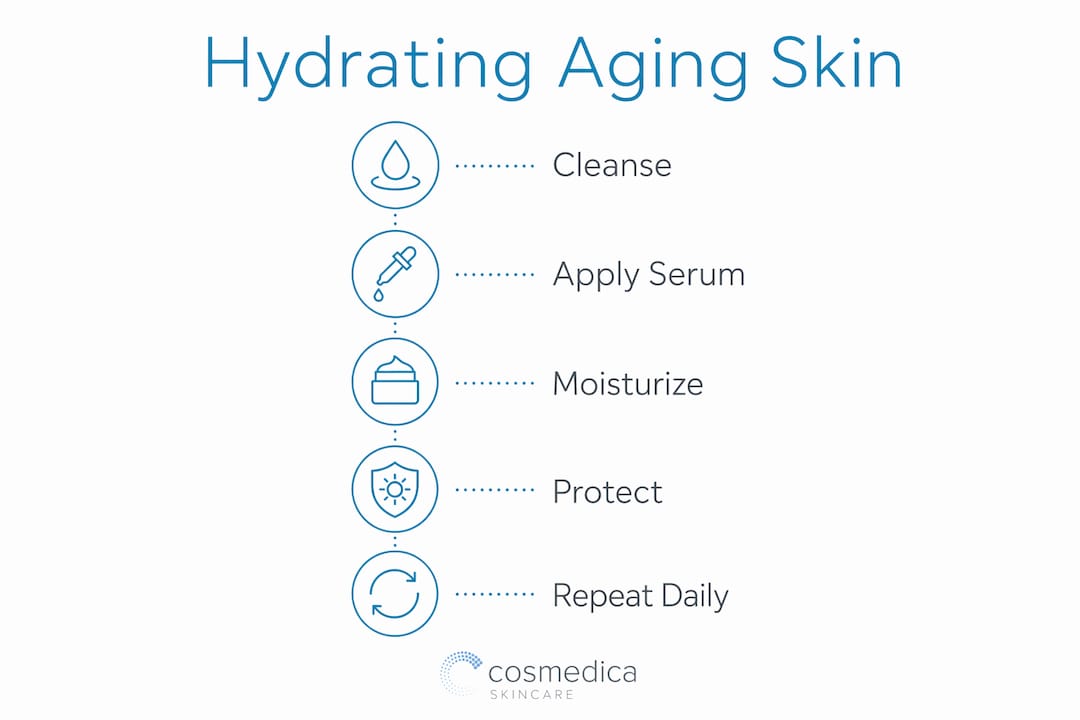
The foundation of any good hydration strategy for older skin starts with how you cleanse. Harsh, foaming cleansers strip the skin’s natural oils and disrupt the lipid barrier before you even apply a single drop of moisturizer. Switching to a gentle, cream-based or micellar cleanser is one of the highest-impact changes you can make. Cleanse with lukewarm water, not hot, since hot water accelerates TEWL and strips sebum.
Moisturizing frequency matters more than most people realize. Applying moisturizer once in the morning is a starting point, but mature skin benefits from twice-daily application, morning and night. Nighttime is particularly valuable because successful hydration requires combining humectants with barrier lipids and occlusives, and a richer night cream gives those ingredients time to work without interference from makeup, sunscreen, or environmental exposure.
Here are the core do’s and don’ts for hydrating mature skin effectively:
Do:
- Apply moisturizer to slightly damp skin to maximize humectant absorption
- Use a hyaluronic acid serum before your moisturizer for layered hydration
- Incorporate ceramide-rich products to repair the lipid barrier
- Drink adequate water daily and eat foods rich in omega-3 fatty acids (salmon, walnuts, flaxseed) to support skin hydration from within
- Wear SPF 30 or higher every day, since UV exposure degrades collagen and worsens barrier function
Don’t:
- Over-exfoliate. Scrubbing too frequently removes the protective lipid layer and worsens TEWL
- Use alcohol-heavy toners or astringents, which dry out the stratum corneum
- Skip moisturizer on oily days. Even oily mature skin loses water through a compromised barrier
- Rely on drinking water alone to hydrate skin. Topical application is necessary because water consumed orally does not preferentially reach the skin’s surface layers
Nutrition plays a supporting role that is often underestimated. Omega-3 fatty acids help maintain the skin’s lipid matrix from the inside out. Vitamin C supports collagen synthesis. Zinc supports barrier repair. These are not replacements for topical care, but they work alongside it. For a full breakdown of how to structure your daily routine, the anti-aging skincare routine guide from Cosmedica-skincare walks through each step in practical detail.
Key takeaways
Aging skin loses moisture faster than younger skin because its barrier weakens with age, and consistent hydration with the right layered ingredients is the most effective way to slow visible aging.
| Point | Details |
|---|---|
| Barrier function drives aging | TEWL increases as the lipid matrix thins, causing dryness and accelerating wrinkle formation. |
| Layer your moisturizer ingredients | Use humectants first, then emollients and ceramides, then occlusives for maximum water retention. |
| Clinical evidence is strong | A 2026 study showed a 93.7% reduction in dryness and 72.5% hydration increase after four weeks of topical use. |
| Consistency is non-negotiable | Hydration improvements take weeks to months of daily use before they become measurable and visible. |
| Start before you see wrinkles | Barrier dysfunction precedes visible aging signs, so hydrating in your 30s is a preventive strategy, not a reactive one. |
Why I think most people start hydrating their skin too late
Here is something I have come to believe after years of following skincare research: most people treat hydration as a response to aging rather than a defense against it. They notice fine lines, feel tightness, or see dullness, and then they reach for a moisturizer. By that point, the barrier has been quietly deteriorating for years.
The research backs this up. Dr. Wyles at the Mayo Clinic is clear that barrier dysfunction precedes visible aging signs. The skin starts losing its grip on moisture before a single wrinkle appears. That means the window to act is in your 30s, not your 50s.
What I find equally important is the tendency to chase anti-wrinkle actives like retinol and vitamin C while neglecting the barrier itself. Both of those ingredients are genuinely effective, but they work better on a well-hydrated, intact barrier. Retinol on a compromised, dehydrated skin surface is more likely to cause irritation than results. Hydration is not the glamorous part of skincare, but it is the foundation that makes everything else work.
My honest recommendation is to prioritize ceramide-rich moisturizers and hyaluronic acid serums before adding any active treatment to your routine. Get the barrier healthy first. Then layer in the actives. The skin rejuvenation methods that deliver the best long-term results are almost always built on a hydration-first foundation.
Realistic expectations also matter here. You will not see a transformation in a week. The clinical trials that show meaningful results run for four to twelve weeks. That timeline is not a flaw in the products. It is just how skin biology works. Commit to the routine, and the results will follow.
— Thomas
Build your hydration routine with Cosmedica-skincare
If you are ready to put this into practice, Cosmedica-skincare has a curated range of products designed specifically for mature, moisture-depleted skin. The moisturizers collection includes ceramide-rich creams, hyaluronic acid formulas, and barrier-supporting treatments that align directly with what the clinical research recommends. For a targeted hydration boost, the Super Serum Set combines hydration-focused actives in one best-selling bundle, making it easy to layer ingredients the right way. All products are cruelty-free, dermatologist-tested, and formulated for real, lasting results. Start with the basics, stay consistent, and let the science do the work.
FAQ
Why does skin lose moisture as we age?
Aging reduces ceramide production, thins the lipid matrix in the stratum corneum, and slows sebaceous gland activity, all of which increase transepidermal water loss (TEWL). The result is skin that evaporates water faster than it can retain it.
How long does it take to see results from hydrating aging skin?
Clinical studies show that meaningful improvements in hydration, elasticity, and wrinkle depth typically require four to twelve weeks of consistent daily use. The 2025 Scientific Reports sodium hyaluronate trial ran for three months before full results were measured.
What are the best moisturizing ingredients for aging skin?
The most effective formulas combine hyaluronic acid (a humectant), ceramides (barrier-repairing lipids), and an occlusive like petrolatum or squalane. Niacinamide and panthenol are strong supporting ingredients that reinforce barrier function and reduce inflammation.
Does drinking more water hydrate your skin?
Drinking water supports overall health, but it does not directly hydrate the skin’s surface layers in a clinically meaningful way. Topical moisturizers that combine humectants with barrier lipids are necessary to address TEWL and restore the stratum corneum.
When should you start focusing on skin hydration for anti-aging?
Starting in your 30s is the most effective approach. Barrier dysfunction and early hydration loss begin before visible wrinkles appear, so building a consistent hydration routine early is a preventive strategy rather than a corrective one.