

The Role of Vitamins in Skincare: Your Science Guide
TL;DR:
- Vitamins are essential micronutrients that support skin health through targeted biological pathways like antioxidant defense, collagen synthesis, and barrier repair. Topical application provides targeted, effective benefits, especially for concerns like aging and acne, while oral supplements mainly correct deficiencies. Consistent use of properly formulated vitamins, combined with sunscreen and a balanced routine, optimizes skin longevity and overall health.
Vitamins are defined as essential micronutrients that support skin structure and function through antioxidant protection, collagen synthesis, barrier repair, and pigmentation control. The role of vitamins in skincare goes far beyond surface-level glow. Vitamin C, Vitamin A (retinoids), and Vitamin B3 (niacinamide) each work through distinct biological pathways to address everything from fine lines and acne to uneven tone and compromised skin barriers. Think of them as your skin’s maintenance crew, each with a specialized job that keeps the whole system running. When we understand what each vitamin actually does, choosing the right products stops feeling overwhelming and starts feeling like a plan.
What are the main vitamins involved in skincare?
Six vitamins show up consistently in evidence-based skincare, and each one earns its place for a specific reason.
Vitamin C (ascorbic acid) is the most researched topical antioxidant in dermatology. It neutralizes free radicals generated by UV exposure, stimulates collagen production in the dermis, and inhibits melanin synthesis to reduce dark spots. Combined antioxidant serums that include both water-soluble and lipid-soluble vitamins provide superior UV protection compared to vitamin C alone. That means a solo vitamin C serum, while effective, is leaving some protection on the table.
Vitamin A (retinoids) is the gold standard for skin renewal. Retinoids accelerate cell turnover, reduce comedone formation in acne-prone skin, and visibly improve fine lines and skin texture over consistent use. Oral high-dose vitamin A carries toxicity risks and is not recommended for routine skin use. Topical retinoids deliver the same cellular benefits with a much safer profile.

Vitamin E (tocopherol) protects lipid membranes in skin cells from oxidative damage. Its real power comes from teamwork. Vitamin C regenerates vitamin E, and their combination enhances photoprotection beyond what either achieves alone. Think of vitamin E as the bodyguard that vitamin C keeps putting back on duty.
Niacinamide (Vitamin B3) repairs the skin barrier, reduces redness, and regulates sebum production. Topical niacinamide at 2 to 5% concentrations produces clinical results comparable to 1% clindamycin for acne within 4 to 8 weeks. For anyone dealing with oily, sensitive, or breakout-prone skin, that is a meaningful benchmark.
Vitamin D supports epidermal cell differentiation and barrier hydration. Its role becomes most visible in people with deficiency, where skin often presents as dry, dull, and prone to irritation. Correcting low vitamin D levels can meaningfully improve skin texture and moisture retention.
Vitamin K is the newest addition to mainstream skincare conversations. Early evidence suggests it reduces post-procedure bruising and redness, making it a useful ingredient in recovery-focused formulations. It is not yet as well-studied as vitamins C, A, or B3, but the early data is promising.
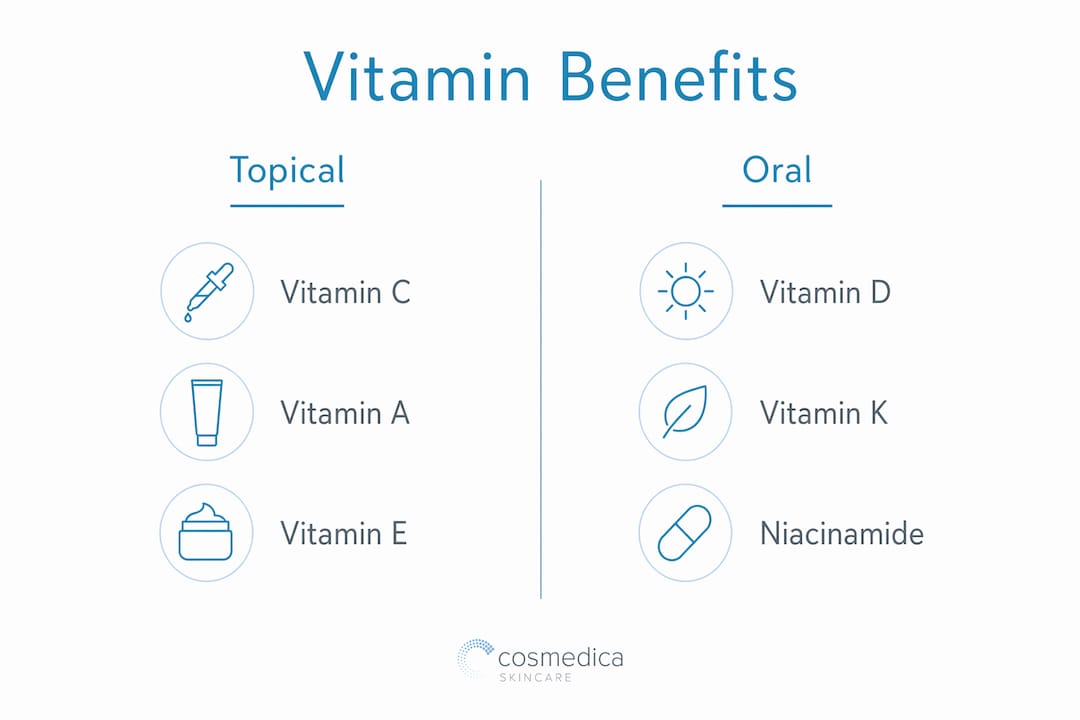
| Vitamin | Primary skin benefit | Best delivery method |
|---|---|---|
| Vitamin C | Antioxidant, brightening, collagen support | Topical serum |
| Vitamin A (retinoids) | Cell renewal, anti-aging, acne | Topical cream or serum |
| Vitamin E | Lipid protection, photoprotection synergy | Topical, often combined |
| Niacinamide (B3) | Barrier repair, redness, sebum control | Topical serum |
| Vitamin D | Hydration, epidermal function | Oral (deficiency correction) |
| Vitamin K | Bruising and redness reduction | Topical, post-procedure |
How do topical and oral vitamins differ in effectiveness?
The delivery method matters more than most people realize, and the research draws a clear line between the two approaches.
Topical application puts vitamins exactly where the skin needs them. Retinoids applied directly to the face reach the dermis and trigger measurable changes in cell turnover within weeks. A well-formulated vitamin C serum penetrates the epidermis and begins neutralizing free radicals at the site of UV exposure. Niacinamide serums reinforce the lipid barrier layer by layer. This targeted delivery is why topical vitamins consistently outperform oral supplements for visible skin improvements in people without a deficiency.
Oral supplementation tells a different story. Oral supplementation benefits skin primarily when it corrects a deficiency. Without a deficiency, the evidence for wrinkle reduction or tone improvement from oral vitamins is limited. Your body prioritizes internal organs when distributing nutrients, so the skin often receives what is left over after other systems are served.
Here is a practical breakdown of when each approach makes sense:
- Use topical vitamins when targeting specific concerns like hyperpigmentation, fine lines, acne, or redness. Topical retinoids, vitamin C serums, and niacinamide treatments deliver localized, measurable results.
- Use oral supplementation when a blood test confirms a deficiency, particularly for vitamin D. Correcting low levels can improve overall skin hydration and barrier function noticeably.
- Combine both approaches for people with dietary gaps or high UV exposure. A diet rich in antioxidant-dense foods like leafy greens, citrus, and nuts supports the skin from the inside while topical products work from the outside.
- Avoid high-dose oral vitamin A unless prescribed by a dermatologist. The toxicity risk is real, and topical retinoids achieve the same skin benefits without the systemic risk.
Pro Tip: If you are unsure whether you have a vitamin D deficiency, ask your doctor for a simple blood panel. Correcting a deficiency often produces noticeable improvements in skin texture and hydration within a few months, without adding a single new product to your routine.
Antioxidant-rich interventions including vitamins significantly increase skin hydration and decrease transepidermal water loss. This means vitamins are not just cosmetic players. They actively support the skin’s ability to hold onto moisture, which is the foundation of a healthy complexion regardless of skin type.
What formulation and usage tips maximize vitamin benefits?
Getting the right vitamins into your routine is only half the equation. How those vitamins are formulated and applied determines whether they actually work.
Vitamin C is notoriously unstable. Topical vitamin C requires a low acidic pH below 3.5 to stabilize and penetrate the skin effectively. Products with a higher pH or poor packaging degrade before reaching the dermis, making them ineffective regardless of the concentration listed on the label. Look for vitamin C serums in opaque or airless packaging, and check that the formula is specifically designed for stability.
- Vitamin C + E + ferulic acid is the gold-standard combination for morning antioxidant protection. Ferulic acid stabilizes both vitamins and amplifies their UV-protective effects. This trio is the reason some serums cost more and deliver more.
- Niacinamide at 5 to 10% works well for most skin types and pairs comfortably with hyaluronic acid, peptides, and ceramides. At higher concentrations, some people experience mild flushing, so starting at 5% is a smart approach.
- Retinoids at night is the standard recommendation because UV exposure degrades retinol and because retinoids increase photosensitivity. Apply your retinoid after cleansing on dry skin, and always follow with sunscreen the next morning.
- Layering order matters. Apply water-based serums like vitamin C and niacinamide before heavier moisturizers. Retinoids go on after a light moisturizer if you are sensitive, or directly on clean skin if your barrier is strong.
Pro Tip: Never mix a high-concentration vitamin C serum with a retinoid in the same application. The low pH of vitamin C can degrade retinol and irritate skin. Use vitamin C in the morning and retinoids at night for the best results from both.
Evidence-based guidelines recommend a morning vitamin C and E serum, a nightly topical retinoid, and consistent daily sunscreen for adults concerned with photoaging. This three-step framework is not complicated, but the consistency is what makes it work. Skipping sunscreen while using antioxidant serums is like wearing a helmet but skipping the seatbelt. Both matter.
How do vitamins address acne, hyperpigmentation, and aging?
Different skin concerns call for different vitamins, and knowing which one to reach for saves a lot of trial and error.
| Skin concern | Best vitamin | Mechanism | Expected timeline |
|---|---|---|---|
| Acne and breakouts | Niacinamide (B3), Vitamin A | Sebum regulation, cell turnover, anti-inflammatory | 4 to 12 weeks |
| Hyperpigmentation | Vitamin C, Niacinamide | Melanin inhibition, barrier support | 8 to 16 weeks |
| Fine lines and photoaging | Vitamin A (retinoids), Vitamin C | Collagen synthesis, cell renewal | 12 to 24 weeks |
| Dryness and sensitivity | Vitamin D, Niacinamide | Barrier repair, hydration support | 4 to 8 weeks |
| Post-procedure redness | Vitamin K, Niacinamide | Redness reduction, anti-inflammatory | 2 to 6 weeks |
Acne responds well to a combination of niacinamide and retinoids. Niacinamide reduces sebum production and calms the inflammation that makes breakouts worse, while retinoids prevent the clogged pores that start the cycle. The clinical comparison of niacinamide to clindamycin for acne is particularly compelling because it positions a vitamin-based ingredient as a genuine alternative to antibiotic treatments, which carry their own long-term concerns.
Hyperpigmentation is where vitamin C really shines. Ascorbic acid inhibits tyrosinase, the enzyme responsible for melanin production, which means it addresses dark spots at the source rather than just masking them. Niacinamide complements this by reducing the transfer of melanin to skin cells, creating a one-two approach that brightens tone more effectively than either ingredient alone.
Photoaging is the skin concern with the deepest evidence base for vitamins. Retinoids increase collagen production and speed up the shedding of damaged surface cells, which visibly smooths texture and reduces fine lines over time. Vitamin C supports collagen synthesis through a separate pathway, making the combination of both vitamins particularly effective for mature or sun-damaged skin.
Sensitive and eczema-prone skin benefits most from niacinamide and vitamin D. Niacinamide strengthens the ceramide-rich lipid barrier that keeps irritants out and moisture in. Vitamin D deficiency is disproportionately common in people with eczema, and correcting it often reduces flare frequency and severity. The role of antioxidants in skincare extends here too, since oxidative stress is a known trigger for inflammatory skin conditions.
Key takeaways
Vitamins improve skin health through specific, evidence-backed mechanisms, and consistent topical use of Vitamin C, Vitamin A, and Niacinamide delivers the most reliable results for the widest range of skin concerns.
| Point | Details |
|---|---|
| Topical beats oral for visible results | Topical vitamins deliver targeted benefits; oral supplements mainly help when correcting a deficiency. |
| Vitamin C needs proper formulation | Effective vitamin C serums require a pH below 3.5 and stable, opaque packaging to work. |
| Synergy amplifies protection | Combining Vitamin C, E, and ferulic acid provides stronger UV defense than any single vitamin alone. |
| Match vitamins to skin concerns | Use retinoids for aging and acne, vitamin C for brightening, and niacinamide for barrier repair and redness. |
| Sunscreen is non-negotiable | Topical antioxidants augment but never replace SPF protection against UV-induced skin damage. |
Why I think most people are using vitamins in the wrong order
Here is something I have noticed after years of looking at skincare routines: most people load up on the right ingredients but apply them in the wrong sequence, at the wrong time of day, or without the sunscreen that makes the whole system work. They buy a great vitamin C serum, use it at night, skip SPF in the morning, and then wonder why they are not seeing results. The vitamins are not failing. The routine is.
The shift I find most exciting in skincare right now is the move away from “anti-aging” as a goal and toward what the industry is starting to call skin longevity. That means using vitamins not just to reverse damage but to build resilience over time. Vitamin C in the morning is not just about brightening today. It is about reducing the cumulative oxidative load that accelerates aging over decades. Retinoids at night are not just about smoothing lines. They are about maintaining the skin’s renewal capacity as cell turnover naturally slows with age.
The misconception I push back on most often is the idea that more is better. Using a 20% vitamin C serum, a high-dose retinoid, and a 10% niacinamide treatment all at once does not give you three times the results. It gives you a compromised barrier and a lot of irritation. The evidence consistently supports moderate concentrations used consistently over time. A 5% niacinamide serum used every day for three months outperforms a 10% formula used sporadically because you kept stopping due to irritation.
My honest recommendation is to build your routine around three pillars: a stable vitamin C serum in the morning with SPF, a retinoid three to four nights per week to start, and a niacinamide treatment whenever your skin needs calming or barrier support. That is it. That framework covers antioxidant protection, cell renewal, and barrier repair, which are the three things vitamins do best for skin.
— Thomas
How Cosmedica-skincare puts these vitamins to work
At Cosmedica-skincare, we have built our vitamin-focused line around the same evidence-based principles covered in this article. Our Vitamin C Super Serum is formulated at the right pH for stability and real skin penetration, so you are not paying for a product that degrades in the bottle. For cell renewal and anti-aging support, our retinol skin care collection offers graduated strengths so you can start gently and build up without wrecking your barrier. And our 10% Niacinamide + Zinc Treatment Serum targets redness, sebum, and barrier repair in one formula. All products are cruelty-free, dermatologist-tested, and designed to work together as a layered routine.
FAQ
What does vitamin C actually do for skin?
Vitamin C neutralizes free radicals, stimulates collagen production, and inhibits melanin synthesis to reduce dark spots and brighten overall skin tone. It is most effective when applied topically in a stabilized, low-pH formula.
Can I use vitamin C and retinol together?
Do not apply them at the same time. Use vitamin C in the morning and retinol at night to avoid pH conflicts that degrade both ingredients and increase the risk of irritation.
How long before I see results from topical vitamins?
Niacinamide shows visible improvements in 4 to 8 weeks, while retinoids and vitamin C typically require 8 to 24 weeks of consistent use for significant changes in texture, tone, and fine lines.
Do oral vitamin supplements improve skin?
Oral supplements improve skin primarily when correcting a deficiency, particularly vitamin D. Without a confirmed deficiency, the evidence for visible skin improvements from oral vitamins is limited.
Is niacinamide safe for sensitive skin?
Yes. Niacinamide is one of the most well-tolerated active ingredients in skincare and is suitable for sensitive, acne-prone, and dry skin types. Starting at 2 to 5% concentration minimizes any risk of mild flushing.