

Vitamin C for Dark Spots: What the Science Actually Says
Topical vitamin C genuinely helps fade dark spots and, more reliably, prevents new ones from forming. The mechanism is specific: ascorbic acid interacts with copper ions at the active site of tyrosinase, the enzyme that drives melanin production, slowing pigment synthesis at the source. A Bayesian meta-analysis of 31 clinical studies confirms vitamin C reduces UV-induced pigmentation in a dose-dependent way, though it works best as a preventive antipigmenting compound rather than a fast eraser of existing spots.
Here’s what that means practically:
- Use it daily in the morning to block new pigmentation triggered by UV exposure.
- Expect gradual fading of existing spots over 8–12 weeks, not overnight results.
- Formulation matters enormously — an unstable or poorly packaged product may deliver little active ingredient to your skin.
- Pair it with SPF every single day or you’re working against yourself.
Key Takeaways
Topical vitamin C reduces dark spots by inhibiting tyrosinase and neutralizing UV-triggered free radicals, with measurable improvements typically appearing between weeks 8 and 12 of consistent daily use.
| Point | Details |
|---|---|
| Mechanism of action | Vitamin C inhibits tyrosinase by binding its copper ions, reducing melanin synthesis at the source. |
| Best evidence window | A 12% vitamin C serum showed significant spot improvements at day 56 and day 84 in clinical evaluation. |
| Formulation non-negotiables | Choose airless or opaque packaging, pH 2.5–3.5 for L-ascorbic acid, and look for vitamin E and ferulic acid alongside it. |
| When to escalate | After 12 weeks of consistent use with daily SPF and no visible change, consult a dermatologist about stronger options. |
| Cosmedica-skincare option | The Super Serum Set offers a stable, properly packaged vitamin C formula aligned with the criteria in this guide. |
Table of Contents
- How does vitamin C actually reduce dark spots?
- Which vitamin C form should you choose, and why does packaging matter?
- What concentration and pH should you look for?
- How to use vitamin C for dark spots, step by step
- What do clinical studies show, and when will you see results?
- What fades dark spots faster than vitamin C?
- Which ingredients pair well with vitamin C?
- Is vitamin C safe for all skin types, and what about side effects?
- The part most people get wrong about vitamin C
- Cosmedica-skincare’s vitamin C serums are built for exactly this routine
- Sources
- FAQ
How does vitamin C actually reduce dark spots?
Vitamin C fights hyperpigmentation through two complementary pathways. The first is direct: it disrupts tyrosinase activity by binding to the enzyme’s copper ions, which cuts off the catalytic reaction that converts tyrosine into melanin. Less tyrosinase activity means less melanin deposited in the skin, which is exactly what you want when dealing with post-inflammatory marks, sun spots, or melasma.
The second pathway is antioxidant-driven. UV radiation generates free radicals that trigger molecular signaling cascades, including AP-1 activation, which ramps up matrix metalloproteinases (MMPs) and damages collagen while also stimulating melanocytes. Vitamin C neutralizes those free radicals before they can set off that chain reaction. A PMC review on topical vitamin C mechanisms describes this photoprotective effect as a key reason daily use reduces photo-induced pigmentation over time.
Penetration is the third piece of the puzzle. For vitamin C to inhibit tyrosinase, it needs to reach the viable epidermis and upper dermis where melanocytes live. That’s why concentration, pH, and vehicle all affect how much active ingredient actually gets there.

Pro Tip: Apply vitamin C to clean, slightly damp skin. A thin layer of water on the surface can actually help L-ascorbic acid penetrate faster than applying it to completely dry skin.
Which vitamin C form should you choose, and why does packaging matter?
The form of vitamin C in your serum shapes everything: potency, stability, and how well it absorbs.
L-ascorbic acid (LAA) is the gold standard. It’s the biologically active form, directly inhibits tyrosinase, and has the most clinical evidence behind it. The catch? It oxidizes quickly when exposed to air, light, or metal ions. You’ve probably seen this as a serum turning yellow or orange, which signals degraded potency.
Common derivatives offer more stability at the cost of some potency:
- Magnesium ascorbyl phosphate (MAP): Water-soluble, gentler, and more stable than LAA. Converts to ascorbic acid in the skin, though conversion efficiency varies.
- Ascorbyl glucoside: Stable and well-tolerated, particularly useful for sensitive skin types.
- Ascorbyl palmitate: Fat-soluble, but evidence for anti-pigmentation efficacy is weaker than LAA or MAP.
A PMC study on vitamin C instability confirms that reducing water content, adding antioxidants like vitamin E and ferulic acid, and using encapsulation or anhydrous formulations are the most effective strategies for preserving potency. An anhydrous L-ascorbic acid formulation studied in a small clinical cohort stayed colorless and stable while producing measurable lightening of pigmentary spots over 28–56 days.
What to look for on the label and packaging:
- Airless pump or opaque bottle (no clear glass dropper bottles)
- LAA listed in the first half of the ingredient list, or a validated derivative like MAP or ascorbyl glucoside
- Vitamin E (tocopherol) and ferulic acid listed alongside LAA — they stabilize it and boost efficacy
- No strong discoloration when you first open the product
Pro Tip: Store your vitamin C serum in a cool, dark place, ideally a drawer rather than a sunny bathroom shelf. Heat and light accelerate oxidation even through opaque packaging.
What concentration and pH should you look for?
Concentration and pH work together to determine how much free ascorbic acid your skin actually receives.
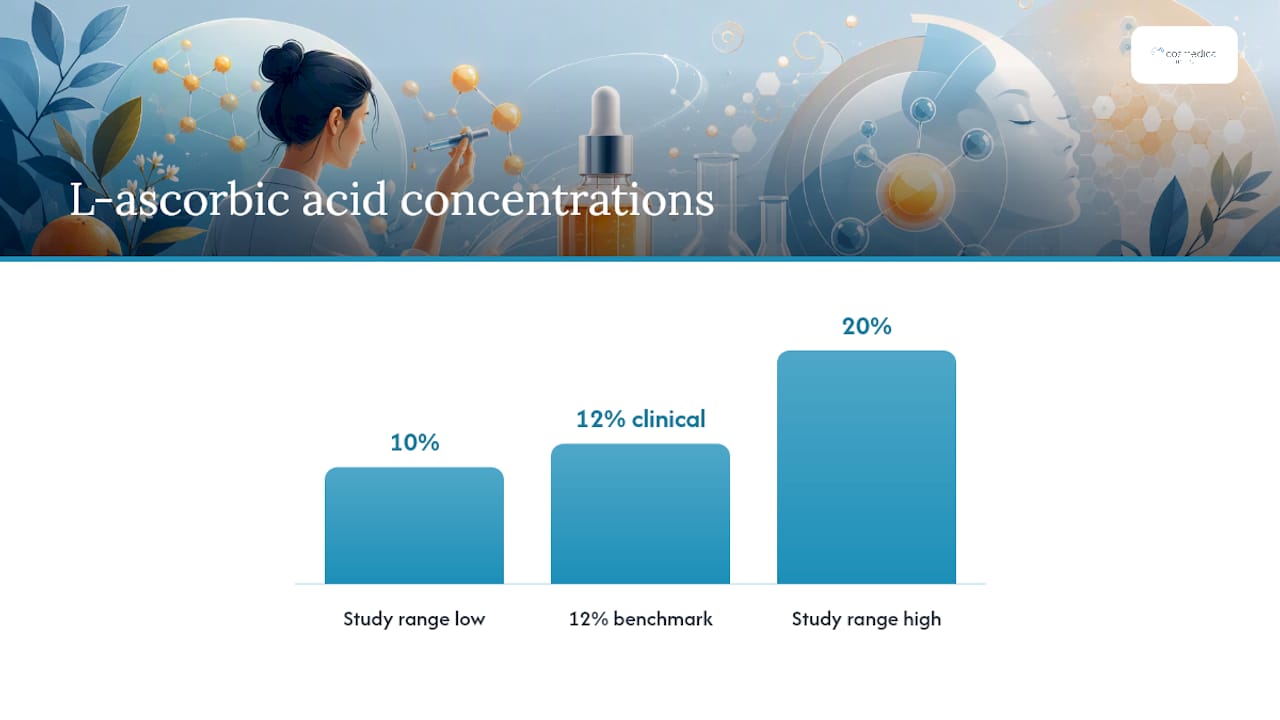
For L-ascorbic acid, clinical research suggests concentrations in the 10–20% range are most commonly used in studies showing pigmentation benefits. A 12% pure vitamin C serum showed statistically significant improvements in dark spot number, intensity, and overall skin tone evenness at both day 56 and day 84 versus baseline — a solid benchmark for what a well-formulated mid-range concentration can do.
pH matters because L-ascorbic acid is only fully active in its protonated (acidic) form. A pH between 2.5 and 3.5 keeps it stable and maximizes skin penetration. Above pH 4, absorption drops off noticeably. Derivatives like MAP and ascorbyl glucoside are more pH-flexible, which makes them easier to formulate and gentler on sensitive skin.
Practical checklist when shopping:
- LAA serums: look for pH 2.5–3.5 (brands sometimes list this; if not, check reviews or contact the brand)
- Derivatives: pH flexibility means they can sit in a more skin-friendly 5–7 range
- Vehicle: serums penetrate better than creams for active delivery; anhydrous formulations offer the best stability for LAA specifically
- Avoid formulas with high concentrations of other low-pH acids in the same product — they can increase irritation without improving efficacy
How to use vitamin C for dark spots, step by step
Morning is the best time for vitamin C. Applied before sunscreen, it adds an antioxidant layer that works alongside SPF to neutralize free radicals UV light generates. That combination is more protective than sunscreen alone.
Morning routine:
- Cleanse with a gentle, pH-balanced face wash.
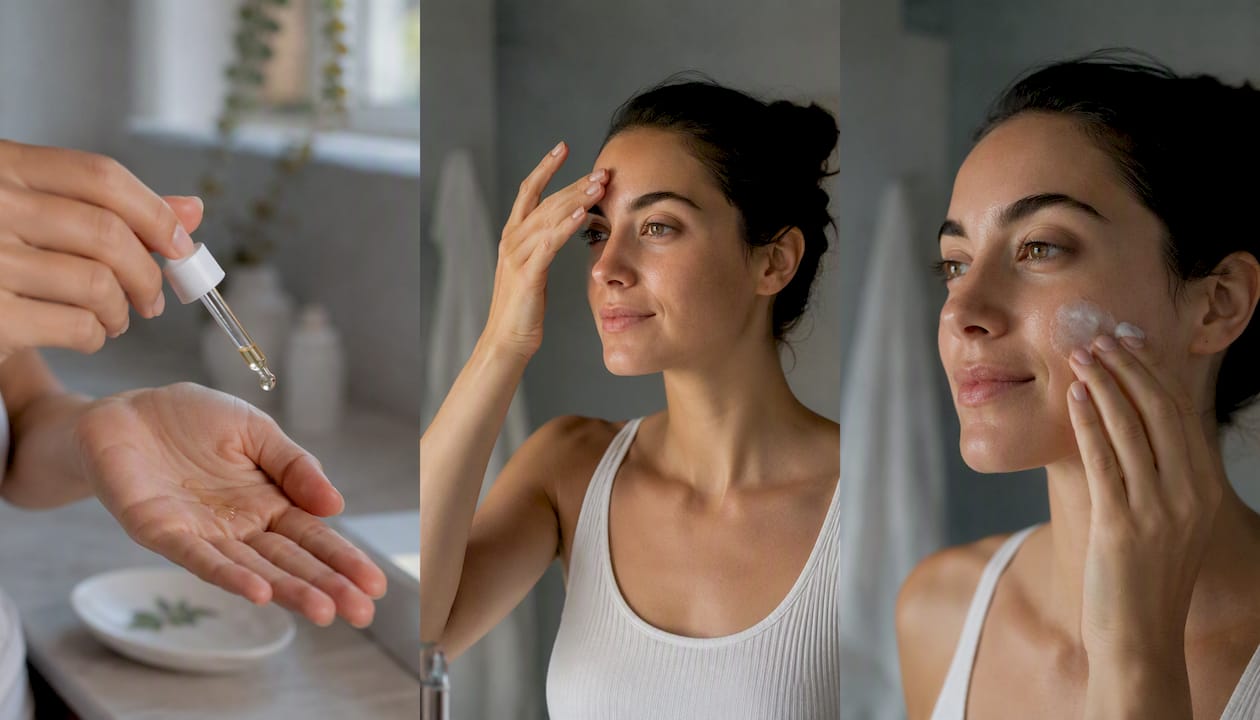
- Apply vitamin C serum to dry or slightly damp skin. Use 3–5 drops and press gently into the face and neck.
- Wait 60–90 seconds for it to absorb before the next step.
- Apply moisturizer.
- Finish with broad-spectrum SPF 30 or higher. No exceptions.
Evening use: You can use vitamin C at night, especially if your skin tolerates it well. If you’re also using retinoids, apply vitamin C first, wait a few minutes, then apply retinol. Alternatively, alternate nights to reduce the chance of irritation.
Introducing it slowly: Start with 2–3 applications per week for the first two weeks, then build to daily use. This gives your skin barrier time to adjust, especially with higher-concentration LAA serums.
Before any professional treatment (microneedling, laser, chemical peel), pause vitamin C for at least 48–72 hours beforehand and for several days after, until the skin barrier has recovered. Applying an active acid to compromised skin increases irritation risk significantly.
Pro Tip: Sunscreen isn’t optional when you’re treating pigmentation. UV exposure is the single biggest trigger for new dark spots and will undo weeks of progress. Think of SPF as the other half of your vitamin C routine.
What do clinical studies show, and when will you see results?
The honest answer: vitamin C is a reliable preventive and a modest, gradual lightening agent. It’s not a rapid depigmenting treatment.
The Bayesian meta-analysis of 31 studies frames it clearly: vitamin C works best at preventing UV-induced pigmentation from forming in the first place. For existing spots, improvement is real but takes time. The 12% vitamin C serum clinical evaluation reported statistically significant reductions in dark spot number and intensity at day 56 and day 84. Most well-designed trials use 28–84 day windows, which aligns with what you should expect at home.
A reasonable timeline looks like this: slight brightening in the first 4 weeks, more noticeable spot fading by weeks 8–12, and continued improvement with consistent use beyond that. Progress is gradual enough that photographing your skin under the same lighting every two weeks helps you see changes that are easy to miss day-to-day.
If you’ve used a properly formulated vitamin C serum consistently for 12 weeks with daily SPF and seen no meaningful change, that’s a signal to consult a dermatologist. Stubborn melasma, deep dermal pigmentation, or post-inflammatory hyperpigmentation from acne may need a stronger intervention.
What fades dark spots faster than vitamin C?
Vitamin C is a daily maintenance tool, not the fastest route to clear skin. These options work more quickly, with different trade-offs:
- Hydroquinone (2–4%): The most studied topical depigmenting agent. Directly inhibits tyrosinase more potently than vitamin C. Prescription-strength versions (4%) work faster but require medical supervision and shouldn’t be used continuously for more than 3–4 months.
- Tranexamic acid: Increasingly popular for melasma. A controlled study found that vitamin C 20% combined with microneedling produced periorbital hyperpigmentation improvement comparable to tranexamic acid plus microneedling — meaning vitamin C can reach that tier when delivery is enhanced.
- Chemical peels (glycolic, lactic, TCA): Speed up cell turnover and physically remove pigmented surface cells. Results in weeks, but downtime and irritation risk are real, especially for deeper peels.
- Microneedling: Creates micro-channels that dramatically increase active ingredient penetration. Often combined with vitamin C or tranexamic acid for amplified results.
- Laser treatments (Q-switched Nd:YAG, fractional lasers): Fastest results for stubborn spots, but highest cost and downtime. Require a trained provider and careful post-care.
For darker skin tones (Fitzpatrick IV–VI), aggressive peels and certain lasers carry a risk of post-inflammatory hyperpigmentation. Dermatologist supervision is strongly recommended before pursuing any of these.
Pro Tip: If you’re considering microneedling, adding a vitamin C serum to the protocol can meaningfully boost results without jumping straight to more aggressive laser treatments. It’s a smart middle step.
Which ingredients pair well with vitamin C?
Vitamin C rarely works alone at its best. A few pairings genuinely amplify its effects:
- Vitamin E + ferulic acid: The classic trio. Ferulic acid stabilizes both vitamins C and E, and the combination has been shown to increase photoprotective efficacy. Look for all three together in a single serum.
- Niacinamide: Works on a different step of the pigmentation pathway (inhibits melanosome transfer to keratinocytes). Pairs well with vitamin C, though very high concentrations of niacinamide alongside low-pH LAA can occasionally cause temporary flushing in sensitive skin. Using them in separate steps (vitamin C first, niacinamide in moisturizer) sidesteps this.
- AHAs/BHAs (glycolic, lactic, salicylic acids): Exfoliation removes pigmented surface cells and helps vitamin C penetrate more effectively. Use them on alternating nights or at different times of day to avoid stacking too many actives at once.
- Hyaluronic acid: No conflict, and it helps with tolerability. Layering a vitamin C and hyaluronic acid formula keeps skin hydrated while the vitamin C works.
- Retinoids: Powerful combination for both pigmentation and aging, but use them carefully. Apply vitamin C in the morning and retinol at night, or alternate nights if your skin is sensitive.
Mixing caution: Don’t layer a low-pH LAA serum directly on top of a strong AHA or BHA in the same step. The combined acidity can push irritation past what your barrier handles comfortably.
Is vitamin C safe for all skin types, and what about side effects?
Generally, yes.
Safety checklist:
- Patch test any new vitamin C product on your inner arm for 48 hours before applying to your face.
- Start at a lower concentration (10% or a gentler derivative) if you have reactive or sensitive skin.
- Never apply vitamin C to actively broken, sunburned, or freshly exfoliated skin.
- Stop use immediately if you experience persistent burning, swelling, or hives.
- Wear SPF 30+ every morning without exception.
For darker skin tones: Vitamin C itself is generally safe and doesn’t carry the PIH risk that aggressive peels or certain lasers do. The caution is about what you combine it with. Avoid pairing high-concentration LAA with strong chemical exfoliants in the same routine, and get professional guidance before any in-office treatment.
Pregnancy: Topical vitamin C is widely considered safe during pregnancy, but always confirm with your OB-GYN before adding any new active to your routine while pregnant or nursing.
Stop use and consult a dermatologist if you experience: persistent burning that doesn’t subside within 30 minutes of application, visible swelling or hives, or any sign of an allergic contact reaction. These are not normal adjustment responses.
The part most people get wrong about vitamin C
Here’s an opinion worth sitting with: most people who “tried vitamin C and it didn’t work” were using the wrong product, not the wrong ingredient.
A clear serum in a glass dropper bottle sitting on a sunny bathroom shelf has likely oxidized before you even open it. And stopping after three weeks because you don’t see dramatic fading? That’s the most common way to miss results that were actually coming.
Vitamin C’s real power is cumulative and preventive. Think of it less like a spot treatment and more like a daily investment in your skin’s future. The PMC review is clear that it’s most effective as a daily antioxidant and maintenance agent, not a clinical-strength depigmenter. That’s not a limitation worth dismissing. It means that with the right formulation, consistent use, and SPF, you’re actively preventing the spots that would have formed over the next decade.
The people who get the most from vitamin C are the ones who treat it like sunscreen: non-negotiable, every morning, for the long haul.
Cosmedica-skincare’s vitamin C serums are built for exactly this routine
Cosmedica-skincare formulates its vitamin C serums with the stability and delivery criteria this guide outlines: properly dosed active vitamin C, airless or opaque packaging to protect potency, and dermatologist-tested formulations suitable for all skin types, including sensitive and darker skin tones.
The Super Serum Set is a practical starting point if you want a complete brightening routine without piecing together individual products. Apply the vitamin C serum each morning after cleansing, follow with moisturizer and SPF, and give it a full 8–12 weeks before evaluating results. Cosmedica-skincare’s formulas are cruelty-free, vegan, and affordable, so committing to a consistent trial doesn’t require a significant financial stretch. Realistic results take time, and that’s exactly what the clinical evidence supports.
Sources
- Topical Vitamin C and the Skin: Mechanisms of Action and Clinical Applications - PMC
- Bayesian meta-analysis on topical vitamin C and pigmentation (PubMed)
- Clinical Efficacy of a 12% Pure Vitamin C Serum Across All Skin Phototypes: An Integrated In Vitro–In Vivo Evaluation | Dermatology and Therapy | Springer Nature Link
- Topical Tranexamic Acid Versus Topical Vitamin C With Microneedling in Periorbital Hyperpigmentation; Comparative Study
This article is general information, not a substitute for advice from a qualified doctor. Consult a qualified healthcare professional about your own circumstances before acting on anything here.
FAQ
Does vitamin C actually fade existing dark spots?
Yes, though gradually.
How long does vitamin C take to fade dark spots?
Most people see noticeable fading between weeks 8 and 12. A 12% vitamin C serum study reported statistically significant improvements at day 56 and day 84 versus baseline.
What fades dark spots the fastest?
Prescription hydroquinone, chemical peels, microneedling, and laser treatments work faster than topical vitamin C. Vitamin C combined with microneedling can match tranexamic acid in clinical settings, making it a strong mid-tier option.
Does a vitamin C serum work for melasma?
Vitamin C can help reduce the appearance of melasma over time, particularly as a preventive agent against UV-triggered flares. Severe or deep melasma usually requires a dermatologist-supervised protocol that may include hydroquinone, tranexamic acid, or in-office treatments alongside daily vitamin C use.