

Vitamin C for Skin: What It Does and How to Use It
TL;DR:
- Topical vitamin C is a well-supported antioxidant that improves skin tone, firmness, and pigmentation with consistent use. It works best in stable formulations with proper packaging at a concentration of 10 to 20 percent, applied daily in the morning before sunscreen. Combining topical serum with oral vitamin C can enhance overall skin health, but targeted cosmetic effects are achieved mainly through topical application.
Topical vitamin C (primarily L-ascorbic acid and its derivatives) is one of the most clinically supported ingredients in skincare. It acts as a potent antioxidant, serves as a cofactor for collagen synthesis, helps fade dark spots by inhibiting melanin production, and strengthens the protective effect of your sunscreen. The practical takeaway is simple: apply an L-ascorbic acid serum every morning after cleansing and before sunscreen, and give it consistent use for several weeks before expecting visible changes in tone and texture.
We know that sounds like a lot of claims for one ingredient. The good news is that the evidence actually holds up, and the how-to is straightforward once you understand the basics.
Table of Contents
- What does vitamin C actually do for your skin?
- Topical vs. oral vitamin C: which one actually moves the needle for skin?
- Which form of vitamin C in a serum is actually stable and effective?
- How to build vitamin C into your morning routine
- Side effects, safety, and what not to mix with vitamin C
- How to pick a vitamin C product that actually works
- What the science actually says: a quick evidence summary
- Key Takeaways
- Why I think most people are using vitamin C wrong
- Cosmedica-skincare’s vitamin C serums follow the rules this article lays out
- Useful sources and further reading
- FAQ
What does vitamin C actually do for your skin?
Think of vitamin C as your skin’s personal bodyguard and construction crew rolled into one. On the protection side, it neutralizes reactive oxygen species (free radicals) generated by UV light, pollution, and everyday metabolic activity. On the building side, it acts as a cofactor for prolyl and lysyl hydroxylases, the enzymes that stabilize collagen fibers, and it also promotes collagen gene expression directly.

Antioxidant action. UV exposure depletes the skin’s natural antioxidant reserves, including ascorbic acid and vitamin E. Topical vitamin C replenishes that supply in the epidermis and dermis, where it can intercept free radicals before they damage proteins, lipids, and DNA. Sunscreens are only partially effective at blocking the free radicals UV produces, so vitamin C neutralizes what gets through and also reduces activation of matrix metalloproteinase-1 (MMP-1), the enzyme most responsible for UV-driven collagen breakdown.
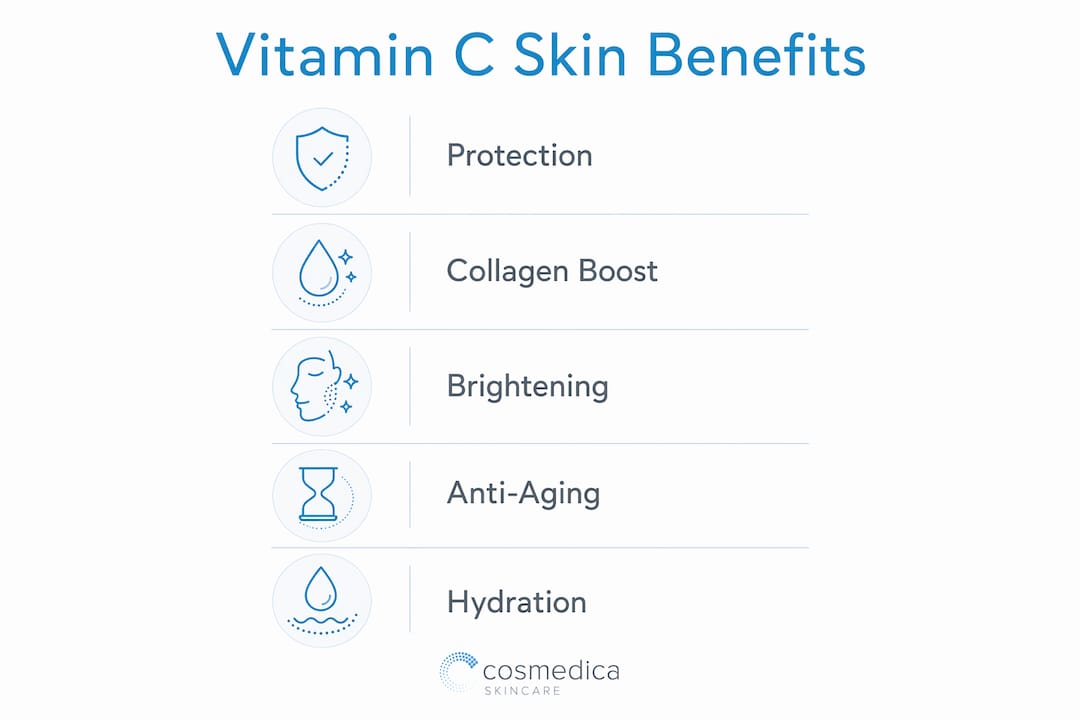
Collagen support. Vitamin C stabilizes collagen through hydroxylation of proline and lysine residues, promotes collagen gene expression, and may help prevent collagen degradation. The result over time is firmer, more resilient skin.
Antipigment effect. Vitamin C inhibits tyrosinase, the key enzyme in melanin synthesis, and has been shown to decrease melanin production both in cultured melanocytes and in clinical studies. The effect is real but gradual, and it works best as a preventive measure alongside sunscreen rather than as a standalone spot corrector.
Stat to know: Clinical trials using 5–10% topical vitamin C formulations have shown measurable improvements in wrinkle scores and pigmentation after 12 weeks of consistent use.
The antioxidant and photoprotective effects are well-documented in systematic reviews, though researchers note that formulation variability and stability challenges make it hard to compare results across products. The mechanism is solid; the product you choose still matters.
Topical vs. oral vitamin C: which one actually moves the needle for skin?
Both matter, but they do different jobs. Topical application achieves higher local concentrations in the epidermis and dermis than oral intake can deliver, which is why dermatologists and researchers consistently prefer topical vitamin C for targeted cosmetic outcomes.
What topical vitamin C delivers:
- Direct antioxidant protection in the epidermis, where UV damage is most acute
- Localized collagen stimulation in the dermis
- Pigmentation improvement through tyrosinase inhibition at the site of melanin production
- Synergistic photoprotection when layered under broad-spectrum sunscreen
What oral vitamin C delivers:
- Systemic antioxidant support throughout the body
- Nutritional support for overall skin barrier integrity and wound healing
- A baseline that prevents deficiency-related skin fragility (think: scurvy-level collagen breakdown)
Oral vitamin C is genuinely useful for general health, but it is unlikely to replicate the localized effects of a well-formulated serum. The Linus Pauling Institute notes that topical application uniquely supports targeted cosmetic outcomes like brightening and collagen support in ways that supplementation alone does not match.
Pro Tip: Combine both approaches: eat vitamin C-rich foods or take a supplement for overall health, and use a topical serum for the cosmetic outcomes you actually want to see in the mirror. They complement each other rather than compete.
For a deeper look at how vitamins work differently when applied topically versus consumed, the role of vitamins in skincare is worth exploring.
Which form of vitamin C in a serum is actually stable and effective?
Not all vitamin C in a bottle is created equal. The form, the pH, and the packaging all affect whether the ingredient reaches your skin in an active state.

L-ascorbic acid (LAA)
This is the most studied form and the one used in the majority of clinical trials. It is water-soluble and highly bioavailable, but it oxidizes quickly when exposed to light, heat, or air. LAA works best at a low pH (below 3.5) for skin penetration, which is effective but can cause tingling or irritation, especially at concentrations above 15%.
Magnesium ascorbyl phosphate (MAP)
MAP is a water-soluble, more stable derivative that converts to ascorbic acid in the skin. It works at a neutral pH, making it far gentler for sensitive skin. The trade-off is that conversion efficiency varies, so the effective dose reaching the skin may be lower than with LAA.
Ascorbyl palmitate and other esterified derivatives
These oil-soluble forms are often used in richer formulations. They are more stable than LAA but have less clinical evidence behind them for skin brightening and collagen effects specifically.
Packaging matters as much as the formula. Vitamin C oxidizes when exposed to light, air, and heat. A serum that has turned yellow or orange has already lost significant potency. Look for dark or opaque glass bottles with airless pumps, and store your serum in a cool, dark place, not on a sunny bathroom shelf.
Combining vitamin C with vitamin E and ferulic acid does more than just add antioxidants. This pairing stabilizes the formula and has been shown to enhance photoprotective effects beyond what vitamin C alone provides.
Pro Tip: If your skin is sensitive or reactive, start with a MAP-based formula or a low-concentration LAA (around 5–10%) rather than jumping straight to a 20% LAA serum. Your skin will thank you for the gentler introduction.
How to build vitamin C into your morning routine
Getting the timing and layering right makes a real difference in how well vitamin C works. Here is the routine that aligns with dermatologist guidance and the clinical evidence.
Step-by-step morning routine
- Cleanse your face with a gentle cleanser to remove overnight buildup.
- Apply your vitamin C serum to clean, dry skin. Use 3–5 drops and press gently into the skin rather than rubbing.
- Layer any additional serums (thinnest to thickest consistency) if you use them.
- Apply moisturizer to seal in hydration.
- Finish with broad-spectrum SPF 30 or higher. This is non-negotiable. Vitamin C and sunscreen work together: the SPF blocks UV, and the vitamin C neutralizes free radicals that get through.
For a more detailed layering guide, the vitamin C skincare routine resource walks through timing and product pairings step by step.
Concentrations by skin type
| Skin type | Recommended concentration | Notes |
|---|---|---|
| Sensitive / reactive | 5–10% LAA or MAP | Start every other day; build to daily |
| Normal / combination | 10–15% LAA | Daily use once tolerance is established |
| Oily / resilient | 15–20% LAA | Can tolerate lower pH formulas |
What to expect and when
| Timeline | What you may notice |
|---|---|
| 2 weeks | Mild tingling on first uses normalizes; skin may look slightly brighter |
| — | Gradual improvement in overall tone and early reduction in dullness |
| 12 weeks | Measurable changes in pigmentation and fine lines with consistent daily use |
Harvard Health confirms that visible results typically require about 3 months of consistent use, so patience is part of the protocol.
Pro Tip: Morning is the right time for vitamin C because that is when your skin faces its biggest oxidative challenge: UV, pollution, and environmental stress. Using it at night is not harmful, but you lose the sunscreen-synergy benefit that makes topical vitamin C so effective.
Side effects, safety, and what not to mix with vitamin C
Vitamin C has a well-established safety profile in adults, but a few things are worth knowing before you start.
Common side effects
Mild tingling on the first few applications of L-ascorbic acid is normal and usually temporary. If you experience burning, extensive redness, or peeling, that is a signal to stop and either switch to a lower concentration or try a derivative like MAP. Dermatologists recommend starting with lower concentrations or alternate-day use for sensitive skin.
Who should be cautious
- Sensitive skin, rosacea, or active eczema: Start with a 5% concentration and patch test first.
- Pregnancy: Topical vitamin C is generally considered low-risk, but always check with your healthcare provider. For broader guidance on skincare during pregnancy, a dedicated resource can help you navigate what is safe.
- Children: Limited study data exists for pediatric use; consult a clinician.
How to patch test
Apply a small amount of the serum to the inside of your forearm. Wait 24 hours. If no redness, itching, or swelling appears, it is generally safe to use on your face.
Ingredient interactions: myths vs. reality
Retinoids: You do not have to choose between vitamin C and retinol, but using both in the same application can increase irritation for some people. A practical approach is to use vitamin C in the morning and retinol at night.
AHAs and BHAs (acids): Layering vitamin C directly on top of an exfoliating acid can push the pH too low and increase irritation. Separate them by time of day or alternate days.
Niacinamide: This is widely misunderstood. The concern that niacinamide and vitamin C cancel each other out is largely a myth. When both are present in a well-formulated product, they are generally safe to use together. If you prefer to be cautious, apply them at different times of day. Cosmedica-skincare’s niacinamide + zinc serum is designed to complement a vitamin C routine when used at separate times.
How to pick a vitamin C product that actually works
Shopping for a vitamin C serum can feel like reading a foreign language. Here is what actually matters on the label.
Your shopping checklist
- Active form: Look for “ascorbic acid,” “L-ascorbic acid,” or a recognized derivative like magnesium ascorbyl phosphate (MAP) near the top of the ingredient list.
- Concentration: Aim for 10–20% for most skin types; 5–10% for sensitive skin. Many brands do not list the percentage on the label, so check the product page or brand website.
- Complementary antioxidants: Vitamin E (tocopherol) and ferulic acid in the same formula stabilize vitamin C and boost its photoprotective effect.
- Packaging: Opaque or dark glass bottle with an airless pump. Avoid clear plastic packaging.
- Expiry and period-after-opening (PAO): Check the open-jar symbol on the packaging for how many months the product stays effective after opening.
What to avoid
Skip products with vague ingredient listings that do not specify the form of vitamin C. Be cautious with very long ingredient lists if you have sensitive skin, since more potential irritants means more chances for a reaction. And if the serum in the bottle is already dark orange or brown when you open it, it has oxidized and is unlikely to deliver meaningful results.
Matching formula to skin type
For brightening and anti-aging goals on normal to oily skin, L-ascorbic acid at 15–20% with vitamin E and ferulic acid is the gold standard. For sensitive skin or anyone new to vitamin C, a MAP-based formula or a lower-concentration LAA serum is a smarter starting point. The benefits of vitamin C for brightening skin go deeper on matching the right formula to your specific concern.
Pro Tip: Store your vitamin C serum in a drawer or cabinet, not on your bathroom counter. Heat and humidity accelerate oxidation. Some people refrigerate their serum to extend its shelf life, which works well for water-based formulas.
What the science actually says: a quick evidence summary
The clinical evidence for topical vitamin C is genuinely solid in several areas, though it is worth understanding where the research is strong and where gaps remain.
What studies show
| Outcome | Study design / duration | Evidence strength |
|---|---|---|
| Antioxidant / photoprotection | Multiple controlled trials, 4–12 weeks | Strong; consistent across studies |
| Pigmentation reduction | Randomized trials, 8–12 weeks | Moderate; effect size varies by formulation |
| Wrinkle / photoaging improvement | Controlled trials, 12 weeks | Moderate; measurable but modest changes |
| Collagen stimulation | In vitro and some clinical data | Mechanistically strong; fewer large RCTs |
Systematic reviews confirm antioxidative, photoprotective, anti-aging, and antipigmentary effects, with clinical trials showing measurable changes in 8–12 weeks for pigmentation and photoaging outcomes. The collagen mechanism is well-established biochemically, though large long-term randomized controlled trials are still limited.
The main research limitations are formulation variability (different forms, concentrations, and pH levels make cross-study comparisons difficult) and the fact that penetration and stability in real-world products remain active areas of study. That said, the weight of evidence supports topical vitamin C as one of the better-studied active ingredients in over-the-counter skincare.
Key Takeaways
Topical vitamin C is most effective when applied daily in the morning before sunscreen, using a stable formula at 10–20% L-ascorbic acid or a recognized derivative, with visible results typically emerging after several weeks of consistent use.
| Point | Details |
|---|---|
| Morning use is optimal | Apply vitamin C after cleansing and before sunscreen to maximize antioxidant and photoprotective synergy. |
| Expect results around 12 weeks | Measurable improvements in pigmentation and fine lines appear after 8–12 weeks of daily use in clinical trials. |
| Form and packaging matter | Choose L-ascorbic acid or MAP in opaque, airless packaging; discard any serum that has turned yellow or orange. |
| Sensitive skin needs a gentler start | Begin with 5–10% concentration or a MAP derivative, applied every other day, and patch test before full use. |
| Cosmedica-skincare’s approach | Cosmedica-skincare offers dermatologist-tested, cruelty-free vitamin C formulations designed to meet the concentration, stability, and packaging standards described in this article. |
Why I think most people are using vitamin C wrong
Most skincare content frames vitamin C as a brightening serum you add when you want a “glow.” That framing undersells it and, ironically, leads to disappointment when the glow does not show up in two weeks.
The more accurate frame is this: vitamin C is a long-game photoprotection ingredient that happens to improve tone and texture as a secondary benefit. Its most important job is neutralizing the oxidative damage that sunscreen does not fully stop. When you think of it that way, the morning timing makes obvious sense, the 3-month timeline feels reasonable, and the sunscreen pairing stops feeling optional.
What I see people get wrong most often is the product choice. They buy a clear-bottled serum that has been sitting on a warm shelf, open it, and expect results. An oxidized vitamin C serum is essentially inert. The packaging and storage rules in this article are not fine print; they are the difference between a product that works and one that does not.
The other underappreciated point is the niacinamide myth. Countless people avoid pairing these two ingredients based on outdated chemistry concerns. In practice, well-formulated products containing both are fine, and separating them by time of day is more than sufficient if you want to be cautious. Do not let that myth shrink your routine unnecessarily.
Cosmedica-skincare’s vitamin C serums follow the rules this article lays out
If you have read this far, you know what to look for: stable packaging, a clinically appropriate concentration, complementary antioxidants like vitamin E, and a cruelty-free formula that has been dermatologist-tested. Cosmedica-skincare’s vitamin C lineup is built around exactly those criteria.
The Super Serum Set is a practical starting point if you want a complete routine in one step, pairing vitamin C with complementary actives in a format designed for consistent daily use. The formulations are vegan, cruelty-free, and affordable without cutting corners on the ingredients that actually matter. You can also browse the full vitamin C serum collection to find the concentration and formula that fits your skin type and goals.
As always, patch test any new serum before full use, and if you have a skin condition or are pregnant, check with your clinician first.
Useful sources and further reading
These are the primary sources used to build this article. Each one is worth bookmarking if you want to go deeper.
- The Roles of Vitamin C in Skin Health (PubMed): Peer-reviewed review covering the antioxidant and collagen cofactor mechanisms in detail.
- Topical Vitamin C and the Skin: Mechanisms and Clinical Applications (PMC): Systematic review summarizing clinical trial evidence for photoprotection, anti-aging, and antipigmentary effects.
- Why Is Topical Vitamin C Important for Skin Health? (Harvard Health): Practical dermatologist-reviewed guidance on morning use, sunscreen synergy, and safety.
- Vitamin C and Skin Health (Linus Pauling Institute): Comprehensive institutional summary of topical vs. oral bioavailability and skin-specific mechanisms.
- Vitamin C Serum: Benefits, How to Apply (Cleveland Clinic): Consumer-friendly guidance on oxidation, packaging, storage, and application.
FAQ
What will vitamin C do for your face?
Topical vitamin C neutralizes free radicals from UV and pollution, supports collagen production, and gradually reduces the appearance of dark spots and uneven tone. Consistent daily use for about 3 months typically produces visible improvements in brightness and texture.
Is vitamin C better than retinol?
They serve different primary purposes. Vitamin C is best for antioxidant protection, brightening, and morning photoprotection synergy with sunscreen. Retinol is better studied for accelerating cell turnover and reducing deeper wrinkles. Many people use both: vitamin C in the morning, retinol at night.
What should you not mix with vitamin C?
Avoid layering vitamin C directly with AHAs or BHAs in the same application, as the combined low pH can increase irritation. Using vitamin C and retinol together in one step can also be irritating; separate them by time of day instead. The niacinamide concern is largely a myth, and the two are generally safe to use together in well-formulated products.
What form of vitamin C is best for skin?
L-ascorbic acid is the most clinically studied form and the most effective for brightening and collagen support, but it requires low pH and stable packaging to stay active. Magnesium ascorbyl phosphate (MAP) is a gentler, more stable alternative that suits sensitive skin well. Look for either form paired with vitamin E and ferulic acid for the best stability and photoprotective benefit.