

What Is Peptide in Skincare? Your Complete Guide
TL;DR:
- Peptides are short chains of amino acids that signal skin cells to produce more collagen and elastin. They target different aging processes, support skin repair, and improve firmness with consistent use over weeks or months.
Peptides in skincare are defined as short chains of amino acids that act as biological messengers, signaling your skin cells to produce more collagen and elastin. Think of them as tiny text messages your skin sends to its own repair crew. When collagen breaks down with age, peptide levels drop too, and that’s when fine lines and sagging begin. A meta-analysis of 19 randomized controlled trials with 1,341 participants confirmed that both topical and oral peptides significantly improve skin brightness and reduce roughness compared to placebo. That kind of evidence puts peptides firmly in the “worth your attention” category for anyone serious about anti-aging skincare.
What is peptide in skincare, and what types exist?
Cosmetic peptides fall into four main functional categories, and each one targets aging through a different biological pathway. Understanding the difference helps you read ingredient labels with real confidence, not just hope.
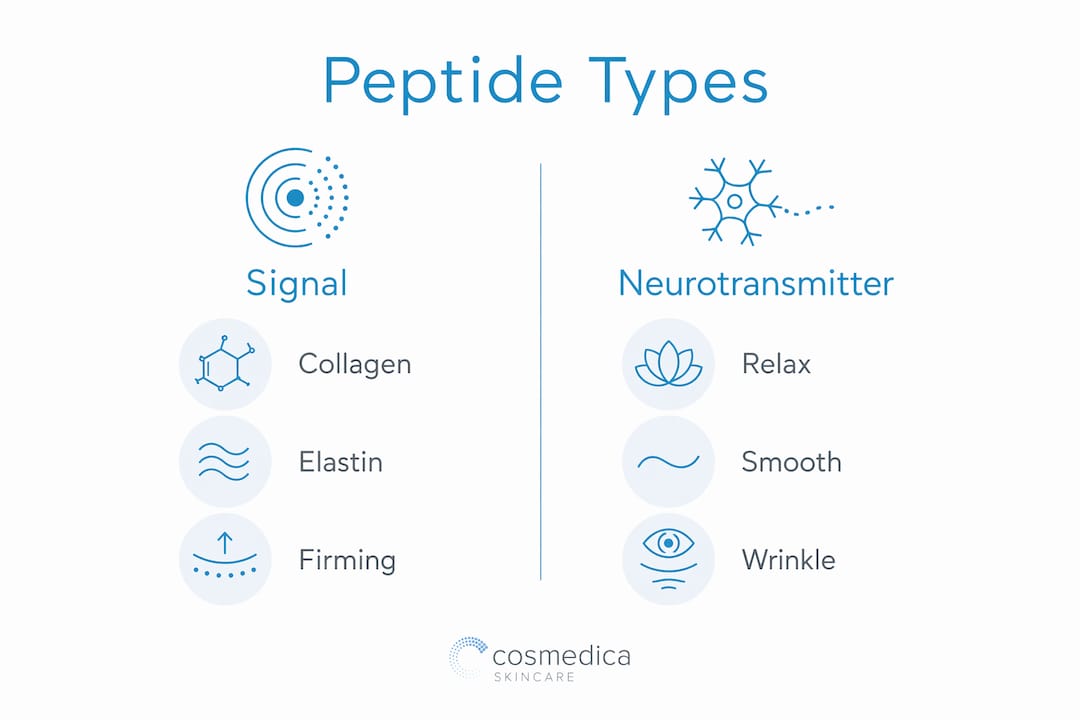
- Signal peptides tell your fibroblasts (the cells responsible for building skin structure) to ramp up production of collagen, elastin, and hyaluronic acid. Palmitoyl pentapeptide-4, commonly listed as Matrixyl, is one of the most studied signal peptides in cosmetic formulations.
- Carrier peptides act like delivery vehicles, shuttling trace minerals such as copper and manganese directly into skin cells. Copper peptides, for example, support wound healing and collagen cross-linking, which keeps skin firm and resilient.
- Neurotransmitter-inhibiting peptides work a bit like a topical muscle relaxer. They reduce the intensity of repetitive facial muscle contractions, softening the appearance of expression lines around the eyes and forehead over time.
- Enzyme inhibitor peptides slow down the enzymes that break down collagen in the first place. Some also inhibit tyrosinase, the enzyme responsible for excess melanin production, which makes them useful for brightening uneven skin tone.
These four peptide categories each target a distinct aging mechanism. That means stacking different types in one routine can address multiple concerns at once without adding irritation.
| Peptide Type | Primary Action | Common Benefit |
|---|---|---|
| Signal | Stimulates collagen and elastin synthesis | Firmer, plumper skin |
| Carrier | Delivers minerals to skin cells | Supports healing and structure |
| Neurotransmitter-inhibiting | Reduces muscle micro-contractions | Softens expression lines |
| Enzyme inhibitor | Slows collagen breakdown and melanin production | Preserves firmness, brightens tone |
Pro Tip: Look for products that combine signal peptides with neurotransmitter-inhibiting peptides. Stacking these two types produces synergistic effects without the irritation risk you’d get from stronger actives.
How do peptides work to improve skin at the cellular level?
Peptides work by activating fibroblasts, the specialized cells that manufacture your skin’s structural proteins. When a signal peptide reaches a fibroblast, it triggers a cascade that produces collagen, elastin, and hyaluronic acid. The result is a stronger extracellular matrix, which is the scaffolding that keeps skin firm and bouncy.

Think of your extracellular matrix like the springs inside a mattress. When those springs are intact, the surface stays smooth and supported. When they break down, you get sagging and creasing. Signal peptides reinforce this matrix by prompting the body to rebuild what time and UV exposure have degraded.
One thing worth understanding: topical and oral peptides face different delivery challenges. Topical peptides must penetrate the skin barrier, which is designed to keep things out. Specialized formulations using nano-carriers and liposomes improve how well peptides actually reach the fibroblasts beneath the surface. Oral peptides face gastrointestinal breakdown, which affects how much of the active compound reaches the skin at all. The vehicle composition of a product matters enormously for clinical effectiveness.
The science is clear: peptides do not fill wrinkles overnight. They work by supporting the skin’s own repair systems over time. The meta-analysis showing a Mean Difference of 2.40 in brightness and a roughness reduction of -14.98 versus placebo reflects weeks to months of consistent use, not a single application.
The data from that same meta-analysis tells an important story. Improvements in brightness and roughness are measurable and statistically significant. That means the results are real, but they require patience and consistency to show up.
Pro Tip: If your peptide serum comes in a jar with a wide opening, the peptides are likely degrading every time you expose the formula to air and light. Opt for airless pump packaging to preserve potency.
How should you add peptides to your skincare routine?
Peptides are one of the most forgiving actives you can add to a routine. They play well with almost every other ingredient, and they work for all skin types, including sensitive and acne-prone skin. Here’s how to get the most out of them.
- Cleanse first. Peptides absorb best on clean skin. Apply your peptide serum right after cleansing, while your skin is still slightly damp, to support penetration.
- Choose leave-on formulations. Rinse-off products like cleansers don’t leave peptides on the skin long enough to work. Leave-on serums and creams are the gold standard for peptide delivery.
- Use twice daily if your product allows. Dermatological guidance supports twice-daily use for most peptide formulations. Morning and night application keeps a steady supply of signaling molecules available to your skin cells.
- Layer correctly. Apply peptide serums before heavier creams and oils. Thinner textures go on first so they can penetrate without being blocked by occlusive layers.
- Pair with complementary actives. Peptides work beautifully alongside hyaluronic acid (for hydration), niacinamide (for barrier support and brightness), and vitamin C (for antioxidant protection). You can also use peptides with retinol, though applying them at different times of day reduces any potential for interaction.
- Be consistent. Results from peptides build gradually. Commit to at least 8–12 weeks before evaluating whether a product is working for you.
Packaging matters more than most people realize. Peptides are sensitive to light, air, and heat. Products in opaque, airless dispensers preserve the active ingredients far better than open jars or clear bottles. Check your anti-aging skincare routine to see where a peptide serum fits most naturally.
Pro Tip: If you’re new to peptides, start with a single peptide serum and use it consistently for 10–12 weeks before adding another. This way, you’ll know exactly what’s working.
What are realistic expectations from peptide skincare?
Peptides support gradual, sustained skin improvement. They are not a quick fix, and setting the right expectations from the start makes the difference between sticking with a routine and abandoning it too soon.
Here’s what you can realistically expect from consistent peptide use:
- Improved skin texture and smoothness within 8–12 weeks of twice-daily use, as collagen synthesis increases and the extracellular matrix strengthens.
- Reduced appearance of fine lines over time, particularly expression lines targeted by neurotransmitter-inhibiting peptides. The effect is a softening, not an erasure.
- Better hydration as peptides stimulate hyaluronic acid production alongside collagen and elastin.
- Brighter, more even skin tone when enzyme-inhibiting peptides are included, thanks to their effect on melanin production.
- Low irritation risk. Board-certified dermatologist Dr. King identifies peptides as cornerstone actives for long-term skin health with minimal risk of dryness or sensitivity. This makes them a strong choice for anyone who has struggled with retinoid irritation.
Peptides are not injectables. They won’t deliver the dramatic, immediate results of Botox or dermal fillers. What they do offer is a non-invasive, low-risk approach to maintaining skin health over the long term. Think of them as maintenance, not a one-time intervention. They keep the foundation strong so that other treatments, if you choose them, have better results to build on.
Peptides are also generally well-tolerated across all skin types with minimal reported side effects. Patch testing is a smart step if your skin tends to react, but no large-scale adverse reactions have been widely documented. That safety profile is a big part of why peptides have become a go-to ingredient for skincare enthusiasts who want results without the recovery time.
Key Takeaways
Peptides are the most effective low-irritation actives for stimulating collagen, improving skin texture, and supporting long-term skin health with consistent use.
| Point | Details |
|---|---|
| Peptides defined | Short amino acid chains that signal skin cells to produce collagen, elastin, and hyaluronic acid. |
| Four functional types | Signal, carrier, neurotransmitter-inhibiting, and enzyme inhibitor peptides each target aging differently. |
| Scientific backing | A meta-analysis of 1,341 participants showed measurable improvements in brightness and skin roughness. |
| Application method | Use leave-on serums twice daily after cleansing; airless packaging preserves potency. |
| Realistic results | Expect gradual improvement over 8–12 weeks, not instant wrinkle removal. |
Why I think peptides deserve a permanent spot in your routine
I’ve spent years watching skincare trends come and go, and peptides are one of the few ingredients that have only gotten stronger with more research behind them. What strikes me most is how often people overlook them in favor of flashier actives like retinol or acids, when peptides are actually doing some of the most important foundational work.
The thing about peptides is that they reward patience in a way that most actives don’t. You won’t wake up after one week and see a transformation. But after three months of consistent use, you’ll notice your skin feels more resilient, looks smoother, and holds moisture better. That kind of quiet, steady improvement is exactly what long-term skin health looks like.
I also think the compatibility factor is underrated. Peptides pair with hyaluronic acid for hydration, niacinamide for barrier support, and even retinol without causing the irritation that often comes from combining stronger actives. That flexibility makes them a practical choice for building a routine that actually works together.
My honest advice: don’t treat peptides as a bonus step you add when you have extra budget. Treat them as a core part of your routine from the start. The science backs them, the tolerance profile is excellent, and the results, while gradual, are real.
— Thomas
Peptide-rich products from Cosmedica-skincare
Cosmedica-skincare formulates with the kind of ingredient integrity that peptide science demands. The Super Serum Set brings together peptide-rich serums designed to address collagen support, hydration, and skin brightness in one collection. For those who prefer overnight repair, the Multi-Active Hydrating Night Cream delivers peptides alongside complementary actives while you sleep, when skin repair is naturally at its peak. All Cosmedica-skincare formulations are cruelty-free, dermatologist-tested, and built for all skin types. If you’re ready to make peptides a consistent part of your routine, these are solid places to start.
FAQ
What is a peptide in skincare, exactly?
A peptide in skincare is a short chain of amino acids that signals skin cells to produce collagen, elastin, and hyaluronic acid. These biological messengers help repair and maintain the skin’s structural proteins that break down with age.
How long does it take for peptides to show results?
Peptides typically require 8–12 weeks of consistent twice-daily use before visible improvements in skin texture, firmness, and fine lines become noticeable. Results build gradually as collagen synthesis increases over time.
Can peptides be used with retinol and vitamin C?
Yes. Peptides are compatible with retinol, vitamin C, hyaluronic acid, and niacinamide. Applying peptides and retinol at different times of day (morning and night) is a practical way to get the benefits of both without any potential interaction.
Are peptides safe for sensitive skin?
Peptides are well-tolerated across all skin types, including sensitive and acne-prone skin, with minimal reported side effects. Patch testing is recommended as a precaution for anyone with highly reactive skin.
What are the best peptides for skin aging?
Signal peptides like Matrixyl (palmitoyl pentapeptide-4) and copper peptides are among the most researched for anti-aging. Combining signal peptides with neurotransmitter-inhibiting peptides addresses both collagen loss and expression lines for broader results.