

What Is Science-Backed Skincare? Your Evidence-Based Guide
TL;DR:
- Science-backed skincare builds routines around clinically tested ingredients proven to deliver real results, focusing on foundational practices like cleansing, barrier repair, and sun protection. A few targeted, evidence-supported products are more effective and safer than overusing multiple or trendy formulas, emphasizing consistency over complexity. The most effective routines are simple, with SPF, barrier repair, and targeted actives, applied regularly over time for sustained skin health.
The beauty aisle can feel like a battlefield. Every product promises “clinically proven” results, every brand claims “dermatologist recommended” status, and every new ingredient is supposedly the secret to perfect skin. But what is science-backed skincare, really? It’s not a marketing phrase. It’s a way of building your routine around ingredients and practices that have been tested in clinical studies, reviewed by dermatology experts, and shown to produce real, measurable results. This guide will walk you through exactly what that looks like and how to put it into practice.
Table of Contents
- Key Takeaways
- What is science-backed skincare, really?
- The core structure of an evidence-based routine
- Top ingredients with real clinical backing
- How to evaluate skincare products critically
- Building your daily routine with evidence in mind
- My honest take on what actually works
- Try science-backed products from Cosmedica-skincare
- FAQ
Key Takeaways
| Point | Details |
|---|---|
| Science-backed means clinically tested | Effective routines rely on peer-reviewed research and dermatology consensus, not trend cycles. |
| A few core steps outperform complexity | Cleansing, barrier repair, and broad-spectrum sun protection are the highest-evidence daily habits. |
| Ingredients matter more than branding | Retinoids, niacinamide, ceramides, and SPF 30+ have the strongest clinical backing for most concerns. |
| Consistency drives real results | Steady, long-term use of well-formulated products produces more change than frequent product switching. |
| How you evaluate products is a skill | Reading ingredient lists and understanding concentrations helps you filter hype from genuine efficacy. |
What is science-backed skincare, really?
At its core, science-backed skincare means building a regimen on clinical research and dermatology consensus, with a focus on cleansing, targeted ingredients, and protection. The emphasis is on skin biology and health outcomes, not just aesthetics. That distinction matters more than it sounds.
Think of it this way. Most of us learned skincare habits from advertisements, friends, or social media. Those sources aren’t always wrong, but they’re rarely filtered through peer-reviewed evidence. Science-based skincare tips, by contrast, ask a specific question before recommending anything: what does the data actually show?
That means looking for ingredients with double-blind, placebo-controlled studies behind them. It means understanding why a product works, not just that it might. And it means recognizing that the skin is a living organ with real biology. Skincare functions as a barrier strategy that reduces the skin’s vulnerability to environmental insults and systemic inflammation. That’s a medical framing, and it changes how you approach your routine entirely.
One thing science-backed skincare is not: complicated. Dermatology experts consistently emphasize that the basics come first, primarily sun protection and barrier repair, with targeted actives added only as needed. More products do not equal better results. In fact, they often cause more irritation and confusion.
The core structure of an evidence-based routine
A solid scientific skincare routine rests on three pillars: cleansing, targeted topical ingredients, and protection. Clinical research consistently supports this framework as the foundation for healthy skin function.
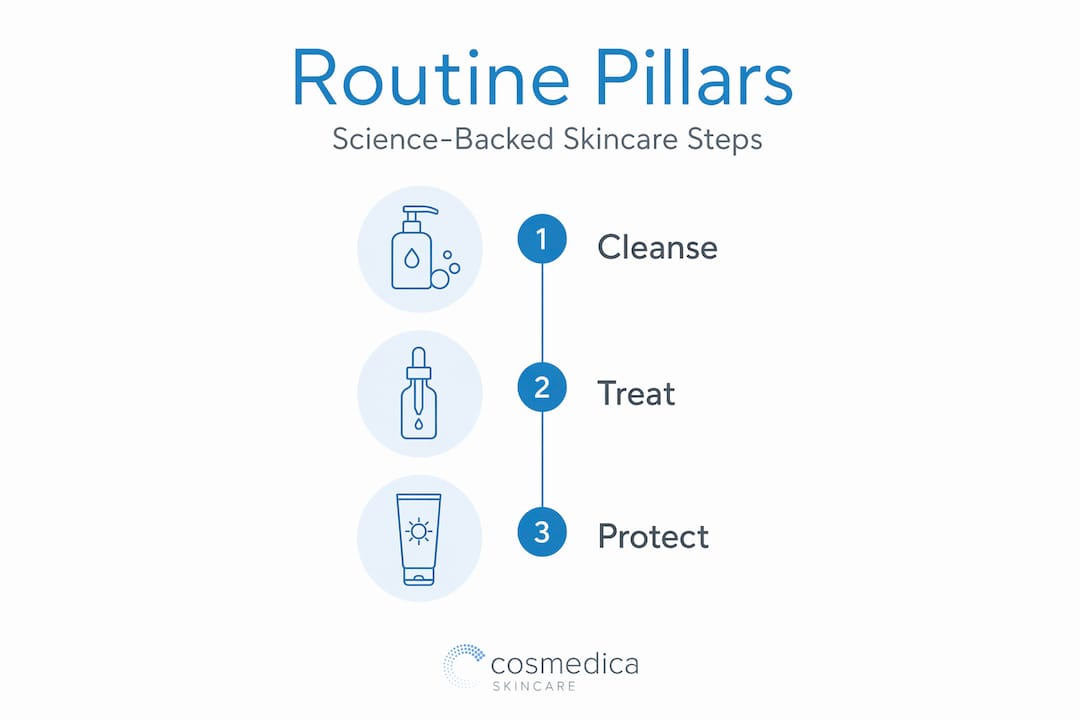
Cleansing is the first step, and it’s more specific than most people realize. The goal is removing surface debris, excess sebum, and environmental pollutants without stripping the skin’s natural lipid barrier. Harsh foaming cleansers with sulfates do the job too aggressively. Gentle, pH-balanced formulas are the clinically preferred option for most skin types.
Targeted topical ingredients come next. This is where you address your specific concerns, whether that’s aging, hyperpigmentation, acne, or dryness. The key word is “targeted.” You don’t need twelve serums. You need two or three actives with strong evidence behind them, applied correctly and consistently.
Protection is the non-negotiable final step in the morning. Broad-spectrum sunscreen with SPF 30 or higher is, without question, the most evidence-backed anti-aging measure available without a prescription. We’ll talk more about this in the next section.
A few common myths worth addressing:
- More products are always better. Not true. Layering too many actives increases the risk of irritation and can compromise barrier function.
- Natural ingredients are always safer. Also not true. Efficacy and safety are determined by formulation, concentration, and evidence, not source.
- Expensive equals effective. Price has no meaningful correlation with clinical performance.
- You need a separate product for every concern. Many well-formulated products address multiple concerns at once.
Pro Tip: If your skin feels tight, stings, or breaks out frequently, that’s often a sign of barrier disruption, not a sign that you need more products. Strip your routine back to the three-pillar basics and rebuild from there.
You can learn more about why consistent routines support anti-aging outcomes over time.
Top ingredients with real clinical backing
This is where evidence-based skincare products genuinely separate themselves from the pack. Some ingredients have decades of peer-reviewed research behind them. Others are backed by a single manufacturer-funded study and a lot of clever marketing. Here’s how the major players stack up.
Broad-spectrum sunscreen (SPF 30+) sits at the top of every dermatologist’s list. The Mayo Clinic recommends applying sunscreen regularly to reduce photoaging and skin cancer risk. Nothing else you apply topically comes close to its anti-aging effect. And the Skin Cancer Foundation notes that reapplication every two hours is necessary after swimming or sweating to maintain efficacy. One morning application is not enough.
Retinoids (which include retinol, retinal, and prescription-strength tretinoin) are the gold standard for wrinkle reduction and texture improvement. Retinoids and mineral sunscreens with zinc oxide or titanium dioxide rank among the most robustly supported ingredients in dermatology. Retinoids work by accelerating cell turnover and stimulating collagen production. Start slowly, two or three nights per week, and build up to daily use.
Niacinamide does several things at once. It strengthens the skin barrier by increasing ceramide and fatty acid production, visibly reduces redness, and targets hyperpigmentation. A global clinical expert panel agrees on ceramides, hyaluronic acid, and niacinamide as safe and effective across treatment phases, including before and after aesthetic procedures. That kind of cross-specialty consensus is meaningful.
Ceramides are lipids that naturally occur in your skin barrier. Think of them as the mortar between the bricks of your skin cells. A meta-analysis found that ceramide creams significantly improve clinical severity scores in patients with atopic dermatitis. For anyone dealing with dryness, sensitivity, or compromised barrier function, ceramide-rich moisturizers are a logical, evidence-grounded choice.
Hydroxy acids, including AHAs like glycolic acid and BHAs like salicylic acid, are clinically supported for chemical exfoliation and cell renewal. AHAs work on the surface to smooth texture and fade dark spots. BHAs penetrate the pore lining, making them especially useful for oily or acne-prone skin.
Here’s a quick comparison to help you see what each major ingredient actually does:
| Ingredient | Primary benefit | Evidence strength | Best for |
|---|---|---|---|
| Broad-spectrum SPF 30+ | Prevents photoaging and skin cancer | Very strong | All skin types, daily AM |
| Retinoids (retinol, tretinoin) | Reduces wrinkles, improves texture | Very strong | Aging, acne, texture |
| Niacinamide | Barrier repair, pigmentation, redness | Strong | Sensitive, uneven tone |
| Ceramides | Barrier repair, hydration | Strong | Dry, sensitive, compromised skin |
| Hyaluronic acid | Deep hydration, plumping | Strong | All types, especially dry |
| Glycolic acid (AHA) | Exfoliation, brightening | Moderate to strong | Dull skin, dark spots |
| Salicylic acid (BHA) | Clears pores, reduces acne | Strong | Oily, acne-prone skin |
| Vitamin C (L-ascorbic acid) | Brightening, antioxidant protection | Moderate to strong | Dull skin, sun damage |
Pro Tip: Hyaluronic acid works best when applied to slightly damp skin. It pulls moisture from the surrounding environment into the epidermis, acting like a sponge. If your skin is bone dry when you apply it, it may actually draw moisture from deeper layers instead.
Want to understand how serums with active ingredients are formulated to deliver these actives effectively? That’s a worth exploring in depth.
How to evaluate skincare products critically
Knowing what ingredients are effective is half the battle. The other half is learning to evaluate what’s actually inside the products you’re considering.
Here’s a practical checklist to help you assess whether a product is genuinely evidence-based or mostly marketing:
- Check the ingredient list, not the claims. The front of the packaging is marketing. The ingredient list is the actual formula. Look for the active ingredients mentioned in the previous section in the first few positions on the list.
- Understand concentrations. Niacinamide is effective at 2 to 5 percent. Vitamin C is most studied at 10 to 20 percent. A product can legally include an ingredient at 0.01 percent and still feature it on the label. That concentration will do nothing.
- Look for peer-reviewed backing, not just “clinically tested.” “Clinically tested” can mean a company ran a small, self-funded consumer perception study. Look for references to published studies or specific percentage improvements backed by third-party research.
- Be skeptical of proprietary blends. When brands hide active concentrations behind “proprietary formulas,” that’s often a sign that the amounts are too low to be effective, but they don’t want you to know.
- Dermatologist recommended does not always mean dermatologist studied. A dermatologist endorsement on a label can be a paid partnership. Dermatologist-recommended skincare carries more weight when the brand publishes the study methodology and results.
- Fragrance on the ingredient list is a yellow flag. It’s not automatically harmful, but fragrance is a common irritant and offers zero skin benefit. For sensitive or compromised skin, fragrance-free formulas are the better choice.
The benefits of clinical skincare become real only when the product you’re using actually contains the actives at levels shown to work. This is why reading labels matters so much. It shifts you from being a passive consumer to an informed one.
You can also explore skin barrier repair products to see what well-formulated barrier support actually looks like in practice.
Building your daily routine with evidence in mind
Putting this all together doesn’t have to be complicated. Here’s a practical, step-by-step outline based on what the science supports for a typical daily routine.
Morning routine:
- Gentle cleanser. A pH-balanced, non-stripping formula to remove overnight buildup. Thirty seconds is enough. You’re not scrubbing dishes.
- Antioxidant serum. Vitamin C or niacinamide in the morning provides antioxidant protection and primes the skin before SPF.
- Moisturizer with ceramides or hyaluronic acid. Think of this as feeding your barrier. Moisturizers are not luxuries but health-relevant strategies that reduce the skin’s vulnerability to environmental damage.
- Broad-spectrum SPF 30+. Apply last. Apply generously. Reapply if you’re outdoors for more than two hours.
Evening routine:
- Double cleanse if you wore SPF or makeup. An oil cleanser first, then your regular gentle formula. This removes sunscreen residue without over-stripping.
- Retinoid (2 to 3 nights per week to start). Apply a pea-sized amount to dry skin after cleansing. This is enough for your whole face.
- Moisturizer. Apply over your retinoid to reduce potential dryness, especially while your skin adjusts.
Now, a few additional science-based skincare tips for making this routine actually work:
- Adjust for your skin type. Oily skin may need a lighter moisturizer. Dry skin may benefit from layering hyaluronic acid under a ceramide cream. Healthy lifestyle habits like staying hydrated and managing stress also genuinely support skin function.
- Be patient. Retinoids typically take 12 weeks to show meaningful improvement. Vitamin C can take six to eight weeks. If you’re switching products every four weeks, you’re not giving anything enough time to work.
- Layer lightest to heaviest. Water-based serums go before moisturizers. Oils go last in the evening.
- See a dermatologist for persistent concerns. Prescription-strength actives for acne, melasma, or rosacea are beyond what over-the-counter products can address. A dermatologist can give you a personalized scientific skincare routine that fits your skin’s specific needs.
Looking for a more detailed breakdown? A step-by-step anti-aging routine built on these principles is a great place to start.
My honest take on what actually works
I’ve spent years looking at how people approach their skincare routines, and the pattern I see most often is this: people overcomplicate everything the moment results slow down. The skin shows a little dryness, and suddenly there are five new products on the shelf. A dark spot lingers, and the whole routine gets overhauled. This cycle is exhausting, and it almost always makes things worse.
In my experience, the most effective routines are also the most boring ones. SPF every single morning. A reliable ceramide moisturizer. A retinoid three nights a week. That’s it for most people. Not glamorous. Not a ten-step ritual. Just consistent, evidence-backed basics applied without interruption for months at a time.
What I’ve also learned is that sun protection is the one step where there’s no debate. Every dermatologist I’ve ever read or spoken to agrees. Photoaging accounts for roughly 80 percent of visible facial aging. If you’re investing in serums and treatments but skipping SPF, you’re working against yourself.
The other thing I’d push back on is the obsession with “natural.” Natural doesn’t mean safe or effective, and synthetic doesn’t mean harmful. Retinoids are derived from vitamin A. Niacinamide is a form of vitamin B3. What makes an ingredient worth using is the evidence behind it, not where it came from.
My honest advice: start simple, be consistent, and trust the process. Skincare results don’t come from finding the perfect product. They come from building a routine you can actually stick to, day after day, season after season.
— Thomas
Try science-backed products from Cosmedica-skincare
If you’re ready to put evidence-based skincare into practice, Cosmedica-skincare has done a lot of the formulation work for you. Every product in the collection is built around clinically supported actives, including ceramides for barrier repair, hyaluronic acid for deep hydration, retinoids for texture and aging, and vitamin C for brightening. The formulas are cruelty-free, affordable, and designed to work for all skin types.
Browse the serum collection for targeted actives like retinol and vitamin C, or explore clinically supported moisturizers packed with ceramides and hyaluronic acid. Not sure where to begin? Take the personalized skin quiz for product recommendations matched to your skin type and concerns. Or check out the new collection for the latest formulations built on the same evidence-based principles this article covers.
FAQ
What does science-backed skincare actually mean?
Science-backed skincare refers to routines and products built on clinical research and dermatology consensus rather than trends or marketing claims. It emphasizes ingredients and practices with peer-reviewed evidence showing real, measurable improvements in skin health.
What are the most evidence-backed skincare ingredients?
Broad-spectrum SPF 30+, retinoids, niacinamide, ceramides, and hyaluronic acid consistently rank as the top evidence-based skincare products supported by clinical studies. Each addresses specific skin concerns with well-documented mechanisms and outcomes.
How do I know if a skincare product is truly science-backed?
Check the ingredient list for actives at effective concentrations, look for references to peer-reviewed research rather than vague “clinically tested” claims, and be skeptical of proprietary blends that hide ingredient percentages.
How long does it take to see results from science-based skincare?
Most clinically supported ingredients require consistent use over six to twelve weeks before visible changes appear. Retinoids, for example, typically show meaningful improvement in wrinkles and texture after about 12 weeks of regular use.
Do I need a complicated routine to get results?
No. Dermatology experts recommend starting with sun protection and barrier repair before adding targeted actives. A simple, consistent three to four step routine outperforms a complex one used inconsistently.