

Why Hyaluronic Acid for Aging Skin Really Works
TL;DR:
- Hyaluronic acid declines with age, reducing skin hydration and supporting collagen breakdown, which accelerates aging signs. It promotes skin firmness by plumping fine lines, stimulating collagen, and protecting the skin barrier, especially when combined with other actives. Proper application techniques and combining topical, oral, and professional treatments enhance its anti-aging benefits over time.
If you’ve ever written off hyaluronic acid as just another moisturizing ingredient, you’re not alone. Most people hear “hydration” and think the story ends there. But the real reason why hyaluronic acid for aging is so worth understanding goes much deeper than surface moisture. This molecule works inside your skin’s architecture, supporting collagen, protecting against environmental stress, and slowing the structural breakdown that makes skin look older. We put together this evidence-based guide to show you exactly what’s happening beneath the surface, and what that means for your routine.
Table of Contents
- Key Takeaways
- Why hyaluronic acid for aging is more than moisturizing
- How hyaluronic acid fights aging at the cellular level
- Understanding HA types and which works best for aging
- How to use hyaluronic acid in your anti-aging routine
- My honest take on hyaluronic acid and aging
- Start your HA routine with Cosmedica-skincare
- FAQ
Key Takeaways
| Point | Details |
|---|---|
| HA declines with age | Your skin’s natural hyaluronic acid drops significantly after 30, accelerating dryness and wrinkle formation. |
| Molecular weight matters | High-weight HA hydrates the surface; low-weight HA penetrates deeper to stimulate collagen production. |
| Application technique is critical | Apply HA on damp skin and layer with moisturizer immediately to lock in hydration effectively. |
| Oral supplementation works | Clinical trials show 120 mg/day of sodium hyaluronate improves elasticity and reduces wrinkle depth in 12 weeks. |
| HA is safe for all skin types | Hyaluronic acid is well tolerated across ages, skin types, and even during pregnancy with minimal risk. |
Why hyaluronic acid for aging is more than moisturizing
Hyaluronic acid, or HA, is a naturally occurring glycosaminoglycan, which is essentially a long-chain sugar molecule that your body produces on its own. It lives in your skin, joints, and connective tissue, acting as a cushion and lubricant. In the skin, it sits within the extracellular matrix, which is the scaffolding that holds everything in place, right alongside collagen and elastin fibers.
Here’s the part that makes HA genuinely remarkable. HA holds up to 1,000 times its own weight in water. Think of it like a sponge that never gets fully squeezed dry. That water-retaining power is what gives young skin its plump, bouncy quality. When your skin is well saturated with HA, fine lines physically fill out, and your complexion looks fuller and smoother.
The problem starts around your early 30s. Your body naturally begins producing less HA, and that decline accelerates through your 40s and 50s. Less HA means less moisture retention, a thinner and less resilient extracellular matrix, and reduced support for the collagen and elastin fibers your skin depends on for firmness. The result is the familiar combination of dryness, sagging, and lines that most of us associate with aging.
Here is a snapshot of what changes in your skin’s HA levels as you age:
| Age Range | HA Status | Visible Effect |
|---|---|---|
| 20s | High natural HA production | Plump, hydrated, resilient skin |
| 30s | HA production begins to slow | Early dryness, first fine lines |
| 40s | Noticeable HA decline | Deeper lines, reduced elasticity |
| 50s and beyond | Significantly reduced HA | More pronounced wrinkles, thinner skin |
Understanding this progression is not just reassuring. It’s the first step toward doing something about it.
Key facts about HA’s natural role:
- It maintains the skin’s extracellular matrix, the structural framework supporting collagen and elastin
- It regulates water balance in the dermis and epidermis
- It supports wound healing and cellular communication in the skin
- Its natural decline after 30 correlates directly with accelerating signs of skin aging
How hyaluronic acid fights aging at the cellular level
Hydration is the entry point, but it is far from the whole story. The hyaluronic acid anti-aging properties that researchers find most compelling operate much deeper in the skin. Here is how HA actually combats aging:
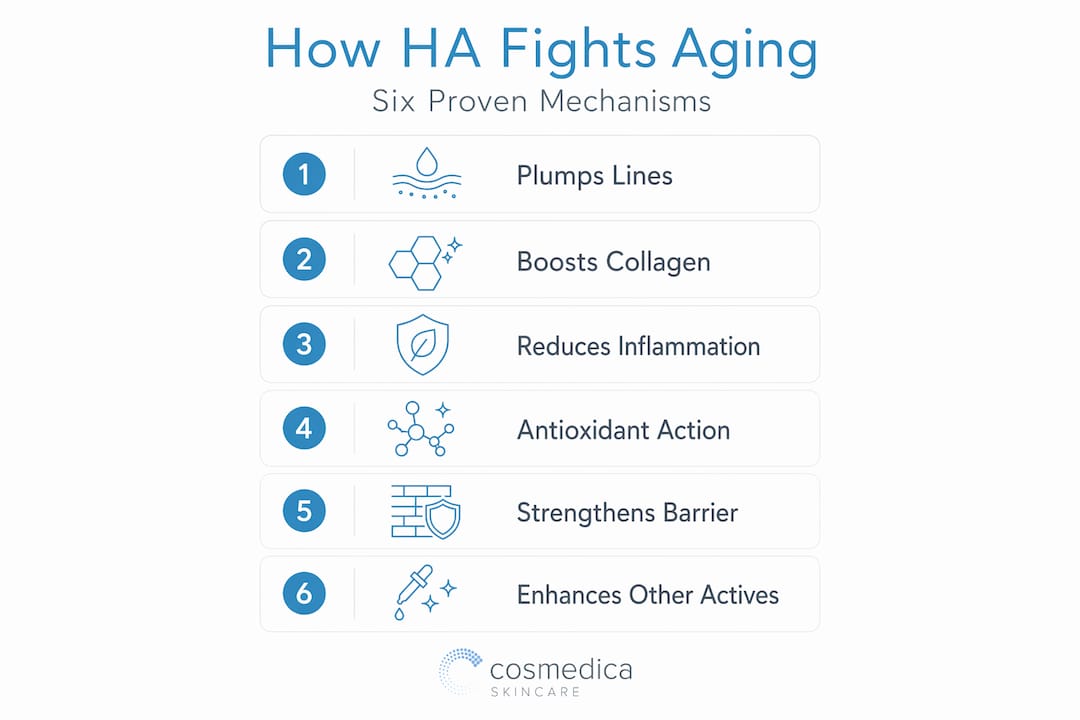
1. It physically plumps fine lines and wrinkles. When HA pulls moisture into the skin, the tissue swells slightly. That swelling fills in fine lines from the inside out. It is not a permanent structural fix, but it is a measurable, visible improvement that makes skin look noticeably smoother with consistent use.
2. It stimulates fibroblasts to produce collagen and elastin. This one surprises a lot of people. HA does not just sit there holding water. It signals fibroblasts to synthesize new collagen and elastin, the proteins responsible for skin firmness and snap-back elasticity. That means regular HA use can contribute to genuine structural improvement over time, not just surface hydration.
3. It has anti-inflammatory properties. Chronic low-grade inflammation, sometimes called “inflammaging,” is one of the primary drivers of accelerated skin aging. HA helps calm that inflammatory response at the cellular level. Less inflammation means less collagen degradation and a slower breakdown of skin structure.
4. It acts as an antioxidant. Free radical damage from UV exposure and pollution is a major aging accelerant. HA has documented antioxidant activity, meaning it helps neutralize some of that oxidative stress before it can break down collagen fibers.
5. It supports the skin barrier. A healthy lipid barrier keeps moisture in and environmental aggressors out. HA helps maintain that barrier function, reducing transepidermal water loss, which is the passive evaporation of moisture through your skin. When your barrier is compromised, skin looks dull, feels tight, and ages faster.
6. It works even better in combination. Research shows that combining HA with biomaterials like polynucleotides offers synergistic protection for dermal fibroblasts against UVA-induced oxidative stress, outperforming HA used alone. This is a signal that HA’s real power often shows up when it is part of a thoughtfully formulated product.
Pro Tip: If you are using HA alongside a vitamin C serum, apply the vitamin C first on clean skin, let it absorb, and then follow with your HA serum. The antioxidant activity of both ingredients amplifies each other’s protective benefits.
Understanding HA types and which works best for aging
Not all hyaluronic acid products are created equal, and the difference matters more than most people realize. The key variable is molecular weight, and it determines how far into your skin the HA can actually travel.
Molecular weight directly affects how hyaluronic acid performs on and in your skin. Here is how the two main forms compare:
| HA Type | Molecular Weight | Penetration Depth | Primary Benefit |
|---|---|---|---|
| High molecular weight HA | Large molecules | Surface layer only | Forms protective moisture barrier, reduces water loss |
| Low molecular weight HA | Small molecules | Deeper dermal layers | Stimulates collagen, supports extracellular matrix |
| Hydrolyzed HA | Very small fragments | Deepest penetration | Maximum collagen stimulation and structural support |
High molecular weight HA sits on top of the skin and forms a thin, breathable film. That film locks in moisture and creates the immediate plumping effect you feel after applying a quality serum. It is great for reducing the look of fine lines right now.
Low molecular weight HA goes further. It penetrates the epidermis and reaches the dermal layers where fibroblasts live. That is where it can trigger new collagen synthesis and support the skin’s structural matrix. This is the form that makes hyaluronic acid effective for wrinkles in a more lasting, structural way.
The best products for aging skin typically contain both. You get the immediate surface benefits and the longer-term structural support working together. If you want to explore how different HA types perform, the HA types guide from Cosmedica-skincare breaks this down in practical, easy-to-follow detail.
One more thing worth knowing: topical HA has physical limits. Even low molecular weight HA cannot penetrate all the way to the deep dermis through intact skin. That is where injectable treatments and oral supplementation come in for those who want more intensive results. More on that in the next section.
How to use hyaluronic acid in your anti-aging routine
Knowing how hyaluronic acid helps aging skin is only useful if you apply it correctly. A lot of people buy a quality HA serum and still feel underwhelmed. Usually, the issue is technique, not the product. Here is how to get the most out of every drop.
-
Apply to damp skin, not dry. This is the single most important step most people skip. HA is a humectant, meaning it draws moisture from its surroundings. On damp skin, it pulls that surface water into the epidermis. On completely dry skin in a dry environment, it can actually draw moisture out of your deeper skin layers, which is the opposite of what you want.
-
Layer with a moisturizer immediately after. Apply your HA serum while your skin is still slightly damp, then follow within 60 seconds with a moisturizer or facial oil. This seals the humectant layer and prevents the water HA pulled in from evaporating right back out. Think of the moisturizer as the lid on the jar.
-
Use it twice daily. Morning and evening application keeps your skin consistently hydrated throughout the day and overnight. Your skin repairs itself most actively while you sleep, so nighttime application supports that regenerative process. For detailed tips on building this into a routine, the HA skincare guide from Cosmedica-skincare walks through each step.
-
Consider pairing with microneedling. Microneedling creates microchannels in the skin that temporarily increase HA absorption dramatically. Combination approaches using HA alongside treatments like microneedling consistently show stronger visible results than topical HA alone. This is something worth discussing with a dermatologist if deeper wrinkle reduction is your goal.
-
Explore oral supplementation. A randomized trial of 150 adults found that 120 mg/day of sodium hyaluronate for 12 weeks produced measurable improvements in skin hydration, elasticity, and wrinkle depth versus placebo. Oral HA can actually increase epidermal thickness and dermal density, which is structural support that topical products alone cannot fully replicate. A separate set of clinical measurements over 12 weeks confirmed improvements in transepidermal water loss, elasticity, and hydration across healthy adults.
-
Know that it is safe for your skin type. Hyaluronic acid is well tolerated across skin types and age groups, including during pregnancy. If you have reactive skin, a patch test on your inner arm before full facial use is a smart habit to build with any new product.
Pro Tip: During winter months or in dry climates, look for serums that combine both high and low molecular weight HA. The high Mw form compensates for the dry air that would otherwise cause HA to pull moisture from your skin rather than the environment.
You can also explore some of the 10 clinically-backed benefits of HA to get the full picture of what this ingredient can do beyond wrinkle reduction.
My honest take on hyaluronic acid and aging
I have worked with a lot of skincare ingredients over the years, and I will say plainly: hyaluronic acid is one of the few where the science actually holds up to the marketing. But there is a version of the HA conversation I find frustrating, and it is the one where it gets positioned as a standalone fix for aging skin.
In my experience, the people who see the best results from HA are not relying on it exclusively. They are using it as part of a layered routine, pairing it with retinol for cell turnover, vitamin C for collagen protection, and a good SPF. HA does something irreplaceable in that stack. It keeps the skin barrier healthy enough to tolerate the more aggressive actives, and it amplifies hydration so everything else can work better.
What I find often gets overlooked is HA’s long-term structural role. Clients who use it consistently for six months or more report a different quality of skin than those who use it occasionally. The bounce-back is better. The skin feels more resilient, not just softer. That is the fibroblast stimulation and matrix support doing its quiet work.
My honest advice: do not wait for a dramatic transformation in the first two weeks and give up. HA works on a longer timeline for its deeper benefits. Give it a genuine three-to-six month commitment, apply it correctly, and pair it with complementary ingredients. You will see the difference. The surface hydration is the part you notice first. The structural support is the part that matters most.
— Thomas
Start your HA routine with Cosmedica-skincare
If you are ready to put all of this into practice, Cosmedica-skincare has you covered with formulations built around real science. The Hyaluronic Acid + Vitamin B5 Serum combines both high and low molecular weight HA with vitamin B5 to strengthen the skin barrier while delivering deep, lasting hydration. It is a focused daily serum that checks every box we covered in this article.
For a complete anti-aging approach, the Super Serum Set pairs HA with complementary actives designed to support your skin at every level, from surface hydration to collagen stimulation. All Cosmedica-skincare products are cruelty-free, dermatologist-tested, and formulated to be gentle enough for sensitive skin. You can browse the full product line to find the right combination for your skin’s specific needs. Real results, at a price that makes a consistent routine actually sustainable.
FAQ
What does hyaluronic acid do for aging skin?
Hyaluronic acid hydrates the skin, plumps fine lines, stimulates collagen and elastin production through fibroblast signaling, and supports the skin barrier. It works through multiple anti-aging pathways simultaneously, not just surface moisturization.
Is hyaluronic acid effective for wrinkles?
Yes. HA physically fills fine lines through hydration and contributes to longer-term wrinkle reduction by stimulating collagen synthesis in the dermis, particularly when low molecular weight forms are used consistently.
When should you start using hyaluronic acid for anti-aging?
Your 30s are the ideal time to start, since HA production naturally begins declining around that age. That said, HA is beneficial at any age and is safe enough to use earlier as a preventive measure.
Can you take hyaluronic acid orally for skin aging?
Clinical research confirms that oral sodium hyaluronate at 120 mg per day for 12 weeks improves skin hydration, elasticity, and wrinkle depth. Oral HA supports skin structure from the inside in ways topical products cannot fully replicate.
Is hyaluronic acid safe for all skin types?
Hyaluronic acid is broadly well tolerated across all skin types, including sensitive and acne-prone skin, and is considered safe during pregnancy. A patch test is recommended when trying any new formula for the first time.