

The Beginner Skincare Guide to Healthy, Happy Skin
TL;DR:
- Starting a skincare routine can be overwhelming, but focusing on three core products—gentle cleanser, moisturizer, and SPF 30+—creates a solid foundation. Applying products from thinnest to thickest and identifying your skin type help personalize your routine for effective results. Consistency with these simple steps over two to three months leads to healthier skin, while adding advanced products should be gradual and deliberate.
Walking into a beauty aisle for the first time can feel like showing up to a test you never studied for. Serums, essences, toners, exfoliants. Everyone online seems to have a 10-step routine, and suddenly you’re questioning whether plain soap and water was always the wrong answer. This beginner skincare guide cuts through the noise. We’re focusing on what actually matters: three core products, a simple routine you’ll stick to, and a clear path to adding more only when you’re ready. No overwhelm. No wasted money. Just real skin results.
Table of Contents
- Key Takeaways
- Your first beginner skincare routine: the products you actually need
- Morning and evening routines, step by step
- How to identify your skin type
- Skincare mistakes to avoid as a beginner
- When to add advanced products to your routine
- My honest take on simple skincare
- Start your skincare journey with Cosmedica-skincare
- FAQ
Key Takeaways
| Point | Details |
|---|---|
| Start with three products | A gentle cleanser, moisturizer, and SPF 30+ sunscreen cover the foundation of any solid routine. |
| Order matters | Apply products from thinnest to thickest: cleanser first, then moisturizer, then sunscreen in the morning. |
| Know your skin type | Identifying whether your skin is oily, dry, combination, or sensitive helps you pick the right formulas. |
| Introduce actives slowly | Wait two to three months on basics before adding serums or treatments, one product at a time. |
| Consistency beats complexity | A simple routine done daily outperforms an elaborate one done occasionally. |
Your first beginner skincare routine: the products you actually need
Let’s keep this simple. The good news is that skincare success depends far more on using gentle products daily than on having a packed shelf of treatments. Three products are your non-negotiables when you’re just starting out.
The three must-haves:
- Gentle cleanser. Think of this as your skin’s reset button. You want something that removes dirt, oil, and sunscreen without stripping your skin dry. Cream or gel cleansers with mild surfactants work well for most beginners. Avoid anything labeled “deep cleansing” or “pore purifying” until you know your skin better.
- Moisturizer. This is your skin’s drink of water at the end of every routine. Even oily skin needs hydration. A lightweight lotion or gel moisturizer works for daytime. A slightly richer cream is great at night. The goal is to keep your skin barrier healthy so it can do its job.
- Broad-spectrum sunscreen, SPF 30+. This is the single most effective anti-aging and skin-health product that exists, and most people skip it. You need broad spectrum coverage with at least SPF 30 every single morning, rain or shine.
| Product | Purpose | Beginner-friendly format |
|---|---|---|
| Gentle cleanser | Removes impurities without stripping | Cream, gel, or micellar water |
| Moisturizer | Seals in hydration, strengthens barrier | Lightweight lotion or gel |
| SPF 30+ sunscreen | Protects against UV damage | Fluid, lotion, or tinted formula |
Optional additions to explore later:
Toners, serums, and exfoliants are not urgent. A toner can help balance skin pH after cleansing. A serum like vitamin C brightens and protects. An exfoliant removes dead skin cells for a smoother texture. None of these belong in your first few weeks. Build the foundation first.
Pro Tip: When you apply sunscreen, use about one ounce (think a shot glass worth) for full-body coverage, and about a nickel-sized amount for your face alone. Most people apply too little, which cuts protection significantly.
Morning and evening routines, step by step
Having the right products means nothing if you apply them in the wrong order or at the wrong time of day. Here’s how a solid daytime skincare routine and an evening wind-down should look.
Morning routine
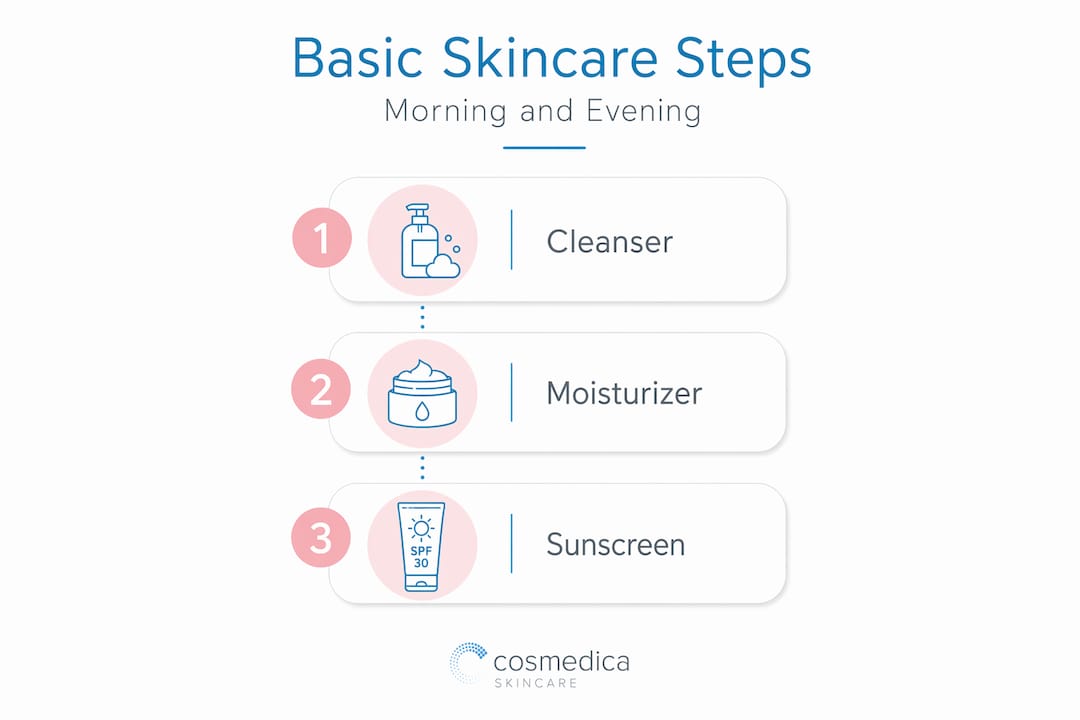
- Cleanse. Wash your face with your gentle cleanser and lukewarm water. Hot water feels great but it breaks down your skin’s lipid barrier over time, leaving skin drier and more reactive. Rinse thoroughly and pat (don’t rub) dry with a clean towel.
- Moisturize. Apply your moisturizer while your skin is still slightly damp. Damp skin absorbs moisturizer more effectively, think of it like pressing a sponge against a wet surface versus a dry one. A thin, even layer is all you need.
- Sunscreen. This goes on last and it goes on every morning. The correct order is cleanser, then moisturizer, then sunscreen. Applying it on top of moisturizer gives it a clean surface to form its protective layer. Let your moisturizer absorb for 60 seconds before applying SPF.
Pro Tip: If you’re spending time outdoors, reapply sunscreen every two hours. Even a water-resistant formula breaks down with sweat, humidity, and sun exposure. Keep a travel-sized tube in your bag.
Evening routine
Your nighttime skincare essentials are even simpler than your morning steps.
- Remove makeup (if applicable). If you wear makeup, use a micellar water or cleansing balm to break it down before your regular cleanser. This is called double cleansing and it prevents residue from sitting on your skin all night.
- Cleanse. Use the same gentle cleanser from your morning routine. Your nighttime routine can be as simple as cleansing and moisturizing. No sunscreen needed once you’re indoors for the night.
- Moisturize. Night is when your skin repairs itself, so give it the hydration it needs. You can use the same moisturizer as the morning, or opt for a slightly richer formula if your skin tends to feel tight or dry by morning.
Consistency matters more than perfection here. Doing this two-step evening routine every night beats doing a complicated five-step routine twice a week.
How to identify your skin type
Picking the right products without knowing your skin type is a bit like buying shoes without knowing your size. You might get lucky, but you might also end up with something that causes real discomfort. Here’s how to figure out where you fall.

The bare-face test:
Wash your face with a gentle cleanser, pat dry, and wait 30 minutes without applying anything. Then observe:
- Oily skin: Your whole face looks shiny, especially the forehead, nose, and chin (the T-zone). Pores appear larger.
- Dry skin: Your skin feels tight, looks dull, and may have flaky patches.
- Combination skin: Your T-zone is oily but your cheeks feel normal or slightly dry.
- Sensitive skin: Your skin stings, reddens, or reacts easily to products. It may feel dry or normal otherwise.
Once you know your type, use the comparison below to select the right formulas:
| Skin type | Cleanser pick | Moisturizer pick | Sunscreen pick |
|---|---|---|---|
| Oily | Gel or foaming cleanser | Lightweight, oil-free gel | Fluid or mattifying formula |
| Dry | Cream or milk cleanser | Rich cream or balm | Hydrating lotion SPF |
| Combination | Gentle gel cleanser | Lightweight lotion | Gel-fluid hybrid SPF |
| Sensitive | Fragrance-free micellar water or cream | Fragrance-free calming moisturizer | Mineral SPF with zinc oxide |
A note on fragrance: Many beginner skincare products include fragrance to make them smell nice. For sensitive or reactive skin, fragrance is one of the most common irritants. Fragrance-free does not mean unscented. Look for “fragrance-free” on the label, not just “unscented.”
If you’re still unsure about your skin type, the Cosmedica-skincare skin quiz is a quick way to get a personalized read and find products matched to your needs.
Skincare mistakes to avoid as a beginner
This is where a lot of people go sideways. You get excited, buy six new products, try them all in week one, and then can’t figure out why your face is breaking out or peeling. Here are the most common skincare mistakes to avoid, and what to do instead.
- Introducing too many products at once. Starting with a minimal routine means that if your skin reacts badly, you can pinpoint exactly which product caused it. A baseline routine should be extremely small so that any irritation is clearly tied to a new product, not a mystery of five competing ingredients.
- Over-washing your face. Cleansing twice a day (morning and night) is enough for most people. Washing more than that strips your natural oils, which actually triggers more oil production. If you have dry or sensitive skin, rinsing with just water in the morning is completely fine.
- Skipping the patch test. Before applying any new product to your whole face, dot a small amount behind your ear or on your inner forearm and wait 24 hours. If no redness, itching, or swelling appears, you’re likely safe to proceed.
- Using harsh cleansers or hot water. Gentle, non-medicated cleansers and lukewarm water protect your skin barrier. Harsh cleansers create a tight, squeaky-clean feeling that actually signals damage, not cleanliness.
- Popping pimples. It’s tempting. Don’t. Picking at breakouts pushes bacteria deeper into the skin, causes inflammation, and can leave scars that take months to fade.
- Over-exfoliating. Exfoliating once or twice a week is plenty for most skin types. Doing it daily, especially with physical scrubs, damages the barrier and creates micro-tears in the skin.
Pro Tip: Write down when you started each new product. If your skin reacts negatively, you’ll have a clear record of what changed and when, saving you a lot of guessing.
When to add advanced products to your routine
Once you’ve been consistent with your basic cleanser, moisturizer, and sunscreen for about two to three months, you can start thinking about adding something more targeted. The keyword here is one at a time.
Here’s how to do it safely:
- Identify your skin concern. Are you dealing with dark spots? Uneven texture? Early signs of aging? Your concern determines which active ingredient to explore. Vitamin C targets brightness and pigmentation. Retinol addresses fine lines and cell turnover. Hyaluronic acid (technically a moisturizing ingredient) enhances your hydration routine significantly and suits nearly every skin type.
- Add the new product in the right position. Serums go on after cleansing and before moisturizer. Getting the application order right matters because serums are formulated to penetrate deeply, and layering moisturizer on top seals everything in. Applying in the wrong order can reduce effectiveness or cause pH imbalance.
- Use it two to three times a week first. Starting with daily use of an active like retinol is a fast track to peeling and redness. Ease in slowly. Let your skin adapt over two to three weeks before increasing frequency.
- Wait two to three months before judging results. Skincare works on skin cell turnover cycles, which take roughly four to six weeks. Adding new actives one at a time and waiting long enough to see results prevents the “nothing is working” spiral that leads people to buy more products than they need.
- Never combine strong actives without research. Retinol and vitamin C, for example, can irritate skin when used together. Retinol and AHA exfoliants together can cause significant sensitivity. When in doubt, use actives on alternating nights rather than stacking them in the same routine.
A good anti-aging progression to consider, once your basics are solid, is outlined in this step-by-step PM routine from Cosmedica-skincare.
My honest take on simple skincare
I’ve spent years testing products, reading research, and talking to people about their skin. And the thing that never changes? The folks with the best skin usually have the simplest routines.
Here’s what I’ve learned the hard way: complex routines don’t work better. They make you feel productive, but they often create more problems than they solve. I’ve seen people layer four actives in week one and then blame their skin for “being difficult” when it breaks out. Their skin wasn’t difficult. Their approach was.
What actually changed my own skin wasn’t finding the perfect serum. It was stopping the habit of switching products every three weeks. Consistency with a boring, basic routine does more for long-term skin health than any trendy ingredient launch.
I’ve also noticed that irritation is the number one reason beginners give up on skincare entirely. That irritation almost always traces back to overuse, skipped patch tests, or too many new products introduced at once. Minimizing the number of products in your routine isn’t a budget compromise. It’s actually the smarter skincare strategy.
My advice? Commit to three products for sixty days. No substitutions, no additions. Then take stock of how your skin feels. That baseline is more valuable than any haul.
— Thomas
Start your skincare journey with Cosmedica-skincare
If you’re ready to build your routine with products that are actually designed for real people and real skin, Cosmedica-skincare makes it refreshingly easy. Every formula is cruelty-free, affordably priced, and designed to work across a range of skin types. Whether you’re looking for a gentle daily moisturizer to anchor your morning routine or ready to explore a vitamin C serum for your first active, we have options that meet you exactly where you are.
We put real thought into pairing products that work well together so you don’t have to guess. The complete routine collection is a great starting point, especially if you want a curated set instead of picking individual products. For those still building out their basics, browsing our full product range lets you shop by category, skin concern, or ingredient. Clean formulations, no guesswork, and results you can actually see.
FAQ
What are the three basics for a beginner skincare routine?
A gentle cleanser, a moisturizer, and a broad-spectrum SPF 30+ sunscreen are the three non-negotiable products for any beginner routine. These three steps cover cleansing, hydration, and daily UV protection.
How do I figure out my skin type at home?
Wash your face, pat it dry, and wait 30 minutes without applying any products. If your skin looks shiny all over, it’s oily. If it feels tight or flaky, it’s dry. Shine on the nose and forehead with normal or dry cheeks signals combination skin.
How often should beginners exfoliate?
Once or twice a week is enough for most skin types, and beginners should wait until their basic routine is fully established before adding any exfoliant. Over-exfoliating damages the skin barrier and leads to redness, sensitivity, and breakouts.
When should I start using serums or retinol?
Give your basic three-product routine two to three months before adding any active ingredient. When you do introduce a serum or retinol, start with two to three uses per week and add one product at a time to track how your skin responds.
Is sunscreen really necessary every day?
Yes. UV damage accumulates even on cloudy days and through windows. Dermatologists recommend a broad-spectrum SPF 30+ applied every morning as the most effective daily step for long-term skin health and aging prevention.