

Why Hyaluronic Acid Is Unique: the Science Behind It
TL;DR:
- Hyaluronic acid is a powerful humectant that forms a gel matrix, binding up to 1,000 times its weight in water to hydrate and plump the skin. Its unique non-sulfated structure and molecular weight variation enable it to operate at multiple skin depths, delivering immediate surface plumping and deeper hydration with minimal irritation. Applying HA on damp skin and sealing it with moisturizer maximizes its benefits, while blended formulations offer comprehensive skin support.
Hyaluronic acid (HA) is defined as a naturally occurring glycosaminoglycan that binds water up to 1,000 times its own weight, making it the most powerful humectant found in human skin. That single property is why hyaluronic acid is unique among every ingredient in your skincare cabinet. No other molecule in the extracellular matrix pulls moisture from the environment and locks it into skin tissue with the same efficiency. You find HA naturally in your skin, joints, and connective tissues, where it keeps everything lubricated, plump, and resilient. Cosmedica Skincare has built an entire product philosophy around this ingredient because the science genuinely earns the hype. This article breaks down exactly how HA works, what makes it structurally different from other moisturizing agents, and how to use it so your skin actually feels the difference.
Why hyaluronic acid is unique at the molecular level
Most moisturizing ingredients work by sitting on the skin surface and slowing water evaporation. Hyaluronic acid does something structurally different, and that difference starts at the chemistry level.

HA is a non-sulfated anionic glycosaminoglycan distributed across connective, epithelial, and neural tissues. That “non-sulfated” detail matters more than it sounds. Most other glycosaminoglycans, like heparan sulfate and chondroitin sulfate, carry sulfate groups along their chains. Those groups change how the molecule interacts with proteins and water. HA skips the sulfate entirely and instead relies on multiple carboxylate groups to attract and hold water molecules. Think of those carboxylate groups as tiny hooks, each one grabbing a water molecule and refusing to let go.
What makes this even more impressive is the way HA chains organize themselves in solution. Rather than lying flat, they coil and cross-link into a three-dimensional, honeycomb-like gel matrix. This structure traps water inside its pockets the way a sponge holds liquid, except HA does it at a molecular scale throughout your skin’s dermis. The result is a hydrated gel that gives skin its characteristic bounce and plumpness.
Here is a quick look at what sets HA apart from other common glycosaminoglycans:
- Sulfation status: HA is non-sulfated; heparan sulfate, chondroitin sulfate, and dermatan sulfate all carry sulfate groups that alter their water-binding behavior.
- Molecular size: HA chains can reach molecular weights of several million Daltons, far larger than most other glycosaminoglycans, which amplifies its gel-forming capacity.
- Biodegradability: HA is naturally broken down by hyaluronidase enzymes in the body, making it non-immunogenic and biodegradable and safe for both cosmetic and biomedical use.
- Tissue distribution: HA appears in virtually every tissue type, from skin and cartilage to the vitreous humor of the eye, a range no other glycosaminoglycan matches.
Pro Tip: When you read a product label, look for “sodium hyaluronate” as well as “hyaluronic acid.” Sodium hyaluronate is the salt form of HA, has a slightly smaller molecular size, and penetrates the outer skin layers more readily than the full acid form.
This structural profile is why HA earns a category of its own. Other humectants like glycerin and urea attract moisture effectively, but neither forms the same gel matrix or operates across so many biological systems simultaneously.
How does molecular weight affect hyaluronic acid’s performance?
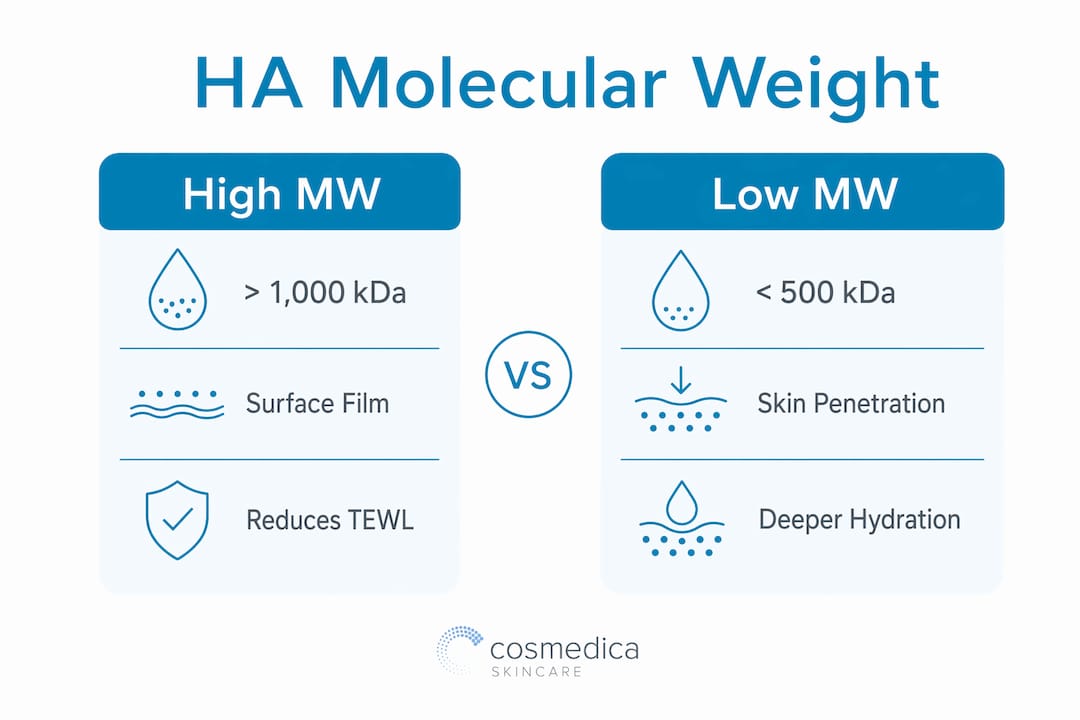
Not all hyaluronic acid products work the same way, and the reason comes down to molecular weight (MW). This is one of the most misunderstood aspects of HA in skincare, and getting it right changes how you shop.
Higher-MW HA forms a surface film on the skin and reduces transepidermal water loss (TEWL), which is the rate at which water escapes through the epidermis. This surface-level action delivers immediate plumping and a smooth, dewy finish. It is the effect you feel within minutes of applying a well-formulated serum. Lower-MW HA, on the other hand, can penetrate deeper into the skin layers, but this comes with a trade-off: smaller fragments have been shown to trigger inflammatory responses in some skin types, particularly sensitive or compromised skin.
| Molecular weight | Skin penetration | Primary benefit | Irritation risk |
|---|---|---|---|
| High (above 1,000 kDa) | Surface only | Reduces TEWL, immediate plumping | Very low |
| Medium (50–1,000 kDa) | Shallow dermal layers | Balanced hydration and barrier support | Low |
| Low (below 50 kDa) | Deeper dermal layers | Longer-term hydration, collagen support | Moderate in sensitive skin |
| Nano (below 5 kDa) | Deepest penetration | Targeted treatment, research-stage | Higher, use with caution |
The practical takeaway is that multi-weight HA formulations outperform single-weight products because they address hydration at multiple skin depths simultaneously. A product with only high-MW HA gives you surface glow but misses the deeper dermis. A product with only low-MW HA risks irritation without the protective surface film. The best serums layer both.
Pro Tip: If you have sensitive or reactive skin, start with a product that lists high-MW or medium-MW HA first on the ingredient list. Once your skin barrier is stronger, you can introduce a blended formula that includes lower-MW fractions for deeper hydration.
This molecular weight variation is also why two products with identical HA concentrations can feel completely different on your skin. Concentration tells you how much HA is present. Molecular weight tells you where it actually goes.
What does the science say about hyaluronic acid skin benefits?
The clinical evidence for HA is stronger than most skincare ingredients can claim, and it covers both topical and oral delivery routes.
A randomized, placebo-controlled trial in 150 healthy adults found that oral sodium hyaluronate at 120 mg per day over 12 weeks produced clinically significant improvements in facial hydration, skin elasticity, transepidermal water loss, and wrinkle depth. That means HA taken as a supplement reached the skin from the inside out, improving barrier function in ways that topical application alone cannot fully replicate. This is a meaningful finding for anyone who wants systemic skin support alongside their topical routine.
On the topical side, the evidence is equally compelling. HA applied to skin delivers fast, visible plumping because the gel matrix immediately draws moisture from the environment and the deeper skin layers into the epidermis. The following table summarizes the key clinically observed benefits:
| Benefit | Mechanism | Evidence type |
|---|---|---|
| Increased skin hydration | Humectant water binding at surface and dermis | RCT, topical and oral studies |
| Reduced transepidermal water loss | High-MW surface film reinforces lipid barrier | Clinical measurement |
| Improved skin elasticity | Hydration restores dermal volume and snap-back | RCT with oral sodium hyaluronate |
| Reduced wrinkle depth | Plumping effect from water retention in dermis | RCT, 12-week oral supplementation |
| Keratinocyte and collagen support | HA as extracellular matrix component signals cell renewal | In vitro and clinical data |
One important clarification: HA’s principal benefit is hydration and plumping, not direct wrinkle removal. The anti-aging effects you see are largely downstream of better hydration and a stronger skin barrier. A well-hydrated skin surface reflects light more evenly, fine lines appear shallower, and the dermis maintains its structural integrity longer. That is real anti-aging value, but it works through moisture, not through rewriting your skin’s biology overnight.
HA also plays a role in keratinocyte proliferation and collagen synthesis over extended periods. These are the processes that keep your skin renewing itself and staying firm. Think of HA not just as a drink of water for your skin, but as part of the scaffolding that keeps the whole structure standing. You can explore the full range of HA benefits in detail to see how each one connects to your specific skin goals.
How to use hyaluronic acid effectively in your skincare routine
Knowing the science is only half the equation. How you apply HA determines whether you get the full benefit or leave most of it sitting on the surface doing very little.
-
Apply to damp skin. HA is a humectant, meaning it draws moisture toward itself. If you apply it to completely dry skin in a dry environment, it will pull moisture from your deeper skin layers rather than from the air. Mist your face lightly or apply HA immediately after cleansing while your skin is still slightly damp.
-
Choose a multi-weight formulation. As covered above, blended molecular weight products hydrate at multiple depths. Single-weight products are less effective overall. Check the ingredient list for terms like “hydrolyzed hyaluronic acid” (low MW) alongside standard “sodium hyaluronate” (medium to high MW).
-
Layer HA before your moisturizer. HA works best when sealed in. Apply your serum first, let it absorb for 30 to 60 seconds, then follow with a moisturizer or facial oil to lock the hydration in place. Skipping this step means the water HA attracted can evaporate before your skin absorbs it.
-
Pair HA with complementary ingredients. HA works well alongside niacinamide (which supports the lipid barrier), vitamin C (which supports collagen synthesis), and ceramides (which reinforce the skin barrier). Avoid layering HA directly with high-concentration acids like glycolic acid at the same time, since low pH can degrade HA’s structure before it reaches your skin.
-
Consider oral supplementation for deeper results. The clinical trial data on oral sodium hyaluronate shows real systemic benefits that topical products cannot fully replicate. If you want to address hydration from the inside out, a daily supplement of 120 mg sodium hyaluronate is the dose with the strongest current evidence behind it.
-
Store your HA products correctly. HA degrades with heat and light exposure. Keep serums in a cool, dark place and check that your product uses an airless pump or dark glass bottle to preserve potency.
The most common mistake people make with HA is applying it to dry skin and then skipping a moisturizer. That combination can actually leave skin feeling tighter and drier than before. The fix is simple: damp skin plus HA plus a sealer. That three-step sequence is where the topical hyaluronic acid magic actually happens.
Key takeaways
Hyaluronic acid’s unique water-binding structure, combined with molecular weight variation and clinical evidence from both topical and oral studies, makes it the most scientifically supported humectant in modern skincare.
| Point | Details |
|---|---|
| Structural uniqueness | HA is non-sulfated and forms a gel matrix that holds up to 1,000 times its weight in water. |
| Molecular weight matters | High-MW HA hydrates the surface; low-MW penetrates deeper but may irritate sensitive skin. |
| Clinical evidence is strong | A 12-week RCT showed oral sodium hyaluronate improved hydration, elasticity, and wrinkle depth. |
| Application method is critical | Apply to damp skin and seal with a moisturizer to prevent HA from drawing moisture out of the skin. |
| Multi-weight formulas win | Products blending multiple molecular weights deliver hydration at every skin depth simultaneously. |
Thomas’s take: what most people get wrong about hyaluronic acid
After years of working with skincare formulations and watching trends come and go, I have one consistent observation: people expect hyaluronic acid to do more than hydrate, and then feel let down when it does not erase deep wrinkles overnight.
Here is the honest truth. HA is extraordinary at what it does, which is hold water and support your skin’s structural environment. But it is not a retinol. It does not accelerate cell turnover or directly stimulate collagen production the way a prescription retinoid does. The anti-aging effects you see from HA are real, but they come from better hydration making your skin look and function better, not from HA rewriting your skin’s biology.
What I find most underappreciated is the molecular weight conversation. Most people pick up a serum, see “hyaluronic acid” on the label, and assume all HA products are equal. They are not. A product with only high-MW HA gives you beautiful surface glow but does almost nothing for the dermis. A product with only low-MW HA can irritate sensitive skin without delivering the surface protection you also need. The brands that invest in multi-weight formulations are the ones worth your money.
My practical advice: use HA as the foundation of your hydration routine, not as your only anti-aging strategy. Pair it with a vitamin C serum in the morning and a retinol product at night if anti-aging is your primary goal. Let HA do what it genuinely excels at, and you will never be disappointed.
— Thomas
Discover Cosmedica Skincare’s hyaluronic acid collection
If you are ready to put the science to work, Cosmedica Skincare has formulated a range of HA-powered products designed to deliver real, visible hydration for every skin type. Our hyaluronic acid serums are built with multi-weight HA blends so your skin gets surface plumping and deeper dermal hydration in a single step. For those focused on long-term results, our anti-aging facial care collection pairs HA with complementary actives like vitamin C and retinol to support collagen, barrier function, and skin renewal together. Every formula is cruelty-free, dermatologist-tested, and made without unnecessary fillers. Your skin deserves ingredients that actually earn their place in the bottle.
FAQ
What makes hyaluronic acid different from other moisturizers?
Hyaluronic acid is a non-sulfated glycosaminoglycan that forms a gel matrix capable of holding up to 1,000 times its weight in water, a capacity no common moisturizing ingredient like glycerin or urea can match. Its ability to operate at multiple skin depths through molecular weight variation also sets it apart from standard occlusive or emollient moisturizers.
Does molecular weight really change how hyaluronic acid works on skin?
Yes, significantly. High-MW HA stays on the skin surface and reduces water loss, while low-MW HA penetrates deeper but can trigger inflammation in sensitive skin types. The most effective products use a blend of multiple molecular weights to address hydration at every skin layer.
Can you take hyaluronic acid as a supplement?
Clinical evidence supports it. A randomized trial found that 120 mg per day of oral sodium hyaluronate over 12 weeks improved skin hydration, elasticity, and wrinkle depth in healthy adults, suggesting systemic benefits that topical products cannot fully replicate on their own.
Is hyaluronic acid safe for all skin types?
High-MW and medium-MW HA are well tolerated across virtually all skin types, including sensitive and acne-prone skin. Low-MW fractions carry a slightly higher irritation risk for compromised skin, so starting with a high-MW or blended formula is the safer approach for reactive skin.
Why does hyaluronic acid sometimes make skin feel dry?
This happens when HA is applied to completely dry skin in a low-humidity environment, causing it to draw moisture from the deeper skin layers rather than the air. Applying HA to slightly damp skin and sealing it with a moisturizer immediately after prevents this effect.