

Botanical Hyaluronic Acid: What It Is and Why It Works
TL;DR:
- Botanical hyaluronic acid is derived from plants and fungi such as Tremella mushrooms and Cassia seeds, mimicking traditional hyaluronic acid’s moisture-binding properties. It supports skin hydration by upregulating cellular proteins like AQP3 and enzymes that produce hyaluronic acid, enhancing barrier function and moisture retention. While comparable in benefits to synthetic HA, sourcing and molecular weight influence its efficacy, making proper formulation and application essential for optimal results.
Botanical hyaluronic acid is defined as a plant- or fungus-derived polysaccharide that mimics the moisture-binding properties of traditional hyaluronic acid in skincare. Think of it as nature’s version of the ingredient you already know and love, pulled from sources like Tremella mushrooms and Cassia seeds instead of animal tissue or lab fermentation. These botanical alternatives attract water to the skin’s surface, reduce visible dryness, and support a healthier skin barrier. If you’ve been curious about what is botanical hyaluronic acid and whether it actually delivers, the short answer is yes, and the science behind it is genuinely fascinating.
What is botanical hyaluronic acid and where does it come from?
Botanical hyaluronic acid is not a single standardized ingredient. It’s a category of plant- and fungus-derived polysaccharides that function like hyaluronic acid (HA) in the skin, acting as humectants that draw moisture from the environment into the stratum corneum. The industry term you’ll see on INCI labels includes names like Tremella fuciformis extract, Tremella mesenterica polysaccharide, and Cassia angustifolia seed polysaccharide. Each source has a distinct molecular profile, and understanding those differences helps you choose smarter.
Tremella mushrooms: the most studied source
Tremella fuciformis, sometimes called the snow mushroom, is the most researched botanical HA source. Its extract contains about 87.76% hyaluronic acid with a molecular weight above 2,000 kDa, making it structurally comparable to high-grade traditional HA. That’s a remarkable level of purity for a plant-based extract. The extraction process uses ethanol precipitation rather than harsh chemical solvents, which preserves the polysaccharide’s molecular integrity and makes it suitable for cosmetic formulations.
Tremella mesenterica is a close relative with a highly branched polysaccharide structure built from mannose, glucose, and xylose components. That branching increases the number of surface hydrophilic groups, which may actually enhance moisture retention compared to the more linear structure of conventional HA. Think of it like a sponge with more surface area to grab onto water molecules.
Cassia seed polysaccharide: the film-forming alternative
Cassia angustifolia seed polysaccharide works differently. Rather than penetrating or deeply binding water within skin layers, it forms a flexible protective film on the skin surface that smooths texture, fills fine lines visually, and locks in existing moisture. BASF markets this ingredient under the name Hyalurosmooth® PW LS 8997, and it’s widely used in serums and moisturizers targeting surface-level plumping. It’s also compatible with actives like niacinamide, vitamin C, and retinoids, which makes it a flexible addition to multi-ingredient formulas.
| Source | INCI Name | Key Function | Molecular Weight |
|---|---|---|---|
| Snow mushroom | Tremella fuciformis extract | Deep humectancy, HA-like hydration | Above 2,000 kDa |
| Jelly mushroom | Tremella mesenterica polysaccharide | Barrier support, gene expression | High, branched structure |
| Cassia seed | Cassia angustifolia seed polysaccharide | Film-forming, surface smoothing | Varies by processing |
Pro Tip: When shopping for botanical HA products, flip to the ingredient list and look for these INCI names specifically. “Botanical hyaluronic acid” on the front label tells you nothing about which source or molecular weight is inside.
How does botanical hyaluronic acid benefit your skin?
The benefits of botanical hyaluronic acid go beyond simple surface moisture. Research shows these polysaccharides interact with the skin at a cellular level, influencing the proteins and enzymes your skin uses to manage hydration on its own.
Here’s what the science actually shows:
- Upregulation of aquaporin-3 (AQP3): Tremella mesenterica polysaccharide upregulates AQP3 by approximately 55 to 57% in keratinocytes. AQP3 is a water channel protein that moves moisture through skin cell membranes. More AQP3 activity means your skin is better equipped to hydrate itself from within.
- Stimulation of hyaluronan synthase enzymes: The same study found upregulation of HAS2 by roughly 22% and HAS3 by up to 475%. These enzymes produce your skin’s own hyaluronic acid, meaning botanical HA doesn’t just add moisture temporarily. It prompts your skin to make more of its own.
- Filaggrin support: Filaggrin is a structural protein critical to skin barrier integrity. Its upregulation by Tremella polysaccharides suggests a real contribution to barrier repair, not just cosmetic plumping.
- Film-forming protection: Cassia seed polysaccharide creates a breathable, flexible layer on the skin surface that reduces moisture evaporation and visibly smooths texture within minutes of application.
“Tremella polysaccharides may modulate gene expression related to skin hydration and barrier function, potentially offering benefits beyond mere moisture retention.” — Structural Elucidation and Moisturizing Potential of Tremella mesenterica Polysaccharide
These findings matter because they position botanical HA as more than a feel-good natural swap. The in vitro evidence suggests genuine biological activity. That said, in vitro results don’t always translate directly to the same magnitude of effect on living skin, so pairing botanical HA with a well-formulated moisturizer remains the smart move. We’ll cover that in the application section below.
For a broader look at what hyaluronic acid does for skin health, the 10 benefits of hyaluronic acid page at Cosmedica-skincare is a solid starting point.
Botanical hyaluronic acid vs synthetic: what’s actually different?
This is the question we hear most often, and the answer is more nuanced than most ingredient breakdowns admit.
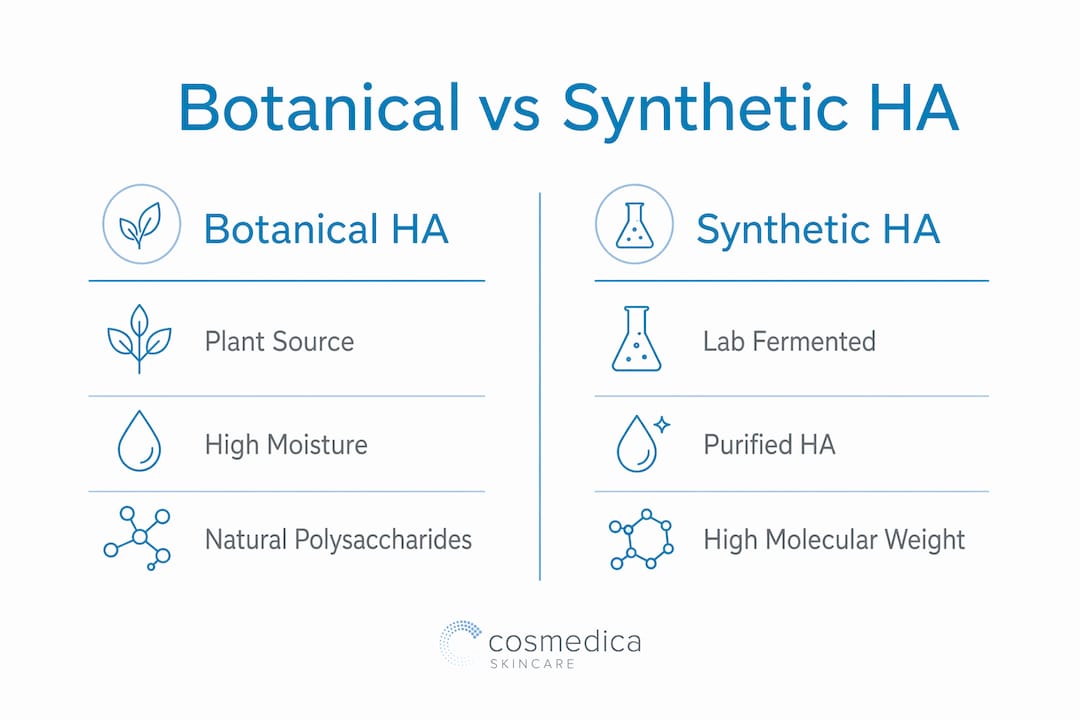
Traditional HA used in skincare comes from two main sources. The first is rooster combs, an animal-derived extraction method that’s largely been replaced. The second is microbial fermentation, where bacteria like Streptococcus equi produce HA in a lab setting. Fermented HA is considered vegan and is the dominant form in most mainstream serums today. Botanical HA, by contrast, comes from plants and fungi without microbial fermentation, which appeals to consumers who want the most natural possible sourcing.
The molecular difference is where things get interesting. Fermented HA is pure hyaluronic acid, a single well-characterized molecule. Botanical HA from Tremella or Cassia is technically a polysaccharide blend that behaves like HA rather than being chemically identical to it. That distinction matters for how formulators work with it, but for your skin, the humectant and barrier-supporting effects are comparable.
Molecular weight also plays a key role. High molecular weight HA above 2,000 kDa sits on the skin surface, forming a moisture-sealing film. Lower molecular weight HA penetrates more deeply into the epidermis for longer-lasting hydration. Tremella extracts naturally sit in the high molecular weight range, which means they excel at surface plumping and immediate softness. If you want deeper hydration, look for formulas that combine botanical HA with a lower molecular weight HA or a penetration-enhancing ingredient like vitamin B5.
Pro Tip: Pair any botanical HA serum with an occlusive moisturizer or facial oil on top. Humectants can increase transepidermal water loss if applied without a barrier layer, especially in dry or air-conditioned environments. Sealing the moisture in is what makes the hydration last.
| Feature | Botanical HA | Synthetic/Fermented HA |
|---|---|---|
| Source | Plants, mushrooms | Lab fermentation or animal tissue |
| Molecule type | HA-like polysaccharide blend | Pure hyaluronic acid |
| Molecular weight | Typically high (above 2,000 kDa) | Available in multiple weight ranges |
| Cruelty-free | Yes | Yes (fermented); No (animal-derived) |
| Skin penetration | Primarily surface-level | Surface and deeper layers (varies by weight) |
| Formulation flexibility | Compatible with most actives | Compatible with most actives |
How to use botanical hyaluronic acid in your skincare routine
Getting the most from botanical HA comes down to application order, pairing, and skin type awareness. Here’s a practical sequence that works for most people:
- Cleanse first. Apply botanical HA to clean, slightly damp skin. The residual moisture gives the humectant something to work with immediately, amplifying that plumping effect.
- Apply your botanical HA serum. Use 2 to 3 drops and press gently into the skin rather than rubbing. This preserves the film-forming properties of ingredients like Cassia seed polysaccharide.
- Layer actives on top if needed. Botanical HA is compatible with niacinamide, vitamin C, and retinoids, so you can apply your treatment serums directly after. The HA layer won’t interfere with their efficacy.
- Seal with a moisturizer or facial oil. This step is non-negotiable. Without an occlusive layer on top, the humectant can pull moisture from deeper skin layers rather than from the air, which defeats the purpose. A ceramide-rich moisturizer or a few drops of squalane oil work well.
- Use morning and evening. Botanical HA is gentle enough for twice-daily use on all skin types, including sensitive and acne-prone skin. There are no photosensitizing concerns, so morning application is completely safe.
Skin types that benefit most include dry and dehydrated skin (obvious), but also oily skin that’s been stripped by harsh cleansers. Oily skin is often dehydrated at the surface while producing excess sebum underneath, and botanical HA addresses that surface dehydration without adding greasiness. Mature skin benefits from the AQP3 and HAS upregulation effects, which support the skin’s natural ability to retain moisture as production slows with age.
For a deeper look at how hyaluronic acid supports clear, youthful skin, the hyaluronic acid explained article at Cosmedica-skincare covers the broader picture well.
Key takeaways
Botanical hyaluronic acid delivers genuine hydration and barrier benefits through plant- and fungus-derived polysaccharides, but its effects depend on source, molecular weight, and how it’s formulated.
| Point | Details |
|---|---|
| Definition matters | Botanical HA is a category of polysaccharides, not one standardized molecule. |
| Best sources | Tremella fuciformis and Tremella mesenterica offer the highest HA content and barrier benefits. |
| Molecular weight shapes results | High molecular weight provides surface plumping; lower weight penetrates more deeply. |
| Always pair with an occlusive | Humectants without a sealing layer can increase water loss in dry environments. |
| Read the INCI label | Look for Tremella extract or Cassia angustifolia polysaccharide to verify what you’re actually buying. |
Why botanical HA is worth paying attention to, from someone who has watched the trends
I’ve spent years watching ingredient trends cycle through the skincare industry, and botanical hyaluronic acid is one of the few that I think has genuine staying power rather than just good marketing.
The shift toward plant-based sourcing isn’t purely aesthetic. Consumers are asking harder questions about where ingredients come from, how they’re processed, and whether the supply chain aligns with their values. Tremella mushroom extracts answer those questions well. The ethanol precipitation extraction method is cleaner than many conventional processes, and the resulting ingredient is both high-purity and cruelty-free.
What I find most compelling, though, is the gene expression data. The fact that Tremella mesenterica polysaccharide upregulates HAS3 by up to 475% in keratinocytes suggests we’re not just looking at a passive moisturizer. We’re looking at an ingredient that may teach skin to hydrate itself more effectively over time. That’s a different category of benefit than a film-forming humectant, and it deserves more clinical follow-up than it’s currently received.
My honest caution is this: the term “botanical hyaluronic acid” is not regulated, and brands use it loosely. Some products contain high-purity Tremella extract with genuine HA content. Others use a small percentage of Cassia seed polysaccharide and call it botanical HA on the front label. Neither is dishonest, exactly, but they’re not the same thing. Reading the INCI list is the only way to know what you’re actually getting. If Tremella fuciformis extract or Tremella mesenterica polysaccharide appears in the first half of the ingredient list, you’re getting meaningful concentration. If it’s near the bottom, it’s likely a trace amount added for marketing purposes.
The future of botanical HA research will probably focus on lower molecular weight fractions from these same mushroom sources, which could offer deeper penetration without sacrificing the natural sourcing story. That’s the gap worth watching.
— Thomas
Explore Cosmedica-skincare’s hydrating serums
At Cosmedica-skincare, we’ve built our hydration lineup around ingredients that actually work, including formulas that pair hyaluronic acid with skin-supporting actives like vitamin B5 for deeper, longer-lasting moisture. Our products are cruelty-free, dermatologist-tested, and formulated for all skin types, so whether you’re new to HA or looking to upgrade your current routine, there’s something here for you. The Hyaluronic Acid + B5 Serum is a great starting point for daily hydration, and the Super Serum Set gives you a full routine built around intensive moisture. Browse the full product collection to find the right fit for your skin goals.
FAQ
What is botanical hyaluronic acid made from?
Botanical hyaluronic acid is made from plant- or fungus-derived polysaccharides, most commonly Tremella fuciformis mushroom extract or Cassia angustifolia seed polysaccharide. These ingredients mimic the moisture-binding behavior of traditional hyaluronic acid without animal-derived or synthetic sources.
Is botanical hyaluronic acid as effective as regular hyaluronic acid?
Botanical HA delivers comparable surface hydration and barrier support to traditional HA, with studies showing Tremella mesenterica polysaccharide upregulates key hydration markers including AQP3 and HAS3 in skin cells. Its high molecular weight means it excels at surface plumping, though it may not penetrate as deeply as low molecular weight synthetic HA.
Can botanical hyaluronic acid cause skin irritation?
Botanical HA is generally well-tolerated across all skin types, including sensitive and acne-prone skin, because it lacks the harsh processing chemicals sometimes associated with synthetic ingredients. Always patch-test a new product, especially if your skin reacts to mushroom-derived ingredients.
How do I know if a product actually contains botanical hyaluronic acid?
Check the INCI ingredient list for names like Tremella fuciformis extract, Tremella mesenterica polysaccharide, or Cassia angustifolia seed polysaccharide. The term “botanical hyaluronic acid” on the front label is a marketing description, not a standardized ingredient name, so the INCI list is the only reliable source of truth.
Do I need to use botanical hyaluronic acid differently than regular HA?
The application method is the same: apply to damp skin and seal with a moisturizer or occlusive. The key reminder is that humectants increase transepidermal water loss without a barrier layer on top, so skipping the moisturizer step will reduce the hydrating effect regardless of whether your HA is botanical or synthetic.