

Face Mist vs Toner: Use Mists for Midday Topups, Toners to Prep
A face mist gives skin a light, quick hit of hydration and refreshment; a toner preps skin after cleansing and can deliver targeted actives like exfoliating acids. They are not interchangeable, and the Cleveland Clinic treats them as distinct steps for a reason. If your routine needs prep and treatment, reach for a toner first. If it just needs a midday pick-me-up, a mist does the job Cosmedica Skincare builds both into its lineup for exactly this reason.
TL;DR:
- Face mists are designed for quick hydration and refreshment, but often provide only temporary moisture unless sealed with moisturizer immediately after use.
- Modern toners hydrate, soothe, and prime skin after cleansing, with some delivering active ingredients like gentle acids that can improve texture and unclog pores.
- The main difference lies in purpose: mists are for mid-day refreshment and dampening before serums, while toners are for post-cleanse prep and treatment.
- Use toner right after cleansing and follow with serum and moisturizer, while mist should be applied on slightly damp skin and sealed in with moisturizer right afterward.
- Properly matching products to skin type enhances effectiveness, with hydrating toners and mists suited for dry skin, and targeted toners for oily or sensitive skin.
Table of Contents
- What Is a Face Mist, Really?
- What Is a Toner Now? Forget the Old Astringent Image
- Mist vs Toner: The Differences That Actually Matter
- How to Use Both Without Overcomplicating Your Routine
- Matching Mist and Toner to Your Skin Type
- Misconceptions and Warning Signs Worth Knowing
- Our Take: Stop Treating These as Rivals
- Start With One Toner, One Mask, and Build From There
- Sources
- FAQ
What Is a Face Mist, Really?
A face mist is a pressurized spray of water and lightweight ingredients like glycerin, aloe, thermal water, or botanical extracts. Think of it as a splash of hydration you can carry in your bag, not a treatment step you plan your whole routine around.
Most people reach for one of three moments: a midday refresh when skin feels tight and dull, a setting step to help makeup blend without looking cakey, or a quick dampening before applying a serum so the formula spreads more evenly. That last use has real backing. Cleveland Clinic notes that applying products to slightly damp skin can improve how well they absorb.

The catch: mist evaporates. Spraying it and walking away can leave skin drier than before you started, because water lifts moisture from the surface as it evaporates. This is why face misting is often described as offering only temporary comfort unless something traps that moisture in right after.
A few things a mist genuinely does well:
- Refreshes skin midday without disturbing makeup
- Adds a light layer of comfort during travel or in dry, air-conditioned rooms
- Dampens skin before a serum to help it glide on and absorb more evenly
- Soothes irritated or post-treatment skin when the formula is minimal and fragrance-free
What Is a Toner Now? Forget the Old Astringent Image
If your mental image of toner is a stinging, alcohol-heavy liquid that strips skin after cleansing, it’s outdated. Modern toners are largely water-based and built to hydrate, soothe, and prime skin for whatever comes next, not punish it.
A good toner does real work in a routine: it wipes away leftover residue from cleansing, helps rebalance skin’s pH after a wash, and creates a better canvas for the serums and moisturizers that follow. Some toners go further, delivering actives directly. Formulas with mild acids like glycolic, lactic, or salicylic can smooth texture and help unclog pores, though the Cleveland Clinic is clear that these need careful, not daily-without-thought, use to avoid damaging the skin barrier.
Toners also come in more than one format:
- Swipe toners: applied with a cotton pad, often used to lift residue or deliver acids
- Spray toners: applied like a mist but formulated as an intentional prep step, not just a refresher
- Hydrating primers: alcohol-free formulas meant to plump and prep before serum
- Acid or exfoliating toners: targeted treatment formulas for texture and clarity, used a few times a week rather than daily
Mist vs Toner: The Differences That Actually Matter
Here’s where the difference between face mist and toner gets concrete. Purpose, timing, and staying power separate them more than anything on the label.
| Factor | Face Mist | Toner |
|---|---|---|
| Primary purpose | Quick hydration, refresh, makeup-set | Post-cleanse prep, residue removal, active delivery |
| Best timing | Midday, over makeup, before serum | Right after cleansing, AM and/or PM |
| Typical ingredients | Water, glycerin, aloe, thermal water | Humectants, mild acids, botanical extracts |
| How long it lasts | Minutes, unless sealed in | Sets up skin for the rest of the routine |
| Decision rule | Skin feels dull or tight right now | Skin needs cleaning up or targeted treatment |
If your skin looks flat by 2 p.m., mist it. If your skin needs prepping before serums go on, or you’re targeting texture and clogged pores, toner is the tool. Patchology points out that some newer formulas blur this line entirely, with hydrating toning mists that do a bit of both. Read the ingredient list, not just the product name, before assuming what a bottle actually does.
How to Use Both Without Overcomplicating Your Routine
The order matters more than most people realize. A standard routine runs cleanser, then toner (if you’re using one), then serums, then moisturizer. Mist fits differently depending on when you use it.
- Morning or evening, right after cleansing: apply toner with a cotton pad or clean hands, patting rather than rubbing it in.
- Before your serum: a light mist on slightly damp skin can help the serum spread and absorb more evenly, per Cleveland Clinic’s guidance on damp-skin application.
- Midday: hold the bottle six to eight inches from your face, close your eyes, and spray two or three times. Pat gently, never rub, so you don’t disturb makeup.
- Immediately after misting: follow with a moisturizer or facial oil to seal that moisture in before it evaporates.
That last step is the one people skip, and it’s the one that matters most. BeautyWorldNews is direct about it: mist gives lightweight, temporary hydration, and skipping the follow-up moisturizer means you lose most of the benefit within minutes. A structured hydration workflow makes this order easier to stick to instead of guessing each time.
Pro Tip: Keep your mist in your bag, not just on your vanity. The whole point of a mist is convenience, and a bottle you never see doesn’t get used.
Matching Mist and Toner to Your Skin Type
Not every skin type needs the same version of either product. Dry or dehydrated skin usually does best with a hydrating toner built around humectants, paired with a mist that leans on hyaluronic acid or glycerin rather than a thin, watery base. A hydrating toner formulated for dry skin can make a noticeable difference here, especially layered under a heavier cream.
Oily and acne-prone skin generally responds better to a gentle salicylic acid toner used a few times a week, since it helps keep pores clear without over-stripping. Steer clear of alcohol-heavy mists or toners in this category. They feel refreshing for a moment, but they tend to trigger more oil production once skin dries out.
Sensitive skin needs the shortest ingredient lists on both fronts: alcohol-free, fragrance-free toners, and minimal mists built on thermal water rather than botanical blends. GlamGeek notes that simple, minimal-ingredient mists are especially useful for sensitive or post-treatment skin, precisely because there’s nothing in them to provoke a reaction.
Aging or dull skin benefits from an AHA or BHA toner a few nights a week for texture, plus an antioxidant-rich mist during the day for a bit of extra defense.
- Dry/dehydrated: hydrating toner + humectant-rich mist
- Oily/acne-prone: gentle salicylic toner, skip alcohol-heavy mists
- Sensitive: alcohol- and fragrance-free toner + minimal thermal-water mist
- Aging/dull: AHA/BHA toner a few nights weekly + antioxidant mist
Misconceptions and Warning Signs Worth Knowing
The biggest myth floating around: a mist can replace your moisturizer. It can’t. A mist adds water to the skin’s surface, but without an occlusive step to lock it in, that water evaporates and can leave skin drier than before you sprayed, as Beautiful Skin Solutions points out. Another outdated idea: toner has to sting to work. Stinging usually signals irritation, not effectiveness. And spraying more mist doesn’t mean more hydration. Past a certain point, you’re just wetting your face, not treating it.
Watch for these warning signs and adjust your formula if you see them:
- Persistent stinging or burning after applying toner
- Redness that shows up consistently, not just once
- Skin that feels tighter or drier hours after misting
- Breakouts that worsen rather than clear up
Alcohol, added fragrance, and over-exfoliation from acid toners used too often are the usual culprits behind all four.
Our Take: Stop Treating These as Rivals
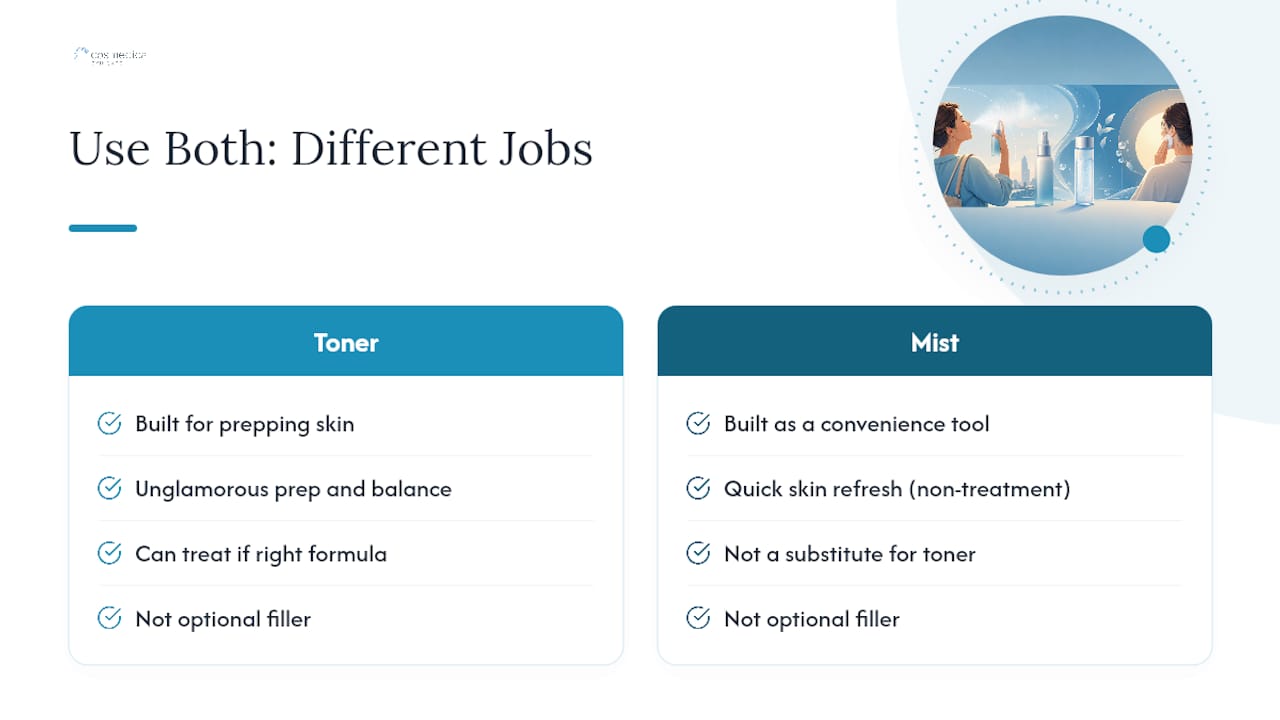
Most of the confusion around face mist vs toner comes from marketing that pits them against each other, when they’re built for different jobs entirely. A toner does the unglamorous work of prepping skin and, in the right formula, treating it. A mist is a convenience tool, not a treatment. Neither one is optional filler, but neither is a substitute for the other either.
Cosmedica Skincare’s own approach reflects this: a rosewater and witch hazel toner built for prep and balance, alongside hydration-focused masks meant to trap moisture rather than let it evaporate… The practical fix for most routines isn’t picking a side. It’s using each product for the job it’s actually suited to.
— Thomas
Start With One Toner, One Mask, and Build From There
You don’t need six products to get this right. If your skin leans dry or dehydrated, a good place to start is a hydrating toner built with humectants rather than an old-style astringent, paired with something that locks moisture in afterward, like the Hyaluronic Dew Multi-Mask. If you’d rather not piece together a routine ingredient by ingredient, the Super Serum Set bundles complementary hydrating formulas so you’re not guessing what pairs with what. Every Cosmedica-skincare product page lists its full ingredient breakdown, so you can check for alcohol or fragrance before you buy, not after your skin reacts to it. If you’re ready to fix the “mist evaporates and does nothing” problem for good, start with a toner and a trapping step, and build outward from there.
Sources
- What Does Toner Do for Your Face? 5 Benefits
- Hydrating face mist guide: Face mist benefits and when to use face mist for best results
- Are face mists worth it? Benefits & best picks - GlamGeek
- What is face misting and does it actually hydrate skin? – Beautiful Skin Solutions
FAQ
What comes first, face mist or toner?
Toner comes first, right after cleansing, since it preps skin and can deliver actives. A mist is typically used later, for a midday refresh or a light dampening before serum.
Can I use face mist as toner?
Not reliably. A mist hydrates and refreshes but doesn’t remove residue, rebalance pH, or deliver the actives many toners are formulated to provide.
Is face mist necessary?
No, but it’s a useful convenience step for midday dryness, makeup blending, or soothing sensitive skin, especially when followed immediately by a moisturizer.
How do you use face mist correctly?
Hold the bottle six to eight inches from your face, spray two or three times with eyes closed, pat gently, and follow up with a moisturizer within a minute or two so the hydration doesn’t evaporate.