

Barrier First Travel Skincare Routine Backed by Flight Studies
The simplest effective travel skincare routine uses five multitasking products: a gentle cleanser, a humectant serum or mist, a barrier moisturizer, sunscreen, and one optional spot treatment. Start hydrating a few days before your trip, layer humectant under occlusive during the flight, rehydrate every two to three hours in the air, and fall back on a 48-hour barrier reset if your skin acts up.
TL;DR:
- Pre-flight hydration with humectants and antioxidants is crucial, avoiding new active products within 48 to 72 hours before travel to prevent skin reactions.
- Cabin air dries skin rapidly, losing up to 37% of hydration during a long flight, requiring hourly reapplication of humectants, barrier moisturizers, and sunscreen near windows.
- Travel skincare kits should include small, multi-purpose items like balm sticks and sprays, with decanted full-size products sealed to prevent leaks during security checks.
- Adjust skincare textures based on destination climate: heavier occlusives for cold or dry environments, and lighter, water-based products for humid, hot locations.
- A 48-hour reset protocol involving minimal cleansing and basic hydration is recommended if skin reacts badly after a flight, before reintroducing active ingredients gradually.
Table of Contents
- Why Pre-Flight Prep Makes or Breaks Your Skin
- What Does Cabin Air Actually Do to Your Skin?
- What Should Go in Your Carry-On Skincare Kit?
- How Should You Adjust Your Routine by Destination?
- What’s the 48-Hour Fix If Your Skin Reacts?
- The Evidence Behind This Routine
- A Dawn Flight, a Window Seat, and What Actually Gets Used
- Where Cosmedica-Skincare Fits Your Travel Bag
- Sources
- FAQ
Why Pre-Flight Prep Makes or Breaks Your Skin
Your skin’s moisture reserves work like a savings account. Show up to the airport already overdrawn, and the cabin will drain you fast. Show up with a little extra banked, and you have a buffer.
The three days before travel matter more than most people realize. Loading up on humectants like hyaluronic acid and glycerin gives your skin cells something to hold onto once the air around you turns bone dry. Pair that with a richer moisturizer and an antioxidant serum in the evenings leading up to your flight, and you’re reinforcing the barrier before it takes a hit.
Here’s what dermatologists consistently flag as the biggest pre-flight mistake: trying a new retinol, a fresh acid exfoliant, or any unfamiliar active in the 48 to 72 hours before you fly. Travel stress, cabin dryness, and skin adjusting to a new product at the same time is a recipe for redness you didn’t need. If you’re building a simple skincare routine for the road, consistency beats experimentation every time.
Four things to knock out before you pack your bag:
- Drink more water than usual for two to three days, not just the morning of your flight
- Layer a hyaluronic acid or glycerin serum under your regular moisturizer each night
- Skip any new retinoid, acid, or unfamiliar active until you’re home
- Do one antioxidant-boosted night routine the evening before departure to fortify your barrier
Pro Tip: If you’re mid-retinol cycle, don’t quit cold. Just pause new introductions. Products you already tolerate well are fine to keep using right up until takeoff.
What Does Cabin Air Actually Do to Your Skin?
Cabin humidity plummets below 10% within two hours of takeoff, and research on long-haul flights found facial skin capacitance, a direct measure of hydration, can drop by as much as 37% during a single flight. That’s not a mild inconvenience. That’s your skin losing more water in a few hours than it typically would in an entire dry winter day at home.
Separate research comparing airline crew to office workers found the same pattern showing up occupationally: lower skin hydration and higher transepidermal water loss among people who fly regularly. Reviews of cabin environments generally recommend maintaining relative humidity below 40% for comfort, and most flights don’t come close to that number, according to a review of in-flight air quality standards.
In-flight skin hydration loss on a long flight
Here’s the sequence worth following once you’re in your seat:
- Do a minimal cleanse only if your face feels genuinely oily or you’ve been eating; otherwise skip it.
- Mist or apply a thin humectant layer, hyaluronic acid or glycerin work well here.
- Seal it in with a barrier moisturizer or a balm stick.
- Add sunscreen if you’re near a window during daylight hours, since UV exposure increases at altitude.
Refresh that sequence every two to three hours. A hydrating spray is often the most practical option for this because it layers over sunscreen or makeup without disturbing either, according to cabin air quality research. Balm sticks work well too, especially for anyone who doesn’t want to touch a bottle mid-flight with airplane hands.
What Should Go in Your Carry-On Skincare Kit?
TSA restricts carry-on liquids to 3.4 ounces (100 milliliters) per container, which means your travel kit needs to be chosen for size as much as function. A minimalist kit that fits a carry-on bag looks like this:
- A travel-size gentle cleanser, only if you typically cleanse mid-flight or on arrival
- A hydrating serum or facial mist in a container under 3.4 oz
- Barrier moisturizer in a squeeze tube or balm format, less prone to leaking than a jar
- SPF stick or a small tube of sunscreen
- Lip balm with SPF
- Optional: eye cream or a small spot treatment for breakouts
If you’re decanting products from full-size bottles, tape around the lids before you pack them. That one small step prevents the pressure-change leaks that ruin an entire bag of clothes. Choose products that pull double duty, a tinted moisturizer with SPF, or a serum that hydrates and brightens, so you’re not hauling six single-purpose items through security.
Pro Tip: Balms and sticks are your best friends here. They can’t spill, they don’t count against your liquid limit the same way bottled products do, and they survive a crushed backpack far better than glass jars.
How Should You Adjust Your Routine by Destination?
The kit stays the same. What changes is texture and emphasis, depending on where you land.
Cold or dry climates call for heavier occlusives. Add ceramides, squalane, or shea butter to lock in moisture against dry outdoor air and indoor heating, similar to how you’d approach a winter skincare routine.
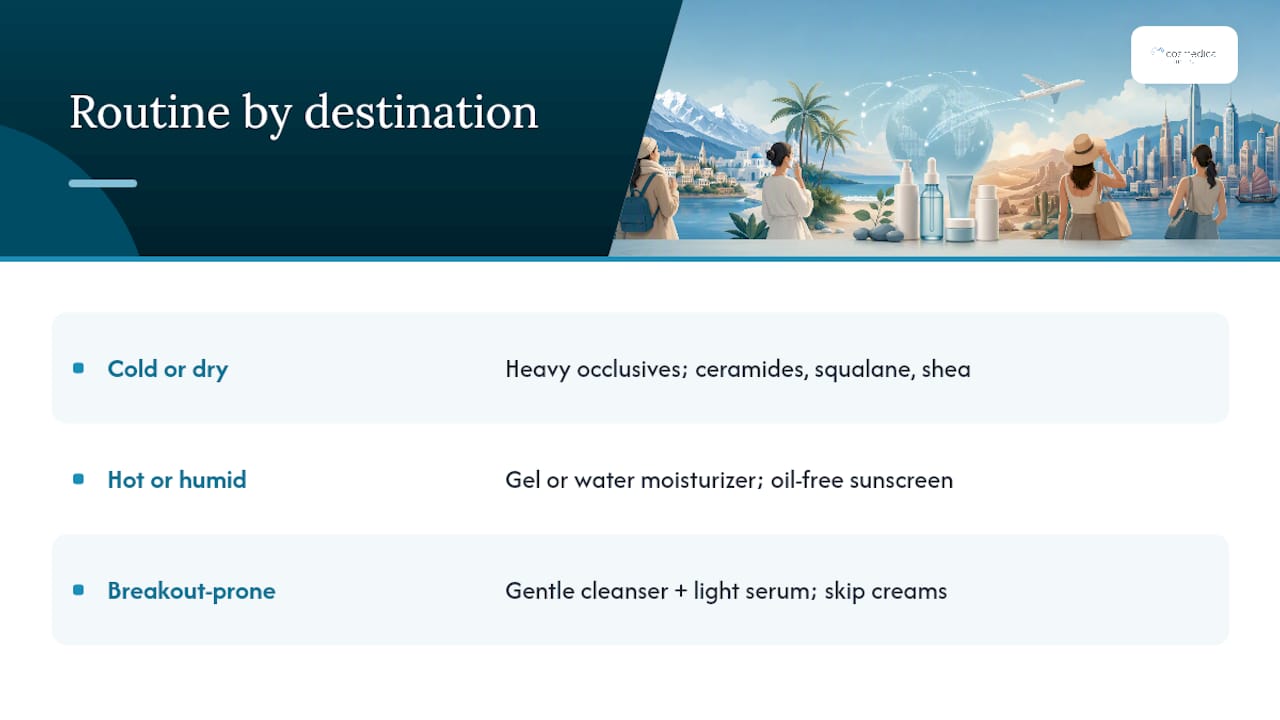
Hot or humid destinations need the opposite. Swap to a gel or water-based moisturizer and an oil-free sunscreen.
If you’re breakout-prone, keep it simple no matter the climate: a gentle cleanser and a lightweight hydrating serum, and leave the rich creams at home entirely. Not sure which category you fall into? A quick skin type check before you pack saves you from bringing the wrong textures altogether.
What’s the 48-Hour Fix If Your Skin Reacts?
If your face turns red, tight, or breaks out after a flight, stop everything except the basics. Dermatologist guidance points to a specific reset protocol rather than piling on more products, per the travel skincare checklist from OTS Dermatology.
- Cut all actives, retinoids, acids, and exfoliants immediately.
- Cleanse minimally, once a day at most, with the gentlest option you have.
- Apply a humectant serum, then a barrier moisturizer, morning and night.
- Use sunscreen every day, even indoors near windows.
- Hold this pattern for a full 48 hours before reintroducing anything else.
Once your skin looks and feels normal again, bring back one active at a time, spaced a few days apart, rather than resuming your full routine at once.
Pro Tip: If irritation includes swelling, blistering, or doesn’t calm down after 48 hours, that’s past the point of a DIY fix. See a dermatologist rather than layering on more products hoping one will work.
The Evidence Behind This Routine
None of this is guesswork. The in-flight hydration study documenting rapid capacitance loss is the reason humectant and occlusive layering matters so much in the air, not just at your destination. Dermatologists consistently point to the same short ingredient list for travel:
- Hyaluronic acid and glycerin, humectants that pull water into skin
- Ceramides, which rebuild the lipid barrier
- Niacinamide, which supports barrier function and calms redness
- Squalane and shea butter, occlusives that seal moisture in
Hydration, daily SPF, and sleep remain the three pillars that matter most for skin on the road, according to dermatologist travel guidance. If you’re shopping for pieces that fit this exact framework, humectant serums, barrier creams, and lightweight moisturizers, Cosmedica-skincare’s product pages are built around those same ingredient categories.
A Dawn Flight, a Window Seat, and What Actually Gets Used
On an early flight, the routine that survives is the one with the fewest steps. A hydrating mist before takeoff, a balm stick reapplied around the two-hour mark, sunscreen if the window seat gets sun. That’s it. Cream jars stay zipped in the bag; nobody wants to dig through a pouch with a tray table down.
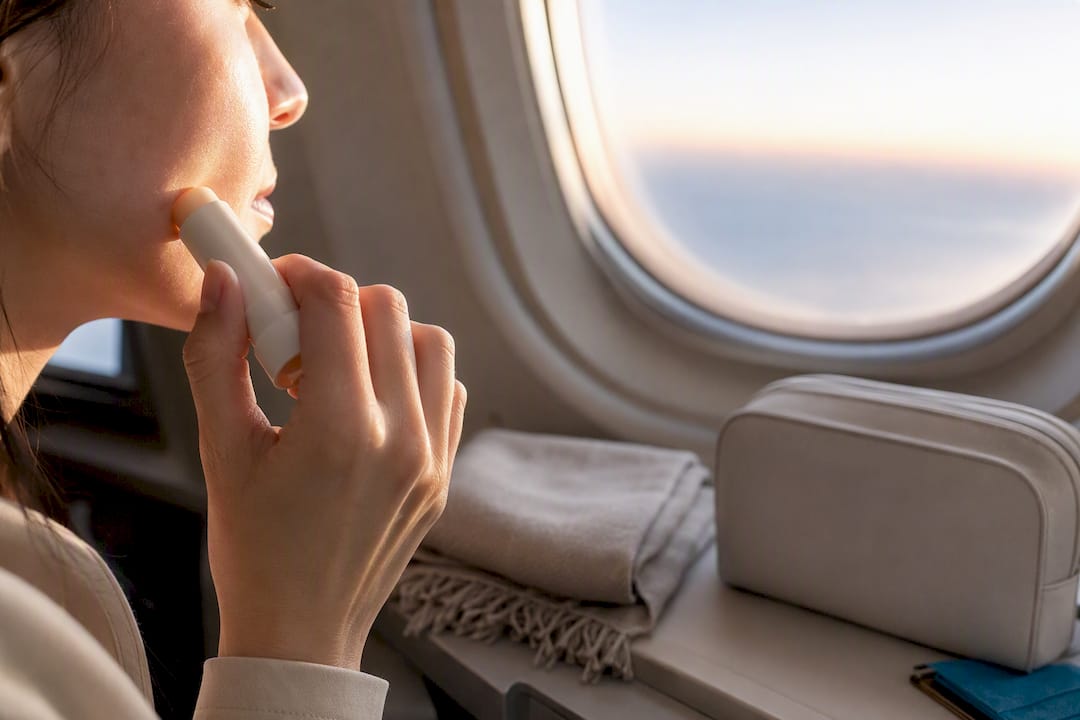
Sticks and sprays win over jars every time on a flight. Less mess, faster reapplication, and no need to find a bathroom to rinse your hands first.
Where Cosmedica-Skincare Fits Your Travel Bag
This routine depends on humectant-forward serums, barrier-supporting moisturizers, and clean formulations without the guesswork of piecing together five different brands. If you’d rather not build your travel kit product by product, the Super Serum Set bundles multiple hydration and brightening serums into one compact grouping, close to the multi-use, minimal-footprint approach this whole routine is built on. It’s a practical starting point if you’re packing for a trip this month and want your skin barrier handled without overthinking every bottle. Check the product page for current sizing before you fly.
Sources
- Skin surface hydration decreases rapidly during long distance flights
- Travel Skincare Checklist: Maintaining Your Routine Across Time Zones - OTS Dermatology
- Liquids rule (TSA)
- A Review of In-Flight Thermal Comfort and Air Quality Status in Civil Aircraft Cabin Environments
FAQ
What Are the Best Skincare Products for Travel?
A hydrating serum with hyaluronic acid or glycerin, a barrier moisturizer, and a stick sunscreen cover most travel needs in three multi-use products.
Can I Bring Full-Size Skincare Products in My Carry-On?
No. TSA limits carry-on liquids to 3.4 ounces (100 milliliters) per container, so decant larger products into travel-size bottles before you pack.
Should I Wear Sunscreen on a Plane?
Yes, especially in a window seat during daytime hours, since UV exposure increases at higher altitude regardless of cloud cover.
What Should I Do If My Skin Breaks Out After Traveling?
Follow a 48-hour reset: stop all actives, and use only a gentle cleanser, humectant serum, barrier moisturizer, and sunscreen until your skin calms down.