

0.1% Retinal vs 1% Retinol: Starter Doses for Skincare Shoppers
Retinal, also called retinaldehyde, is the faster and more potent over-the-counter retinoid, while retinol is the gentler starting point that still gets real results over time. If you’ve used retinol before without issues and want quicker anti-aging progress, retinal is worth the switch. If you’re new to retinoids or your skin flags every active ingredient, start with retinol. Either way, patch test first and wear sunscreen every single day.
TL;DR:
- Retinal typically delivers faster results and greater potency because it requires only one enzymatic conversion to retinoic acid, compared to retinol’s two.
- Over-the-counter retinal at 0.05% to 0.1% can outperform higher-percentage retinol products, like 1%, due to its higher bioavailability and conversion efficiency.
- To minimize irritation, start with half the retinol percentage when switching to retinal and increase frequency gradually over several weeks.
- Proper packaging, such as opaque bottles and airless dispensers, is crucial to maintain retinal’s stability and effectiveness.
- Regular use of sunscreen, patch testing, and gentle routines help prevent adverse reactions and optimize results with either retinoid.
Table of Contents
- Retinol vs Retinal: The Quick Comparison
- Why Being One Step Closer to Retinoic Acid Matters
- What the Percentages on the Label Actually Mean
- Irritation, Sensitivity, and How to Avoid Overdoing It
- Why the Bottle Matters as Much as the Ingredient
- What the Clinical Research Actually Shows
- How to Decide Between Retinal and Retinol
- Building a Routine That Actually Works
- My Take After Digging Into the Research
- Where to Start if You’re Ready to Try One
- Sources
- FAQ
Retinol vs Retinal: The Quick Comparison
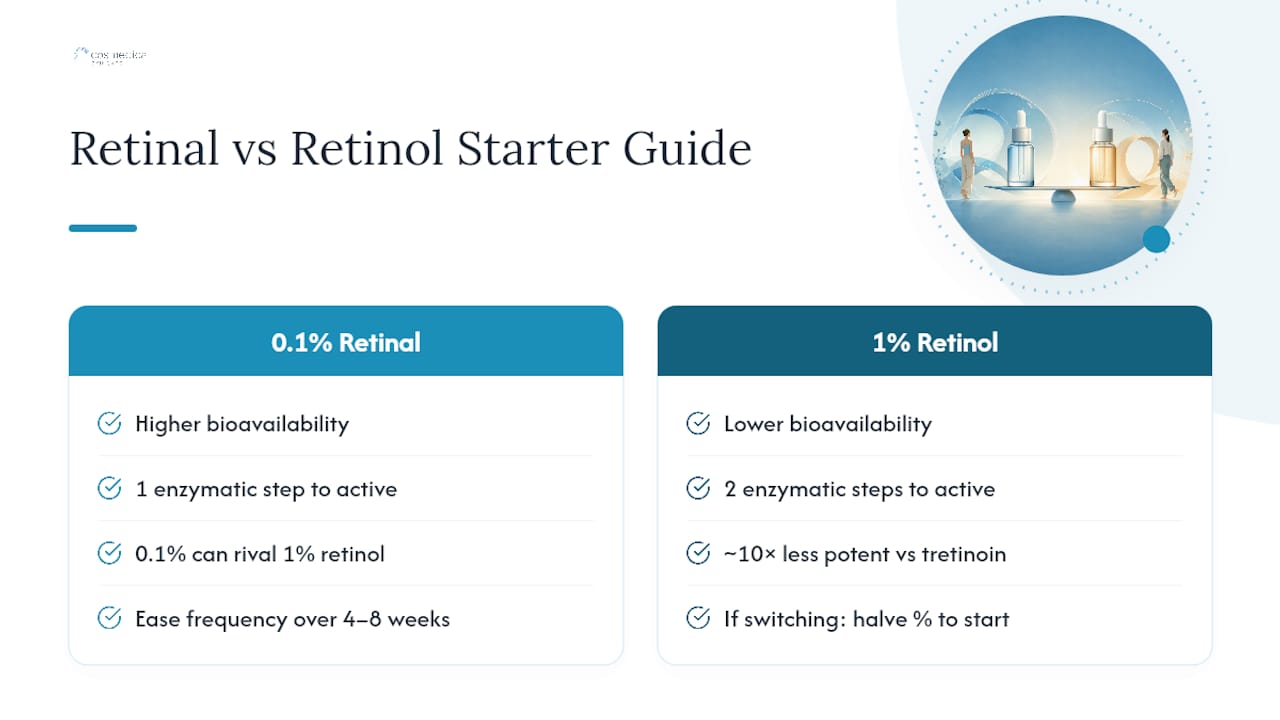
Here’s the thing about comparing these two: they’re related, but they’re not interchangeable, even at the same percentage on a label. Retinol needs two enzymatic conversions to become the active form your skin actually uses (retinoic acid). Retinal needs just one. That single-step head start is why retinal tends to act faster and hit harder.
- Conversion steps: Retinol converts retinol → retinal → retinoic acid (two steps). Retinal converts retinal → retinoic acid directly (one step).
- Typical OTC strength: Retinol products commonly run 0.1% to 1%. Retinal products are usually formulated lower, often 0.05% to 0.1%, because it’s simply stronger per unit.
- Percentages aren’t equivalent: A 0.1% retinal is not comparable to a 0.1% retinol. Think of it more like comparing a shot of espresso to a cup of drip coffee measured in the same size mug.
- Time to results: Retinal often shows visible change faster, sometimes within weeks. Retinol usually takes longer but tends to be easier on reactive skin along the way.
Why Being One Step Closer to Retinoic Acid Matters
All topical vitamin A derivatives are chasing the same destination: retinoic acid, the form your skin cells actually recognize and respond to. The pathway runs from retinyl esters, to retinol, to retinal, and finally to retinoic acid, with each step handled by specific enzymes inside your skin cells. Retinyl esters sit at the mild end of that chain. Retinoic acid, available only by prescription, sits at the potent end.
Retinol has to clear two enzymatic conversions before it becomes usable. Retinal only needs one. That difference sounds small, but enzymatic conversion isn’t perfectly efficient. Every extra step is a chance for some of the product to get converted more slowly, stored, or metabolized elsewhere before it ever becomes active. Metabolism studies in keratinocytes show that skin cells convert retinal to retinoic acid more efficiently than they convert retinol through the full chain.
That’s the whole reason retinal tends to punch above its listed percentage. Dermatology literature actually ranks irritation potential along the same ladder as potency: retinyl esters < retinol < retinal < retinoic acid. More conversion efficiency generally means both faster payoff and a slightly higher chance of redness if you rush it.
What the Percentages on the Label Actually Mean
This is where a lot of people get tripped up, and honestly, it’s an easy mistake to make. Retinal is inherently more bioavailable, so a lower percentage of it can outperform a much higher percentage of retinol.
A review of topical retinoid formulations notes that retinol itself is roughly tenfold less potent than prescription tretinoin, and that retinaldehyde needs fewer enzymatic conversions to reach that same active endpoint. That gap is exactly why a 0.1% retinal product can rival or beat a 1% retinol product in practice.
If you’re switching from retinol to retinal, don’t reach for the same number on the bottle. A common approach clinicians suggest is halving your usual retinol percentage as your starting retinal dose, then easing into more frequent use over four to eight weeks as your skin adjusts. Most OTC brands cap retinal around 0.1% for exactly this reason. Anything marketed higher deserves a second look at the formulation, and probably a conversation with a dermatologist before you commit.
Pro Tip: Don’t shop by percentage alone. A well-formulated 0.05% retinal from a brand that controls for stability can outperform a poorly stabilized 1% retinol that’s already lost potency sitting on a shelf.
Irritation, Sensitivity, and How to Avoid Overdoing It
Both ingredients can cause the classic retinoid reactions: dryness, flaking, redness, and that tight feeling that makes you second-guess your skincare choices at 2 a.m. Retinal’s stronger conversion efficiency means it can bring these on a bit faster if you jump in at full strength, though well-formulated products can offset a lot of that risk.
Here’s a step-up approach that works for most people, whether you’re starting with retinol or graduating to retinal:
- Patch test first. Apply a small amount behind your ear or on your inner arm for two nights before using it on your face.
- Start at two nights a week. Give your skin a full week to show you how it reacts before adding a third night.
- Buffer with moisturizer. Apply a fragrance-free moisturizer first, then your retinoid on top, to soften the initial impact.
- Alternate nights as you build tolerance. Move to every other night, then nightly, only once flaking and redness have calmed down.
- Pause if irritation escalates. Stinging that lingers, visible swelling, or peeling that won’t quit means it’s time to scale back, not push through.
If you’re pregnant, breastfeeding, or trying to conceive, skip retinoids altogether and talk to your doctor about safer alternatives. Mayo Clinic’s guidance on topical retinoids is clear on this point, and it applies whether you’re using an OTC retinol or a prescription-strength product.
Why the Bottle Matters as Much as the Ingredient
Retinal is chemically fussier than retinol. It oxidizes faster when exposed to air and light, which means a product that isn’t formulated to protect it can lose real potency before you’ve even finished the bottle. That’s a big part of why so many retinal serums come in anhydrous (water-free) bases, or use encapsulation and airless pump packaging instead of jars.
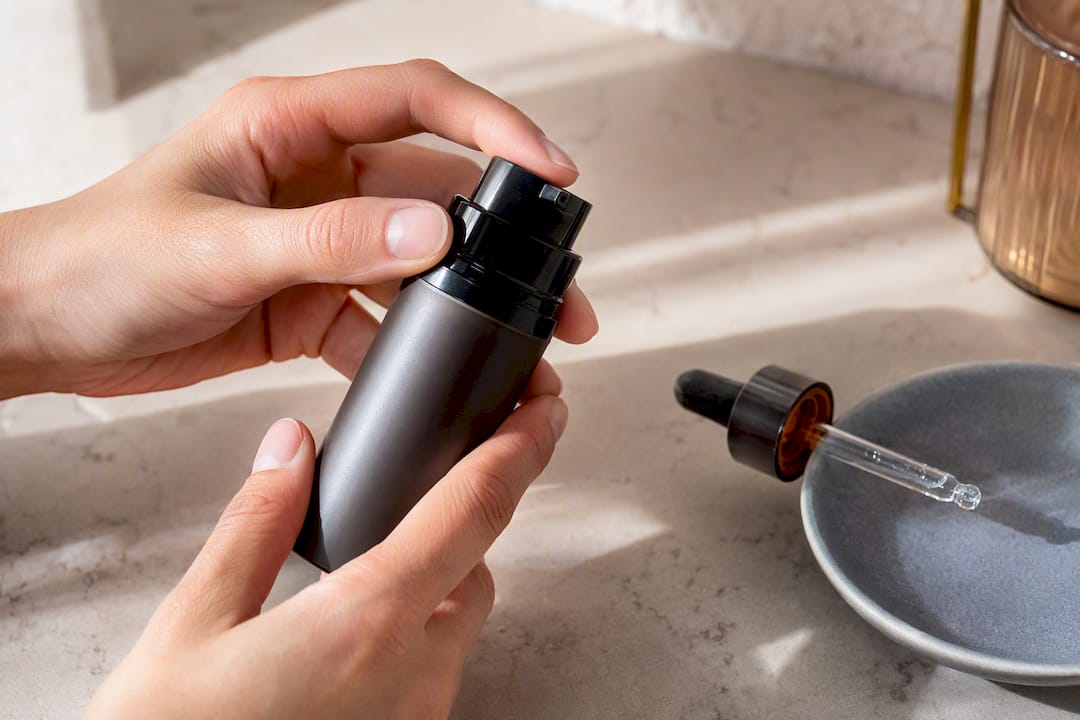
When you’re shopping, look for opaque or dark bottles, pump dispensers instead of open jars, and formulas that skip heavy water-based emulsions for the retinal itself. Formulation research on topical retinoids points to these packaging choices as a genuine factor in whether a product performs like its label promises. If a retinal serum smells noticeably different from when you bought it or has changed color, that’s usually your cue that it’s degraded and no longer worth using at full frequency.
What the Clinical Research Actually Shows
The split-face and imaging studies on this topic are more encouraging than a lot of marketing copy would have you believe, and they’re specific enough to plan around.
One prospective study found that a 0.1% anhydrous retinal concentrate improved fine lines, pigmentation, and pore visibility within six weeks, with good tolerability reported throughout the trial, according to research published in Cosmetics. Separate randomized trials on retinaldehyde in the 0.05% to 0.1% range showed measurable improvement in wrinkle depth and other skin metrics, again with an acceptable safety profile. Imaging-based research has also found retinal penetrates skin more effectively than retinol and produces greater wrinkle reduction, while causing less irritation than prescription-strength retinoic acid, per comparative imaging data.
As a rough timeline: expect early texture changes around week two, visible smoothing by week six, and more defined improvement in fine lines and tone by week twelve. That said, trial results are tied to the exact formulation tested. A retail product with different stabilizers or delivery systems won’t necessarily perform identically, even at the same listed percentage.
How to Decide Between Retinal and Retinol
Pick based on your skin’s history and your goals, not on which ingredient sounds more advanced.
- Choose retinal if: you’ve already used retinol without major irritation, you want faster visible results, or you’re being guided by a dermatologist toward a stronger OTC option.
- Choose retinol if: you’re new to retinoids, your skin reacts to most new products, or you want a lower-cost, more widely available entry point while you learn how your skin responds.
- Choose neither, and see a clinician instead if: you have persistent acne, significant pigmentation, or want faster, more dramatic change than OTC products typically deliver. Prescription tretinoin is a different tier of strength entirely, and it needs medical oversight.
There’s no prize for jumping straight to the strongest option. Slow and steady with either ingredient beats fast and irritated every time.
Building a Routine That Actually Works
Getting the ingredient right matters less than getting the routine right. Here’s how to bring either retinol or retinal into your nights without wrecking your skin barrier in the process.
- Patch test for two nights. Small amount, inner arm or behind the ear, before it goes anywhere near your face.
- Apply to fully dry skin. Damp skin absorbs retinoids faster, which sounds great until it means faster irritation too.
- Start at two to three nights a week. Give your skin a full week on each frequency before increasing.
- Layer moisturizer strategically. Apply moisturizer first if your skin runs sensitive, or after the retinoid if you tolerate actives well and want maximum absorption.
- Separate from other actives. Skip vitamin C, exfoliating acids, and retinoids on the same night at first. Once your skin builds tolerance, you can alternate them on different evenings.
- Sunscreen, no exceptions. Retinoids increase photosensitivity, so morning SPF isn’t optional, it’s the other half of the treatment.
- Watch for purging versus irritation. Purging shows up as small breakouts in areas you normally break out, and it typically resolves within four to six weeks. Irritation shows up as burning, swelling, or peeling in new areas, and it means you need to dial back frequency immediately.
Pro Tip: If your skin is stinging within the first sixty seconds of application, that’s not “working,” that’s a sign to buffer with moisturizer next time or drop back a frequency level.
Switching from retinol to retinal midstream? Treat it like starting over, not leveling up. Cut your usual frequency in half for the first two weeks, then reassess.
My Take After Digging Into the Research
The retinol versus retinal debate gets framed as a strength contest, and that framing misses the point. The real question is whether your skin barrier can keep up with the ingredient you’ve chosen, because a highly potent product you can’t tolerate consistently will always lose to a gentler one you actually stick with three nights a week for six months.
What surprised me most in the research wasn’t retinal’s speed, it was how much packaging and formulation quality changed the outcomes across studies. An unstable retinal serum sitting in a clear jar is arguably weaker in practice than a well-stabilized retinol. Some brands formulate with that stability question in mind, favoring cruelty-free, dermatologist-tested formulas built for consistent, real-world performance rather than a number that looks impressive on a label. If you’re unsure which strength fits your skin, start conservative and build up. Your face will thank you in six weeks, not six days.
— Thomas
Where to Start if You’re Ready to Try One
If you’re newer to retinoids or want a low-risk way to build a full routine around one, the Super Serum Set pairs a beginner-friendly retinol formula with the supporting actives your skin needs to buffer irritation, all in one curated set instead of piecing it together yourself. Start exactly as outlined above: two to three nights a week, moisturizer as a buffer, sunscreen every morning without exception. If you already tolerate retinol well and want to explore Cosmedica-skincare’s broader retinol lineup before stepping up in potency, the retinol skin care collection is the place to compare formulas and find your next step up.
Sources
- Efficacy and Safety of a Novel Anhydrous 0.1% Retinal-Based Concentrate with Hydrophilic Actives for Photoaged Skin
- Efficacy and safety of retinaldehyde creams in photoaged skin (PubMed entry)
- Use of retinoids in topical antiaging treatments: clinical evidence and formulation considerations
FAQ
Is 1% Retinol the Same as 1% Retinal?
No. Retinal is significantly more bioavailable than retinol, so identical percentages are not equivalent in strength.
What Do the Japanese Use Instead of Retinol?
Skincare routines in Japan often favor gentler actives like niacinamide and rice-derived ingredients alongside retinoids, prioritizing barrier support over aggressive exfoliation. This isn’t a rejection of retinoids so much as a broader emphasis on gradual, low-irritation routines.
Is 0.2% Retinal Stronger Than 1% Retinol?
It can be. Because retinal needs only one enzymatic conversion to become active retinoic acid, compared to retinol’s two, research indicates it delivers greater potency even at a fraction of the labeled percentage.
Should I Use Retinol or Retinal First?
Start with retinol if you’ve never used a retinoid before. If you’ve already built tolerance to retinol without irritation and want faster results, retinal is the logical next step rather than a starting point.