

How to Select Anti Aging Products That Actually Work
TL;DR:
- Choosing effective anti-aging products requires understanding your skin type, prioritizing proven ingredients like retinol and vitamin C, and ensuring proper packaging and consistent use.
- A routine focused on key actives, sun protection, patience, and professional guidance yields the best results, regardless of price or marketing claims.
The anti-aging skincare aisle can feel like a maze. There are hundreds of products promising to erase wrinkles, restore firmness, and reverse years of sun damage, yet most of them leave you guessing. Knowing how to select anti aging products that genuinely deliver requires more than reading the front of the box. It means understanding your skin type, decoding ingredient lists, and having realistic expectations about what topical skincare can and cannot do. This guide cuts through the noise with science-backed advice tailored specifically for women who are serious about their skincare.
Table of Contents
- Key takeaways
- How to select anti aging products for your skin type
- Decoding anti aging product ingredients
- Building your anti aging skincare routine
- Avoiding mistakes and managing expectations
- Evaluating price, packaging, and clinical claims
- My honest take on choosing anti aging skincare
- Explore Cosmedica-skincare’s anti aging collection
- FAQ
Key takeaways
| Point | Details |
|---|---|
| Know your skin type first | Identifying whether your skin is dry, oily, sensitive, or combination shapes every product decision you make. |
| Ingredients matter more than price | Proven actives like retinol, vitamin C, and peptides outperform expensive creams without them. |
| Packaging affects potency | Retinoids and vitamin C degrade in light and air, so opaque, airless packaging preserves results. |
| Patience is non-negotiable | Most products need at least six weeks of daily use before visible improvement appears. |
| Sunscreen is the foundation | Daily SPF 30 or higher is the single most effective anti-aging step in any routine. |
How to select anti aging products for your skin type
Before you reach for any serum or cream, you need to get honest with yourself about what your skin is actually doing. Choosing anti aging skincare without knowing your skin type is like buying shoes without knowing your size. It might work out, but the odds are not in your favor.
Here is a quick breakdown of the main skin types and what they mean for your anti-aging choices:
- Dry skin tends to show fine lines earlier because the lipid barrier is compromised. You need rich, occlusive moisturizers packed with ceramides and hyaluronic acid, and your actives should come in cream or oil-based formulas.
- Oily skin benefits from lightweight, non-comedogenic textures like gels and serums. Niacinamide is a superstar here because it addresses both enlarged pores and early signs of aging without clogging anything.
- Sensitive skin calls for a slower, gentler approach. Fragrance-free formulas and a low concentration of actives reduce the risk of flaring up redness or irritation.
- Combination skin often means treating different zones differently. A lightweight serum across the whole face paired with targeted moisturizer on dry areas usually works well.
- Normal skin has the most flexibility, but that does not mean piling on everything. A streamlined routine with one or two well-chosen actives will outperform a cluttered ten-step lineup.
Once you know your skin type, think about your top one or two aging concerns. Fine lines around the eyes, loss of firmness along the jaw, uneven skin tone from sun damage, or persistent dryness all call for different hero ingredients. Trying to fix everything at once often results in irritation and inconsistency. Pick your priority and build from there.
Pro Tip: Not sure about your skin type? Wash your face with a gentle cleanser, skip any products for 30 minutes, and observe how your skin feels. Tight and flaky means dry. Shiny and slick means oily. Tight in some spots and shiny in others means combination.
No single product works for every person. Matching your choices to your actual skin profile is how you get real results instead of wasted money.
Decoding anti aging product ingredients
This is where most people either get lost or get deceived. Labels are packed with long chemical names, and marketing copy loves to highlight the most exotic-sounding thing in the formula, whether or not it is present in a meaningful amount. Learning to read ingredient labels critically is one of the most powerful things you can do when choosing anti aging skincare.
Here is a comparison of the most proven anti aging product ingredients and what each one actually does:
| Ingredient | Primary benefit | Best for | Key consideration |
|---|---|---|---|
| Retinol / retinoids | Boosts collagen, increases cell turnover | Fine lines, texture, dullness | Start low, use at night, always follow with SPF |
| Vitamin C (L-ascorbic acid) | Antioxidant protection, brightening | Sun damage, discoloration | Needs stable, opaque packaging to stay active |
| Peptides | Signals collagen and elastin production | Firmness, sagging skin | Gentle enough for sensitive skin |
| Hyaluronic acid | Draws moisture into the skin | Dryness, plumping fine lines | Apply to damp skin for maximum effect |
| Niacinamide | Reduces pores, evens tone, strengthens barrier | Oily, acne-prone, uneven skin | Pairs well with most other actives |
| Ceramides | Rebuilds and repairs the skin barrier | Dry, sensitive, compromised skin | Often paired with hyaluronic acid in moisturizers |
Retinoids increase cell turnover and stimulate collagen production, making them the gold standard for addressing fine lines and uneven texture. Higher strengths work faster but cause more initial irritation, so starting with a low percentage and building up slowly is the smarter move. Think of it like easing into an exercise routine rather than sprinting on day one.
Vitamin C is another heavy hitter, but its effectiveness depends entirely on formulation stability. Retinoids and vitamin C degrade when exposed to light and air, which is why a clear glass jar is a red flag for these actives. Look for vitamin C products in dark or opaque, airtight packaging.
Peptides are smaller protein fragments that act like messengers, telling your skin to produce more collagen and elastin. They are especially good for anyone with sensitive skin who finds retinol too harsh. You can explore how retinol and hyaluronic acid work together to address multiple signs of aging at once.
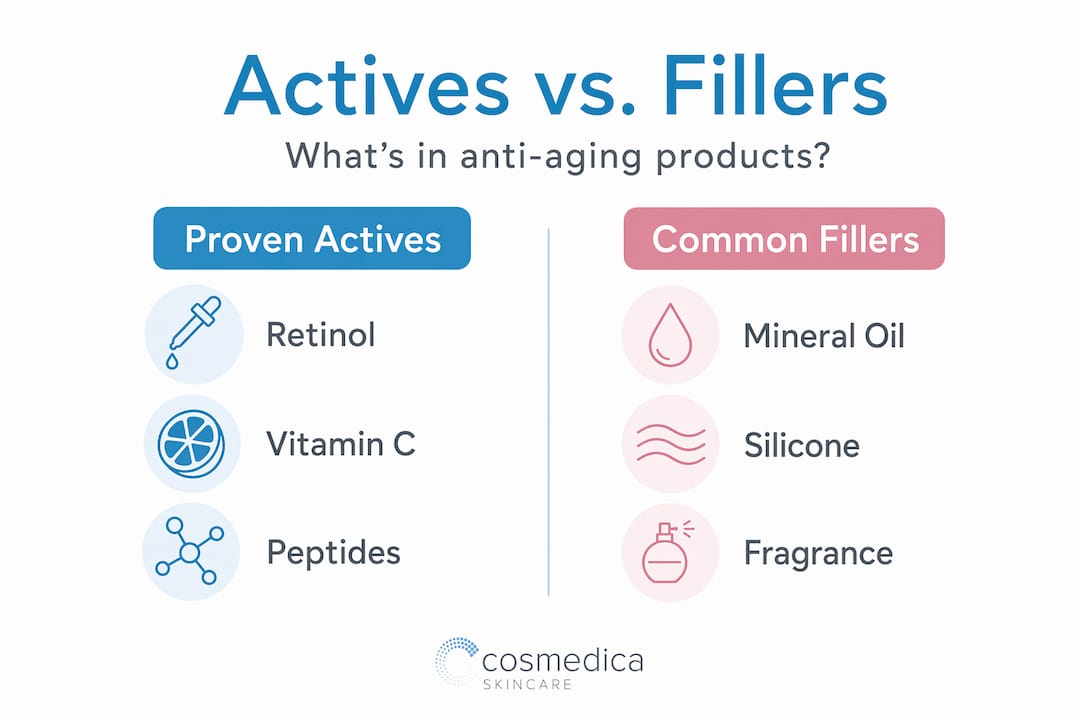
Pro Tip: Flip the product over and check where your key active sits in the ingredient list. Ingredients are listed from highest to lowest concentration. If retinol or vitamin C appears near the bottom after fragrance and preservatives, the amount is likely too small to make a meaningful difference.
One thing worth understanding is that many products labeled “anti-aging” are essentially moisturizers without actives that can actually trigger skin renewal. Molecular size matters. An ingredient has to be small enough to penetrate the epidermis and signal cellular change. Hyaluronic acid, for example, in its high-molecular-weight form sits on the surface and hydrates. Its low-molecular-weight form penetrates deeper. These are genuinely different products, even if the label just says “hyaluronic acid.”
Building your anti aging skincare routine
Knowing which ingredients to look for is half the battle. The other half is using them correctly. Here is a practical, step-by-step approach to building an anti-aging routine that actually sticks.
-
Start with a gentle cleanser. Morning and night. No stripping, no scrubbing. Your skin barrier needs to stay intact for actives to work properly.
-
Apply any water-based serums next. In the morning, this is your vitamin C serum for antioxidant protection. At night, this is where hyaluronic acid or niacinamide serum fits in.
-
Introduce retinol at night only. Start with two or three nights per week at a low concentration. Gradually increase frequency over several weeks as your skin adjusts. Never layer retinol with other potent actives like vitamin C or exfoliating acids on the same night.
-
Layer your moisturizer on top. This seals in the actives and provides barrier support. For dry skin, go richer. For oily skin, a lightweight gel moisturizer works well. Look for options with ceramides and hyaluronic acid for extra barrier reinforcement.
-
Finish your morning routine with SPF 30 or higher. Every single day, including cloudy ones. Sun damage is the leading cause of premature skin aging and it also undermines the effectiveness of every other product in your routine.
-
Patch test any new potent product first. Apply a small amount to the inside of your wrist or behind your ear and wait 48 hours before applying to your face. This one step saves you from widespread irritation.
-
Adjust seasonally. Your skin’s hydration needs change with the weather. A lighter gel moisturizer in summer may need to be swapped for a richer cream in winter, even if your core actives stay the same.
A consistent routine with a handful of well-chosen products beats a complicated one you abandon after two weeks. The science behind consistent skincare routines shows that ingredient synergy over time drives real results.
Avoiding mistakes and managing expectations
Even well-researched routines can go sideways. Here are the most common pitfalls we see when people are learning how to pick skincare for anti-aging purposes.
- Expecting overnight results. Most products require at least six weeks of daily use before you notice visible changes, and improvements can reverse if you stop. This is not a one-month experiment. It is a long-term practice.
- Overloading on actives too soon. Layering retinol, vitamin C, exfoliating acids, and peptides all at once in week one is a recipe for a damaged barrier and red, flaky skin. Introduce one new active at a time.
- Ignoring irritation signals. Some redness and dryness when starting retinol is normal. But persistent burning, swelling, or breakouts that were not there before mean you need to stop and reassess.
- Skipping sunscreen. This one deserves emphasis because it is genuinely the most common mistake. Retinol increases sun sensitivity, and applying it nightly without SPF in the morning is like taking one step forward and two steps back.
- Trusting front-of-label claims over ingredient lists. Words like “firming,” “lifting,” and “youth-activating” are marketing terms. They tell you nothing about what is actually in the product.
“Patience with ingredient introduction, especially retinoids, prevents common issues like redness or flaking and improves long-term adherence.” — Mayo Clinic
If you experience persistent irritation, cystic breakouts, or significant changes in your skin that do not resolve after reducing product use, that is your cue to consult a board-certified dermatologist. There is no shame in getting professional input. A dermatologist can help you identify whether a reaction is product-related or something else entirely, and they can recommend prescription-strength options if over-the-counter actives are not delivering results.
Evaluating price, packaging, and clinical claims
One of the trickiest parts of choosing anti aging skincare is figuring out what you are actually paying for. The market is segmented into distinct tiers, and more expensive does not automatically mean more effective.
| Price tier | Typical positioning | What to watch for |
|---|---|---|
| Mass market | Widely accessible, budget-friendly | Often lacks clinical actives in effective concentrations |
| Masstige | Mid-range, aspirational branding | Growing segment with solid formulations; check ingredient placement |
| Premium / luxury | High price, beautiful packaging | Price often reflects brand and packaging, not formula quality |
| Clinical / dermatologist-recommended | Results-focused, often plainer packaging | Most evidence-backed; fastest growing category in 2026 |
The anti-aging market is stratified by price, with clinical and dermatologist-recommended products showing the fastest growth. This reflects a broader shift toward consumers prioritizing results over aesthetics. The most expensive moisturizer in the lineup often has the most beautiful packaging, not the most active formula.
Packaging is genuinely worth your attention. Think of a vitamin C serum in a clear glass dropper bottle sitting on a sunny bathroom shelf. By week three, that oxidized formula is no longer doing much for your skin. Opaque, airtight packaging preserves ingredient potency and is a real indicator of whether a brand understands formulation science.
The other thing worth scrutinizing is the trend toward “longevity” marketing in skincare. Ingredients like NAD+ precursors and urolithin-A have interesting science behind them as oral supplements, but topical longevity claims require clinical data on topical biomarker changes, not borrowed evidence from supplement trials. A $155 cream with a longevity label and no published topical studies is a marketing exercise, not a scientific one.
The winning approach: prioritize products with proven actives at effective concentrations, packaged to protect those actives, and supported by clinical testing on the skin itself. A $25 retinol serum in an airless pump with 0.5% retinol will almost always outperform a $90 “rejuvenating” cream in a clear jar with no actives worth naming.
My honest take on choosing anti aging skincare
I’ve spent years looking at how people approach anti-aging skincare, and the pattern I keep seeing is this: they fall for the product with the most compelling story, not the most compelling formula.
The skincare industry is genuinely good at storytelling. A brand will launch a product with a name that sounds like a scientific breakthrough, pour the budget into elegant packaging and influencer campaigns, and bury the actual formula in fine print. What I’ve learned is that ignoring the front of the packaging and flipping straight to the ingredient list is the most valuable habit you can develop.
What I’ve also come to appreciate is that consistency with simple, proven ingredients outperforms chasing every new active that gets a moment of buzz. Retinol, vitamin C, peptides, SPF. That is not an exciting list. But the people I’ve seen get real, lasting results are the ones who commit to a focused routine for months, not the ones who rotate through ten trendy products every season.
My other honest observation: too many people underestimate how much of aging is prevention, not correction. The best time to start a consistent anti-aging routine is before the lines are deep and the damage is done. If you are in your 30s reading this, SPF and a good retinol now will do more for your skin at 50 than any corrective treatment you can buy later.
And if your skin is giving you persistent trouble? See a dermatologist. A professional consultation is not a luxury. It is often the most cost-effective step you can take.
— Thomas
Explore Cosmedica-skincare’s anti aging collection
At Cosmedica-skincare, we have built our entire line around the principle that effective skincare should not require a luxury budget. Every formula starts with proven actives at concentrations that actually work. Our Vitamin C Super Serum is packaged in an opaque, airless bottle specifically to protect its potency, and our retinol range is formulated to minimize irritation while delivering real results.
If you are ready to put this guide into practice, our full anti-aging collection covers serums, moisturizers, and targeted treatments organized by skin concern. Not sure where to begin? Our skin quiz will match you with the right products for your specific skin type in under two minutes. We also carry thoughtfully curated gifts for skincare lovers if you want to share a well-designed routine with someone you care about. All products are cruelty-free, dermatologist-tested, and formulated to deliver results you can actually see.
FAQ
How long before anti aging products show results?
Most products require at least six weeks of consistent daily use before visible results appear, with optimal results typically seen after three to six months.
What ingredients actually work in anti aging skincare?
Retinol, vitamin C, peptides, hyaluronic acid, ceramides, and niacinamide are the most evidence-backed actives. Combining these ingredients with daily SPF yields the strongest long-term results.
Does price determine anti aging product quality?
Not reliably. A product’s effectiveness depends on the concentration and stability of its active ingredients, not its price tag. Many mass-market options with proven actives in effective concentrations outperform premium creams that lack them.
How do I know if an anti aging product is causing irritation?
Mild dryness or flaking when introducing retinol is normal and temporary. Persistent burning, swelling, or breakouts are signs to reduce usage or discontinue. Patch testing new actives for 48 hours before full application helps prevent widespread reactions.
Why is sunscreen considered an anti aging product?
Because sun damage is the leading cause of premature skin aging and directly undermines the effectiveness of every other anti-aging product you use. Daily SPF 30 or higher is non-negotiable for any anti-aging routine to work.