

How to Treat Under Eye Wrinkles: Your OTC Guide
The fastest way to start treating under-eye wrinkles today is a three-step daily habit: broad-spectrum SPF in the morning, a hyaluronic acid serum to plump dehydration lines, and a low-strength OTC retinoid at night. That combination covers the two biggest drivers of periorbital aging: UV-driven collagen breakdown and the gradual thinning of the skin around your eyes. Dermatology reviews confirm that topical retinoids rebuild collagen and increase skin thickness, while hyaluronic acid provides immediate plumping by holding water in the tissue. Clinical trials have shown roughly 30% improvement in fine lines with consistent retinoid use.
Your quick-start micro-plan:
- AM: gentle cleanser → hyaluronic acid serum → caffeine eye gel (optional, for puffiness) → eye-safe moisturizer → broad-spectrum SPF
- PM: gentle cleanser → hydrating serum → low-strength retinoid (buffered) → moisturizer
- Before you start: patch test any new active on your inner forearm and wait 48–72 hours
Table of Contents
- How to treat under eye wrinkles with a morning routine
- What your nighttime routine should look like
- Which OTC ingredients actually work on under-eye skin?
- Quick fixes vs. long-term under-eye wrinkle solutions
- Key Takeaways
- The part most guides skip
- Cosmedica-skincare products worth adding to your routine
- Useful sources
- FAQ
How to treat under eye wrinkles with a morning routine
A good morning routine does two things at once: it smooths what’s already there and stops further damage from forming. Here’s the order that works.
- Gentle cleanser. Rinse away overnight product residue without stripping the lipid barrier. The under-eye area is thin and reactive, so a mild, fragrance-free formula is the right call here.
- Hyaluronic acid serum. Apply to slightly damp skin so the HA has water to pull in. Think of it as giving your skin a big drink before the day starts. It won’t rebuild collagen, but it visibly softens dehydration lines within minutes.
- Caffeine eye gel or niacinamide serum. Caffeine temporarily constricts blood vessels, reducing puffiness and mild discoloration. Harvard Health lists caffeine alongside retinoids and peptides as a clinically recognized ingredient for periorbital concerns. Niacinamide adds antioxidant support and complements SPF.
- Eye-safe moisturizer. Lock in the serum layers before SPF. Look for glycerin or ceramides in the formula.
- Broad-spectrum SPF. Sunscreen is the single most impactful daily habit for slowing collagen loss around the eyes. Mineral formulas (zinc oxide or titanium dioxide) sit well near the eye area without stinging. Reapply midday if you’re outdoors, and add sunglasses with UV400 lenses for extra coverage.
Application tips:
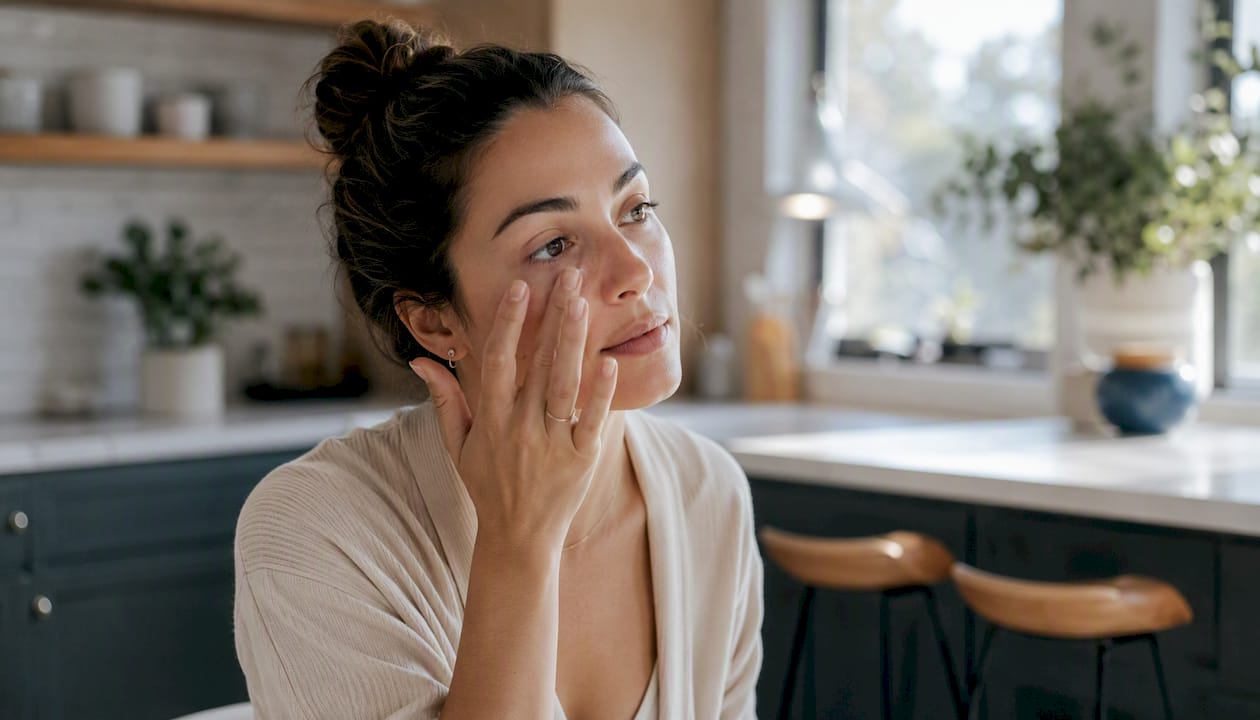
- Always use your ring finger. It applies the least pressure and reduces tugging on delicate skin. Dermatologists recommend this technique specifically for the periorbital zone.
- Stay on the orbital bone, about 5 mm from the lash line, to prevent product migration into the eye.
- Keep your eye gel in the fridge overnight. A cold applicator or chilled product gives an instant depuffing effect on rough mornings.
Pro Tip: Pat, never rub. Dragging the skin around your eyes, even gently, accelerates the mechanical breakdown of collagen over time.
What your nighttime routine should look like
Nighttime is when your skin does the heavy lifting, so this is when actives matter most.
- Oil-free cleanser. Remove SPF, makeup, and pollution residue thoroughly but gently.
- Hydrating serum. Apply hyaluronic acid first to reduce any baseline dryness before you layer an active on top. Dry skin plus retinoid equals unnecessary irritation.
- Retinoid, buffered. Use the moisture sandwich method: apply a thin layer of moisturizer, wait a minute, then apply a rice-grain-sized amount of your retinoid to the orbital area, then seal with another layer of moisturizer. This buffers the active and dramatically cuts down on peeling and redness.
- Seal with moisturizer. A fragrance-free formula with ceramides or peptides works well here.
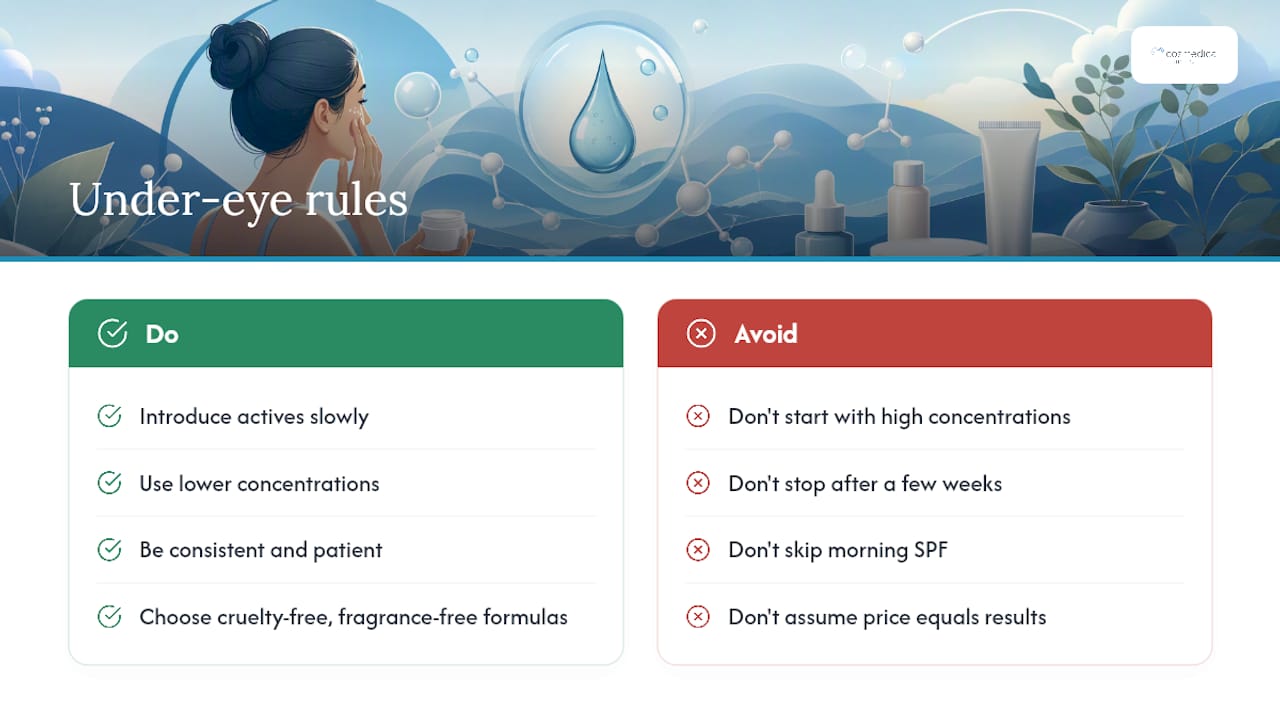
Start retinoids just once or twice a week. Your skin needs time to adjust, and the under-eye area is thinner than the rest of your face. Rushing the schedule is the most common reason people give up on retinoids entirely.
Layering warnings to keep in mind:
- Skip AHAs (like lactic acid) and BHAs near the eye on any night you use a retinoid. Stacking exfoliating acids with retinoids around the eyes is a fast track to irritation.
- Avoid applying retinoid directly to the eyelid or near the tear duct.
- If you notice burning or persistent redness, pause use for a week before trying again at a lower frequency.
Which OTC ingredients actually work on under-eye skin?
| Ingredient | What it does | What to look for on labels |
|---|---|---|
| Retinol / Retinal | Stimulates collagen, thickens epidermis | Encapsulated retinol for eye area |
| Peptides | Signal collagen production, improve firmness | Palmitoyl pentapeptide-4, palmitoyl tripeptide-1 |
| Hyaluronic acid | Holds water, plumps dehydration lines | Low + high molecular weight HA for layered effect |
| Caffeine | Reduces puffiness via vasoconstriction | Listed in top 5 ingredients for eye gels |
| Niacinamide | Antioxidant, barrier support, brightening | 5%–10% concentration |
| Vitamin C | Antioxidant, collagen co-factor | L-ascorbic acid or stabilized derivatives |
Retinoids are the most evidence-backed option for periorbital wrinkle reduction. They work by binding to receptors in skin cells and triggering collagen synthesis and epidermal thickening. The delivery system matters too: encapsulated retinol releases the active gradually, which increases effectiveness while reducing the irritation that makes people quit.
Peptides act like little messenger molecules. They tell your skin cells to produce more collagen and can inhibit enzymes that break it down. Look for peptide-rich formulas that list palmitoyl pentapeptide-4 or similar signal peptides near the top of the ingredient list.
Hyaluronic acid is the quick-win ingredient. High molecular weight HA sits on the surface and plumps immediately. Low molecular weight HA penetrates deeper for longer-lasting hydration. A formula with both gives you the best of both effects. Understanding the molecular weight differences helps you read labels more confidently.
Niacinamide and vitamin C don’t rebuild collagen directly, but they protect what you have. Antioxidants neutralize free radicals from UV and pollution that degrade collagen daily. Think of them as your defensive line while retinoids and peptides do the rebuilding.
Quick fixes vs. long-term under-eye wrinkle solutions
Some days you need results in 20 minutes. Other days you’re playing the long game. Both approaches have a place in a smart routine.
Immediate fixes (effects last hours to a day):
- Chilled hyaluronic acid serum or eye gel: plumps dehydration lines fast.
- Caffeine eye gel: reduces puffiness and mild dark circles by constricting blood vessels.
- Cooling metal applicators: temporarily tighten and depuff the area.
Long-term structural improvements (weeks to months):
- Consistent retinoid use rebuilds collagen and thickens the epidermis over time.
- Peptide serums support ongoing collagen signaling.
- Daily SPF prevents new UV-induced collagen breakdown, protecting the gains you’re making at night.
The smartest approach combines both: use a hyaluronic acid serum and caffeine eye gel in the morning for an immediate lift, then let your nightly retinoid do the structural work while you sleep.
Key Takeaways
Daily SPF combined with a nightly OTC retinoid and consistent hydration is the most effective affordable approach to reducing under-eye wrinkles over time.
| Point | Details |
|---|---|
| SPF is non-negotiable | Broad-spectrum sunscreen daily is the single most impactful habit for slowing periorbital collagen loss. |
| Retinoids rebuild collagen | Clinical trials show roughly 30% improvement in fine lines with consistent retinoid use. |
| Introduce actives slowly | Start retinoids once a week using the moisture sandwich method; increase frequency over 6–8 weeks. |
| Quick fixes complement long-term care | Hyaluronic acid and caffeine plump and depuff immediately; retinoids and peptides deliver structural change over 8–16 weeks. |
| Cosmedica-skincare fits the mid-range | Cruelty-free, dermatologist-tested formulations with targeted actives at an accessible price point. |
The part most guides skip
There’s a tendency in under-eye skincare content to either terrify readers about retinoids or dismiss them entirely. Both miss the point. The under-eye area is delicate, yes, but that doesn’t mean it’s off-limits for actives. It means the introduction needs to be slower and the concentrations lower.
What actually separates people who see results from those who don’t isn’t the product they chose. It’s consistency and patience. A $15 encapsulated retinol used correctly three nights a week will outperform a $90 eye cream applied once and abandoned because results weren’t visible in two weeks. The collagen-rebuilding process takes months, not days.
The other thing worth saying plainly: sunscreen matters more than any serum. You can spend every night layering actives and undo a meaningful portion of that work by skipping SPF in the morning. Protecting what you have is just as important as rebuilding it.
Cruelty-free, fragrance-free formulations aren’t a compromise. They’re often better tolerated around the eyes precisely because they skip the ingredients most likely to cause irritation. That’s not a marketing angle. It’s practical skin science.
Cosmedica-skincare products worth adding to your routine
Clear skin around the eyes doesn’t require a complicated or expensive routine. It requires the right ingredients, consistently applied. Cosmedica-skincare’s cruelty-free, dermatologist-tested lineup covers every step of the guide above, without the inflated price tag.
The Super Serum Set is the ideal starter bundle: it pairs hydration, antioxidant support, and targeted actives in one purchase, making it easy to build the AM/PM routine this guide recommends. For brightening and depuffing specifically, the Brightening Eye Treatment Gel is formulated for the periorbital zone and works well as your morning caffeine/brightening step. The 10% Niacinamide + Zinc Treatment Serum layers cleanly under SPF and supports barrier health daily.
Browse the full new collection to find the pairings that match your skin’s current priorities, whether that’s plumping, firming, or brightening.
Useful sources
- Dermatology review: topical retinoids, peptides, and hyaluronic acid
- Skin care for aging skin: minimizing age spots, wrinkles, and under-eye bags — Harvard Health
- Under eye wrinkles: why they form first and what actually smooths them — North Biomedical
- Eye cream for wrinkles: which ingredients actually work, according to science — North Biomedical
- A Complete Guide To Under Eye Skincare, According To Dermatologists — Women’s Health
- Can you use retinol around your eyes? — Live That Glow
- Can you use tretinoin under your eyes? Risks & benefits — GetHeally
- Cosmedica Skincare
FAQ
Yes. Retinoids are the most evidence-backed topical class for periorbital wrinkle reduction, with clinical trials showing roughly 30% improvement in fine lines. Use a low concentration, buffered with moisturizer, and build frequency slowly.
When do under-eye wrinkles start appearing?
Fine lines around the eyes often appear in the mid-to-late twenties, earlier than wrinkles elsewhere on the face, because periorbital skin is thinner and moves constantly with facial expressions.
How long before you see results from an OTC eye routine?
Hyaluronic acid and caffeine produce visible plumping within minutes. Collagen-driven improvements from retinoids and peptides typically take 8–16 weeks of consistent use.
What’s the safest way to start retinol near the eyes?
Patch test on your inner forearm first, then apply a rice-grain-sized amount to the orbital area once a week using the moisture sandwich method. Increase frequency gradually over 6–8 weeks as your skin adjusts.
Are cruelty-free eye products as effective as conventional ones?
Cruelty-free formulations can be just as effective, and fragrance-free versions are often better tolerated around the eyes. Cosmedica-skincare’s dermatologist-tested line uses the same evidence-backed actives (retinol, peptides, niacinamide, hyaluronic acid) without animal testing.