

Retinol During Pregnancy: New Evidence, Why Doctors Still Say Stop
Bottom line: avoid retinol and other retinoids during pregnancy and while you’re actively trying to conceive. Oral isotretinoin carries a well-documented, serious risk; topical products expose you to far less of the drug, but major medical groups still say skip them. If you’re already using retinol and just found out you’re pregnant, stop the product today and call your OB.
TL;DR:
- Topical retinoids are generally advised against during pregnancy because of limited safety data and potential risks, despite inconsistent evidence.
- Oral isotretinoin is a confirmed teratogen with a high risk of major fetal malformations, requiring strict prevention programs.
- Recent studies suggest that topical retinol exposure may not significantly increase the risk of birth defects, but data still do not definitively prove safety.
- Pregnant women should discontinue retinol as soon as they start trying to conceive and consult their healthcare provider to identify suitable alternatives.
- Safe skincare options during pregnancy include azelaic acid, niacinamide, vitamin C, and hyaluronic acid, which effectively address similar concerns without known risks.
Table of Contents
- What Do Doctors Recommend About Retinol During Pregnancy?
- Is Oral Retinol Different From Topical Retinol Risk?
- What Does the Research Actually Show About Retinol in Pregnancy?
- How Long Before Trying to Conceive Should You Stop Retinol?
- What Should You Do If You Used Retinol While Pregnant?
- Which Skincare Ingredients Are Safe to Use Instead of Retinol?
- Should You Avoid Retinol While Breastfeeding Too?
- What Should You Ask Your OB or Dermatologist?
- A Realistic Read on Where the Evidence Actually Stands
- Building a Pregnancy-Safe Skincare Routine That Still Works
- Sources
- FAQ
What Do Doctors Recommend About Retinol During Pregnancy?
The American College of Obstetricians and Gynecologists is direct about this one: topical retinoids are generally not recommended during pregnancy, and ACOG advises reviewing any skin treatment with your OB before continuing it. That’s the closest thing to a unified professional stance you’ll find on retinol during pregnancy, and it’s the reason most dermatologists echo the same advice even when a patient’s skin genuinely benefits from retinol.
Part of the caution traces back to how skincare gets regulated in the first place. The FDA has confirmed that cosmetics, unlike drugs, don’t go through premarket safety approval, which means nobody tested your retinol serum specifically for pregnancy safety before it landed on a shelf. That regulatory gap is exactly why clinicians default to caution: without pregnancy-specific safety data required from the outset, “we don’t have proof it’s fine” becomes reason enough to say “skip it.”
Here’s where the consensus lands, and where it gets a little more nuanced:
- The universal message: avoid retinoids (oral and topical) during pregnancy and mention any skincare actives at your prenatal visits.
- Where doctors agree completely: oral isotretinoin is off the table, full stop, for anyone pregnant or trying to conceive.
- Where there’s more room for discussion: some dermatologists note that a single missed cutoff with a low-concentration retinol serum is unlikely to be harmful, but they still recommend stopping rather than continuing.
- What almost nobody argues: that retinol should be continued once pregnancy is confirmed.
Pro Tip: Keep a running list of every active ingredient in your routine, not just retinol, before your first prenatal appointment. It turns a vague “what products am I using?” question into a two-minute conversation.
Is Oral Retinol Different From Topical Retinol Risk?
Not all “retinol” carries the same danger, and lumping them together is the single most common source of confusion for pregnant readers researching this topic. Oral isotretinoin (brand names like Accutane are the ones most people recognize) is a prescription medication taken systemically for severe acne. Topical retinol, tretinoin, adapalene, and retinaldehyde (retinal) are applied to skin and absorbed in much smaller amounts.
Oral isotretinoin is a confirmed human teratogen. Historical data on exposed pregnancies reported malformation rates as high as 20 to 35 percent, a risk severe enough that the FDA mandated the iPLEDGE program, which requires monthly pregnancy testing, mandatory contraception, and pharmacy-level verification before every prescription refill for anyone who can become pregnant. There is no ambiguity in this category.
Topical retinoids work differently. Skin absorption of retinol, tretinoin, and adapalene is limited, so the amount reaching the bloodstream is a fraction of what oral isotretinoin delivers. That’s an important distinction, but it’s not a green light. Early case reports flagged possible fetal effects from topical tretinoin, and while larger cohort studies since then have produced inconsistent, inconclusive findings, inconsistent isn’t the same as reassuring.
Here’s the risk hierarchy as clinicians generally frame it, from highest concern to lowest:
- Oral isotretinoin: confirmed teratogen, strict prevention program required.
- Prescription topical tretinoin and adapalene: low systemic absorption, but still advised against.
- Over-the-counter retinol and retinal: lower potency than prescription versions, still on the avoid list.
- Retinyl esters in some cosmetic formulas: weakest of the group, still not recommended during pregnancy.
Notice that “lower risk” appears at every tier except the bottom. None of them get an official pass.
What Does the Research Actually Show About Retinol in Pregnancy?
A 2026 systematic review and meta-analysis pooled eight studies on first-trimester topical retinoid exposure and found no statistically significant link to major congenital malformations or spontaneous abortion. The pooled relative risk for major malformations came in at 0.83, with a confidence interval of 0.64 to 1.07, and the relative risk for spontaneous abortion sat at 0.99. Because that confidence interval crosses 1.0, the finding isn’t strong enough to call topical retinol “cleared.” It’s reassuring, not conclusive.
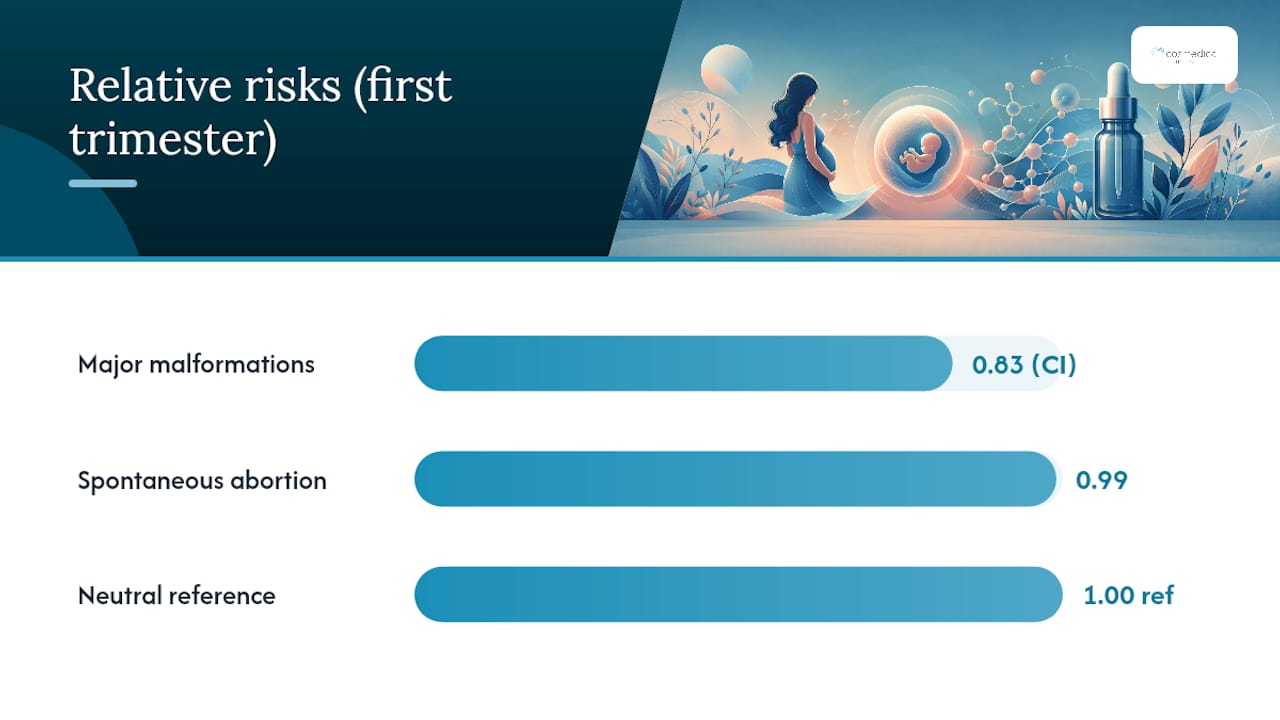
A large chunk of that reassurance comes from one Nordic registry study, which contributed heavily to the pooled numbers. Registry data have real strengths: large sample sizes, real-world use patterns, and less recall bias than surveys asking people to remember what they used months earlier. But when one dataset drives most of the statistical weight, a single population’s habits and health system can shape the whole picture more than a smaller, more varied set of studies would.
The review’s authors flagged several limitations worth understanding before treating this as settled science:
| Limitation | Why it matters |
|---|---|
| Exposure timing and classification | Many studies rely on self-report or pharmacy records, not confirmed daily use, so “exposed” can mean very different things |
| Sample size of exposed births | Fewer confirmed retinol pregnancies than researchers would like, which widens uncertainty |
| Possible termination bias | Pregnancies with early concerning findings may end before reaching the birth outcomes researchers track |
| Formulation-specific data | Studies rarely separate retinol from tretinoin from adapalene, so ingredient-level risk stays blurry |
Pro Tip: If you read a headline claiming retinol is “proven safe” in pregnancy, check whether it’s citing this exact review. The data is genuinely encouraging, but the authors themselves stop short of calling it proof.
The same review’s authors caution that registry-driven reassurance still calls for individualized counseling rather than blanket clearance, which is exactly why ACOG’s guidance hasn’t shifted despite the newer data.
How Long Before Trying to Conceive Should You Stop Retinol?
There’s no single, universally agreed cutoff for over-the-counter topical retinol before conception, which frustrates a lot of people who want a clean number. The conservative, widely recommended approach is simpler than a countdown clock: stop retinoids once you’re actively trying to conceive, and bring it up at your preconception visit so your clinician can weigh your specific product and skin history.
Oral isotretinoin works completely differently, and this is where the contrast really matters. The iPLEDGE program requires a negative pregnancy test, mandatory contraception, and a defined waiting period before someone who has taken isotretinoin can safely attempt pregnancy. That’s a strict, medically enforced timeline. Nothing that formal exists for a drugstore retinol serum, partly because the drug itself works differently and partly because, again, cosmetics were never required to generate that kind of safety data in the first place.
If pregnancy is somewhere on your radar in the next several months, here’s a practical checklist to bring into your preconception planning:
- Pull retinol, tretinoin, and adapalene from your routine now, not after a positive test.
- Write down every active ingredient in your current skincare, including concentrations if you know them.
- Book a preconception visit and bring that list, even if pregnancy is still months away.
- Ask your clinician specifically about any remaining questions on timing for your situation, since general guidance doesn’t account for individual skin conditions like cystic acne.
- Line up a pregnancy-safe alternative before you stop, so you’re not caught without a routine during the transition.
Pro Tip: Swap retinol for a pregnancy-safe active before you’re pregnant, not after. Your skin barrier adjusts more smoothly when you’re not simultaneously managing morning sickness and a routine overhaul.
What Should You Do If You Used Retinol While Pregnant?
Stop the product and don’t spiral. A single week or even a few weeks of retinol use before you knew you were pregnant is a common situation, not a rare emergency, and clinicians widely agree that limited, accidental topical exposure is unlikely to cause harm.
Here’s the practical sequence to follow:
- Stop using the product immediately, and don’t restart “just to finish the tube.”
- Write down the exact product name, strength, and the dates you used it. Your clinician will ask, and vague answers make counseling harder.
- Call your OB rather than waiting for your next scheduled visit. This isn’t an emergency-room situation, but it’s worth a phone call sooner rather than later.
- Expect a conversation, not automatic testing. Most clinicians will discuss your specific exposure window and product strength before deciding whether a targeted ultrasound or additional monitoring makes sense.
- Don’t assume the worst based on outdated case reports. The newer pooled data leans reassuring, even though it isn’t a guarantee.
A step-by-step breakdown of exactly what to say and ask at that appointment is worth reading in full if you want to walk in prepared, and A guide on what to do if you used retinol before you knew you were pregnant covers that groundwork.
Which Skincare Ingredients Are Safe to Use Instead of Retinol?
You don’t have to abandon an active skincare routine for nine months. Several pregnancy-safe alternatives address the same concerns retinol targets, just through different mechanisms.
- Azelaic acid treats acne and evens tone, and it’s generally considered pregnancy-safe by clinical sources, making it one of the closest functional swaps for retinol’s acne benefits.
- Niacinamide calms redness, supports the skin barrier, and layers well under most other actives.
- Vitamin C (L-ascorbic acid) brightens and offers antioxidant support without the irritation risk retinol carries.
- Hyaluronic acid hydrates without any systemic absorption concerns, which makes it about as low-risk as skincare gets.
- Bakuchiol gets marketed as a “natural retinol alternative,” but the evidence behind it is still limited, so treat the comparison as a starting point rather than a proven equivalent.
- Low-strength lactic acid offers gentle exfoliation for texture concerns without the intensity of a stronger chemical peel.
Beyond swapping actives, your baseline routine matters just as much: a gentle cleanser, a reliable moisturizer, and broad-spectrum SPF every single day. Skip aggressive peels, high-strength salicylic acid treatments, and unregulated at-home exfoliating devices, since pregnancy is not the time to experiment with anything that promises dramatic results fast.
Pro Tip: Introduce one new active at a time, two weeks apart, so you can tell what’s working and what’s irritating your skin, which changes more than usual during pregnancy.
A guide to building a pregnancy skincare routine walks through how to layer these swaps in a practical order, and if you’re specifically weighing vitamin C concentrations, the breakdown on choosing the right vitamin C strength during pregnancy is worth a look before you buy.
Should You Avoid Retinol While Breastfeeding Too?
Many clinicians extend the same precaution into the breastfeeding period, mostly because the data gap that exists in pregnancy exists here too. Nobody has thoroughly studied how much topical retinol transfers into breastmilk, and while systemic absorption through skin stays low, “low” and “zero” are not the same thing when an infant is the one being exposed.
- Common clinical advice: treat breastfeeding similarly to pregnancy and avoid retinoids as a precaution.
- The reasoning: limited absorption through your skin doesn’t rule out some transfer into milk, and that transfer hasn’t been measured well enough to reassure anyone confidently.
- What to do if you’re currently nursing and using retinol: stop the product and raise it with your pediatrician or OB, especially if you’ve been using it regularly rather than occasionally.
If your skin concerns are significant enough that waiting through breastfeeding feels like a lot, that’s a legitimate thing to discuss with your clinician rather than something to solve on your own.
What Should You Ask Your OB or Dermatologist?
Walking into an appointment with specific questions gets you better answers than a general “is this okay?” Bring these three angles:
- Report the specifics: the exact product name, the strength or concentration if listed, and the dates and frequency you used it.
- Ask about testing: whether your particular exposure timing and duration warrant a targeted ultrasound, additional monitoring, or no further action at all.
- Ask about resuming later: when it might be reasonable to reintroduce retinol after delivery, and whether that timeline changes if you plan to breastfeed.
Having these three questions ready turns a potentially anxious conversation into a focused one, and it gives your clinician the specific details they need to counsel you accurately rather than defaulting to generic caution.
A Realistic Read on Where the Evidence Actually Stands
The retinol-and-pregnancy conversation online tends to swing between two extremes: panic over decades-old case reports, or overconfidence in a single reassuring study. Neither extreme serves you well. The 2026 meta-analysis is a genuinely useful update, but a confidence interval that crosses 1.0 is a researcher’s way of saying “probably fine, can’t promise it,” not “cleared.” That distinction gets lost in translation constantly, especially in comment sections and product reviews that cite the same study as if it settled the question.
What actually matters for your decision-making is simpler than the statistics debate suggests. ACOG’s guidance hasn’t moved, the regulatory gap in cosmetic safety testing hasn’t closed, and the downside of switching to azelaic acid or vitamin C for nine months is close to zero. When the cost of caution is this low and the upside of certainty is this far off, the precautionary path isn’t overreacting. It’s just math that happens to favor patience.
Where I’d push back on the conventional framing is the tendency to treat every retinoid the same in casual conversation. A drugstore retinol serum and prescription-strength tretinoin are not interchangeable in potency, and treating them as identical risks either underselling a legitimate concern or overselling a small one. Ask specifically about your product, not “retinol” as a category.
This reflects the same guidance found in ACOG’s clinical resources and the current published reviews on the subject, and it should never replace a conversation with your own OB or dermatologist, who knows your specific health history.
— Thomas
Building a Pregnancy-Safe Skincare Routine That Still Works
Cutting retinol doesn’t mean cutting results. A pregnancy-safe routine built around vitamin C, hyaluronic acid, and gentle exfoliation can still deliver visible brightening, hydration, and smoother texture, without the guesswork of a category ACOG advises against. Cosmedica-skincare’s 10% Niacinamide + Zinc Treatment Serum tackles the same redness and texture concerns retinol often addresses, and the 5% Lactic Acid Treatment with Hylasyn offers gentle exfoliation without the irritation risk of stronger peels. All Cosmedica-skincare formulas are dermatologist-tested and cruelty-free, which matters more than usual when you’re already being careful about everything else going near your skin.
If you want a full regimen rather than piecing one together, the Super Serum Set bundles non-retinoid actives into a ready-made routine, and the pregnancy-safe skincare collection is worth browsing once your clinician has cleared your specific product choices. Start there, check the ingredient list against what your OB approved, and build from a routine you can stick with for the next nine months and beyond.
This article is general information, not a substitute for advice from a qualified doctor. Consult a qualified healthcare professional about your own circumstances before acting on anything here.
Sources
- Skin Conditions During Pregnancy | ACOG
- Topical retinoids and risk of major congenital malformations and spontaneous abortion: a systematic review and meta-analysis (Frontiers, 2026)
- Teratogenic effect of isotretinoin in both fertile females and males (Review) | PMC
- Cosmetics and pregnancy | FDA
FAQ
What happens if you accidentally use retinol while pregnant?
Stop the product right away and call your OB. Clinicians generally agree that brief, unknowing exposure is unlikely to cause harm, though your provider may still discuss your specific timing and dosage.
How long before pregnancy should I stop using retinol?
There’s no single fixed cutoff for over-the-counter topical retinol, but the conservative recommendation is to stop as soon as you start actively trying to conceive and bring it up at a preconception visit.
What do OBs say about retinol and pregnancy?
Major bodies including ACOG advise that topical retinoids are generally not recommended during pregnancy and recommend discussing all skin treatments with your OB.
What skincare should you avoid during pregnancy?
Avoid retinoids (retinol, tretinoin, adapalene), high-strength salicylic acid treatments, and aggressive chemical peels. Azelaic acid, niacinamide, vitamin C, and hyaluronic acid are widely considered safer alternatives.
Is it safe to use retinol while breastfeeding?
Many clinicians recommend the same precaution used during pregnancy, since data on retinol transfer into breastmilk remains limited. Stop the product and check with your pediatrician or OB if you have concerns.