

Retinol Percentages: 0.1%–0.3% Sweet Spot and a 5 Step Titration
But here’s the part labels don’t tell you: the percent printed on the bottle is only one piece of the puzzle. The retinoid type, the formulation around it, and your own skin’s conversion capacity all decide how strong that product actually behaves on your face. Prescription retinoids like tretinoin play in a different, more potent league entirely.
TL;DR:
- Retinol percentages are only rough indicators; actual strength depends on formulation, skin conversion capacity, and the retinoid type used.
- Starting retinol gradually over several weeks helps minimize irritation and improves long-term tolerance, especially for sensitive skin.
- Retinal converts faster than retinol but isn’t necessarily ten times stronger, and tretinoin remains the most potent and fastest-acting option with prescription access.
- Product formulation, packaging, and added soothing agents influence how a given retinol percentage feels and performs on skin.
- Darker and sensitive skin types should slow their retinol introduction and avoid retinoids during pregnancy or breastfeeding to prevent inflammation and hyperpigmentation risks.
Table of Contents
- Understanding Retinol Percentages and Strength Tiers
- How to Start Retinol and Titrate Up Safely
- Retinol vs. Retinal vs. Tretinoin: What Percent Comparisons Miss
- Why Formulation Changes What a Percentage Actually Delivers
- Retinol Safety for Darker Skin, Sensitive Skin, and Special Cases
- Where This Guidance Comes From
- Find Your Right Starting Point
- A Straight Answer on Retinol Strength
- Sources
- FAQ
Understanding Retinol Percentages and Strength Tiers
Think of a retinol percentage the way you’d think of the “spice level” on a hot sauce label. It’s a starting clue, not a guarantee. Still, percentages give us a useful map, and dermatology research backs specific ranges for specific goals.
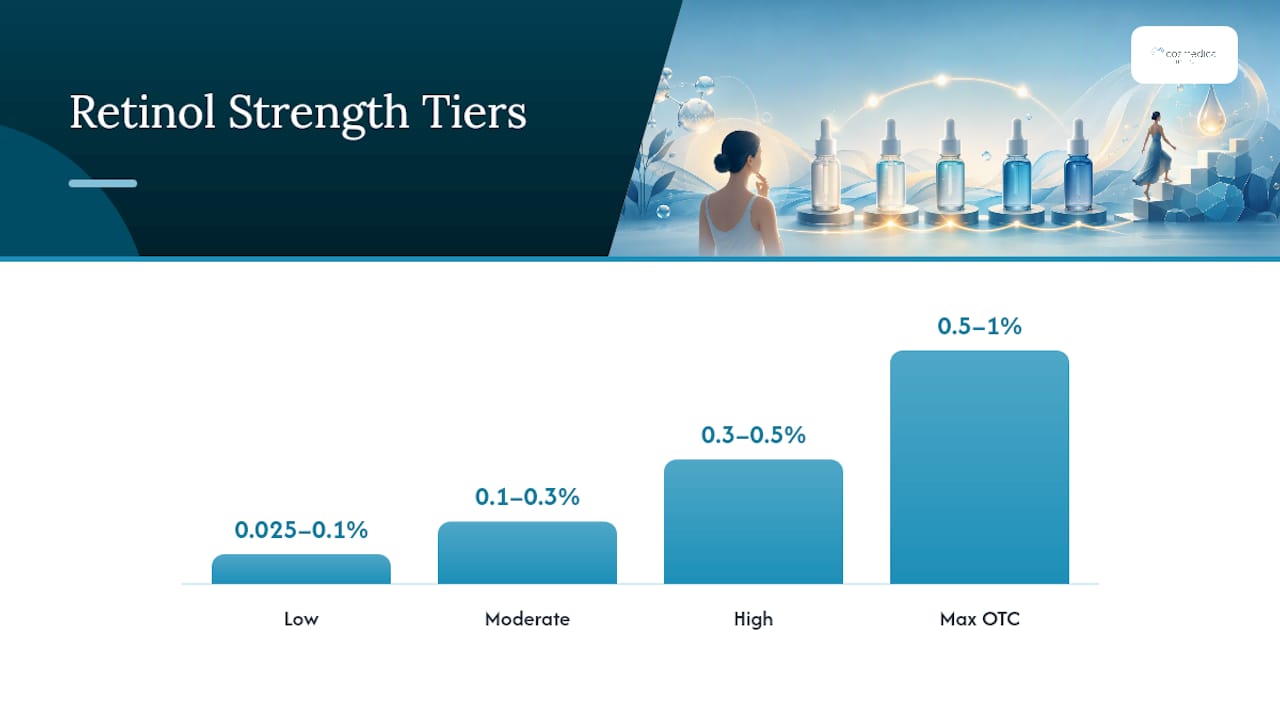
Here’s how the tiers generally break down:
- Very low concentrations can be gentle enough for first-time users or sensitive skin, with results gradually becoming noticeable over time with consistent use.
- Low (0.025%–0.1%): The classic “beginner workhorse” range. Clinical work on topical retinol shows measurable improvements in collagen and skin texture at concentrations this low, typically over 8 to 12 weeks.
- Moderate (0.1%–0.3%): Where most consistent users eventually settle. Dermatologist guidance flags this as the sweet spot where efficacy and tolerability balance out for the average adult, and pushing past 0.5% often makes more sense as a prescription conversation than an OTC shopping trip.
- High (0.3%–0.5%): Noticeably faster results for experienced users, but irritation risk climbs fast here. This is the range some clinical summaries loosely equate to low-dose prescription tretinoin activity.
- Max OTC (0.5%–1%): Available over the counter in some markets, but this tier is where diminishing returns kick in hard. You’re paying for a bigger number without a proportional bump in results, and irritation often outpaces benefit.
That last point matters more than most shoppers realize. Retinol conversion inside skin is enzyme limited. Once you exceed what your skin can actually convert into active retinoic acid, the excess doesn’t sit around waiting to help later. It just irritates. A commonly cited heuristic puts retinol at roughly 10 to 20 times less potent than tretinoin, though that multiplier shifts depending on the study and the formulation, so treat it as a rough compass, not a formula.
Pro Tip: If a product doesn’t list its percentage at all, that’s not automatically a red flag. Reputable brands sometimes withhold the exact number to protect formulation IP. What matters more is whether the brand discloses the retinoid type and gives clear usage guidance.
How to Start Retinol and Titrate Up Safely
Getting this sequence backwards is the single biggest reason people quit retinol convinced their skin “can’t handle it.” The fix is almost always frequency first, concentration second.
- Week 1 to 2: Apply a low-strength product (0.025%–0.05%) twice a week at night, always followed by moisturizer.
- Week 3 to 4: If skin looks calm, no flaking or stinging, bump to three nights a week at the same concentration.
- Week 5 to 8: Move to every other night if tolerance holds. This is the point most sensitive-skin users should pause and stay put.
- Month 3 onward: Consider nightly use, or step up to the 0.1%–0.3% tier, but only if you’ve had zero irritation for at least two consecutive weeks.
- Beyond 6 months: Experienced users who’ve plateaued in results can discuss moving toward 0.3%–0.5% or a prescription retinoid with a dermatologist.
Sensitive skin users should start slower than this, sometimes stretching each stage to three or four weeks. Average users can move through the early stages a bit faster. Experienced retinoid users who’ve used the ingredient for years without issue can often skip straight to moderate frequency at a moderate concentration.
Watch for the signs, not the calendar. Mild dryness, slight flaking, and a temporary rough patch near the mouth or nose are normal adjustment signals. Stinging that lasts more than a few minutes, visible redness that doesn’t fade by morning, or a burning sensation on application are red flags telling you to step back a stage, not push through.
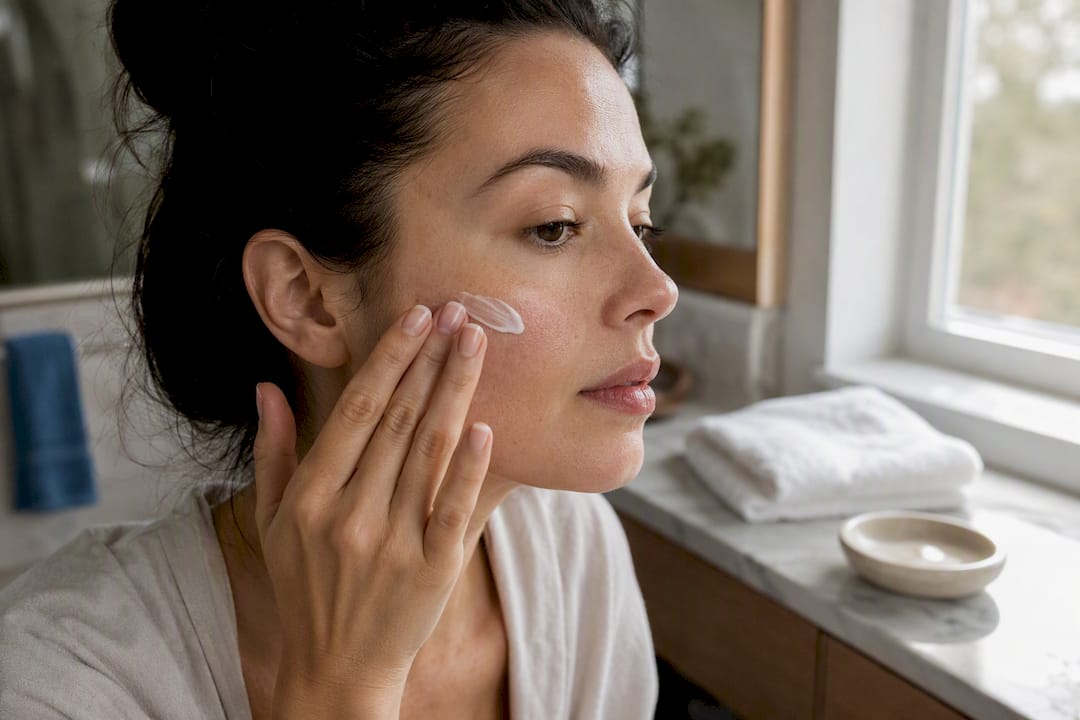
Application technique matters as much as the schedule. Apply to fully dry skin, wait a few minutes, then follow with a rich moisturizer to buffer the retinol’s contact with your skin barrier. Some people prefer the “sandwich method,” applying moisturizer before and after retinol, which effectively dilutes intensity without diluting the product itself. If you’re brand new to this ingredient, a dedicated beginner routine that walks through buffering step by step is worth bookmarking before your first application.
Retinol vs. Retinal vs. Tretinoin: What Percent Comparisons Miss
They’re different units entirely.
Here’s the conversion chain your skin actually runs: retinol first converts to retinaldehyde (retinal), which then converts to retinoic acid, the form your skin cells actually respond to. Tretinoin skips both steps. It arrives as retinoic acid already, which is exactly why it’s a prescription drug and works faster, but also irritates faster.
That two-step conversion for retinol is the rate-limiting factor in how it performs. Retinal only needs one conversion step, which is the biological reason it’s often described as more potent, gram for gram, than retinol. But “more potent” doesn’t mean a fixed multiplier you can do math with:
- Some controlled comparisons show similar efficacy between retinol and retinal at matched concentrations, depending on which skin outcome you’re measuring.
- The often-repeated claim that retinal is “10 times stronger” than retinol isn’t consistently supported across formulations.
- Tretinoin remains the most direct-acting of the three, which is also why it carries the strictest usage guidance and requires a prescription.
The practical takeaway: if you’ve plateaued on retinol at a tolerable concentration and want more visible change, retinal is a reasonable next step before jumping straight to a prescription. If you’ve built solid tolerance over months and want faster, more predictable results, that’s the point to have a tretinoin conversation with a dermatologist rather than just buying a higher-percentage retinol. Our retinal versus retinol breakdown covers starter dosing for each if you’re deciding between the two.
Why Formulation Changes What a Percentage Actually Delivers
Two products with the same printed percentage can feel completely different on skin, and this is where a lot of shoppers get tripped up chasing numbers alone.
The vehicle matters too. A retinol suspended in a lightweight gel behaves differently on skin than the same percentage in a heavy cream base, and packaging plays a quieter role than most people realize: retinol degrades with light and air exposure, so a product in a clear jar can lose potency well before the percentage on the label stops being accurate.
When you’re reading a label, look for:
- Time-release or encapsulated language, which often signals a gentler real-world experience
- Opaque, airless packaging (pumps or tubes beat open jars)
- Ingredient lists that pair retinol with soothing agents like niacinamide or ceramides
- Vague marketing terms like “advanced formula” without any technical backing, which deserve more skepticism than trust
Retinol Safety for Darker Skin, Sensitive Skin, and Special Cases
Retinol’s biggest risk isn’t dryness. It’s inflammation, and inflammation hits some skin types harder than others.
For darker skin tones (Fitzpatrick IV through VI), inflammation can trigger melanocyte activity that leads to post-inflammatory hyperpigmentation, dark marks that outlast the original irritation by months. The standard clinical mitigation is a slower titration schedule than the general protocol above, paired with consistent moisturizer buffering from day one, not just when irritation shows up.
If you’re pregnant or breastfeeding, skip retinol entirely and talk to your doctor about safe alternatives. This isn’t a percentage question. It’s a category question, and no concentration is considered appropriate during that window.
Watch for these signs of barrier stress at any skin tone:
- Persistent redness that doesn’t calm down between applications
- Tightness or stinging that shows up before you’ve even applied moisturizer
- Peeling that looks raw rather than flaky
- Breakouts that appear in new areas you haven’t had trouble with before
If you see two or more of these, pause retinol completely for a week, moisturize heavily, and drop concurrent exfoliants like AHAs or BHAs until your barrier settles. Dermatology guidance is consistent on one point worth remembering: consistent, tolerable use produces better long-term results than sporadic use of a high-strength product that your skin fights every time.
Where This Guidance Comes From
This guide reflects peer-reviewed dermatology research on retinoid conversion and clinical outcomes, cross-referenced with Cosmedica Skincare’s ongoing work formulating cruelty-free, dermatologist-tested retinol products.
- Read more on the biology behind results in how retinol works on skin
- Compare real product formats and concentrations in our guide to retinol product examples
- Browse Cosmedica’s retinol skin care collection to see tiered options in practice
[Author credentials, clinical case notes, and curated customer results to be added by the Cosmedica editorial team.]
Find Your Right Starting Point
If you’re still unsure where to start, the honest answer is: lower than you think, and slower than you want. Some skincare lines build their retinol offerings around that exact philosophy, with gentler entry points, clear labeling, and formulas designed for consistent use rather than discomfort. Pair your retinol with a proper moisturizer for buffering, and if you’re ready to build out a full routine around it, the Super Serum Set gives you a ready-made lineup instead of guessing what pairs well together.
A Straight Answer on Retinol Strength
The number on the label matters less than whether you actually stick with the product it’s printed on. The skin doesn’t reward intensity. It rewards repetition. If you’ve genuinely plateaued after months of consistent, tolerable use and still want more, that’s the moment to loop in a dermatologist about prescription tretinoin rather than reaching for a bigger number on a different bottle.
— Thomas
This article is general information, not a substitute for advice from a qualified doctor. Consult a qualified healthcare professional about your own circumstances before acting on anything here.
Sources
- Retinoids in the treatment of skin aging: an overview of clinical efficacy and safety
- Topical retinoids in dermatology: modes of action and clinical use
FAQ
Is 1% Retinol Stronger Than 0.2% Retinal?
Not necessarily. Retinal converts to active retinoic acid in fewer steps than retinol, so gram for gram it tends to act faster, but matched-concentration comparisons show the gap isn’t a fixed multiplier, and formulation affects the outcome as much as the raw percentage.
Is 0.3% Retinol Too Strong for Beginners?
Yes, for most first-time users.
Is 2.5% Retinol Too Strong?
Retail products at that concentration are unusual because OTC retinol effectiveness plateaus well before that level, while irritation risk keeps climbing.
Is 1% Retinol the Same as 1% Retinal?
No. They’re different molecules with different conversion paths to active retinoic acid, so identical percentages don’t translate to identical potency or identical irritation risk. Compare them by how your skin responds, not by the number alone.