

Buy Multi Weight, Not the Label: Sodium Hyaluronate vs Hyaluronic Acid
Sodium hyaluronate is simply the salt form of hyaluronic acid, and both are humectants that pull water into your skin. The practical difference isn’t the label at all. It’s molecular weight, which determines whether an ingredient sits on the surface for instant plumping or works deeper for lasting hydration. Since most cosmetics already use sodium hyaluronate for stability, your real decision comes down to molecular-weight claims and whether the product uses a multi-weight blend.
TL;DR:
- Molecular weight determines whether hyaluronic acid or sodium hyaluronate provides instant plumping or long-lasting hydration, with multi-weight blends offering combined benefits.
- Sodium hyaluronate dissolves more readily, resists oxidation better, and is generally more stable, but penetration depends on molecular weight, not salt form.
- Low molecular weight hyaluronic acid penetrates deeper into the skin, while high molecular weight forms create a surface film that promotes immediate moisture retention.
- Formulation quality and molecular-weight claims matter more than whether the ingredient is labeled hyaluronic acid or sodium hyaluronate, especially for long-term hydration benefits.
- Both forms are considered safe for most skin types, but choosing products with balanced molecular weights and pairing with occlusive moisturizers maximizes hydration outcomes.
Table of Contents
- Sodium Hyaluronate vs Hyaluronic Acid: The Basic Chemistry
- Sodium Hyaluronate or Hyaluronic Acid: Key Differences at a Glance
- What Is Low Molecular Weight Hyaluronic Acid, and Why Does It Matter?
- Where Sodium Hyaluronate and Hyaluronic Acid Work Best
- Is Sodium Hyaluronate Safe? What Dermatologists Say
- How to Choose Between Hyaluronic Acid and Sodium Hyaluronate Products
- How Cosmedica-skincare Approaches Hyaluronic Acid Formulation
- A Straight Answer on Which One to Buy
- Try a Multi-Weight Hyaluronic Acid Formula from Cosmedica-skincare
- Sources
- FAQ
Sodium Hyaluronate vs Hyaluronic Acid: The Basic Chemistry
Here’s the thing most product labels never explain: hyaluronic acid, in its pure acid form, is actually pretty rare in skincare. Your body makes it naturally as a long, tangled sugar chain that lives in your skin, joints, and eyes, acting like a sponge that can hold up to a thousand times its weight in water. That’s the biological original, the substance your skin is already producing (in shrinking amounts as you age).
Sodium hyaluronate is what you get when that acid reacts with sodium to form a salt. Chemically, it’s a small tweak. Practically, it changes everything about how the ingredient behaves in a bottle. According to Medical News Today, sodium hyaluronate is favored in skincare because it’s more stable and is often manufactured at a lower molecular weight, which helps it work closer to the surface and slightly deeper into the epidermis.
Formulators lean toward the salt form for a simple reason: it dissolves faster and resists breaking down over the life of a product, according to formulation chemistry research comparing the two forms. Pure hyaluronic acid is trickier to work with. It’s less soluble and more prone to oxidizing, which shortens shelf life.
On an ingredient list, you’ll usually see one of these terms:
- Hyaluronic Acid — the parent compound, less common in finished formulas
- Sodium Hyaluronate — the salt form, the most widely used version in serums and creams
- Sodium Acetylated Hyaluronate — a modified version built for better skin penetration
- Hydrolyzed Hyaluronic Acid — HA broken into smaller fragments, usually low molecular weight
- Hydroxypropyltrimonium Hyaluronate — a modified form designed to bind to hair and skin surfaces
Brands sometimes list “hyaluronic acid” on the front of the bottle for recognition, even when the actual INCI ingredient is sodium hyaluronate. That’s marketing shorthand, not a different ingredient.
Sodium Hyaluronate or Hyaluronic Acid: Key Differences at a Glance
If you’re standing in front of two serums trying to decide which one deserves your money, here’s what actually separates sodium hyaluronate from hyaluronic acid on a formulation level.
Solubility and stability are where the salt form wins outright. Sodium hyaluronate dissolves more readily in water-based formulas and holds up better against heat, light, and time on a shelf. That’s a big part of why it dominates the market: a serum that degrades in three months isn’t a serum anyone wants to sell.
Water-binding capacity is nearly identical between the two. Both grab and hold moisture at an impressive rate, and that’s the whole point of using either one. You’re not sacrificing hydration by choosing the salt form.
Penetration depth is where the biggest misconception lives. A lot of shoppers assume “sodium hyaluronate” automatically means deeper penetration than “hyaluronic acid,” but that’s not accurate. Penetration is a molecular-weight issue, not a salt-versus-acid issue. You can have a high molecular weight sodium hyaluronate that sits entirely on the surface, and a low molecular weight hyaluronic acid that reaches deeper layers. The label word tells you almost nothing about how far the ingredient travels.
Here’s a quick side-by-side to keep straight while you shop:
| Factor | Hyaluronic Acid (parent acid) | Sodium Hyaluronate (salt form) |
|---|---|---|
| Water solubility | Lower, harder to dissolve | Higher, dissolves easily |
| Shelf stability | More prone to breakdown | More resistant to oxidation |
| Water-binding | Very high | Very high |
| Skin penetration | Depends on molecular weight | Depends on molecular weight |
| Common use in cosmetics | Less frequent | Standard choice for most serums |
The shopping takeaway is straightforward: stop scanning for “hyaluronic acid” versus “sodium hyaluronate” as if it’s a quality signal. Instead, look for the molecular-weight claim, and give real weight to products that list multiple molecular weights in one formula. That detail tells you far more than the base ingredient name ever will.
What Is Low Molecular Weight Hyaluronic Acid, and Why Does It Matter?
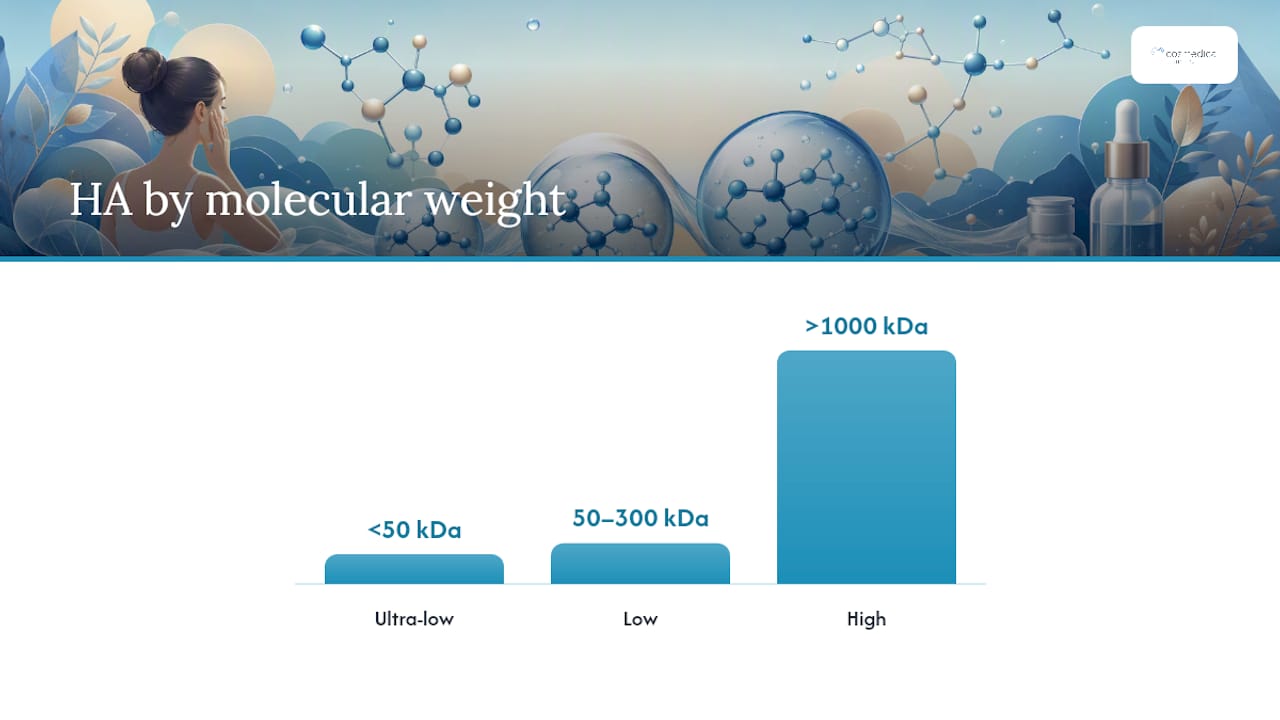
Molecular weight is measured in kilodaltons (kDa), and it’s the single biggest factor in how any HA ingredient behaves once it touches your skin. Think of it like particle size in a water filter: bigger particles get stopped at the surface, smaller ones pass through.
High molecular weight HA (generally above 1,000 kDa) forms a film on the skin’s surface. It can’t penetrate the stratum corneum because the molecules are simply too large, but that film does something valuable: it locks in moisture and gives you that immediate, visible plumping effect. This is the “big drink of water” people notice within minutes of applying a serum.
Low molecular weight hyaluronic acid (roughly 50 to 300 kDa) is small enough to move into the epidermis, the living layer of skin beneath the dead surface cells. It hydrates from within rather than just sitting on top, which is why it tends to show up in products marketed for fine lines and deeper hydration.
Ultra-low molecular weight fragments (under 50 kDa) go even deeper, reaching toward the upper dermis in some formulations. But this is also where the science gets more cautious. A PMC review of topical hyaluronic acid applications notes that very small HA fragments may trigger pro-inflammatory responses in certain skin types. Smaller isn’t automatically better, and a formula built entirely around ultra-low weight fragments isn’t necessarily the smarter buy.
Statistic to know: clinical research published in a Wiley dermatology journal found that multi-molecular weight hyaluronic acid blends produced greater hydration gains over several weeks compared to single high-molecular-weight formulations alone. That’s a meaningful data point if you’ve ever wondered why so many serums now advertise “multiple weights” instead of just one.
That’s the case for multi molecular hyaluronic acid blends. By combining high, medium, and low weights in one formula, you get the immediate surface plumping from the large molecules and the sustained, deeper hydration from the smaller ones. It’s a layered strategy rather than a single mechanism. That’s a big reason why blended formulas tend to outperform single-weight products in longer-term hydration testing.
The takeaway here isn’t that low weight beats high weight or vice versa. It’s that the two do different jobs, and a well-balanced formula uses both instead of leaning entirely on one extreme.
Where Sodium Hyaluronate and Hyaluronic Acid Work Best
Knowing the molecular-weight science is only half the battle. The other half is knowing what to actually buy for the result you want.
- Lightweight serums typically favor low to mid molecular weight HA, since these need to absorb quickly and deliver hydration without leaving a heavy film. If your skin feels tight by midday, this is usually your category.
- Rich creams and night formulas often lean on higher molecular weight HA paired with emollients, since the goal is surface hydration and barrier support rather than fast absorption.
- Sheet masks and hydrating masks commonly use a blend, since a 15 to 20 minute treatment benefits from both immediate plumping and a hydration boost that continues after you rinse.
- Post-procedure or sensitive-skin products frequently use modified forms like sodium acetylated hyaluronate, which is engineered to be gentler while still binding water effectively.
Most cosmetic formulations use HA or sodium hyaluronate at typical low concentrations suitable for topical use. Above that, you start seeing diminishing returns and, in some cases, a sticky or tacky finish on skin. More isn’t automatically better here, contrary to what an aggressive percentage on a bottle might suggest.
Pro Tip: Apply your hyaluronic acid or sodium hyaluronate serum on damp skin, right after cleansing, and follow it with an occlusive moisturizer within 60 seconds. HA is a humectant, meaning it pulls moisture from its surroundings, so if the air is dry and you skip the moisturizer, it can occasionally pull hydration from your skin instead of adding to it.
That single sequencing habit, applying to damp skin and sealing with an occlusive, matters more for your results than whether the bottle says “hyaluronic acid” or “sodium hyaluronate” on the front label. Check out our guide on whether hyaluronic acid should go on wet or dry skin for the full breakdown.
Is Sodium Hyaluronate Safe? What Dermatologists Say
The short answer, and the one that should ease most of your worry: both forms are considered broadly safe for topical use. Cleveland Clinic’s safety overview and other comprehensive safety assessments describe hyaluronic acid and sodium hyaluronate as generally well-tolerated, non-comedogenic, and appropriate for most skin types, including sensitive and acne-prone skin.
True allergic reactions to topical HA are rare. When irritation does happen, it’s more often tied to other ingredients in the formula (fragrance, certain preservatives, high concentrations of actives layered on top) rather than the HA itself.
Harvard Health’s dermatologist commentary makes a point worth repeating here: both HA and its salt forms bind large amounts of water and are broadly safe, and formulation matters more than which technical name appears on the label. That’s a useful filter for cutting through marketing noise. A few practical guardrails worth following:
- Patch-test any new HA product on your inner forearm for 24 hours if you have reactive or eczema-prone skin.
- Pair HA with barrier-supporting ingredients like ceramides or squalane, especially if your skin barrier is already compromised.
- If you’re pregnant or nursing, typical cosmetic concentrations of topical HA are generally considered fine, but check with your provider about your specific situation.
- Skip layering multiple high-percentage actives (retinol, exfoliating acids, HA) all in one routine without easing in gradually.
Dermatologists tend to care far less about the acid-versus-salt debate than shoppers do. Their guidance almost always circles back to the same point: formulation quality, concentration, and how the product is layered into your routine matter more than the exact word printed on the front of the bottle.
How to Choose Between Hyaluronic Acid and Sodium Hyaluronate Products
Standing in the skincare aisle (or scrolling a product page at 11 p.m.) with ten nearly identical serums in front of you is its own kind of exhausting. Use this shortlist to cut through it fast.
- Check the INCI list, not just the front label. The actual ingredient name on the back tells you more than the marketing name on the front.
- Look for a molecular-weight claim. Brands that specify “low molecular weight” or “multi-weight complex” are usually more transparent about how the product actually works.
- Match the format to your goal. Want instant plumping for an event tonight? Look for high molecular weight or a film-forming formula. Want ongoing hydration over weeks? Prioritize low molecular weight or a blend.
- Check the concentration. Most effective serums fall in the 0.1% to 2% range; wildly higher numbers aren’t automatically an upgrade.
- Confirm there’s an occlusive step nearby. A great HA serum without a moisturizer to seal it in is only doing half its job.
- Watch for red flags. Be skeptical of any product claiming “deep penetration” without specifying a molecular weight, and be equally skeptical of products marketed as superior purely because they use one ultra-low molecular weight fragment. Balanced beats extreme almost every time.
Our breakdown of what hyaluronic acid actually does for your skin walks through more of these use cases if you want the fuller picture before you buy.
How Cosmedica-skincare Approaches Hyaluronic Acid Formulation
We build our hyaluronic acid formulas around the same evidence this article just walked through: stability matters, molecular weight matters, and the label word matters far less than people assume.
- We use sodium hyaluronate as our base form because of its solubility and resistance to breakdown, which keeps our serums performing consistently from the first use to the last.
- Where it makes sense for the product, we work with multi-weight approaches so a single serum can offer both immediate surface hydration and support at a deeper level.
- We pair our HA formulas with barrier-friendly ingredients rather than isolating HA alone, because sealing in hydration is just as important as delivering it.
- We keep our formulations cruelty-free, focusing on delivering effective hydration.
If you want to see this philosophy in action, our hyaluronic acid serum guide breaks down how we think about layering actives, and our face serum comparison goes deeper into picking the right texture for your skin type. Customer feedback we hear most often centers on how quickly skin feels hydrated without that heavy, greasy residue, which tracks with what the molecular-weight science predicts for a well-built multi-weight formula.
A Straight Answer on Which One to Buy
Chasing the “right” label between hyaluronic acid and sodium hyaluronate is time you could spend on something that actually moves the needle for your skin. My honest recommendation: buy sodium hyaluronate based multi-weight formulations for balanced hydration, pair them with an occlusive moisturizer, and patch-test first if your skin tends to react.
The molecular-weight profile and overall formulation quality of a product will always tell you more than the specific word on the ingredient list. Stop treating the label word as a decision point, and start treating it as background noise while you focus on concentration, weight blend, and what the rest of the formula is doing to support your barrier.
— Thomas
Try a Multi-Weight Hyaluronic Acid Formula from Cosmedica-skincare
You don’t need to decode ingredient labels or chase the “correct” molecular weight on your own. Cosmedica-skincare builds its hyaluronic acid formulas around stable sodium hyaluronate and layered hydration, the same approach this whole article just laid out, so you can shop by result instead of by chemistry homework. Every formula is cruelty-free and dermatologist-tested.
If you want a straightforward starting point, the Super Serum Set bundles hydration-focused actives so you’re not guessing which single product to buy first. You can also browse the full treatments and serums lineup to compare formats and find the texture that fits your routine. Add a moisturizer from our collection of occlusive-friendly options to seal in whatever hydration your serum delivers, and you’ve got a complete, evidence-aligned routine in two steps.
Sources
The claims in this article draw on dermatological commentary, clinical research, and safety literature rather than marketing copy. If you want to dig into the primary sources yourself:
- Wiley clinical study / review on topical hyaluronic formulations
- Harvard Health: Hyaluronic acid for skin benefits and how to use it
- PMC review on hyaluronic acid topical uses and molecular-weight effects
- Medical News Today: Sodium hyaluronate in skin care
FAQ
Is Sodium Hyaluronate the Same as Hyaluronic Acid?
Not exactly, but they’re extremely close. Sodium hyaluronate is the sodium salt form of hyaluronic acid, and both bind large amounts of water in skin. The salt form is generally more stable and easier to formulate, which is why it shows up more often on ingredient lists.
Which Form of Hyaluronic Acid Is Best?
Neither form is universally “best,” since the real difference comes down to molecular weight rather than the acid-versus-salt label. Research on multi-molecular weight blends shows they tend to outperform single-weight formulas for hydration over several weeks, making a blended product a stronger overall pick than either extreme alone.
Why Do Some Dermatologists Not Like Hyaluronic Acid?
It’s rarely the ingredient itself that concerns dermatologists. Concerns usually trace back to poor formulation, skipping the moisturizer step after applying HA in dry climates, or products relying too heavily on ultra-low molecular weight fragments, which some research suggests may trigger pro-inflammatory responses in sensitive skin.
Is Sodium Hyaluronate Good for Face Skin?
Yes, it’s considered broadly safe and effective for facial skin, including sensitive and acne-prone types, according to Cleveland Clinic’s safety overview. It works best when paired with an occlusive moisturizer to help lock the hydration in.
Does Cosmedica-skincare Use Sodium Hyaluronate or Hyaluronic Acid?
Cosmedica-skincare formulates with sodium hyaluronate for its stability and solubility, often within multi-weight approaches designed for both surface and deeper hydration. Current formulas and pricing are available directly on the Cosmedica-skincare site.