

3–6 Months to Firmer Skin: Why Use Vitamin C in the Morning
Yes, for most people, applying vitamin C in the morning makes the most sense. It neutralizes the free radicals that build up from sun exposure and pollution throughout the day, and it teams up with your sunscreen for extra protection. That said, the real magic ingredient is consistency: if nighttime is when you’ll actually remember to use it, a nightly habit still beats a sporadic morning one.
TL;DR:
- Using vitamin C in the morning enhances protection by neutralizing free radicals from sun and pollution before applying sunscreen.
- Applying a 10% to 20% concentration of L-ascorbic acid, in a packaging that prevents oxidation, offers the best balance of effectiveness and skin tolerance.
- Consistent daily use over at least three months leads to measurable improvements in skin firmness, collagen support, and hyperpigmentation fading.
- Layer vitamin C serum after cleansing, wait a minute before moisturizing, and always finish with broad-spectrum SPF 30 or higher.
- Combining vitamin C with retinol or acids in the same routine can cause irritation; better to alternate or keep these actives separate.
Table of Contents
- Why Morning Use Is Recommended for Vitamin C
- How to Apply Vitamin C in Your Morning Routine
- Which Vitamin C Concentration Works Best in the Morning?
- Can You Layer Vitamin C With Retinol or Exfoliating Acids?
- How Long Until You See Results From Vitamin C?
- Cosmedica Skincare’s Morning-Ready Vitamin C Options
- Why “Just Use It Every Day” Beats Most Morning Routine Advice
- Ready to Build Your Morning Vitamin C Routine?
- Sources
- FAQ
Why Morning Use Is Recommended for Vitamin C
Think of vitamin C as your skin’s backup security system. Sunscreen blocks the UV photons before they hit your skin, but it can’t mop up every stray reactive molecule that sneaks past. That’s where topical vitamin C steps in, scavenging leftover free radicals and calming down the enzyme activity (called MMPs) that breaks down collagen after sun exposure. Applied before sunscreen, it works as a second layer of daytime defense, not a replacement for SPF.
The research backs this up nicely. Topical vitamin C has been shown to brighten skin, fade hyperpigmentation, and support the skin’s structural layers over time, with antioxidant, photoprotective, and antiaging effects documented across multiple studies.
Here’s the number that matters: one study using a 12% vitamin C serum applied twice daily found measurable gains in dermal thickness and firmness after roughly 84 days of continuous use. That’s about three months of showing up every single day. Dermatologists tend to agree that daily use matters more than the clock. Morning just happens to pair naturally with the sunscreen step you’re already doing.
How to Apply Vitamin C in Your Morning Routine
Getting the order right takes the guesswork out of your routine. Here’s the sequence that dermatologists and skincare guides consistently recommend:
- Cleanse your face and pat it dry. Vitamin C absorbs best on clean, dry skin, not damp skin.
- Apply your vitamin C serum, a few drops across your face and neck, using gentle upward strokes.
- Wait about a minute if you’re layering multiple serums, applying the thinnest formulas first.
- Follow with moisturizer to lock in hydration and buffer any mild tingling.
- Finish with broad-spectrum SPF 30 or higher, no exceptions, even on cloudy days.
Makeup goes on just fine over a fully absorbed vitamin C and SPF combo. If mornings are chaotic, a vitamin C infused moisturizer that also carries sun protection can collapse two steps into one.
Pro Tip: If your serum feels tacky after a minute, you probably applied too much. A little goes a long way, especially with higher concentrations.

Which Vitamin C Concentration Works Best in the Morning?
Not all vitamin C is created equal, and the label matters more than the marketing. L-ascorbic acid is the gold standard for potency, but it’s also the most likely to irritate sensitive skin because of its low pH. Gentler derivatives like magnesium ascorbyl phosphate and ascorbyl glucoside convert to active vitamin C once absorbed, trading a bit of strength for a lot less sting.
Research points to a sweet spot for effective concentration:
- Formulas at 8% or higher tend to show biologically meaningful results.
- The 10% to 20% range is where most reputable products land, balancing potency against irritation.
- Anything above 20% mostly adds risk of redness and stinging without meaningfully better results.
- Packaging counts too: vitamin C oxidizes fast in light and air, so look for opaque, airless pump bottles over clear jars.
If you have reactive or sensitive skin, start on the lower end of that range, patch test on your inner arm for a couple of days, or opt for a stabilized derivative before working up to stronger formulas.
Can You Layer Vitamin C With Retinol or Exfoliating Acids?
Vitamin C plays well with some ingredients and clashes with others, so knowing the lineup saves you a lot of redness. It works especially well alongside vitamin E and hyaluronic acid, a combination that boosts antioxidant power while replenishing moisture at the same time. That pairing is worth exploring if you’re building out your vitamin C and hyaluronic acid routine for uneven tone.
Where things get tricky is mixing vitamin C with strong actives in the same routine:
- Retinol can destabilize vitamin C’s low pH formulas and doubles up on irritation. Save retinol for nighttime.
- AHAs and BHAs stack acidity on acidity, which is a fast track to redness for sensitive skin.
- Benzoyl peroxide can actually oxidize and deactivate some vitamin C formulas on contact.
If you’re not sure your skin can handle combining actives yet, keep vitamin C in the AM and save retinol or acids for PM, or alternate them on different days.
Pro Tip: New to vitamin C? Start with it three times a week for the first two weeks before working up to daily use. Your skin barrier will thank you.
How Long Until You See Results From Vitamin C?
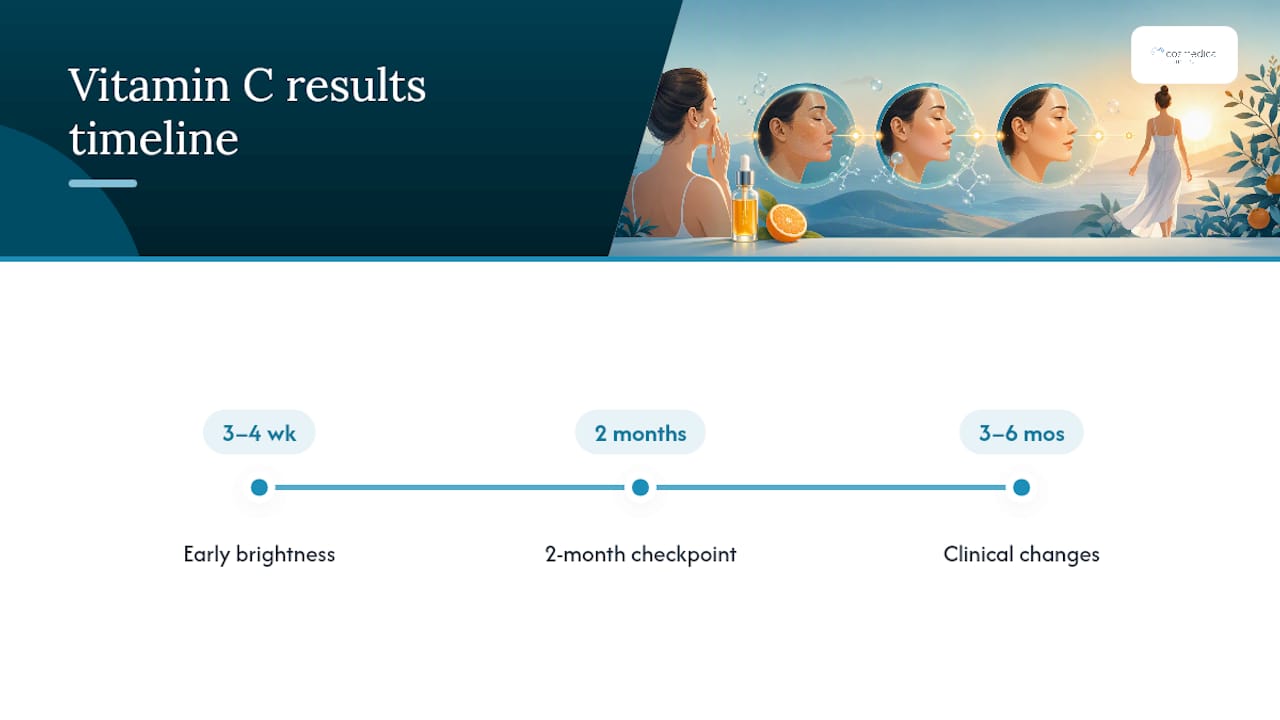
Patience pays off here, but not all payoff arrives at once. Most people notice a brighter, more even-toned complexion within 3 to 4 weeks of daily use, that early glow that makes you double-check the mirror.
The deeper changes take longer. Measurable improvements in collagen support, dermal thickness, and hyperpigmentation typically need 3 to 6 months of consistent daily application to show up clinically, echoing the timeline seen in the 12% serum study referenced earlier. If you’re not seeing any change after two full months, or if your skin is reacting with persistent redness rather than adjusting, that’s your cue to lower the concentration or switch to a gentler derivative for hyperpigmentation instead of stopping altogether.
Cosmedica Skincare’s Morning-Ready Vitamin C Options
Formulation choices matter just as much as timing, and Cosmedica-skincare built its vitamin C lineup around that idea. The Vitamin C Super Serum sits within the clinically supported concentration range and comes in packaging designed to slow oxidation, so the formula stays potent from the first drop to the last.
For a simpler one-step morning option, the Vitamin C Facial Day Cream combines antioxidant support with daily hydration in a single jar, ideal for anyone who wants fewer bottles cluttering the counter.
A few reasons these fit naturally into an AM routine:
- Formulated within an effective 10% to 20% concentration window
- Cruelty-free and paraben-free formulas suitable for daily use
- Designed to layer cleanly under moisturizer and sunscreen without pilling
For a broader look at what this ingredient can do beyond brightening, the 15 benefits of vitamin C serum breaks down the full range of effects worth knowing about.
Why “Just Use It Every Day” Beats Most Morning Routine Advice
Most skincare content treats vitamin C timing like it’s a rigid rulebook: morning only, this exact order, wait precisely 90 seconds between steps. That level of precision sounds authoritative, but it overstates what the research actually supports. Consistency, not clock-watching, is what drives the 3-to-6-month structural changes people are chasing.
Where I think the conventional advice actually falls short is in downplaying formulation quality. Concentration and packaging deserve at least as much attention as the AM versus PM debate.
If you’re prioritizing one thing, prioritize adherence over perfection. Pick a formula you can tolerate daily, pair it with SPF every single morning, and give it the full three months before judging whether it’s working. Everything else, the exact wait times, the precise layering order, is secondary to just showing up with it consistently.
— Thomas
Ready to Build Your Morning Vitamin C Routine?
If you’ve read this far, you already know the formula quality and concentration matter as much as timing does. Cosmedica-skincare’s Vitamin C Super Serum sits in the dermatologist-recommended 10% to 20% range, in packaging built to slow oxidation, so what you apply on day 60 works as hard as what you applied on day one. It’s formulated for daily use, cruelty-free, and priced to fit an everyday routine rather than a splurge purchase.
Before adding anything new to your lineup, patch test on your inner arm for a couple of days, and always pair daily vitamin C use with a broad-spectrum sunscreen, since vitamin C supports your SPF but never replaces it. Ready to see what three consistent months can do? Browse the full vitamin C collection and pick the formula that matches your skin’s sensitivity level.
Sources
- Why is topical vitamin C important for skin health? | Harvard Health Publishing
- Topical vitamin C and the skin: mechanisms and clinical application | PMC
- Clinical efficacy of a 12% pure vitamin C serum across all skin phototypes | Dermatology and Therapy (SpringerLink)
- Vitamin C serum: benefits and how to use | Cleveland Clinic
- Randomized clinical trial: vitamin C supplementation and mood/stress outcomes | PubMed
FAQ
Should I Use Vitamin C Serum in the Morning or at Night?
Morning is generally preferred because vitamin C adds antioxidant protection that complements your sunscreen during the day. Nighttime use is still effective and not harmful, so if that’s when you’re more likely to remember it, stick with that routine instead.
Why Do Some Guides Say Not to Use Vitamin C at Night?
The concern isn’t that nighttime use is unsafe, it’s that vitamin C’s daytime antioxidant role pairs so naturally with sunscreen that skipping the AM application feels like leaving protection on the table. Nighttime use still delivers brightening and collagen support benefits; it simply misses that daytime synergy.
Does Vitamin C Tighten Saggy Skin?
Vitamin C supports collagen production, which can improve firmness and dermal thickness with consistent daily use over 3 to 6 months. It’s a gradual support tool rather than an instant tightening treatment, so expect subtle firming rather than a dramatic lift.
Is Vitamin C Good for Anxiety?
No, oral vitamin C supplementation has not been shown to meaningfully improve mood or reduce anxiety in healthy people. A randomized clinical trial found that 1,000 mg per day for four weeks raised blood vitamin C levels without producing a significant change in mood measures.
What Concentration of Vitamin C Should I Use in the Morning?
Most dermatologists point to the 10% to 20% range as the sweet spot for visible benefits without excess irritation. If you have sensitive skin, start closer to the lower end or choose a gentler derivative before working up to a stronger formula.