

5 Steps Leaping Bunny Uses to Prove No Animal Testing for Shoppers
Leaping Bunny certification means a company and every single one of its ingredient suppliers has proven, through supplier declarations and independent audits, that no animal testing has happened after a fixed cut-off date. That’s a step beyond a brand simply saying “we’re cruelty-free” on a label. To wear the bunny, brands hand over their whole supply chain for scrutiny. Before you trust the logo, though, check the official brand list or app. That’s where the real verification lives.
TL;DR:
- Leaping Bunny certification verifies that a brand and its suppliers have not conducted animal testing after a specific cut-off date, confirmed through declarations and independent audits.
- The standard covers the entire company and supply chain, not individual products, and does not guarantee ingredients are vegan or free from animal-derived components.
- Certification requires a fixed testing cut-off date, ongoing supplier declarations, and annual audits, with optional logo use on packaging.
- The logo alone is unreliable for verification, so shoppers should consult the official Leaping Bunny registry or app for confirmation.
- Certification cost varies, with larger brands expected to pay for audits, and the Leaping Bunny standard is more comprehensive than other cruelty-free schemes like PETA.
Table of Contents
- What Is Leaping Bunny Certification, Exactly?
- How Leaping Bunny Certification Works, Step by Step
- Leaping Bunny Standards, Broken Down for Shoppers
- Leaping Bunny vs PETA, Vegan Society, and Other Cruelty-Free Labels
- How to Verify a Leaping Bunny Certified Brand Before You Buy
- Why Verification Depth Should Matter to You as a Shopper
- Our Take: Skip the Logo Hunt, Check the Registry Instead
- Where Cosmedica-skincare Fits if You Want Cruelty-Conscious Skincare Now
- Sources
- FAQ
What Is Leaping Bunny Certification, Exactly?
Leaping Bunny is a cruelty-free certification program administered by the Coalition for Consumer Information on Cosmetics, a coalition that includes Cruelty Free International along with other animal protection groups across North America. It’s the certification most widely recognized internationally, which is part of why the bunny logo shows up on shelves from Los Angeles to London.
Here’s the part people miss: Leaping Bunny certifies at the company or brand level, not product by product. That means the whole corporate entity, and its full roster of suppliers, gets vetted, rather than one specific serum or lipstick earning a stamp while the rest of the line stays unchecked.
It’s also worth being precise about what the logo does not promise:
- No new animal testing after a fixed date, verified through the supply chain
- Company-wide scope, not a single-product guarantee
- No claim about vegan ingredients. A Leaping Bunny brand can still use beeswax, lanolin, or other animal-derived ingredients and remain fully compliant
Think of it as a “no testing” seal, not an “all vegan, all natural” seal. Those are two different questions, and only one of them is what Leaping Bunny answers.
How Leaping Bunny Certification Works, Step by Step
Getting certified is a real process, not a checkbox. Here’s how a brand actually earns the bunny:
- Open a company account and start the application. The Corporate Standard breaks the application into sections covering company information, cut-off date, and supplier documentation.
- Lock in a Fixed Cut-off Date. This is the date before which any animal testing on the company’s behalf is grandfathered in, and after which none is allowed, ever. Many brands choose either their founding date or the date they file the application, since that simplifies proving compliance going forward.
- Collect supplier declarations. Every ingredient supplier signs a Declaration of Raw Material Compliance, and every manufacturer signs a Declaration of Product Compliance, confirming nothing they supply was tested on animals after the cut-off.
- Build a Supplier Monitoring System. Brands can maintain this through annual declaration renewals or by adding cruelty-free language directly into purchase order contracts. Either way, it has to be maintained, not filed once and forgotten.
- Submit and stay audit-ready. Once the application goes in, the brand agrees to independent audits when required, and must recommit to the standard every single year to keep the certification active.
Pro Tip: If you’re a brand founder reading this, gather every supplier and manufacturer contact email before you start the application. Declarations get requested mid process, and a missing contact can stall approval for weeks.
Leaping Bunny Standards, Broken Down for Shoppers
A few technical terms show up constantly in Leaping Bunny discussions, and knowing them helps you read brand claims with a sharper eye.
The fixed cut-off date is the anchor of the whole standard. It’s a specific, documented date after which no animal testing can have occurred anywhere in the supply chain. Brands typically pick either their founding date or their application date, since both make supplier compliance easier to trace.
Supplier monitoring is the ongoing homework. Declarations aren’t a one-time signature. They get renewed, and the Corporate Standard requires companies to keep documentation, including sample purchase-order language, on file for every supplier.
Audits carry a cost rule worth knowing: companies with gross annual sales above a specific threshold are generally expected to pay for their own independent audit, while smaller companies are typically covered by the program itself. Either way, every certified company has to stay audit ready.
- Logo display on packaging is optional. A certified brand can skip the bunny entirely and still be fully compliant.
- Government-mandated testing in foreign markets gets handled through distributor contract addenda, language that legally protects the brand from being forced into testing it never wanted.
Leaping Bunny vs PETA, Vegan Society, and Other Cruelty-Free Labels
Not every “cruelty-free” claim carries the same weight, and the differences matter more than most shoppers realize.
- Verification depth. Leaping Bunny requires signed supplier declarations and independent audits reaching into the supply chain. Many other schemes rely mainly on a company signed statement, with no equivalent supplier level check. Ethical Consumer ranks Leaping Bunny among the more rigorous marks for exactly this reason.
- Scope. Leaping Bunny certifies at the brand or company level. Some other logos apply product by product, or to an entire corporate family at once, which changes what a single logo on one item actually tells you about the rest of the portfolio.
- Vegan status is a separate question entirely. Leaping Bunny doesn’t certify vegan ingredients, so a brand can be Leaping Bunny certified and still contain honey or lanolin. If vegan formulation matters to you specifically, look for a vegan certification alongside the bunny, not instead of it.
When supply-chain trust is your priority, Leaping Bunny is the stronger signal. When ingredient sourcing (not testing history) is the concern, a vegan-specific label answers a different question.
How to Verify a Leaping Bunny Certified Brand Before You Buy
Packaging art is the least reliable way to confirm certification, since logo use is optional and printing rules vary. Here’s what actually works:
- Check the official brand list at LeapingBunny.org, which is the single authoritative source for who’s currently certified.
- Use the Cruelty Free Shopping Guide app, which lets you scan a barcode or search a brand name on the spot, right in the store aisle.
- Don’t assume no logo means no certification. Plenty of certified brands choose not to print the bunny for design or cost reasons.
- Watch for red flags: vague “we don’t test on animals” language with no supplier detail, generic rabbit graphics that aren’t the official mark, or brands that go quiet when asked about their supply chain.
Why Verification Depth Should Matter to You as a Shopper
A cruelty-free claim without supplier proof is just marketing copy. What sets Leaping Bunny apart is that it forces a documented paper trail. A fixed cut-off date and independent audits close the loophole that lets brands say “we don’t currently test” while staying vague about what their raw material suppliers do upstream.
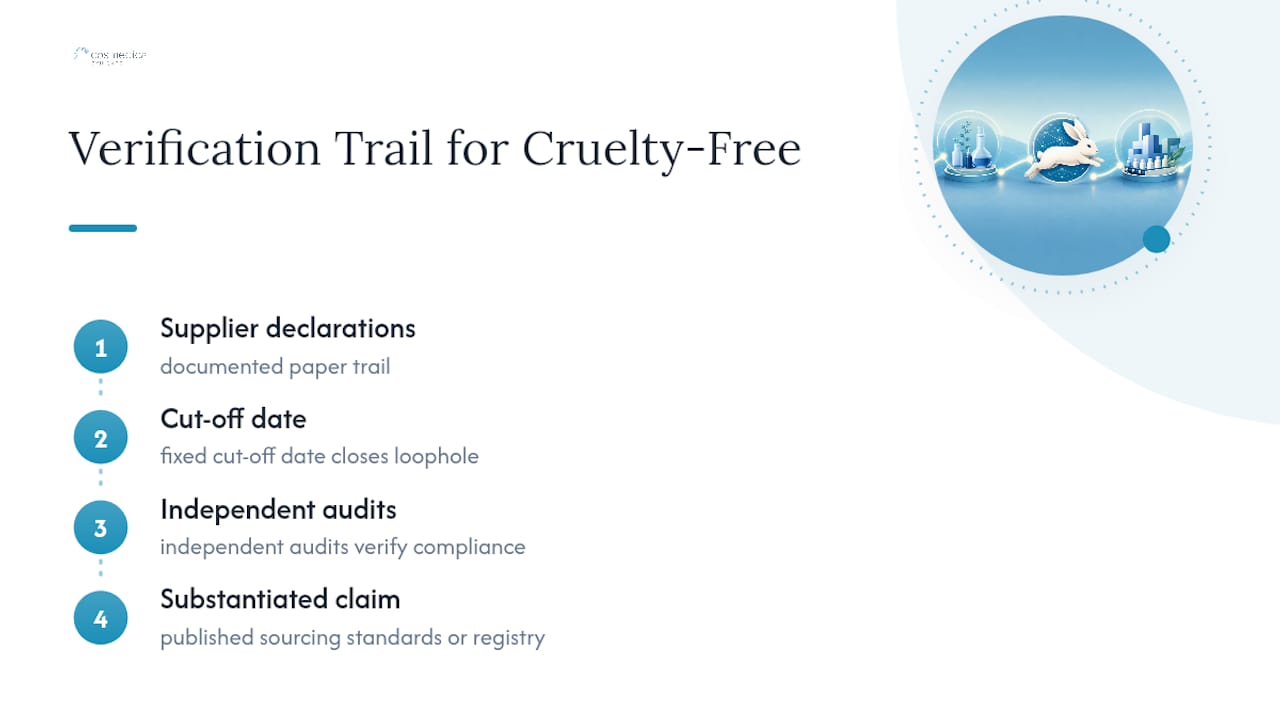
That’s the standard worth holding every ethical claim to. At Cosmedica-skincare, cruelty-free and eco-conscious formulation guides how products get built, and we’d rather you develop the habit of checking a brand’s actual supplier policy than take any logo at face value. If a brand publishes its sourcing standards or shows up on an official registry, that’s a far better trust signal than a bunny silhouette on a bottle.
Our Take: Skip the Logo Hunt, Check the Registry Instead
The conventional advice on cruelty-free shopping tells people to scan the front of the bottle for a bunny icon. That’s backwards. The logo is optional, packaging redesigns are expensive, and plenty of genuinely certified brands never bother printing it. The actual verification lives in the fixed cut-off date, the supplier declarations, and the audit trail, none of which fit on a label.
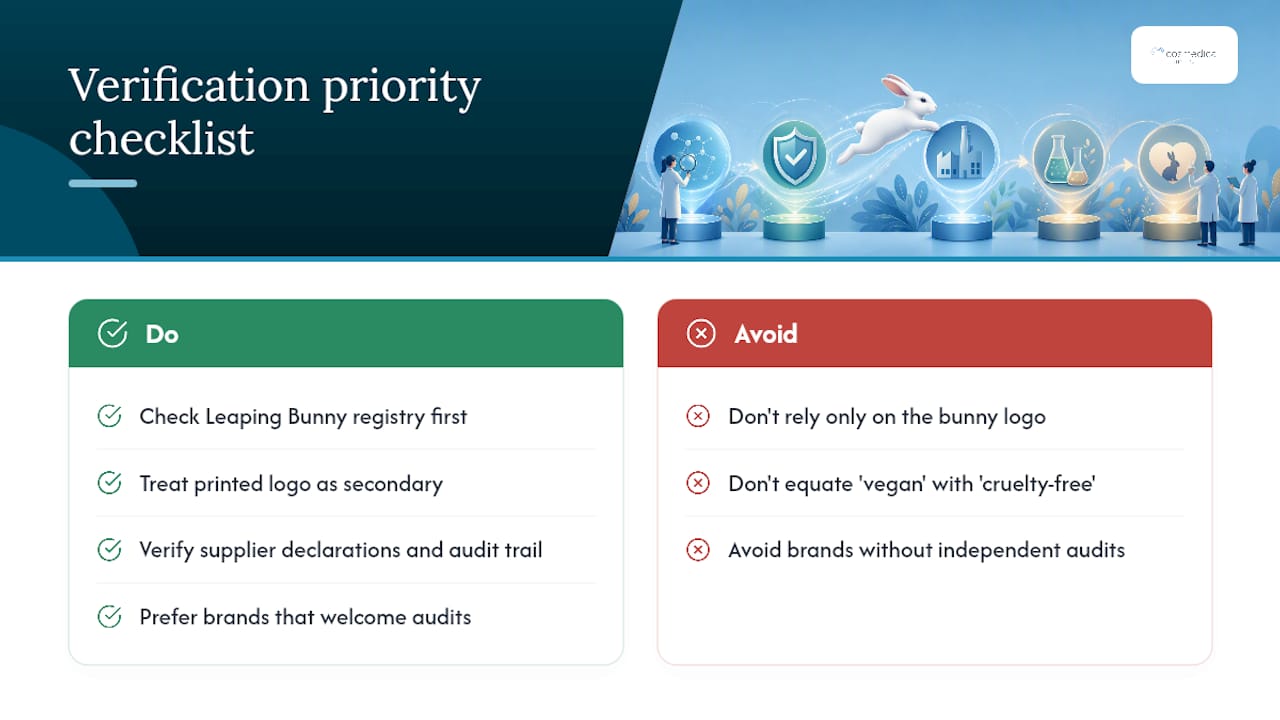
What the research here supports is a simple reordering of priorities: check the official Leaping Bunny list or app first, treat the printed logo as a nice-to-have, and understand that “cruelty-free” and “vegan” are two separate promises that happen to get bundled together in casual conversation. A brand can ace one and skip the other entirely.
If you take one thing from all of this, let it be that verification beats vocabulary. A brand that welcomes an independent audit is telling you something a marketing slogan never can.
— Thomas
Where Cosmedica-skincare Fits if You Want Cruelty-Conscious Skincare Now
If you’d rather shop than research supplier declarations tonight, Cosmedica-skincare offers a straightforward option. Every formula is built cruelty-free from the ground up, a commitment detailed on our sustainability page, and the products are priced to be an easy switch rather than a splurge. Our Super Serum Set pairs a few of our most requested formulas together if you want a simple starting point for a routine overhaul.
One honest note: buying from a cruelty-conscious brand and buying from a Leaping Bunny certified brand aren’t automatically the same claim. If third-party certification specifically is what you need for peace of mind, always confirm any brand against the official Leaping Bunny registry rather than taking a website’s word for it. Browse our full skincare lineup when you’re ready to see what a cruelty-conscious routine can look like.
Sources
- Leaping Bunny — The Leaping Bunny difference
- Leaping Bunny user guide / Corporate Standard of Compassion for Animals (user guide PDF)
- Getting started | Leaping Bunny
- Guide to non-animal testing certifications — Ethical Consumer
FAQ
How much does it cost to get Leaping Bunny certified?
Leaping Bunny doesn’t publish a flat certification fee. Companies above a certain gross annual sales threshold typically pay for their own independent audit, while smaller companies are generally covered by the program for that cost.
What’s the difference between Leaping Bunny and PETA certification?
Leaping Bunny requires signed supplier declarations and independent audits reaching into the supply chain, while PETA’s cruelty-free program relies primarily on a company-signed statement of assurance with no equivalent supplier audit layer.
Is Tree Hut Leaping Bunny certified?
Certification status changes over time and isn’t something to guess at from packaging alone. Check the brand directly against the official Leaping Bunny brand list before relying on any claim.
What brands are Leaping Bunny certified?
The certified brand roster spans hundreds of companies across skincare, cosmetics, and household products, and it updates regularly as new brands complete the application and existing ones recommit annually. The official Leaping Bunny list is the only reliable way to confirm a specific brand’s current status.
Does Leaping Bunny certification mean a product is vegan?
No. Leaping Bunny certifies the absence of animal testing after a fixed cut-off date, but products can still contain animal-derived ingredients like beeswax or lanolin and remain fully compliant.