

0.3%–1% Rule: Safe Use of Essential Oils in Skincare
Yes, essential oils can earn a place in your skincare routine, but only under specific conditions: properly diluted, patch tested first, kept away from sun exposure if they’re phototoxic, and ideally already blended into a stable, dermatologist-tested product rather than mixed at home. Undiluted application is where most problems start. The sections below walk through the clinical evidence, the real risks, and exactly how to use these oils without a trip to the dermatologist’s office.
TL;DR:
- Dilute essential oils to 0.3% to 1% for facial use, and always patch test first to identify delayed allergic reactions before full application.
- Avoid high-risk oils like cinnamon, clove, oregano, and certain citrus oils unless they are specifically processed to eliminate phototoxic compounds.
- Use carrier oils suited to your skin type, calculating about 6 drops per ounce to achieve safe, stable concentrations in skincare routines.
- Recognize that oxidation and storage conditions increase allergenic potential, so discard oils that smell off or change in appearance.
- Choose formulations with controlled, dermatologist-tested concentrations rather than DIY blends, especially for sensitive or reactive skin.
Table of Contents
- What Are Essential Oils, and How Do They Differ From Carrier Oils?
- What Does the Research Actually Say About Skin Benefits?
- What Are the Real Risks: Irritation, Allergies, and Phototoxicity?
- Which Essential Oils Suit Which Skin Concerns?
- How Do You Use Essential Oils Safely on Your Face?
- Why Formulation Matters More Than the Oil Itself
- Essential Oils vs. Fragrance Oils: What’s the Real Difference?
- Cosmedica Skincare’s Take: Natural Doesn’t Mean Unregulated
- Explore Dermatologist-Tested Formulas Without the DIY Guesswork
- Sources
- FAQ
What Are Essential Oils, and How Do They Differ From Carrier Oils?
Essential oils are concentrated volatile compounds pulled from plants through steam distillation or cold expression, which is why a single drop of rose oil represents pounds of petals. Chemically, they’re cocktails of terpenes, alcohols, and esters, the same molecule families responsible for a lavender field’s scent and a citrus peel’s photosensitizing punch.

That chemical makeup is not consistent from bottle to bottle. Harvest timing, plant genetics, soil, and even distillation temperature shift the final composition, which is exactly why standardization remains a persistent challenge for the industry. Two bottles labeled “100% pure tea tree oil” can have meaningfully different terpene profiles depending on where and when the plant was harvested.
This is where the terminology gets confused, and clearing it up matters for safety:
- Essential oils are the volatile, aromatic fraction, potent and fast-evaporating.
- Carrier oils (jojoba, sweet almond, sunflower) are fatty, non-volatile oils used to dilute essential oils and moisturize skin on their own.
- Absolutes and concretes are solvent-extracted, often containing trace solvent residue and different irritant profiles than steam-distilled oils.
Knowing which category a bottle falls into tells you immediately whether it’s something to apply generously or something to measure in drops.
What Does the Research Actually Say About Skin Benefits?
The strongest clinical signal in the entire essential oil category belongs to tea tree oil for mild acne. A systematic review of clinical trials and in vivo studies found tea tree has more consistent supporting data than nearly any other essential oil, though the reviewers still called for larger, better controlled trials before treating it as a proven acne treatment.
By the numbers: A 90-day clinical study of 40 participants tested a combined blend of tea tree, lavender, eucalyptus, and tangerine oils at a controlled 10% total concentration. The result: measurable improvements in skin barrier hydration and reduced sebum, with no adverse reactions reported at that dose.
That same study flagged something worth remembering: tangerine oil showed dose-dependent cytotoxicity in lab testing, even though the finished blend at clinical dosing was well tolerated. Concentration is everything here.
Beyond acne and hydration, the broader mechanistic case for essential oils rests on:
- Antioxidant activity that helps counter oxidative stress on skin cells
- Antimicrobial action against certain acne-associated bacteria
- Anti-inflammatory effects observed in lab and animal models, with some translating to human skin in short trials
A scoping review of essential oils in inflammatory skin conditions described the evidence for eczema and psoriasis as promising but inconsistent, hampered by small sample sizes and wildly variable product quality across studies. Real signal exists. It’s just not yet the slam-dunk marketing copy often suggests.
What Are the Real Risks: Irritation, Allergies, and Phototoxicity?
Dermatologists have a saying worth repeating here: natural does not mean automatically safe, and concentrated terpenes can trigger irritation, sensitization, and photosensitivity just as readily as any synthetic ingredient. That’s not a knock on essential oils. It’s just chemistry.
Allergic contact dermatitis is the big one to understand. It’s a Type IV delayed hypersensitivity reaction, meaning symptoms typically show up 24 to 72 hours after exposure, not immediately. You’ll see redness, itching, and sometimes scaling or small blisters at the contact site, and it can spread if you keep using the product.
Dermatology guidance consistently names the same repeat offenders:
- Tea tree oil
- Ylang-ylang
- Lemongrass
- Clove oil
- Jasmine
Bergamot and other citrus oils bring a different hazard entirely: phototoxicity. Certain compounds in unrefined citrus oils react with UV light to cause burns, blistering, or lasting dark patches, sometimes called “margarita dermatitis” when it shows up after sun exposure and a spilled citrus cocktail. Look for bergapten-free or FCF (furocoumarin-free) versions if a product contains bergamot or lemon.
Lab evidence: DPRA assay testing on commercial essential oils found many carry peptide reactivity levels predictive of skin sensitization, with some oils in the Lamiaceae family (which includes lavender and rosemary) showing moderate reactivity even though they’re often marketed as gentle.
There’s a second, less obvious hazard: oxidation. Terpenes like limonene and linalool break down over time into hydroperoxides, and these oxidized compounds are far more allergenic than the fresh oil. An old bottle of lavender oil sitting in a warm bathroom cabinet is chemically a different, riskier product than the one you bought a year earlier.
How do you tell irritation from an allergy? Irritation tends to show up fast, stays roughly where you applied the product, and fades once you stop. An allergic reaction takes longer to appear, can spread beyond the application site, and often intensifies with repeated exposure. If you see spreading redness, blistering, or swelling near the eyes or mouth, stop use and see a dermatologist.
Which Essential Oils Suit Which Skin Concerns?
No single oil is universally “best.” Fit depends on your skin type, sensitivity, and what you’re trying to fix, but a few patterns show up consistently across the clinical and dermatology literature.
- Tea tree oil has the strongest data for blemish-prone and oily skin, but it needs low concentrations, typically under 5%, and a patch test first since it’s also one of the more common allergens.
- Lavender oil shows up often in soothing formulations for mild irritation, though it belongs on the sensitization watch list too.
- Chamomile oil carries a similar reputation for calming reactive skin, with a gentler profile than tea tree for most people.
- Frankincense oil gets heavy marketing attention for mature skin, but the clinical evidence supporting anti-aging claims is thin compared to ingredients like retinol or vitamin C.
- Eucalyptus and tangerine (mandarin) oil appeared in the combination hydration study mentioned earlier, but only at carefully controlled, low doses.
A separate caution list deserves its own mention: cinnamon, clove, and oregano oils carry meaningfully higher irritation potential and generally don’t belong in leave-on facial products at all. Citrus oils, including bergamot, sit in their own category thanks to phototoxicity, not just irritation risk.
The honest takeaway is that “best” is personal. What calms one person’s skin can flare another’s, which is exactly why patch testing isn’t optional advice, it’s the whole point.
How Do You Use Essential Oils Safely on Your Face?
Concentration is the single biggest variable separating a soothing product from an irritating one. For facial application, most dermatology sources recommend staying around 0.3% to 1% total essential oil concentration, with body products tolerating somewhat higher levels since skin there is generally thicker and less reactive.
- Choose the right carrier oil for your skin type. Jojoba oil suits oily and combination skin since its structure mimics sebum closely. Sweet almond oil works well for dry skin thanks to its richer, more emollient texture. Sunflower oil is a lighter, budget-friendly option for general use.
- Calculate your dilution. A standard rule of thumb: roughly 6 drops of essential oil per ounce (30 mL) of carrier oil gets you close to a 1% dilution, suitable for facial use. Halve that for a more conservative 0.5% start.
- Patch test before applying anywhere near your face. Apply a small amount of the diluted mixture to the inner forearm, cover loosely, and wait 24 to 48 hours. Any redness, itching, or swelling means stop and don’t use that oil.
- Watch for delayed reactions, not just immediate ones, since allergic contact dermatitis often takes a day or more to appear.
- See a dermatologist for formal patch testing if you suspect a reaction but can’t pin down the cause, especially since standard patch panels can miss oxidized-terpene allergies that only show up when testing the actual product.
- Store oils in dark glass bottles, away from heat and light, and try to use them within a year of opening to limit oxidation buildup.
- Avoid layering high-concentration essential oil blends with retinoids, strong acids, or right after in-office procedures like chemical peels, since compromised or newly resurfaced skin barriers absorb more and react faster.
Pro Tip: If a bottle of essential oil smells noticeably different than when you bought it, sharper, sourer, or just “off,” treat that as your cue to toss it. Oxidized terpenes are odor-detectable well before they show up on a lab test, and they’re the version of the oil most likely to trigger a reaction.
For a deeper walkthrough on incorporating diluted oils into a facial routine, our guide to using facial oils covers layering order and application timing in more detail.
Why Formulation Matters More Than the Oil Itself
The gap between a DIY blend mixed in your kitchen and a professionally formulated serum comes down to control, and that control is where most of the real safety improvements happen. A 2025 review of essential oil delivery systems points to nanoemulsions and nanostructured lipid carriers (NLCs) as two technologies reshaping how these oils get used topically.
Here’s what those systems actually do:
- Nanoemulsions break the oil into microscopic droplets suspended in water, improving stability and slowing the evaporation and oxidation that plague raw oils.
- NLCs encapsulate the active compound inside a lipid matrix, controlling release rate and reducing the concentration spike that causes irritation.
- Professional formulators also add antioxidants to slow oxidation and use proper preservative systems, something a home blend almost never accounts for.
The same oil that irritates skin at full strength can be perfectly tolerable inside a well-engineered 0.5% microemulsion, since dose and delivery matrix change the outcome as much as the oil itself does. That’s a strong argument for choosing finished, tested products over mixing your own high-concentration blends at home, especially when combining multiple active ingredients without professional guidance.
Essential Oils vs. Fragrance Oils: What’s the Real Difference?
Essential oils and fragrance oils get lumped together constantly, but they’re chemically unrelated categories with different risk profiles. Essential oils are natural, plant-derived, and volatile, extracted through distillation or expression, carrying whatever biologically active compounds the plant produces. Fragrance oils are synthetic (or partly synthetic) blends engineered purely for scent, with zero requirement to contain any therapeutic compound at all.
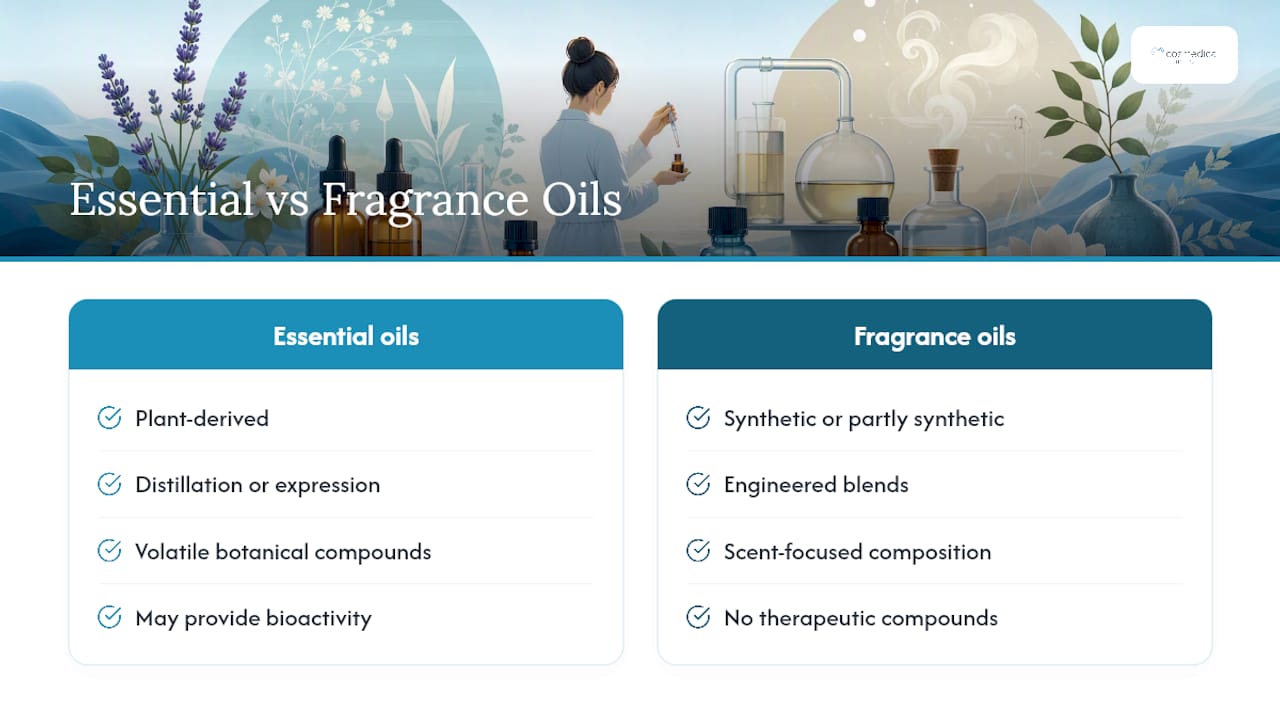
That distinction matters for two reasons. First, fragrance oils can technically be formulated to be gentler on skin since chemists control every molecule going in, but plenty aren’t, and “fragrance” on an ingredient list is one of the most common triggers for sensitive-skin reactions precisely because it can hide dozens of undisclosed compounds. Second, essential oils bring both the potential benefits (antimicrobial, anti-inflammatory activity) and the potential risks (allergenicity, phototoxicity) tied to their natural chemistry, while fragrance oils bring scent and, often, irritation risk without any of the trade-off benefit.
If you have reactive or eczema-prone skin, avoiding both concentrated essential oils and synthetic fragrance is usually the safer default. Fragrance-free formulations sidestep this whole category of risk entirely, which is why fragrance-free approaches matter so much for sensitive skin. Neither “essential oil” nor “fragrance oil” on a label should be read as automatically safe or automatically risky. What matters is concentration, formulation quality, and your own skin’s history with that specific ingredient.
Cosmedica Skincare’s Take: Natural Doesn’t Mean Unregulated
We think the essential oil conversation online skips the boring part that actually keeps people safe: dosing and testing. That’s the part we care about most. Our formulations are built around dermatologist-tested concentrations, not trend-chasing ratios pulled from a wellness blog, and stability testing that limits the oxidation risk covered above.
We’re not going to tell you an oil-infused serum will erase fine lines overnight; the clinical data doesn’t support that kind of claim, and we’d rather earn your trust with accuracy than lose it with hype. If you have a diagnosed skin condition or a known allergy history, a conversation with a dermatologist before adding any new oil-based product still beats guessing.
— Thomas
Explore Dermatologist-Tested Formulas Without the DIY Guesswork
Skip the drop-counting and the patch-test math: Some skincare brands offer oil-informed formulations at controlled, dermatologist-tested concentrations, aiming to provide barrier-supporting and soothing benefits without requiring consumers to measure ingredients themselves. Our serum and moisturizer lineup is formulated cruelty-free and priced to be accessible, not luxury-markup accessible, truly accessible.
If you want a starting point, the Super Serum Set pairs well with a gentle, low-irritation routine, and our moisturizer collection is worth a look if hydration and barrier support are your main goals. For anyone dealing with reactive or easily irritated skin, our piece on soothing irritated skin pairs naturally with a lower-concentration routine. Browse the current lineup and see what fits your skin’s actual needs, not just what’s trending this month.
Sources
- Safety and efficacy of combined essential oils for the skin barrier properties: In vitro, ex vivo and clinical studies
- Systematic reviews and clinical trials on essential oils in cosmetics and dermatology
This article is general information, not a substitute for advice from a qualified doctor. Consult a qualified healthcare professional about your own circumstances before acting on anything here.
FAQ
Can I put essential oils directly on my skin?
No. Applying essential oils neat (undiluted) significantly raises the risk of irritation and allergic contact dermatitis. Dilute in a carrier oil like jojoba or sweet almond, generally to 0.3% to 1% for facial use, before applying anywhere near your face.
Which essential oils should I avoid in skincare?
Cinnamon, clove, and oregano oils carry higher irritation risk and generally don’t belong in leave-on facial products. Citrus oils like bergamot and lemon are phototoxic unless processed to remove furocoumarins (labeled bergapten-free or FCF), and tea tree, ylang-ylang, lemongrass, and jasmine are among the most frequent causes of allergic reactions in patch-test studies.
How long should I patch test an essential oil before using it?
Apply the diluted oil to your inner forearm and wait 24 to 48 hours, since allergic reactions are often delayed rather than immediate. Any redness, itching, or swelling during that window means you should not use that oil on your face.
Are essential oils better than fragrance oils for sensitive skin?
Neither is automatically safer since both carry real irritation potential; fragrance oils are synthetic scent blends with no guaranteed skin benefit, while essential oils bring natural bioactive compounds alongside their own allergy and phototoxicity risks. For reactive or eczema-prone skin, fragrance-free formulations typically sidestep the most reactions.
Does Cosmedica-skincare use essential oils in its products?
Cosmedica-skincare formulates with natural, dermatologist-tested ingredients at controlled concentrations designed to minimize irritation risk. Current product details and full ingredient lists are available on the Cosmedica-skincare site.