

What Is Cross-Linked Hyaluronic Acid for Skin?
TL;DR:
- Cross-linked hyaluronic acid forms a stable gel network that resists enzymatic breakdown, lasting months in skin. It offers exceptional hydration, volume restoration, and structural support in both topical and injectable treatments. Proper formulation and professional administration are critical for safety, efficacy, and achieving realistic skincare and aesthetic results.
Cross-linked hyaluronic acid is a chemically modified form of hyaluronic acid (HA) engineered to form a stable, three-dimensional gel network that resists enzymatic breakdown far longer than native HA. While standard hyaluronic acid dissolves in your skin within 24 to 48 hours, cross-linked HA can maintain its structure and hydrating effects for months. That difference is not cosmetic. It is structural, and it changes everything about how this ingredient performs in both topical skincare and injectable aesthetic treatments. We will break down exactly what cross-linked HA is, how it compares to the non-modified version, and how you can use it wisely.
What is cross-linked hyaluronic acid and how does it differ from regular HA?
Hyaluronic acid is a naturally occurring polysaccharide found throughout your body, especially in your skin, joints, and connective tissue. Its job is to attract and hold water, acting like a sponge that keeps tissues plump and lubricated. The problem with native HA is that your body’s enzymes, specifically hyaluronidases, break it down within 24 to 48 hours. That rapid turnover is fine for biological maintenance, but it makes unmodified HA nearly useless for sustained skincare or aesthetic correction.

Cross-linking solves this by chemically bonding individual HA chains together into a dense, interlocking network. Think of native HA as a handful of loose strings. Cross-linked HA is more like a fishing net: the same material, but woven into a structure that holds its shape under pressure and resists being pulled apart. The result is a gel that stays where it is placed, holds water more effectively, and lasts significantly longer in the skin.
The industry standard cross-linking agent is BDDE (1,4-butanediol diglycidyl ether), chosen for its biodegradability and chemical stability. BDDE creates covalent bonds between HA chains without introducing toxic byproducts, provided the final product is properly purified. This is why product quality and manufacturing standards matter enormously when you are choosing an HA-based treatment.
Comparing cross-linked vs. non-cross-linked hyaluronic acid
Here is a side-by-side look at how these two forms of HA stack up across the properties that matter most for skincare and aesthetics:
| Property | Native (non-cross-linked) HA | Cross-linked HA |
|---|---|---|
| Structure | Linear, free-floating chains | 3D gel network |
| Degradation rate | 24 to 48 hours | Months (varies by cross-linking degree) |
| Water retention | High | Very high (up to 1,000x its weight) |
| Primary use | Topical serums, moisturizers | Dermal fillers, long-lasting topical formulas |
| Texture | Thin, watery | Viscous gel |
| Reversibility | Naturally absorbed | Reversible with hyaluronidase enzyme |
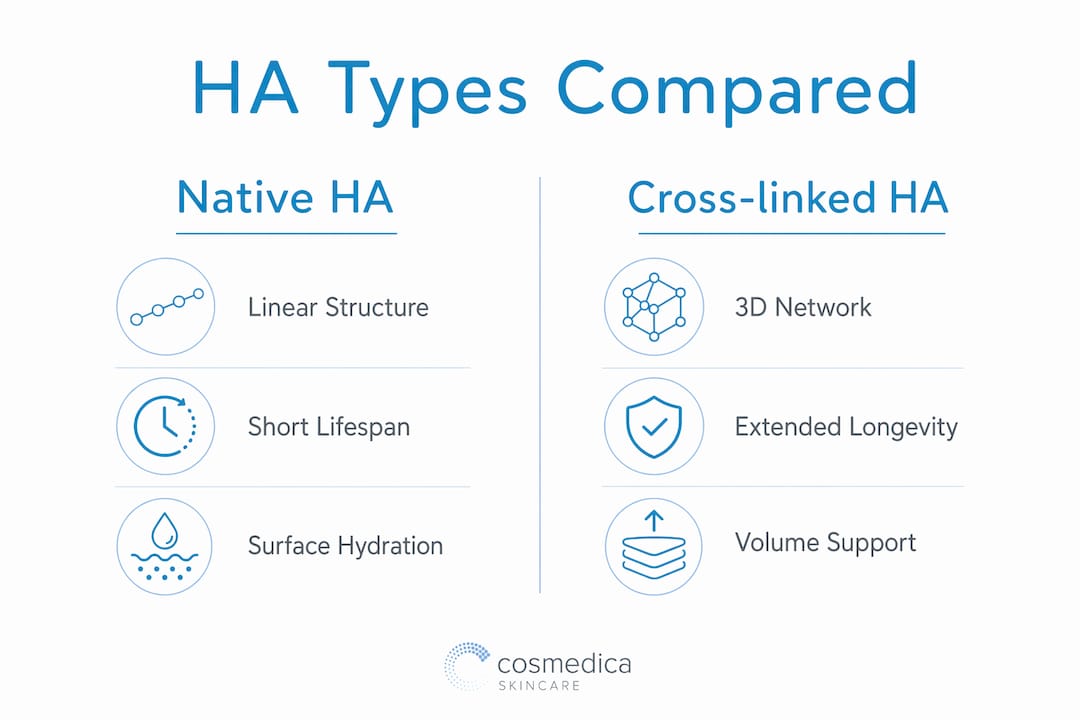
The key takeaway from this table is that the two forms are not interchangeable. Native HA is excellent for daily surface hydration. Cross-linked HA is the right choice when you need sustained volume, deeper structural support, or longer-lasting moisture retention.
What are the benefits and uses of cross-linked hyaluronic acid?
The most celebrated cross-linked hyaluronic acid benefit is its ability to hold an extraordinary amount of water. Cross-linked HA holds up to 1,000 times its weight in water, which translates directly to plumper, more supple skin that looks visibly hydrated. That is not just a nice number. It means a small amount of cross-linked HA in a formula or filler delivers hydration that native HA simply cannot match over the same timeframe.
The uses of cross-linked hyaluronic acid span two major categories: injectable dermal fillers and advanced topical formulations.
In injectable aesthetics, cross-linked HA is the active ingredient in leading dermal fillers used to restore facial volume, smooth deep wrinkles, and define features like lips and cheekbones. Because the gel resists enzymatic degradation, results typically last from six months to over a year depending on the product and treatment area. The degree of cross-linking directly controls how firm or soft the resulting gel is. Higher cross-linking produces firmer gels suited for structural areas like the jawline or cheeks. Lower cross-linking yields softer gels better suited for delicate zones like under the eyes or lips.
In topical skincare, cross-linked HA appears in serums, moisturizers, and masks designed to deliver longer-lasting surface hydration than standard HA serums. These formulas sit on or just below the skin’s surface, acting as a reservoir that slowly releases moisture throughout the day.
Here is a quick summary of the core cross-linked HA benefits for skin health:
- Deep, sustained hydration that outlasts non-modified HA formulas
- Improved skin elasticity, helping skin snap back more readily
- Volume restoration in areas affected by age-related fat and collagen loss
- Reduced appearance of fine lines and wrinkles through mechanical plumping
- Structural support in targeted facial areas when used as a filler
Pro Tip: If you are exploring topical products with cross-linked HA, look for formulas that list it alongside ceramides or peptides. These ingredients reinforce the lipid barrier, helping the skin retain the moisture that cross-linked HA draws in.
How to use cross-linked hyaluronic acid safely and effectively
Understanding how to use hyaluronic acid correctly starts with recognizing that topical and injectable forms are entirely different tools. Topical HA, including cross-linked versions in serums and creams, works at the skin’s surface and upper layers. It hydrates, softens, and supports the epidermis. Injectable cross-linked HA works beneath the skin, restoring volume and lifting tissue from deeper structural layers. Mixing up these two categories leads to unrealistic expectations in both directions.
One of the most common mistakes people make with topical HA is layering multiple HA products at once, thinking more is better. Overuse or layering HA can actually cause transepidermal water loss, especially in dry climates or low-humidity environments. When HA cannot draw moisture from the air, it pulls water from deeper skin layers instead, leaving skin drier than before. One well-formulated HA product, applied to damp skin and sealed with a moisturizer, outperforms three stacked serums every time.
For topical cross-linked HA, follow these guidelines:
- Apply to slightly damp skin immediately after cleansing to maximize water absorption
- Follow with a moisturizer or facial oil to lock in hydration and prevent evaporation
- Use once or twice daily; more frequent application does not increase benefit
- Avoid layering multiple HA serums in the same routine
- Choose products with complementary ingredients like niacinamide, ceramides, or vitamin C
For injectable cross-linked HA, the rules are different and the stakes are higher:
- Always consult a licensed medical professional or board-certified dermatologist
- Ask specifically about the cross-linking degree and filler brand being used
- Understand that results are not permanent but are reversible with hyaluronidase
- Avoid treatments from unlicensed providers regardless of cost savings
- Plan for minor swelling or bruising as a normal part of the process
Pro Tip: When shopping for topical HA products, check whether the formula specifies molecular weight or cross-linking. High-molecular-weight HA stays on the surface for immediate plumping. Low-molecular-weight HA penetrates more deeply. Cross-linked versions in topical products offer the longest-lasting surface hydration of the three.
You can also explore how to enhance your skincare regimen with HA by pairing it thoughtfully with retinol or vitamin C, both of which work synergistically with HA’s hydrating properties.
What makes a high-quality cross-linked hyaluronic acid product?
Not all cross-linked HA products are created equal, and the difference between a premium filler and a budget one often comes down to manufacturing precision. The cross-linking degree and purification process are the two most critical quality variables, and both directly affect safety and performance.
Cross-linking degree refers to the percentage of HA chains that have been chemically bonded. A higher percentage produces a firmer, more viscous gel with greater structural support and longer durability. A lower percentage creates a softer, more pliable gel. Neither is universally superior. The right choice depends entirely on the treatment area and the desired outcome.
Purification is non-negotiable. Cross-linked HA fillers must undergo thorough purification to remove residual cross-linking agents like unreacted BDDE. Residual agents left in the final product can trigger inflammatory reactions, granulomas, or other adverse responses. This purification step is complex and expensive, which is why high-quality fillers cost more. Cutting corners here is a genuine safety risk.
The rheological profile of a filler, meaning its elasticity (G prime) and viscosity, is dictated by the cross-linking degree and the choice of cross-linking agent. These properties determine how a filler behaves under the mechanical stresses of facial movement, how long it lasts, and whether it integrates naturally with surrounding tissue.
Here is how cross-linking degree affects filler characteristics in practice:
| Cross-linking degree | Gel firmness | Best application area | Typical longevity |
|---|---|---|---|
| Low (less than 5%) | Soft, pliable | Under-eye, lips, fine lines | 6 to 9 months |
| Medium (5 to 10%) | Moderate | Nasolabial folds, mid-face | 9 to 12 months |
| High (greater than 10%) | Firm, structural | Cheeks, jawline, chin | 12 to 18 months |
For topical skincare products, the same principle applies in a less dramatic way. A higher cross-linking level in a serum or moisturizer means the HA stays on the skin surface longer, providing extended hydration without being absorbed as quickly. When evaluating a product, look for transparency from the brand about the HA source, molecular weight, and whether cross-linked HA is specifically included.
Key takeaways
Cross-linked hyaluronic acid outperforms native HA in longevity, water retention, and structural support because its 3D gel network resists enzymatic degradation that would otherwise break down unmodified HA within 24 to 48 hours.
| Point | Details |
|---|---|
| Cross-linking extends HA longevity | Native HA degrades in 24 to 48 hours; cross-linked HA lasts months due to its bonded network structure. |
| Water retention is exceptional | Cross-linked HA holds up to 1,000 times its weight in water, delivering superior hydration vs. native HA. |
| Cross-linking degree controls performance | Higher cross-linking creates firmer gels for structural areas; lower cross-linking suits delicate zones. |
| Purification determines safety | Residual BDDE must be removed during manufacturing to prevent inflammation and ensure biocompatibility. |
| Topical and injectable forms serve different purposes | Topical HA hydrates the surface; injectable cross-linked HA restores volume and lifts deeper skin layers. |
My honest perspective on cross-linked HA and realistic expectations
One thing I want to be direct about: cross-linked hyaluronic acid is a mechanical ingredient, not a biochemical miracle. Its benefits are mechanical, meaning it works by physically holding water and filling space. It does not synthesize collagen, reprogram your skin cells, or reverse aging at a cellular level. That is not a criticism. It is actually what makes HA so reliably effective and safe. When you understand what it actually does, you stop chasing inflated claims and start getting real results.
What I find genuinely underappreciated is how much the cross-linking degree matters for everyday consumers, not just aesthetic practitioners. Most people pick an HA serum based on price or packaging. But if you have dry, mature skin that needs prolonged surface hydration, a topical formula with cross-linked HA will outperform a standard HA serum in a meaningful, noticeable way. That distinction is worth paying attention to.
I also think the injectable side of this conversation gets unnecessarily mystified. Cross-linked HA fillers are among the safest and most studied aesthetic treatments available, with high patient satisfaction and minimal downtime when administered correctly. The risks come almost entirely from poor product quality or unqualified practitioners, not from the ingredient itself. If you are considering fillers, the right question is not “Is this safe?” It is “Who is administering this, and what product are they using?”
My advice: start with a well-formulated topical cross-linked HA product to understand how your skin responds to the ingredient. Build from there. Maximal dosing and stacking products is not a strategy. Thoughtful, targeted use is.
— Thomas
Explore Cosmedica Skincare’s hyaluronic acid collection
At Cosmedica Skincare, we have built our HA lineup around exactly the kind of quality and transparency we talk about in this article. Every formula is cruelty-free, dermatologist-tested, and designed to deliver real hydration without unnecessary fillers or irritants. Whether you are starting with a daily serum or building a full anti-aging routine, we have options that work for every skin type and budget.
The Super Serum Set is a great place to start. It brings together our most effective HA-based formulas in one curated kit, designed to layer intelligently and deliver both immediate plumping and long-term hydration support. If you want to browse the full range, our complete skincare collection includes serums, moisturizers, and targeted treatments built around high-quality hyaluronic acid and complementary active ingredients.
FAQ
What is cross-linked hyaluronic acid used for?
Cross-linked hyaluronic acid is used in two main applications: injectable dermal fillers for facial volume restoration and anti-aging, and advanced topical skincare formulas for prolonged surface hydration. Its gel structure resists enzymatic breakdown, making it far more durable than native HA.
How long does cross-linked hyaluronic acid last in the skin?
As a dermal filler, cross-linked HA typically lasts six to eighteen months depending on the cross-linking degree and treatment area. In topical products, it provides longer-lasting surface hydration than non-modified HA but does not penetrate deeply enough to produce volumizing effects.
Is cross-linked hyaluronic acid safe?
Cross-linked HA is considered safe and well-tolerated when properly manufactured and administered. Clinical studies confirm high patient satisfaction and minimal downtime. Safety risks arise primarily from residual cross-linking agents in poorly purified products or from unqualified injection technique.
What is the difference between cross-linked and non-cross-linked hyaluronic acid?
Non-cross-linked HA consists of free-floating chains that degrade within 24 to 48 hours. Cross-linked HA forms a bonded 3D network that resists degradation for months. Non-cross-linked HA suits daily topical hydration; cross-linked HA suits sustained volume and long-lasting moisture retention.
Can you use cross-linked hyaluronic acid every day in skincare?
Yes, topical products containing cross-linked HA are safe for daily use. Apply to damp skin and follow with a moisturizer to seal in hydration. Avoid layering multiple HA products in one routine, as overuse can cause transepidermal water loss rather than improving hydration.