

What Is Sensitive Skin? Symptoms, Causes, and Care
TL;DR:
- Sensitive skin involves heightened reactivity causing discomfort and visible signs, often from barrier dysfunction. It results from genetic, environmental, and internal triggers that weaken the skin barrier, leading to dryness and increased sensitivity. Managing it effectively requires gentle routines, trigger avoidance, and, when necessary, professional diagnosis to address underlying conditions.
Sensitive skin is defined as a heightened skin reactivity that causes discomfort, burning, itching, or redness in response to products and environmental changes that most people tolerate without issue. According to the Cleveland Clinic, common sensitive skin symptoms include dryness, stinging, tingling, and visible signs like rash or peeling after exposure to everyday triggers like soaps, makeup, or weather shifts. What makes this condition tricky is that it shows up differently for everyone. Some people see clear redness and scaling. Others feel intense burning with no visible signs at all. Understanding what sensitive skin actually is, and what’s driving it, is the first step toward doing something about it.
What is sensitive skin and what does it feel like?
Sensitive skin is not a single diagnosable disease. It is better understood as a syndrome with both subjective sensations and objective signs, meaning it can look and feel very different from person to person. Dermatology Times classifies it as a spectrum rather than a fixed condition, which is why two people can both have sensitive skin and describe completely different experiences.

The subjective side includes sensations like burning, stinging, itching, pain, and tingling. These feelings can appear with or without any visible changes on the skin. The objective side includes signs you can actually see: raised patches, redness, scaling, rash, or peeling. Both categories count as sensitive skin symptoms, and both deserve attention.
Think of your skin barrier like a brick wall. The “bricks” are your skin cells, and the “mortar” holding them together is a mix of lipids and proteins. When that mortar weakens, moisture escapes and irritants get in. This is called transepidermal water loss, or TEWL, and it is one of the clearest physical markers of a compromised barrier. A disrupted skin barrier leads to dryness, tightness, and increased reactivity, making the skin far more vulnerable to everyday triggers.
One thing worth knowing: sensitive skin is not the same as having an allergy. Allergic reactions involve the immune system in a specific, measurable way. Sensitive skin reactions are often irritant-based, meaning the skin simply cannot handle certain exposures without reacting. That distinction matters when you are trying to figure out what to avoid and how to treat it.
What causes sensitive skin and what triggers flare-ups?
Sensitive skin develops from a complex mix of genetic factors, environmental exposures, and sometimes underlying skin conditions. Researchers classify it as either primary (genetic predisposition with no underlying disease) or secondary (linked to a diagnosable dermatological condition like eczema or rosacea). Understanding which category fits your experience helps guide the right approach.
External triggers
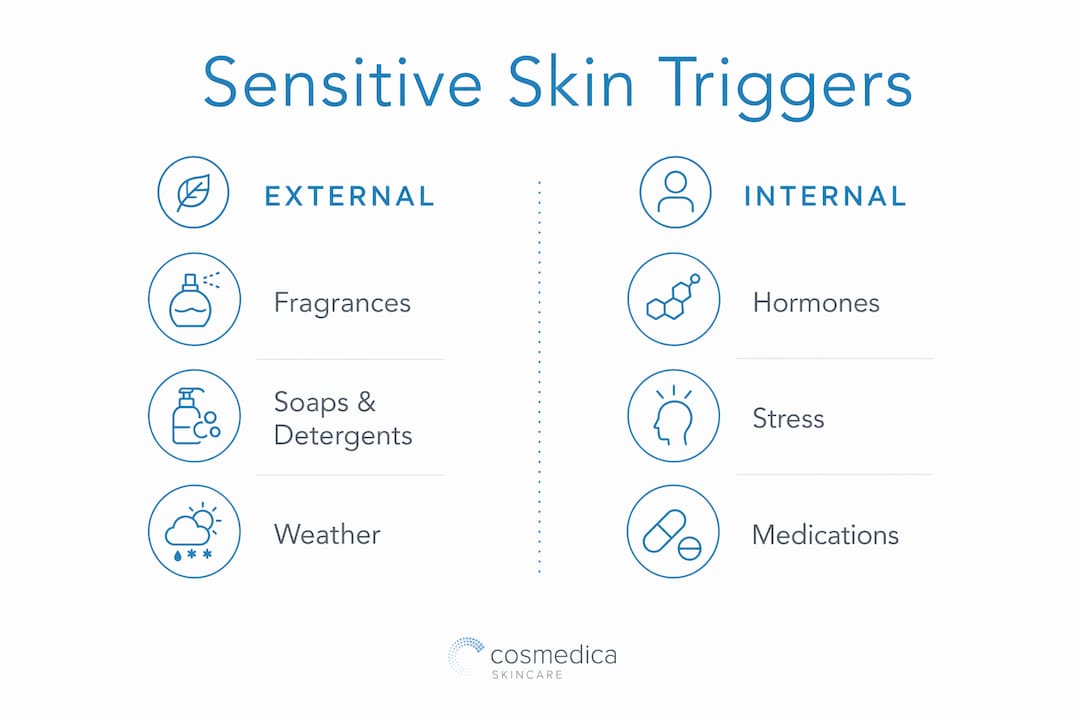
External triggers are the ones most people notice first because the reaction follows contact with something specific. Common culprits include:
- Personal care products: Soaps, shampoos, makeup, and lotions with fragrances, sulfates, or alcohol are frequent offenders.
- Household products: Laundry detergents, fabric softeners, and cleaning sprays often contain chemicals that irritate reactive skin.
- Fabrics: Wool and synthetic materials can cause friction and irritation, especially on already-sensitized skin.
- Climate and weather: Cold wind, low humidity, and sudden temperature changes all stress the skin barrier. Heat and sun exposure can trigger flushing and redness.
- Pollution: Airborne particles and toxins deposit on the skin and disrupt its protective function over time.
Internal triggers
Internal triggers are less obvious but just as real. Hormone changes, stress, and certain medications can all shift how reactive your skin is on any given day. Many people notice their skin becomes more sensitive during hormonal fluctuations, whether from a menstrual cycle, pregnancy, or menopause. Stress elevates cortisol, which weakens the skin barrier and increases inflammatory responses. Some prescription medications list skin sensitivity as a known side effect.
Pro Tip: Keep a simple trigger journal for two weeks. Note what you applied to your skin, what you ate, your stress level, and any symptoms. Patterns often emerge faster than you’d expect, and that information is gold when you visit a dermatologist.
The core issue in most cases is barrier dysfunction. When the skin barrier is compromised, TEWL increases and the skin loses its ability to regulate moisture and block irritants. Restoring barrier integrity is not just helpful, it is the foundation of every effective sensitive skin management plan.
How is sensitive skin diagnosed?
Sensitive skin falls into two broad categories: clinically validated and self-perceived. This distinction, highlighted by Dermatology Times, shapes how a healthcare provider approaches diagnosis and treatment.
| Type | Key features | How it’s identified |
|---|---|---|
| Clinically validated | Elevated TEWL, visible erythema, scaling, rash | Objective measurements, clinical exam |
| Self-perceived | Stinging, burning, tingling with no visible signs | Patient history, symptom documentation |
| Secondary sensitive skin | Linked to eczema, rosacea, or acne | Diagnosis of underlying condition |
| Primary sensitive skin | Genetic predisposition, no underlying disease | Exclusion of other conditions |
Clinically validated sensitive skin shows measurable signs. A dermatologist can use TEWL measurements and hydration assessments to confirm barrier dysfunction. Self-perceived sensitive skin is just as real, but it relies more heavily on a detailed patient history and symptom log. Thorough clinical examination combined with a careful product and trigger history is the gold standard for getting an accurate picture.
Conditions like rosacea, eczema, and acne frequently overlap with sensitive skin. Rosacea causes facial flushing and visible blood vessels. Eczema creates dry, itchy patches that can weep or crust. Acne-prone skin is often reactive to many topical treatments. A healthcare provider can evaluate whether an underlying condition is driving your symptoms, which changes the treatment plan significantly.
Many people with sensitive skin never seek professional help, especially when symptoms feel manageable. Research published in MDPI found that individuals with facial involvement and more intense symptoms are more likely to seek medical advice. If your symptoms are persistent, worsening, or affecting your quality of life, a dermatologist visit is worth it.
How to care for sensitive skin: daily strategies that actually work
Managing sensitive skin is less about finding a miracle product and more about building a consistent, gentle routine that respects your barrier. Here is a practical framework that works for most reactive skin types.
-
Cleanse gently, not aggressively. Use a fragrance-free, non-foaming or low-foam cleanser with a neutral pH. Clinical evidence shows that non-irritating cleansers can actually improve barrier function and hydration on their own. Avoid hot water, which strips lipids from the skin surface.
-
Moisturize immediately after cleansing. Apply a barrier-supporting moisturizer while your skin is still slightly damp. Look for ingredients like ceramides, hyaluronic acid, niacinamide, and glycerin. These work together to lock in moisture and reinforce the lipid barrier. Our gentle moisturizers at Cosmedica-skincare are formulated specifically with these barrier-friendly ingredients in mind.
-
Patch test every new product. Apply a small amount to the inside of your wrist or behind your ear for 24 to 48 hours before using it on your face. This simple step catches reactions before they become full-blown flare-ups.
-
Introduce new products one at a time. Adding multiple products simultaneously makes it impossible to identify what caused a reaction. Wait at least one week between introducing new items.
-
Wear broad-spectrum SPF daily. UV exposure weakens the skin barrier and triggers inflammation. Choose a mineral sunscreen with zinc oxide or titanium dioxide, both of which sit on top of the skin rather than absorbing into it. These formulas are generally better tolerated by reactive skin.
-
Manage lifestyle factors actively. Prioritize sleep, reduce stress where possible, and stay hydrated. These factors directly influence how reactive your skin is day to day. Our practical daily guide covers these habits in more detail.
-
Avoid known irritants in your environment. Switch to fragrance-free laundry detergent, choose soft fabrics like cotton and bamboo, and be mindful of air quality and temperature extremes.
Pro Tip: When shopping for the best products for sensitive skin, look for labels that say “fragrance-free” rather than “unscented.” Unscented products can still contain masking fragrances that irritate reactive skin.
The goal of every step above is the same: reduce the load on your skin barrier so it can repair itself. Think of your skin as a self-healing system. Your job is to stop adding stress and start giving it the conditions it needs to recover.
Common misconceptions about sensitive skin
Sensitive skin is one of the most misunderstood conditions in everyday skincare conversations. Getting the facts straight helps you make better decisions and avoid the frustration of chasing the wrong solutions.
-
“Sensitive skin is just dry skin.” Dryness and sensitivity often coexist, but they are not the same thing. Dry skin lacks oil. Sensitive skin has a compromised barrier that reacts to stimuli. You can have oily skin and still be highly reactive.
-
“If there’s no rash, it’s not sensitive skin.” Many people experience sensory symptoms without visible signs, including burning, stinging, and tingling. These sensations are valid symptoms, not imagined discomfort.
-
“Natural ingredients are always safe for sensitive skin.” Natural does not mean non-irritating. Essential oils, citrus extracts, and botanical fragrances are among the most common triggers for reactive skin. The source of an ingredient matters far less than how your skin responds to it.
-
“You just need to find the right product.” Sensitive skin is a multifaceted syndrome with genetic, environmental, and sometimes medical components. A single product swap rarely solves it. Consistent routine changes and trigger management are what create lasting improvement.
-
“Sensitive skin means you can’t use active ingredients.” Many people with reactive skin successfully use actives like niacinamide, azelaic acid, and low-concentration lactic acid. The key is starting slowly, using low concentrations, and pairing actives with strong barrier support.
The emotional side of sensitive skin is real too. Constant reactions, the cost of trying product after product, and the frustration of not knowing what will trigger a flare can wear on you. If you feel like you have tried everything, that is a strong signal to see a dermatologist rather than continuing to experiment alone.
Key takeaways
Sensitive skin is a barrier dysfunction condition that requires consistent, gentle care and trigger management rather than a single product fix.
| Point | Details |
|---|---|
| Sensitive skin defined | It is heightened skin reactivity with both subjective sensations and objective visible signs. |
| Barrier dysfunction is central | Compromised skin barrier increases TEWL, causing dryness, tightness, and reactivity. |
| Two main types exist | Clinically validated cases show measurable signs; self-perceived cases rely on symptom history. |
| Triggers are diverse | Products, weather, stress, hormones, and fabrics all contribute to flare-ups. |
| Care requires consistency | Gentle cleansing, barrier-supporting moisturizers, SPF, and trigger avoidance form the core routine. |
What I’ve learned from years of watching people manage sensitive skin
The most common mistake I see is people treating sensitive skin like a problem to be solved quickly. They buy five new products at once, get a reaction, and have no idea which one caused it. Then they throw everything out and start over. That cycle is exhausting and expensive, and it rarely leads anywhere useful.
What actually works is slowing down. One product at a time. A consistent, boring routine that you stick with for at least four to six weeks before judging results. Sensitive skin does not respond well to constant change. It responds to stability.
The second thing I would push back on is the idea that you can fully manage sensitive skin through products alone. Stress is a real trigger. Sleep deprivation is a real trigger. Hormonal shifts are real triggers. I have seen people spend hundreds of dollars on skincare while ignoring the fact that they are running on five hours of sleep and high cortisol. The skin reflects what is happening internally, and no serum fixes that.
If your symptoms are severe, persistent, or affecting your face, please see a dermatologist. I know cost and access are real barriers for many people, and that is genuinely frustrating. But a professional evaluation can save you years of guesswork. Conditions like rosacea and eczema require specific treatments that over-the-counter products cannot address. Getting a correct diagnosis is not giving up on self-care. It is the smartest form of it.
Document your skin. Take photos. Write down what you used and how your skin responded. That record is one of the most useful things you can bring to a dermatologist, and it helps you spot your own patterns over time. Your skin is telling you something. Learning to listen is the whole game.
— Thomas
Gentle skincare for reactive skin from Cosmedica-skincare
At Cosmedica-skincare, we formulate with sensitive skin in mind. Our products skip the harsh fragrances, unnecessary fillers, and known irritants that cause flare-ups, focusing instead on barrier-supporting ingredients like hyaluronic acid, ceramides, and niacinamide. If you are building or rebuilding your routine, our Super Serum Set is a great starting point, combining hydration and barrier repair in one simple step. For overnight recovery, the Multi-Active Hydrating Night Cream works while you sleep to calm and restore reactive skin. Browse our full sensitive skin collection to find gentle, cruelty-free options that work with your skin rather than against it.
FAQ
What is sensitive skin in simple terms?
Sensitive skin is a condition where the skin reacts negatively to products, weather, or environmental changes that most people tolerate without issue. Reactions include burning, itching, redness, and dryness, with or without visible signs.
What are the most common sensitive skin symptoms?
The most common symptoms include burning, stinging, itching, tingling, redness, dryness, and rash. Some people experience strong sensations with no visible changes on the skin surface.
What triggers sensitive skin flare-ups?
Common triggers include fragranced products, soaps, detergents, extreme weather, stress, hormone changes, certain fabrics, and medications. Identifying your personal triggers through a symptom journal is one of the most effective management strategies.
How do I know if I have sensitive skin or a skin condition like eczema?
Sensitive skin and conditions like eczema or rosacea can overlap significantly. A dermatologist can distinguish between them using clinical examination, TEWL measurements, and a detailed product and symptom history. Self-diagnosis is often unreliable when symptoms are persistent or severe.
What are the best products for sensitive skin?
The best products for sensitive skin are fragrance-free, alcohol-free, and formulated with barrier-supporting ingredients like ceramides, hyaluronic acid, niacinamide, and glycerin. Mineral sunscreens with zinc oxide are also well-tolerated by most reactive skin types.