

What Is Skin Plumping? Your Guide to Fuller Skin
TL;DR:
- Skin plumping enhances skin volume, hydration, and firmness using hyaluronic acid and collagen mechanisms. Consistent topical and oral treatments, along with lifestyle habits like sun protection and hydration, are essential for lasting results. Combining immediate hydration with long-term support maintains a fuller, smoother, and more youthful appearance.
Skin plumping is defined as the process of increasing skin volume, hydration, and firmness to create a fuller, smoother, and more youthful appearance. It works through two distinct mechanisms: immediate hydration driven by humectants like hyaluronic acid, and long-term structural support provided by collagen. Think of your skin like a mattress. Collagen acts as the springs, and hyaluronic acid is the padding that creates volume and smoothness. Both are needed for true plumping. When either element declines, skin loses its bounce, starts to look flat, and eventually begins to sag. Understanding what is skin plumping at this molecular level is the first step toward doing something real about it.
What causes skin to lose plumpness and sag?
Skin loses its plumpness through a combination of biological aging and environmental stress. Knowing the causes helps you target the right solutions.

The biology of skin sagging
Collagen and elastin are the two proteins that keep skin firm and springy. Starting in your mid-20s, the body produces less of both every year. By the time most people notice visible sagging, the structural decline has been happening quietly for years. Elastin loss is especially significant because it reduces the skin’s ability to snap back after movement or pressure.
Natural hyaluronic acid production also slows with age. Since hyaluronic acid binds 1,000 times its weight in water, even a modest reduction in its levels causes a noticeable drop in skin volume and hydration. Oil production decreases at the same time, weakening the lipid barrier that keeps moisture locked in.
Hormonal shifts, particularly menopause, accelerate this process significantly. Estrogen supports both collagen synthesis and hyaluronic acid production, so when estrogen levels drop, skin can lose plumpness faster than age alone would cause.
External factors compound the internal ones:
- UV exposure breaks down collagen and elastin fibers directly, making sun damage one of the fastest routes to premature sagging.
- Chronic dehydration reduces the water content in the epidermis, making skin look dull and deflated even in younger people.
- Smoking restricts blood flow to the skin and generates free radicals that destroy collagen.
- Poor sleep and high stress elevate cortisol, which degrades collagen over time.
- Repetitive facial movements and gravity pull skin downward, especially once structural support has already weakened.
Pro Tip: Apply a broad-spectrum SPF 30 or higher every morning, even on cloudy days. UV damage is the single most preventable cause of collagen breakdown and premature skin sagging.
How does hyaluronic acid plump skin?
Hyaluronic acid (HA) is the most well-known ingredient in skin hydration techniques, and for good reason. It is a naturally occurring sugar molecule found in the skin’s dermis and epidermis. Its job is to attract and hold water, giving skin that plump, dewy look we associate with youth.
High vs. low molecular weight HA
Not all hyaluronic acid works the same way. High molecular weight HA stays on the skin’s surface, forming a film that prevents water loss. Low molecular weight HA and sodium hyaluronate penetrate the upper skin layers to deliver hydration deeper into the epidermis. Combination formulations that include both sizes are the most effective approach for visible plumping.
| HA Type | Where It Works | Primary Benefit |
|---|---|---|
| High molecular weight | Skin surface | Prevents water loss, smooths texture |
| Low molecular weight | Upper dermis | Deeper hydration, improves elasticity |
| Sodium hyaluronate | Epidermis | Lightweight penetration, fast absorption |
| Combination formula | Surface + upper dermis | Broadest plumping and hydration effect |
Topical HA delivers results within hours to days. You will notice skin looks smoother and feels more supple quickly. However, topical HA does not replenish your skin’s endogenous stores. The moment you stop applying it, the effect fades. Consistent daily use is the only way to maintain the benefit.
Oral HA supplementation offers a different angle. Taking 120 mg of oral hyaluronic acid daily produces visible improvements in skin hydration and elasticity within 4 weeks, with benefits sustained over 12 weeks. That timeline matters because it means oral HA works from the inside out, supporting the skin’s own hydration reserves rather than just coating the surface.
Pro Tip: Apply your hyaluronic acid serum to slightly damp skin, then seal it immediately with a moisturizer. HA draws moisture from its environment, so without a barrier on top, it can actually pull water out of your skin in dry climates.
You can learn more about how HA works and why it is one of the most studied ingredients in modern skincare.
Does collagen actually plump skin?
Collagen is the structural protein that makes up the majority of the skin’s dermis. It supports skin elasticity and firmness, functioning like the springs inside a mattress. When collagen is abundant, skin bounces back. When it depletes, skin loses its shape and begins to sag.
What collagen supplementation actually does
Collagen supplements work differently from hyaluronic acid. They do not produce overnight results. Instead, they support the body’s own collagen synthesis over time, gradually improving the skin’s structural foundation. Here is what the research shows:
- Hydrolyzed collagen is broken into smaller peptides that the body can absorb through the gut and use to stimulate fibroblast activity in the dermis.
- Collagen supplementation improves skin elasticity and firmness over 8–12 weeks, making it a long-term investment rather than a quick fix.
- Vitamin C is a required cofactor for collagen synthesis. Without adequate vitamin C, the body cannot properly build new collagen fibers.
- The most effective protocol combines 2.5–10 g of hydrolyzed collagen with 100 mg of vitamin C daily, alongside topical hyaluronic acid.
- Consistency matters more than dose. Taking collagen sporadically produces minimal results. Daily use over at least 8 weeks is the minimum for measurable change.
- Food sources support supplementation. Bone broth, fish, and egg whites provide amino acids that support collagen production alongside supplements.
The key distinction between collagen and HA is timing. Hyaluronic acid gives you visible plumping within days. Collagen rebuilds the structure that makes plumping last. You need both working together for results that hold up over time.
For a deeper look at restoring collagen naturally, Cosmedica-skincare has a dedicated guide covering topical and dietary approaches.
How to plump skin with practical techniques and habits
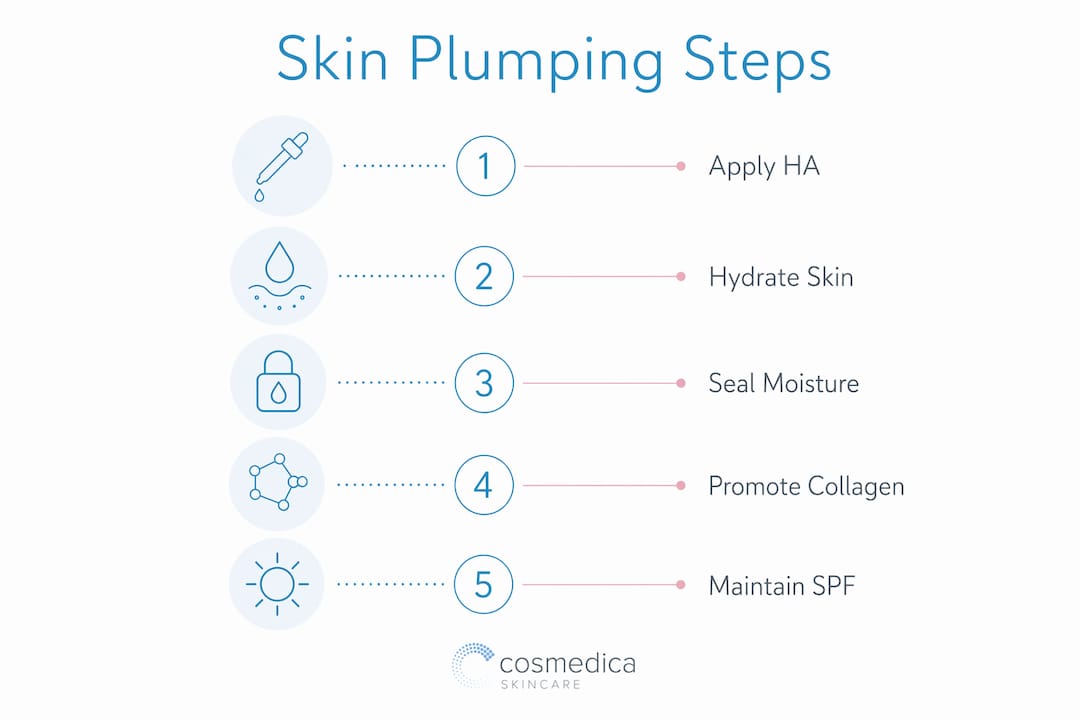
Effective skin plumping treatments are not just about which serum you apply. The most consistent results come from combining the right ingredients with supportive lifestyle habits. Here is a practical framework:
-
Stack topical HA with oral collagen. Use a hyaluronic acid serum morning and night for immediate surface hydration. Take hydrolyzed collagen with vitamin C daily for structural support. These two approaches target different layers of the skin and work better together than either does alone.
-
Drink enough water and eat water-rich foods. Skin hydration techniques extend beyond your bathroom shelf. Cucumbers, watermelon, and leafy greens all contribute to cellular hydration. Aim for consistent daily water intake rather than trying to “catch up” on hydration after the fact.
-
Protect your skin from UV damage every single day. Sunscreen is not optional if plump skin is your goal. UV radiation degrades collagen and elastin faster than any other environmental factor. Broad-spectrum SPF 30 or higher, applied daily, is the most cost-effective skin elasticity solution available.
-
Add gentle exfoliation to your routine. Dead skin cells accumulate on the surface and make skin look dull and flat. A mild chemical exfoliant, such as lactic acid, removes that buildup and allows your serums to penetrate more effectively. Cosmedica-skincare’s 5% Lactic Acid Treatment + Hylasyn combines exfoliation with hyaluronic acid for a dual-action approach.
-
Try facial massage. Gentle upward massage stimulates circulation and lymphatic drainage. It does not rebuild collagen on its own, but it reduces puffiness, improves product absorption, and gives skin a temporary lift that complements your active ingredients.
-
Look for ingredients that target aquaporins. Aquaporins are molecular water channels that regulate how water moves through skin cells. Emerging cosmetic ingredients target these channels to enhance moisture retention at the cellular level. This represents one of the more exciting directions in skin plumping technology, moving beyond surface hydration toward cellular water regulation.
-
Avoid habits that destroy collagen. Smoking, excessive alcohol, high-sugar diets, and chronic sleep deprivation all accelerate collagen breakdown. No serum can fully compensate for daily lifestyle choices that work against your skin’s structure.
Key Takeaways
Skin plumping requires both immediate hydration through hyaluronic acid and long-term structural support through collagen, with consistent daily habits determining whether results last.
| Point | Details |
|---|---|
| Skin plumping has two layers | Hyaluronic acid hydrates fast; collagen rebuilds structure over 8–12 weeks. |
| HA molecular weight matters | Combination formulas with high and low molecular weight HA deliver the broadest plumping effect. |
| Collagen needs vitamin C | Take 2.5–10 g of hydrolyzed collagen with 100 mg of vitamin C daily for effective synthesis. |
| Lifestyle drives results | SPF, hydration, sleep, and avoiding smoking protect collagen and sustain skin plumpness. |
| Topical HA requires consistency | Surface hydration fades without daily application; oral HA supports longer-lasting internal hydration. |
The part most people skip (and why it costs them results)
Here is what I have noticed after years of paying close attention to skincare science and real-world results: most people pick a side. They either go all-in on a hyaluronic acid serum and expect it to do everything, or they start taking collagen supplements and wonder why their skin still looks flat after two weeks.
The honest truth is that neither ingredient works in isolation the way people hope. Hyaluronic acid is brilliant at what it does. It pulls water into the skin and creates that immediate, satisfying plumpness. But it is entirely surface-level and temporary. Stop using it, and the effect disappears within a day or two. That is not a flaw. It is just the nature of a humectant.
Collagen supplementation, on the other hand, requires patience that most people do not give it. Eight to twelve weeks is the minimum timeline for structural change. Most people quit after three weeks because they do not see dramatic results in the mirror. They are not wrong to want faster feedback. They are just using the wrong ingredient to get it.
What I advocate for is a layered approach that respects both timelines. Use topical HA for the immediate visual feedback that keeps you motivated. Use oral collagen for the structural foundation that makes those results more durable. Add vitamin C, both topically and in your diet, because skin plumpness reflects optimal hydration and collagen balance and collagen cannot be synthesized without it.
The other thing I want to flag is hormonal context. If you are in perimenopause or post-menopause, your skin is working against a significant hormonal headwind. That does not mean plumping is impossible. It means you need to be more consistent, more protective of your collagen, and more realistic about timelines. The biology is real. So is the progress, if you stay the course.
— Thomas
Plump skin starts with the right products
Cosmedica-skincare builds its formulations around the exact ingredients that support skin plumping: hyaluronic acid in multiple molecular weights, collagen-boosting actives, and protective antioxidants. The Super Serum Set is a strong starting point, combining serums that target hydration and skin renewal in one routine. For overnight recovery, the Multi-Active Hydrating Night Cream delivers deep moisture while you sleep, supporting the skin’s natural repair cycle. Every product is cruelty-free, dermatologist-tested, and formulated for all skin types. Browse the full moisturizers collection to find the right hydration layer for your routine.
FAQ
What is skin plumping in simple terms?
Skin plumping is the process of increasing skin hydration and structural support to make skin look fuller, smoother, and younger. It relies on hyaluronic acid for immediate hydration and collagen for long-term firmness.
How long does it take to see results from skin plumping?
Hyaluronic acid produces visible surface plumping within hours to days. Collagen supplementation requires 8–12 weeks of consistent daily use before structural improvements become noticeable.
Is skin plumping effective for older skin?
Skin plumping is effective at any age, though results take longer when collagen levels are already significantly depleted. Combining topical hyaluronic acid with daily oral collagen and vitamin C produces the most consistent improvement in mature skin.
What are the best natural skin plumping methods?
The most effective natural approaches include daily hyaluronic acid application, hydrolyzed collagen supplements with vitamin C, consistent sun protection, adequate water intake, and gentle facial massage to support circulation and product absorption.
Can you plump skin without professional treatments?
Yes. Topical and oral skincare ingredients including hyaluronic acid and hydrolyzed collagen produce measurable plumping results without clinical procedures, provided they are used consistently and combined with protective lifestyle habits.