

What Is a Skin Resurfacer? Your 2026 Treatment Guide
TL;DR:
- Skin resurfacing treatments remove or rejuvenate damaged outer skin layers to improve texture and appearance. Fractional laser technology offers effective results with shorter recovery time by treating portions of skin in each session. Choosing the right method depends on your skin concerns, tone, and downtime tolerance.
A skin resurfacer is a treatment that removes or rejuvenates damaged outer skin layers to restore a smoother, healthier complexion. The industry term for this category is skin resurfacing, which covers a wide range of professional techniques including laser therapy, chemical peels, dermabrasion, and microneedling. Whether you are dealing with acne scars, uneven tone, or fine lines, skin resurfacing treatments work by triggering your skin’s natural repair process. The result is fresher, firmer skin with improved texture and clarity. We put this guide together to help you understand exactly how these treatments work, what to expect, and how to choose the right option for your skin.
What is a skin resurfacer and how does it work?
A skin resurfacer is defined as any medical or cosmetic method that either removes the outer layers of damaged skin or heats the deeper dermis to stimulate collagen production. Think of your skin like a scuffed leather jacket. Resurfacing strips away or repairs the worn surface so the fresh, undamaged material underneath can show through. According to Penn Medicine, skin resurfacing is a non-surgical procedure that removes damaged outer skin layers or stimulates collagen production, with recovery ranging from a few days to up to 3 months depending on treatment intensity.
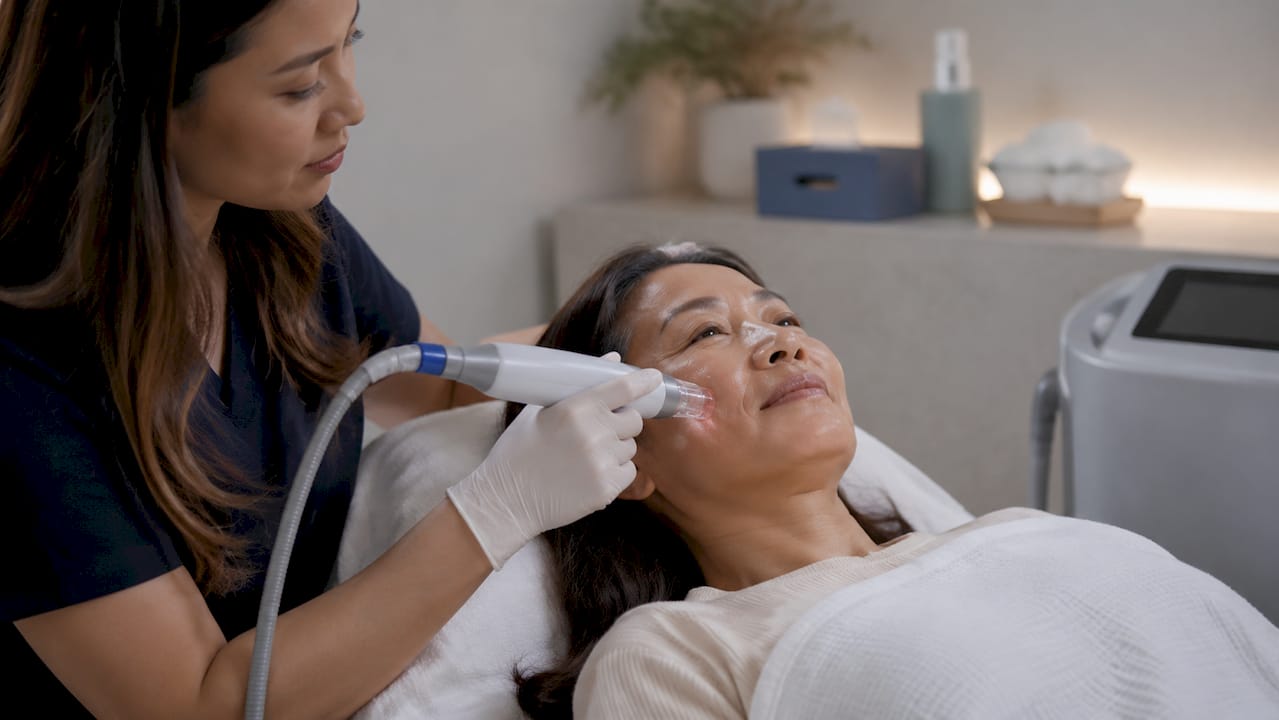
The core mechanism behind all skin resurfacing techniques is controlled injury. By deliberately damaging the skin to a precise depth, the treatment forces the body to rebuild collagen and elastin. More collagen means firmer, plumper skin with fewer visible lines and scars. The depth of that controlled injury is what separates aggressive ablative treatments from gentler non-ablative ones.
The main types of skin resurfacing treatments
Understanding the types of skin resurfacing helps you match the right method to your skin concern and lifestyle. Each approach targets the skin differently, and the tradeoff between results and recovery time is real.
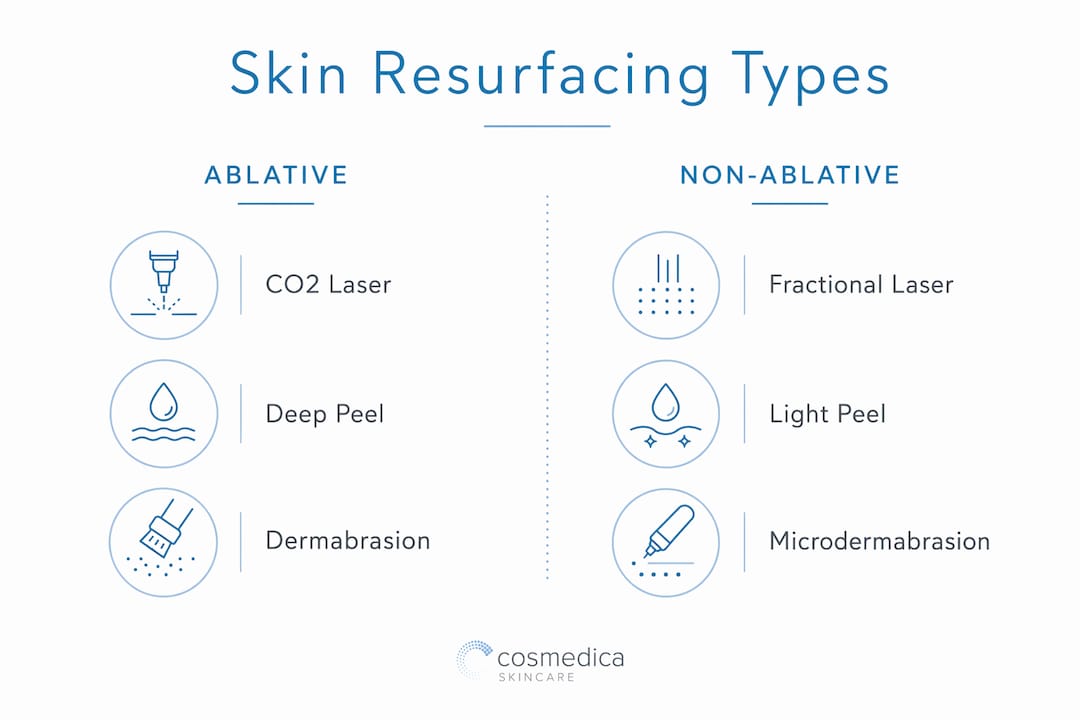
Ablative vs. non-ablative lasers
Ablative lasers vaporize the skin’s surface, while non-ablative lasers heat the deeper dermis without removing skin at all. CO2 lasers are the most powerful ablative option and deliver dramatic results for deep wrinkles and scars. Erbium lasers are a gentler ablative alternative with slightly less downtime. Non-ablative lasers like Nd:YAG stimulate collagen with minimal surface disruption, making them popular for people who cannot afford extended recovery.
Fractional laser technology
Fractional lasers represent the most significant advance in skin resurfacing in the past two decades. Instead of treating the entire skin surface, fractional technology treats 10% to 70% of the skin per session, leaving surrounding tissue intact to accelerate healing. Think of it like aerating a lawn: you treat columns of skin while healthy tissue around each column speeds up recovery. Fractional ablative lasers vaporize microscopic columns of skin surrounded by intact tissue, promoting faster healing and deeper collagen remodeling than traditional full-field ablative lasers.
Chemical peels
Chemical peels use acids such as glycolic acid, salicylic acid, trichloroacetic acid (TCA), or phenol to dissolve and exfoliate the outer skin layers. Superficial peels target only the epidermis and require no downtime. Medium peels reach the upper dermis and cause several days of peeling. Deep phenol peels deliver results comparable to ablative lasers but come with significant recovery time and carry higher risk. For a broader look at facial exfoliation options, chemical peels sit at the more intensive end of the spectrum.
Dermabrasion and microdermabrasion
Dermabrasion uses a rotating wire brush or diamond wheel to physically abrade the skin surface. It is highly effective for acne scars and surface irregularities but requires local anesthesia and carries real downtime. Microdermabrasion is a much gentler version that uses fine crystals or a diamond tip to polish the outermost skin layer. Microdermabrasion is essentially a deep exfoliation with no recovery time, making it a good entry point for people new to skin resurfacing.
| Treatment Type | Depth | Downtime | Best For |
|---|---|---|---|
| Ablative CO2 laser | Deep dermis | 1–3 weeks | Deep wrinkles, severe scars |
| Erbium laser | Mid dermis | 5–10 days | Moderate lines, pigmentation |
| Non-ablative laser | Dermis (no surface removal) | Minimal | Mild texture, early aging |
| Fractional laser | Variable | 3–7 days | Scars, texture, tone |
| Medium chemical peel | Upper dermis | 5–7 days | Pigmentation, fine lines |
| Dermabrasion | Surface to mid dermis | 1–2 weeks | Acne scars, surface texture |
| Microdermabrasion | Epidermis only | None | Dullness, mild texture |
Pro Tip: If you are new to resurfacing, start with a superficial chemical peel or microdermabrasion to see how your skin responds before committing to a more intensive treatment.
What benefits and results can you expect?
The benefits of skin resurfacing go well beyond cosmetic. When collagen remodeling kicks in after treatment, you get structural improvements that topical products simply cannot replicate.
Here is what skin resurfacing consistently delivers:
- Smoother texture: Ablative and fractional treatments remove rough, uneven surface cells and replace them with new, organized skin.
- Reduced fine lines and wrinkles: Collagen stimulation plumps the dermis from within, softening lines around the eyes and mouth.
- Improved acne scarring: Skin resurfacing for acne scars is one of the most studied applications. Fractional lasers and dermabrasion break down scar tissue and encourage even regrowth.
- More even skin tone: Chemical peels and lasers both reduce hyperpigmentation, sun spots, and melasma by targeting melanin-rich cells.
- Firmer skin: New collagen production tightens the skin surface over weeks and months post-treatment.
Laser resurfacing improves texture, fine lines, acne scars, and pigmentation but is not a treatment for severe laxity or volume loss. If your primary concern is sagging skin or lost facial volume, resurfacing alone will not address it. Structural lifting requires different cosmetic procedures such as facelifts or injectable fillers.
Results are also cumulative. A single ablative session can produce visible improvement, but combining resurfacing with consistent daily skincare and diligent sun protection extends and deepens those results. Pairing treatments with hyaluronic acid in your routine helps maintain hydration while the skin barrier rebuilds.
Recovery timelines vary significantly by treatment type. Non-ablative treatments may require only a few days of mild redness. Intensive ablative CO2 treatments can mean up to 3 months of full healing, though most visible recovery wraps up within 2 to 3 weeks.
How to choose the right skin resurfacing treatment
Choosing the right resurfacing method is not a one-size-fits-all decision. The best treatment for you depends on your skin tone, the severity of your concern, how much downtime you can realistically manage, and your overall treatment goals.
Here is a step-by-step approach to making that decision:
-
Identify your primary concern. Fine lines, acne scars, pigmentation, and texture each respond differently to different treatments. Acne scars respond best to fractional ablative lasers or dermabrasion. Pigmentation often responds well to chemical peels or non-ablative lasers.
-
Assess your skin tone honestly. Patients with darker skin tones face a higher risk of hypopigmentation with ablative CO2 lasers. Erbium lasers, non-ablative options, and carefully selected chemical peels are generally safer for deeper skin tones.
-
Be realistic about downtime. Ablative treatments often require 1–3 sessions but come with significant recovery. Non-ablative fractional treatments may need 3–6 sessions for maximum effect but allow you to return to daily life within days.
-
Consult a board-certified dermatologist or plastic surgeon. Treatment choice depends on severity, skin tone, and downtime tolerance, and expert clinical judgment tailors parameters for the best safety and outcome. A professional consultation is not optional. It is the step that separates a great result from a complication.
-
Plan your aftercare before your appointment. Post-treatment skin is vulnerable. You will need gentle cleansers, barrier-repairing moisturizers, and broad-spectrum SPF 30 or higher every single day. Skipping sun protection after resurfacing can undo months of results.
Pro Tip: Ask your provider specifically about their experience treating your skin tone. The right wavelength and pulse settings for Fitzpatrick skin types IV through VI are very different from those used for lighter skin, and that expertise matters.
Comparing skin resurfacing techniques: effectiveness, recovery, and risks
Every skin resurfacing technique carries a different risk profile. Understanding those risks helps you go in with realistic expectations and the right questions for your provider.
Effectiveness by concern:
- Ablative CO2 and erbium lasers deliver the strongest results for deep wrinkles and significant scarring.
- Fractional lasers balance strong results with a more manageable recovery.
- Chemical peels excel at pigmentation and surface texture but are less effective for deep structural scars.
- Microdermabrasion improves dullness and mild texture but does not address deeper concerns.
Recovery realities:
Ablative full-field treatments require the most recovery, typically 1–3 weeks of visible healing with redness persisting for months. Fractional treatments cut that to 3–7 days of downtime. Non-ablative options and superficial peels allow most people to return to work the next day with only mild redness.
Risks to know:
- Hyperpigmentation or hypopigmentation: More common in darker skin tones, especially with aggressive ablative lasers.
- Infection: Any treatment that removes the skin barrier creates a window for bacterial or viral infection. Antiviral medication is often prescribed before ablative treatments to prevent herpes simplex flares.
- Scarring: Rare but possible, particularly if aftercare instructions are not followed or if the treatment is too aggressive for the skin type.
- Prolonged redness: Some people experience erythema for several months after ablative treatments.
Skin resurfacing is is effective when matched correctly to the patient. The choice between ablative and non-ablative resurfacing always comes down to balancing treatment aggressiveness against downtime tolerance. There is no universally superior option. There is only the right option for your skin, your schedule, and your goals. For a broader look at skin rejuvenation methods and how resurfacing fits into an anti-aging routine, it helps to see the full picture before booking a session.
Key Takeaways
Skin resurfacing is most effective when the treatment type is matched to your skin tone, concern severity, and realistic downtime tolerance, with fractional laser technology offering the best balance of results and recovery for most people.
| Point | Details |
|---|---|
| Core definition | A skin resurfacer removes or rejuvenates outer skin layers to stimulate collagen and improve texture. |
| Fractional laser advantage | Fractional technology treats 10%–70% of skin per session, cutting recovery time while still remodeling collagen. |
| Skin tone matters | Darker skin tones carry higher risk with ablative CO2 lasers; erbium and non-ablative options are safer alternatives. |
| Sessions needed | Ablative treatments typically require 1–3 sessions; non-ablative fractional treatments often need 3–6 for full effect. |
| Aftercare is non-negotiable | Daily SPF and barrier-repairing moisturizers protect results and prevent post-treatment pigmentation issues. |
Why fractional technology changed everything I thought about resurfacing
I spent years watching people walk away from consultations intimidated by the idea of skin resurfacing. The old narrative was simple: great results, brutal recovery. Full-field ablative CO2 treatments delivered real change, but two to three weeks of raw, weeping skin kept most people away. Fractional laser technology genuinely shifted that equation, and I think it is still underappreciated.
What strikes me most is how often people assume more aggressive always means better. It does not. A series of fractional non-ablative sessions on someone with moderate acne scarring and a Fitzpatrick type IV skin tone will outperform a single aggressive ablative treatment that carries real pigmentation risk. The math only works when you factor in safety, not just power.
The misconception I hear most often is that skin resurfacing is a one-and-done fix. It is not. The collagen remodeling that makes resurfacing effective continues for months after treatment. People who pair their sessions with consistent vitamin C serums, retinol, and daily SPF see results that compound over time. Those who skip aftercare often wonder why their results faded by month three.
My honest advice: do not let cost or fear of downtime push you toward a treatment that is wrong for your skin. A well-chosen series of gentler sessions will always beat a single aggressive treatment that your skin was not ready for.
— Thomas
Support your skin before and after resurfacing with Cosmedica-skincare
Skin resurfacing does the heavy lifting, but what you apply afterward determines how well your results hold. At Cosmedica-skincare, we formulate products specifically for skin that needs rebuilding, hydration, and protection. Our Super Serum Set combines collagen-boosting actives that work in sync with your skin’s post-treatment repair cycle. For deep hydration while your barrier recovers, the Multi-Active Hydrating Night Cream delivers moisture without irritating sensitized skin. Browse our full skincare range to build a post-resurfacing routine that protects your investment and keeps your results going strong.
FAQ
What is a skin resurfacer in simple terms?
A skin resurfacer is any treatment that removes or rejuvenates damaged outer skin layers to improve texture, tone, and appearance. Common methods include lasers, chemical peels, and dermabrasion.
Is skin resurfacing effective for acne scars?
Skin resurfacing for acne scars is one of its strongest applications. Fractional ablative lasers and dermabrasion break down scar tissue and stimulate new collagen growth for smoother skin.
How many sessions does skin resurfacing take?
Ablative treatments typically require 1–3 sessions, while non-ablative fractional treatments often need 3–6 sessions for the best results.
Does skin resurfacing hurt?
Pain during laser resurfacing is moderate and well managed with topical anesthetics. Most people feel heat during and shortly after treatment, with discomfort easing within hours.
How much does skin resurfacing cost?
Costs range from $500 to over $5,000 depending on the device, treatment area, and provider expertise. More intensive ablative treatments sit at the higher end of that range.