

What Is Skin pH and Why It Matters for Your Skin
Skin pH is the measure of acidity on your skin’s surface, and it directly controls two things that determine how your skin looks and feels: your skin barrier and your microbiome. Think of it as your skin’s invisible shield setting. When it’s calibrated right, your barrier stays strong, moisture stays in, and the good bacteria that protect you thrive. When it drifts too far in either direction, things start to fall apart fast.
Here’s why balanced skin pH is worth paying attention to:
- Barrier function: An acidic surface keeps the stratum corneum intact and prevents moisture loss.
- Microbiome stability: Beneficial bacteria prefer an acidic environment; pathogens like S. aureus do not.
- Enzyme activity: pH-sensitive enzymes that produce ceramides only work properly in an acidic range.
- Hydration: A healthy acid mantle slows transepidermal water loss, keeping skin plump and resilient.
Table of Contents
- What Is Skin pH? The Science Behind Your Acid Mantle
- What Is the Healthy pH Range for Your Skin?
- How Does an Imbalanced pH Show Up on Your Skin?
- Can You Test Your Skin’s pH at Home?
- How to Restore and Maintain a Healthy Skin pH
- What Clinical Research Says About Skin pH and Barrier Function
- Key Takeaways
- Why pH Is the Skincare Variable Most People Overlook
- pH-Friendly Skincare That Actually Supports Your Barrier
- Useful Sources
- FAQ
What Is Skin pH? The Science Behind Your Acid Mantle
The pH scale runs from 0 to 14. Zero is pure acid, 14 is strongly alkaline, and 7 is neutral (think distilled water). Your skin sits comfortably on the acidic side of that scale, and that’s exactly where you want it.
The reason your skin is acidic comes down to something called the acid mantle, a thin, slightly acidic film that sits on the outermost layer of your skin (the stratum corneum). It’s produced by a combination of sebum, sweat, and metabolic byproducts from your skin cells. Several biological mechanisms work together to maintain this acidity, including the sodium-hydrogen exchanger NHE1, secretory phospholipase A2 activity, and filaggrin-derived acids that collectively acidify the stratum corneum.
Why does that acidity matter so much? Two enzymes, acid sphingomyelinase (aSMase) and beta-glucocerebrosidase (β-GlcCer’ase) are responsible for converting lipid precursors into ceramides, the fats that literally hold your skin barrier together. Both enzymes have acidic optima, meaning they work best at a low pH. Raise the pH and their activity drops, ceramide production slows, and your barrier starts to leak.
Stat to know: A multicenter study measuring natural skin surface pH found a mean of approximately 4.9, with a 95% interval of roughly 4.1–5.8.
Pro Tip: Tap water in many U.S. cities is slightly alkaline, and washing your face can raise your skin’s pH for up to six hours. That’s not a reason to skip cleansing, but it is a reason to follow up with a pH-balanced product right after.
What Is the Healthy pH Range for Your Skin?
You’ve probably seen “pH 5.5” repeated everywhere as the gold standard for skin. It’s a reasonable ballpark, but modern research tells a more nuanced story.

A multicenter measurement study found a mean skin surface pH of approximately 4.9 on the forearm after 24 hours without any products. Research also shows that skin with pH values below 5.0 demonstrates better barrier function, hydration, and scaling parameters than skin measuring above 5.0. So while 5.5 isn’t wrong, it may actually be on the high end of optimal.
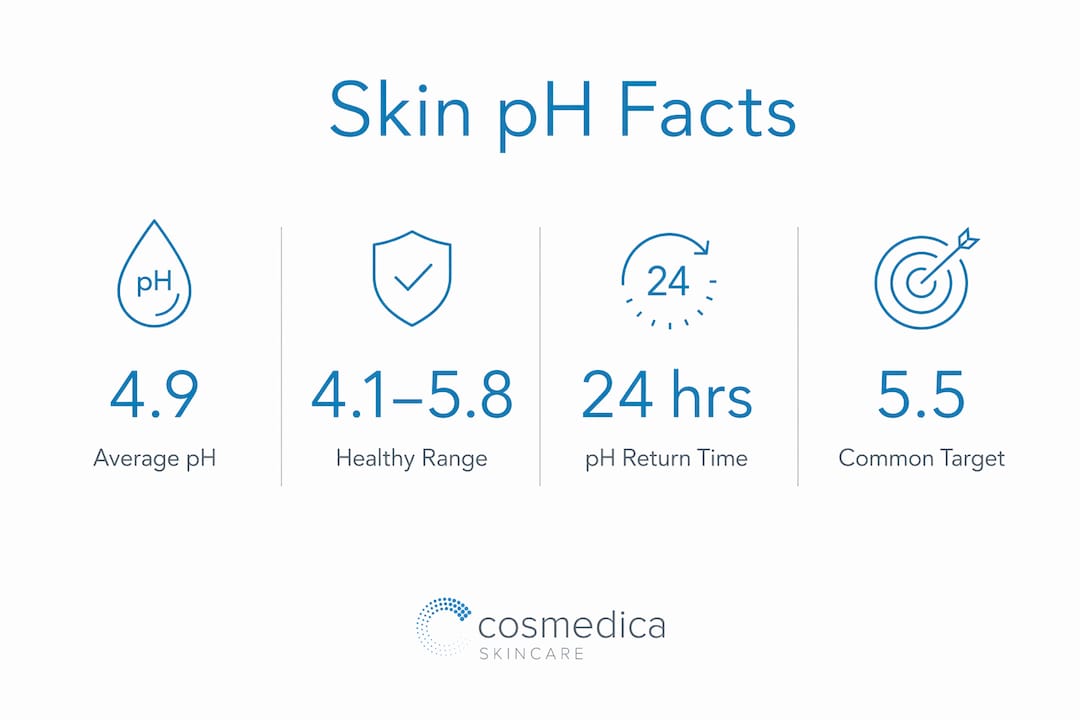
pH also varies significantly by body site and by person.
| Body Site | Typical pH Range | Notes |
|---|---|---|
| Forearm (reference) | 4.1–5.8 (mean ~4.9) | Standard measurement site in clinical studies |
| Face | Slightly higher than forearm, often within 4.5–6.0 | More exposure to water, cleansers, and environment |
| Occluded areas (underarm, groin) | Can rise above 5.8 | Local pH tends to be higher due to moisture and occlusion |
| Darkly pigmented skin | Typically ~0.5 pH unit lower than lightly pigmented skin | Pigmentation correlates with a more acidic surface |
Age matters too. Neonatal skin starts at a higher pH and acidifies over the first weeks of life. Older skin tends to drift more alkaline, which partly explains why mature skin is more prone to dryness and sensitivity. The takeaway: pH variability is real, and a single “ideal” number doesn’t apply to everyone equally.
Stat to know: Skin with pH below 5.0 shows measurably better barrier function and hydration compared to skin above 5.0, according to controlled multicenter data.
How Does an Imbalanced pH Show Up on Your Skin?
pH disruption doesn’t always announce itself dramatically. Often, it looks like a skin problem you’ve been blaming on something else entirely.
Signs your skin may be too alkaline (most common scenario):
- Persistent dryness and flakiness, even when you’re moisturizing regularly
- Tight, uncomfortable feeling after cleansing
- Increased sensitivity to products that never bothered you before
- Accelerated skin cell shedding (desquamation) that leaves skin looking dull
- Higher susceptibility to bacterial infections, including breakouts caused by S. aureus overgrowth
When skin pH rises into the alkaline range, those ceramide-producing enzymes slow down, the barrier weakens, and pathogens find it much easier to colonize. That’s the chain reaction behind a lot of “mystery” sensitivity and recurring acne.
Signs your skin may be dealing with over-acidification from active ingredients:
- Redness and stinging after applying AHAs or BHAs
- Persistent irritation that doesn’t resolve within 24–48 hours
- Peeling beyond normal exfoliation
Pro Tip: Before blaming your skin type for dryness or breakouts, check your cleanser. A high-pH bar soap is one of the most common culprits behind disrupted acid mantle. If your skin feels “squeaky clean” after washing, that’s actually a warning sign, not a good one. Learn more about common skincare mistakes that quietly wreck your barrier.
Can You Test Your Skin’s pH at Home?
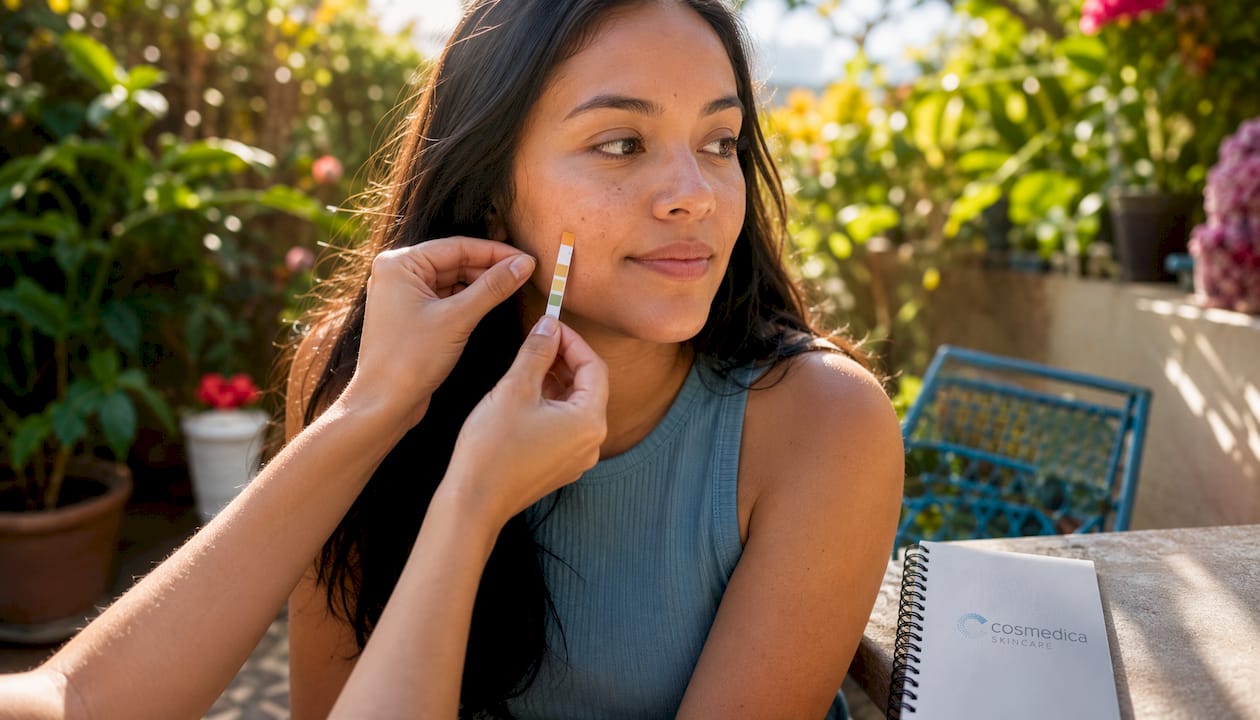
Yes, rough at-home checks are possible, though clinical testing by a dermatologist is more accurate. Here’s how each works.
At-home pH strip testing:
- Avoid applying any skincare products for at least 24 hours before testing.
- Wait at least 30 minutes after washing your face so pH has time to partially recover.
- Press a pH test strip gently against clean, dry skin (the forearm is the standard reference site).
- Hold for the time specified on your strip packaging (usually 1–2 seconds).
- Compare the color change to the strip’s reference chart.
- A reading between 4.1 and 5.8 is generally within the healthy range, reflecting the clinically measured 95% interval for natural skin surface pH.
“If your pH becomes too high or too low, that disrupts the skin’s natural microenvironment. Your normal, healthy bacteria don’t grow as well, and the skin barrier doesn’t work as well.” — Dr. Bullock, Cleveland Clinic
Limitations to keep in mind: pH strips measure surface pH only, not the microdomain variations within the stratum corneum. Results can shift based on recent sweating, product residue, or even the pressure you apply. Think of a home strip test as a directional signal, not a precise diagnostic.
When to see a dermatologist: if you’re dealing with persistent redness, suspected infection, or a skin condition like eczema or rosacea that isn’t responding to routine adjustments, a dermatologist can use calibrated flat-tip electrodes for a much more accurate reading.
How to Restore and Maintain a Healthy Skin pH
The good news: your skin is remarkably good at returning to its natural pH on its own. Your job is mostly to stop doing things that keep knocking it off balance.
Daily routine priorities:
- Use a gentle, low-pH cleanser (formulated between pH 4–6) instead of traditional bar soaps, which often measure above pH 9.
- Follow cleansing with a pH-balanced toner or essence to help your skin recover faster.
- Apply a ceramide-containing moisturizer to reinforce the barrier while your acid mantle restores itself.
- Wear broad-spectrum sunscreen daily; UV exposure degrades barrier lipids and can shift surface pH over time.
What to avoid:
- High-pH bar soaps and harsh sulfate cleansers
- Over-washing (twice daily is enough for most skin types)
- Aggressive physical scrubs that disrupt the stratum corneum
- Layering multiple strong acids in a single session
Using AHAs and BHAs without disrupting your pH:
- Start with a clean, dry face.
- Apply your acid exfoliant (glycolic, lactic, or salicylic) first, on its own, and let it absorb for a few minutes.
- Follow with hydrating layers (hyaluronic acid serum, then moisturizer) to buffer and support recovery.
- Limit acid use to 2–3 times per week unless your skin has built up tolerance.
Formulation research supports keeping topical product pH in the 4–6 range for skin health maintenance. That applies to your cleanser, toner, and any active treatments. Our guide to using acid serums safely goes deeper on sequencing if you want the full breakdown.
Pro Tip: Apply acid exfoliants on dry skin, not damp skin. Damp skin absorbs actives faster and more deeply, which increases the chance of irritation. Dry skin gives you more control over penetration.
What Clinical Research Says About Skin pH and Barrier Function
The science here is consistent and well-replicated. An acidic skin surface, roughly in the 4.0–5.8 range, supports barrier function, microbiome stability, and the enzyme activity needed for ceramide production. That’s not a cosmetic claim; it’s backed by multicenter measurement studies and mechanistic biochemistry.
The enzyme story is particularly compelling. When researchers raise stratum corneum pH in controlled experiments, aSMase and β-GlcCer’ase activity drops, ceramide synthesis slows, and transepidermal water loss increases measurably. This is the direct biochemical link between an alkaline cleanser and dry, reactive skin.
| Study Focus | Key Finding |
|---|---|
| Multicenter surface pH measurement | Mean pH ~4.9; 95% interval 4.1–5.8 on forearm |
| Barrier metrics vs. pH threshold | pH below 5.0 correlates with better hydration and lower scaling |
| Enzyme activity and pH | aSMase and β-GlcCer’ase activity declines as pH rises above acidic optimum |
| Pigmentation and pH | Darkly pigmented skin generally has a lower pH than lightly pigmented skin |
There’s also growing clinical interest in pH-targeted therapies for inflammatory and barrier disorders, which signals that pH management is moving from cosmetic advice into dermatological treatment territory. Knowing your skin’s pH isn’t just a wellness trend; it’s increasingly a clinical tool.
Stat to know: Skin with pH below 5.0 shows measurably better barrier function and hydration, based on multicenter controlled data.
Key Takeaways
Healthy skin pH, typically in the 4.1–5.8 range with an average near 4.9, supports ceramide production, microbiome stability, and barrier integrity, and most disruption comes from high-pH cleansers and over-washing.
| Point | Details |
|---|---|
| Optimal pH range | Healthy skin surface pH averages ~4.9, with a 95% interval of 4.1–5.8. |
| Low pH means better barrier | Skin below pH 5.0 shows measurably better hydration and barrier function. |
| Enzyme dependency | Ceramide-producing enzymes need an acidic environment; rising pH reduces their activity. |
| Routine priority | Switch to a low-pH cleanser and follow with a ceramide moisturizer to protect your acid mantle. |
| Cosmedica-skincare | Cosmedica-skincare formulates pH-conscious cleansers, serums, and moisturizers designed to support barrier function. |
Why pH Is the Skincare Variable Most People Overlook
Most skincare conversations focus on ingredients: retinol, vitamin C, niacinamide. pH rarely gets a seat at the table, and that’s a real gap. You can apply the best ceramide moisturizer on the market, but if you’re cleansing with a high-pH bar soap first, you’re undermining the very enzymes that produce ceramides naturally. The product can’t fully compensate for the disruption happening upstream.
What strikes me most about the clinical research is how consistent it is. The multicenter data, the enzyme studies, the microbiome work — they all point in the same direction. An acidic surface isn’t just “fine”; it’s actively protective. Yet most people have never checked the pH of their cleanser, and many are using products that sit well above pH 7.
The other thing worth saying plainly: the “squeaky clean” feeling after washing is a sign of barrier damage, not cleanliness. That sensation means your acid mantle has been stripped. If your routine regularly produces it, your skin is spending hours every day in recovery mode instead of doing its actual job.
pH awareness doesn’t require a chemistry degree or an expensive testing kit. It mostly requires swapping one product (your cleanser) and paying attention to how your skin feels after washing. That single change tends to produce visible results within a few weeks, which is a faster payoff than most active ingredients deliver.
pH-Friendly Skincare That Actually Supports Your Barrier
Your cleanser, serum, and moisturizer all interact with your skin’s pH, and choosing products formulated with that in mind makes a real difference. Cosmedica-skincare builds its formulations around dermatologist-tested, pH-conscious principles, so you’re not accidentally undoing your routine with the wrong product.
For a ready-made starting point, the Super Serum Set pairs targeted serums designed to work within a pH-friendly routine, supporting hydration and barrier recovery without harsh disruption. If gentle acid exfoliation is on your list, the 5% Lactic Acid Treatment + Hylasyn delivers AHA benefits at a concentration and pH that respects your acid mantle rather than stripping it. Browse Cosmedica-skincare’s full moisturizer collection for ceramide-rich options that reinforce barrier function after cleansing.
Useful Sources
- Stratum corneum acidification: how and why? — Best for understanding the biological mechanisms (NHE1, sPLA2, filaggrin) that create and sustain the acid mantle.
- Multicenter study on measurement of the natural pH of the skin surface — Best for the numeric pH range data and site-to-site variability.
- Natural skin surface pH is on average below 5, which is beneficial for its resident flora — Best for understanding the link between acidic pH, barrier metrics, and microbiome health.
- Towards Optimal pH of the Skin and Topical Formulations — Best for formulation guidance and the clinical rationale for pH 4–6 in topical products.
- The Skin Acid Mantle: An Update on Skin pH — Best for a current review of clinical implications, pH-targeted therapies, and consensus ranges.
- Cleveland Clinic: What Is Your Skin’s pH and Why Does It Matter? — Best for a clinician-reviewed consumer overview with expert commentary.
FAQ
What is the ideal skin pH level for healthy skin?
Healthy skin surface pH averages around 4.9, and falls within a clinically measured 95% interval of 4.1–5.8. Skin below pH 5.0 tends to show better barrier function and hydration than skin above that threshold.
How do I fix my skin pH?
Start by switching to a gentle, low-pH cleanser (formulated between pH 4–6) and follow with a ceramide moisturizer. Avoid high-pH bar soaps and over-washing, both of which strip the acid mantle and can take hours to recover from.
What is the pH level of skin during pregnancy?
Skin pH can shift during pregnancy due to hormonal changes that affect sebum production and sweat composition. There is no single universal figure, and individual variation is significant; a dermatologist can assess your specific skin if you notice changes in sensitivity or barrier function.
Does skin pH affect acne?
Yes. When skin pH rises into the alkaline range, the microbiome balance shifts and pathogenic bacteria find it easier to colonize. Keeping your skin in the 4.1–5.8 range supports the conditions that discourage acne-causing bacteria from thriving.
Can I test my skin pH at home?
You can get a rough reading using pH test strips on clean, product-free skin, ideally 24 hours after your last skincare application. Home strips give directional information but lack the precision of the calibrated flat-tip electrodes a dermatologist would use.