

How to Soothe Irritated Skin: Natural Remedies That Work
TL;DR:
- Irritated skin results when the skin’s protective barrier is damaged, causing redness and discomfort. Simple home care involving gentle cleansing, cool compresses, and barrier repair moisturizers can effectively soothe flare-ups. Seek medical attention if symptoms worsen, spread, or show signs of infection after several days of home treatment.
Irritated skin is defined as a state where the skin’s protective barrier is compromised, triggering redness, itching, dryness, and discomfort. Knowing how to soothe irritated skin comes down to one core principle: restore the barrier gently and stop making it worse. The skin’s outermost layer, the stratum corneum, acts like a brick wall. When that wall cracks, irritants get in and moisture escapes. The good news is that most cases respond well to simple home care. We’ll walk you through the causes, the best remedies for skin irritation, and exactly what to apply on irritated skin to get real relief.
What causes skin irritation and how does it affect your skin?
Skin irritation happens when an external or internal trigger disrupts the lipid barrier, the thin layer of fats and proteins that keeps your skin sealed and protected. Once that barrier breaks down, your skin becomes reactive, dry, and inflamed. Understanding your trigger is the first step toward calming irritated skin for good.
Common triggers include:
- Environmental factors: Cold, dry air, wind, and UV exposure strip moisture from the skin’s surface and weaken barrier function.
- Harsh skincare products: Sulfates, alcohol-based toners, and synthetic fragrances are among the most frequent culprits. Fragrance-free products are widely recommended for reactive skin for good reason.
- Over-exfoliation: Using acids, retinoids, or physical scrubs too frequently removes the protective top layer faster than the skin can rebuild it.
- Allergens and irritants: Detergents, certain fabrics, pet dander, and even some foods can provoke contact dermatitis or hives.
- Water quality: Hard water with high mineral content leaves residue that clogs pores and disrupts pH balance.
When these triggers hit, the skin’s immune response kicks in. Mast cells release histamine, blood vessels dilate, and you get the classic signs: redness, swelling, and that maddening itch. Think of it like a fire alarm going off inside your skin. The alarm is useful, but you need to put out the fire, not keep adding fuel.
Conditions like eczema and rosacea involve a chronically weakened barrier, which means flare-ups happen more easily and take longer to settle. If you have either condition, the same gentle principles apply, but you may need prescription support alongside home care. During any flare-up, the single most important rule is to stop introducing new products. Every new ingredient is a potential irritant when your barrier is already down.
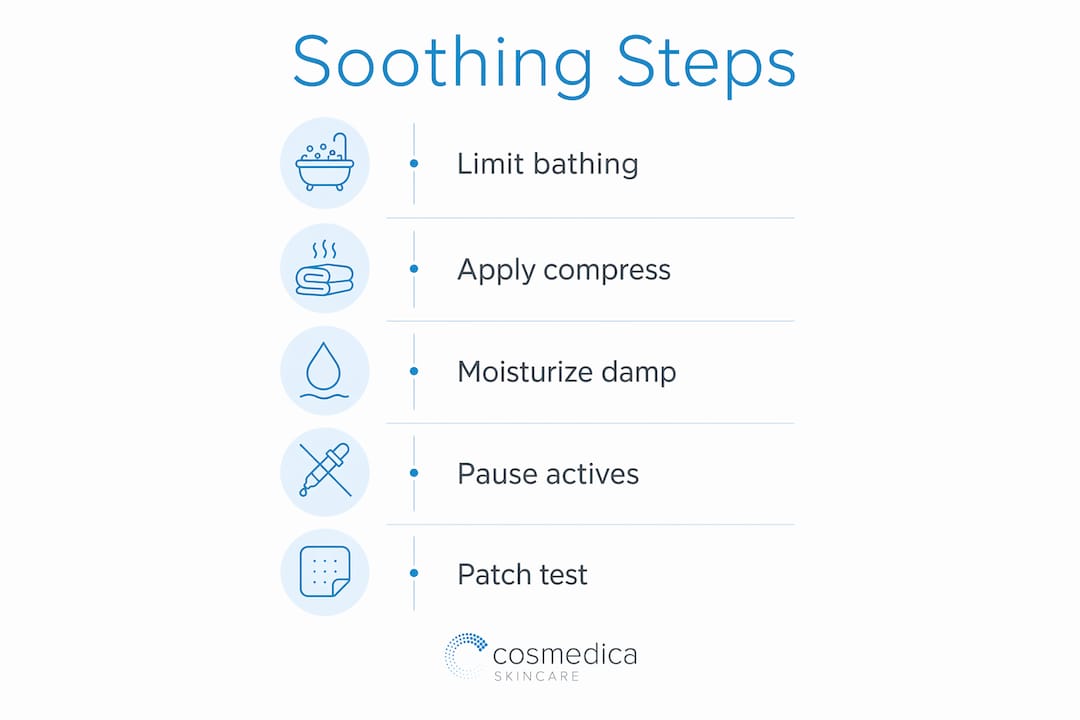
How to soothe irritated skin at home: a step-by-step routine
The most effective approach to calming irritated skin is not a complicated 10-step routine. It is a stripped-back, gentle protocol that gives your barrier the space to heal. Here is how to do it right.
1. Adjust your bathing habits immediately
Limit baths and showers to 5–10 minutes using lukewarm water and a gentle, fragrance-free cleanser. Hot water feels soothing in the moment, but it dissolves the natural lipids your skin needs to stay protected. A gentle cleanser for sensitive skin should feel like nothing on your face. If it tingles, foams aggressively, or leaves your skin tight, it is too harsh.
2. Apply a cool compress
Cool compresses applied for 10–15 minutes reduce redness and inflammation quickly. Soak a soft cloth in cold water, wring it out, and press it gently against the irritated area. Do not rub. This technique works because cold temperatures constrict blood vessels, which directly reduces the visible redness and the sensation of heat.

3. Moisturize while skin is still damp
Apply your moisturizer within two minutes of patting your skin dry. This traps residual water in the skin and gives the moisturizer’s ingredients a head start. Ceramide-rich moisturizers that combine ceramides, cholesterol, and fatty acids in a 3:1:1 ratio are the gold standard for barrier repair. Ceramides are the “mortar” between your skin’s cells. Without them, the wall crumbles.
4. Pause all active ingredients
Pause retinoids and exfoliants until your skin is fully calm. This includes vitamin C serums, AHAs, BHAs, and niacinamide at high concentrations. These ingredients are excellent for healthy skin but act as additional stressors when your barrier is already compromised.
Pro Tip: Apply your moisturizer in gentle, pressing motions rather than rubbing strokes. Rubbing generates friction that can worsen redness on already sensitive skin.
Here is a simple daily routine to follow during a flare-up:
| Step | Product type | Notes |
|---|---|---|
| Morning cleanse | Gentle, fragrance-free cleanser | Lukewarm water, 60 seconds max |
| Morning moisture | Ceramide-rich moisturizer | Apply on damp skin |
| Sun protection | Mineral SPF 30+ | Zinc oxide or titanium dioxide only |
| Evening cleanse | Same gentle cleanser | No double cleansing during flare-ups |
| Evening moisture | Barrier repair moisturizer or plain petrolatum | Lock in hydration overnight |
| Optional | Cool compress | 10–15 minutes before moisturizing |
Which natural remedies and over-the-counter products calm irritated skin safely?
Nature has a few genuinely effective tools for soothing products for sensitive skin. The key is knowing which ones actually work and which ones sound good but do more harm than good.
Remedies that deliver real results:
- Colloidal oatmeal baths: Oatmeal creates a protective barrier and locks in moisture. Soak for 15–20 minutes for best results. Colloidal oatmeal is FDA-recognized as a skin protectant, which means it has earned its reputation through clinical evidence, not just tradition.
- Aloe vera gel: Pure aloe vera contains compounds called polysaccharides that form a cooling, anti-inflammatory film on the skin. Use refrigerated pure aloe for an extra calming effect.
- Panthenol (vitamin B5): This ingredient is a humectant and skin-repairing agent. Think of it as a sponge that draws moisture into the skin while also helping cells regenerate. Fragrance-free formulas with aloe vera, ceramides, and panthenol are among the most effective soothing products for sensitive skin.
- Calamine lotion: Effective for itching caused by contact dermatitis, insect bites, or mild rashes. It works by creating a cooling sensation and mildly drying weeping skin.
- 1% hydrocortisone cream: Available over the counter, this low-dose steroid reduces inflammation quickly. Use it for no more than seven consecutive days on the face and follow package directions carefully.
- Oral antihistamines: Useful when itching is histamine-driven, such as with hives or allergic reactions. They do not repair the barrier but they break the itch-scratch cycle that worsens damage.
Ingredients to avoid during a flare-up:
- Synthetic fragrances and parfum
- Alcohol (ethanol, denatured alcohol)
- Essential oils, including tea tree and lavender
- Menthol and camphor
- Witch hazel
Before applying any new product, patch test on your wrist or behind your ear for 24 hours. Look for redness or swelling before applying it to your face. This single habit prevents a lot of unnecessary setbacks.
Pro Tip: Store your aloe vera gel or ceramide moisturizer in the refrigerator. The cold temperature adds an extra layer of anti-inflammatory relief when you apply it to hot, irritated skin.
Common mistakes that make skin irritation worse
Most people accidentally prolong their own skin irritation by doing too much, too fast. Recognizing these patterns is just as important as knowing the right remedies.
| Common mistake | Healthier alternative |
|---|---|
| Using hot water to cleanse | Switch to lukewarm water for all face washing |
| Applying multiple new products at once | Use only cleanser, moisturizer, and SPF until skin calms |
| Exfoliating to “remove flaky skin” | Skip all exfoliants until the barrier fully heals |
| Rubbing skin dry with a towel | Pat gently with a soft cloth |
| Applying heavy occlusives like petroleum jelly over active inflammation | Wait until redness subsides before using heavy occlusives |
| Skipping moisturizer because skin feels oily | Moisturize every time you cleanse, regardless of skin type |
One mistake that surprises many people is the heavy occlusive trap. Petroleum jelly and thick balms are excellent for sealing in moisture once inflammation has settled. But applying them over active, hot inflammation can trap heat and bacteria, which worsens the problem. Timing matters.
Switching products too frequently is another common pitfall. When skin is irritated, the temptation is to try every soothing product you own. Resist it. Switching skincare products frequently during a flare-up introduces multiple new variables and makes it impossible to know what is helping and what is hurting. Stick to two or three trusted products until your skin stabilizes.
When should you see a doctor for skin irritation?
Most cases of skin irritation resolve with home care within a few days. Knowing when to escalate is what separates a minor inconvenience from a serious complication.
Seek medical attention if you notice any of the following:
- The rash spreads rapidly or covers a large area of your body
- You develop a fever alongside the skin symptoms
- The affected area shows signs of infection: warmth, pus, swelling, or a foul odor
- The rash involves sensitive areas like your eyes, mouth, or genitals
- Symptoms do not improve after 48 hours to one week of consistent home care
- You experience pain rather than just itching
Some rashes require prescription treatment such as topical steroids or antibiotics that go beyond what over-the-counter products can provide. A dermatologist can identify whether you are dealing with contact dermatitis, an infection, or an autoimmune condition like psoriasis.
Before your appointment, avoid applying makeup, new products, or scrubbing the area. Keeping the skin in its natural state allows the doctor to observe the rash accurately and make a correct diagnosis. This is one of those cases where doing less is genuinely the right call.
Key Takeaways
Calming irritated skin requires a gentle, consistent barrier-repair routine using ceramides, fragrance-free products, and cool compresses, while pausing all active ingredients until the skin fully heals.
| Point | Details |
|---|---|
| Barrier repair is the priority | Use ceramide-rich, fragrance-free moisturizers applied on damp skin after every cleanse. |
| Cool compresses reduce redness fast | Apply a cold, damp cloth for 10–15 minutes to constrict blood vessels and ease inflammation. |
| Pause all active ingredients | Stop retinoids, acids, and exfoliants until your skin is fully calm to avoid worsening damage. |
| Patch test every new product | Test on your wrist for 24 hours before applying anything new to irritated skin. |
| Know when to see a doctor | Seek care if symptoms worsen, spread rapidly, show infection signs, or do not improve within a week. |
Why less is always more when your skin is angry
I have seen this pattern more times than I can count. Someone’s skin flares up, and their first instinct is to add more: more serums, more masks, more treatments. It feels productive. It rarely is.
The gold standard routine during a flare-up is genuinely just three steps: a gentle cleanser, a simple barrier-repair moisturizer, and sunscreen. That’s it. Every ingredient you add beyond that is a new variable your compromised skin has to process.
The hardest part of healing irritated skin is patience. We live in a world that rewards speed, and skincare marketing feeds that instinct with promises of overnight results. But the skin barrier rebuilds itself on its own timeline, typically over several days to a few weeks depending on the severity of the damage. Aggressive treatments do not speed that up. They slow it down.
What I have found actually works is trusting the process. Commit to the stripped-back routine for at least a week before evaluating. Resist the urge to exfoliate the flaky patches. Resist the urge to try a new “soothing” mask you just bought. Give your skin the quiet it needs, and it will reward you.
One more thing worth saying: not every skin reaction is a skincare problem. Stress, sleep deprivation, dietary changes, and hormonal shifts all show up on your face. If your skin keeps flaring despite a solid routine, look at the bigger picture before adding more products.
— Thomas
Gentle skincare for irritated skin from Cosmedica-skincare
When your skin needs calm, the products you reach for matter. Cosmedica-skincare formulates with exactly this in mind: gentle, cruelty-free, and fragrance-free options that support barrier repair without overwhelming reactive skin. The Multi-Active Hydrating Night Cream delivers overnight moisture with barrier-supporting ingredients, making it a reliable choice during and after a flare-up. For daily hydration, the ceramide-rich moisturizers collection offers fragrance-free formulas suited to sensitive and irritated skin. Whether you are rebuilding after a reaction or maintaining calm skin long-term, Cosmedica-skincare has gentle options worth exploring.
FAQ
What is the fastest way to calm irritated skin?
Apply a cool compress for 10–15 minutes, then follow with a fragrance-free, ceramide-rich moisturizer on damp skin. This combination reduces inflammation and seals in moisture quickly.
What should I avoid putting on irritated skin?
Avoid fragrances, alcohol, essential oils, exfoliating acids, and retinoids until your skin fully heals. These ingredients stress a compromised barrier and prolong recovery.
How long does it take for irritated skin to heal?
Most mild irritation resolves within a few days of consistent, gentle care. More significant barrier damage can take one to two weeks to fully settle.
Can oatmeal baths really help with skin irritation?
Yes. Colloidal oatmeal is an FDA-recognized skin protectant that forms a protective barrier and locks in moisture. Soaking for 15–20 minutes provides measurable anti-inflammatory relief.
When does irritated skin need a doctor?
See a doctor if your rash spreads rapidly, shows signs of infection like pus or warmth, involves your eyes or mouth, causes pain, or does not improve within 48 hours to one week of home care.