

The Role of Water in Skin Health: 2026 Guide
TL;DR:
- Water is essential for maintaining skin elasticity, barrier function, and a youthful look. Proper hydration depends on drinking enough water and supporting the skin barrier with humectants, emollients, and occlusives. Over-exfoliation and dry indoor air damage the skin barrier, leading to increased dehydration and accelerated aging.
Water is the single most important factor in maintaining skin elasticity, barrier function, and a youthful appearance. The role of water in skin health goes far beyond surface hydration. Dermatologists now recognize that skin moisture depends on a two-part system: how much water you drink and how well your skin barrier holds that moisture in. A 2018 systematic review published in Skin Research and Technology found that adding 2 liters of water per day for one month measurably increased both superficial and deep skin hydration, particularly in people with low baseline intake. That finding tells us something important: water intake matters most when your body is already running low.
How does water maintain skin hydration and elasticity?
Water keeps skin cells plump, functional, and ready to repair themselves. Without adequate water content, the epidermis, the outermost layer of your skin, loses its ability to bounce back after being stretched or pressed. Think of a fresh grape versus a raisin. The difference is almost entirely water.
The aquaporin-3 pathway
Your skin does not absorb water directly from the surface like a sponge. Instead, aquaporin-3 channels act as microscopic pipelines that transport water from deeper tissues up to the epidermis. These channels require systemic hydration to function well. When you are dehydrated, aquaporin-3 activity slows, and the surface of your skin gets less of the moisture it needs to stay supple.
Water also supports skin cell maturation and turnover. New skin cells need water to develop properly before they migrate to the surface. When hydration is low, this process slows down, and the result is a dull, uneven complexion.
Natural moisturizing factors and lipid barriers
The skin produces its own hydration system called natural moisturizing factors (NMFs). These are water-binding compounds, including amino acids and urocanic acid, that live inside skin cells and pull moisture from the environment. NMFs work alongside intercellular lipids, the fatty substances between skin cells that act like mortar between bricks. Together, they keep water locked inside the epidermis.
When both systems are working well, skin looks plump, smooth, and reflects light evenly. Fine lines appear softer because the skin cells are fully inflated. Hydrated skin also heals faster and responds better to active skincare ingredients.
Pro Tip: Drink a glass of water first thing in the morning before coffee or tea. Overnight, your body loses water through breathing and light sweating. Rehydrating early gives your aquaporin-3 channels a head start.
What are the effects of dehydration on skin?
Dehydration does visible damage to skin faster than most people realize. The effects show up in texture, tone, and resilience before they show up in a blood test. Here is what actually happens, step by step.
-
The skin barrier weakens. When water content drops, the intercellular lipids that hold skin cells together start to break down. This creates microscopic gaps in the barrier, allowing irritants and bacteria to enter more easily.
-
Transepidermal water loss (TEWL) increases. A compromised barrier cannot hold moisture in. Water evaporates from the skin surface at a faster rate, creating a cycle where dehydration feeds more dehydration. Barrier impairment directly increases dryness and skin irritation.
-
Skin looks dull and feels tight. Dehydrated skin reflects light unevenly because the surface is no longer smooth. You may notice a papery texture or a feeling of tightness after washing your face.
-
Fine lines become more visible. Dehydrated skin cannot plump up fine lines the way well-hydrated skin can. Wrinkles around the eyes and mouth appear deeper when the skin is water-depleted.
-
Chronic dehydration accelerates aging. Repeated dehydration reduces collagen synthesis and weakens the skin’s repair mechanisms. Over time, this speeds up visible signs of aging in ways that are difficult to reverse.
One distinction worth knowing: dehydrated skin and dry skin are not the same thing. Dehydrated skin is a temporary condition caused by a lack of water. It can affect any skin type, including oily and acne-prone skin. Dry skin, on the other hand, is a skin type defined by a genetic lack of oil production. You can have oily, dehydrated skin at the same time. Treating them the same way leads to the wrong results.
What are the best ways to hydrate skin inside and out?
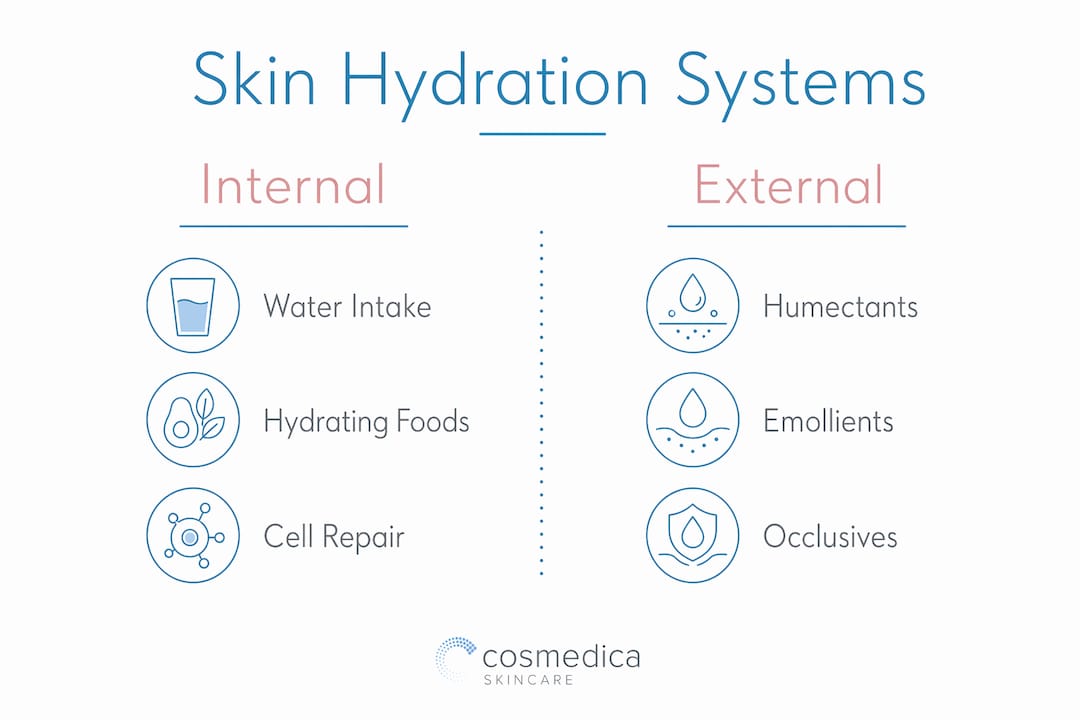
Skin hydration and health require both internal and external strategies working together. Drinking more water helps, but it is not the whole picture.
Internal hydration: drinking water and diet
Increasing daily water intake produces real results, especially if your baseline intake is low. The systematic review in Skin Research and Technology confirmed measurable improvements in skin moisture levels when participants added 2 liters of water per day. That said, dermatologist Dr. Jose Rossello notes that for people already well-hydrated, drinking more water does not produce dramatic visible skin changes. The benefit is strongest when you are correcting a deficit.
Foods with high water content, like cucumbers, watermelon, and leafy greens, also contribute to your daily intake. Reducing alcohol and caffeine helps too, since both act as diuretics and pull water from your tissues.
External hydration: the three-layer approach
Topical skincare works best when you layer three types of ingredients in the right order.
| Layer | Ingredient type | What it does |
|---|---|---|
| First | Humectant (e.g., hyaluronic acid) | Draws water into the skin |
| Second | Emollient (e.g., ceramides, squalane) | Smooths and softens the skin surface |
| Third | Occlusive (e.g., petrolatum, mineral oil) | Seals moisture in and blocks TEWL |
Applying these layers to slightly damp skin makes a real difference. Humectants are hygroscopic, meaning they pull moisture from whatever is nearby. On damp skin, they draw from the water on your surface. On completely dry skin in a dry room, they can pull water from deeper skin layers, which actually worsens dehydration. This is one of the most overlooked techniques in everyday skincare.
Pro Tip: After cleansing, pat your face dry but leave it slightly damp. Apply your hyaluronic acid serum immediately, then follow with your moisturizer while the serum is still absorbing. This sequence locks in the most moisture.
Environmental factors also affect hydration. Dry indoor air, especially in winter with central heating, pulls moisture from your skin constantly. A humidifier in your bedroom can reduce overnight TEWL significantly. Harsh cleansers and over-exfoliation strip the skin barrier, so choosing gentle, pH-balanced formulas protects your hydration investment.
Which skincare ingredients actually improve skin moisture?
The science-backed guide to skin hydration points to three categories of ingredients that work together to build and maintain moisture. Understanding what each one does helps you choose products that actually deliver results.
-
Hyaluronic acid is the gold standard humectant. It binds up to 1,000 times its weight in water, making it one of the most efficient moisture-attracting molecules in skincare. It exists naturally in your skin, but levels drop with age and sun exposure. Topical hyaluronic acid replenishes what time takes away. For a deeper look at why this ingredient has become so widely used, the science behind hyaluronic acid explains its growing role in modern formulations.
-
Ceramides are lipids that make up roughly 50% of the skin barrier. They mimic the natural fats between skin cells and rebuild barrier strength when it has been damaged by weather, harsh products, or aging. A ceramide-rich moisturizer is one of the most effective tools for reducing TEWL over time.
-
Petrolatum and mineral oil are occlusives. They sit on top of the skin and form a physical seal that prevents water from escaping. Petrolatum is one of the most effective occlusives available, retaining moisture without clogging pores when used correctly.
-
Squalane is an emollient derived from olives or sugarcane. It fills in the gaps between skin cells, creating a smoother surface and supporting the lipid barrier without feeling heavy or greasy.
-
Glycerin is another humectant, often paired with hyaluronic acid. It is less talked about but equally effective at drawing moisture into the skin. Many well-formulated moisturizers use glycerin as a base ingredient.
The most effective approach layers these ingredients strategically. Humectants go on first, emollients follow, and occlusives finish the routine. This sequence mirrors how the skin’s own moisture system works, from water-binding in the cells outward to lipid sealing at the surface.
Key Takeaways
Skin hydration depends equally on how much water you consume and how well your skin barrier retains it, making both internal intake and topical care non-negotiable for healthy skin.
| Point | Details |
|---|---|
| Water intake matters most for low hydrators | Adding 2 liters daily measurably improves skin moisture, especially when baseline intake is low. |
| Dehydration and dry skin are different conditions | Dehydrated skin lacks water and can affect any skin type; dry skin lacks oil and is a genetic trait. |
| Layer humectants, emollients, and occlusives | Apply in this order on damp skin to maximize moisture retention and minimize TEWL. |
| Barrier damage accelerates moisture loss | Over-exfoliation and harsh cleansers break down the lipid barrier, causing water to escape faster. |
| Hyaluronic acid needs moisture to work | Apply it to damp skin so it draws from surface water, not from deeper skin layers. |
Why I think most people are solving the wrong hydration problem
After years of looking closely at how people approach skin hydration, one pattern keeps showing up: most people focus entirely on what they put on their skin and ignore what they are doing to their barrier. They buy the best hyaluronic acid serum, apply it faithfully, and still wake up with tight, dull skin. The reason is almost always barrier damage.
Over-exfoliation is the biggest culprit I see. People use strong acids or physical scrubs three to four times a week, strip the lipid layer completely, and then wonder why their moisturizer is not working. The answer is simple: you cannot fill a bucket with a hole in it. TEWL increases dramatically when the barrier is compromised, and no amount of serum compensates for that.
The second mistake I see is treating dehydration and dryness as the same problem. Someone with oily, dehydrated skin reaches for a heavy oil-based cream and ends up with breakouts. The right fix for dehydrated skin is water-binding ingredients, not more oil. Getting that distinction right changes everything about how you build a routine.
My honest recommendation: before adding more products, simplify. Use a gentle cleanser, apply a hyaluronic acid serum to damp skin, and seal it with a ceramide moisturizer. Do that consistently for four weeks. Most people see a real difference without adding anything else. The hydration routine guide at Cosmedica-skincare walks through exactly this kind of simplified approach, and it is worth reading before you invest in anything new.
— Thomas
Cosmedica-skincare’s hydration-focused product lineup
Cosmedica-skincare builds its formulations around the same three-layer principle: humectants, emollients, and occlusives working together. The new collection includes hydrating serums with hyaluronic acid and ceramide-rich moisturizers designed to support the skin barrier from the first application. For readers who want a complete routine in one step, the Trio Facial Serum Kit layers active ingredients to address hydration, brightness, and barrier repair together. Every product is cruelty-free, dermatologist-tested, and formulated for all skin types. If you have been struggling with tight, dull, or dehydrated skin, these are the products worth trying first.
FAQ
What is the role of water in skin health?
Water maintains skin elasticity, supports cell turnover, and enables aquaporin-3 channels to transport moisture to the epidermis. Without adequate hydration, the skin barrier weakens and moisture escapes faster through TEWL.
How much water should I drink for better skin?
Research shows that adding 2 liters of water per day for one month measurably improves skin hydration, particularly for people with low baseline intake. For those already well-hydrated, topical skincare has a greater impact than increasing water intake further.
What does dehydrated skin look like?
Dehydrated skin typically appears dull, feels tight after cleansing, and shows more visible fine lines. It can affect any skin type, including oily skin, and is caused by a lack of water rather than a lack of oil.
Does hyaluronic acid actually hydrate skin?
Yes. Hyaluronic acid binds up to 1,000 times its weight in water, making it one of the most effective humectants available. Apply it to slightly damp skin for best results, since on dry skin it can draw moisture from deeper layers instead of the surface.
What damages skin hydration the most?
Over-exfoliation, harsh cleansers, and dry indoor air are the top causes of hydration loss. These factors break down the skin’s lipid barrier, increasing TEWL and making it harder for any moisturizer to keep skin hydrated.