

What Is Skin Hydration and Why Your Skin Needs It
TL;DR:
- Skin hydration measures water inside skin cells, crucial for a plump, smooth appearance. Moisturization seals water in to prevent evaporation, both processes are essential for healthy skin. Proper layering of humectants and barrier repair products supports optimal hydration and skin resilience.
Skin hydration is defined as the water content held within your skin cells, and it is the single most important factor in whether your complexion looks plump, smooth, and resilient or dull, tight, and flaky. We often hear “hydration” and “moisturization” used interchangeably, but they describe two different processes. Hydration refers to water levels inside the cells. Moisturization refers to preventing that water from escaping. Both matter, and understanding the difference is the first real step toward skin that actually looks and feels healthy. Key ingredients like hyaluronic acid, ceramides, and glycerin each play a specific role in this system, and knowing how they work makes choosing the right products far less confusing.
What is skin hydration, and how does it differ from moisturization?
Skin hydration is the measure of water content inside the skin’s cells, specifically within the outermost layer called the stratum corneum. When those cells are well hydrated, skin looks bouncy and feels soft. When they are depleted of water, skin looks dull and feels tight, even if it is producing plenty of oil.
Moisturization is a separate but related process. A moisturizer’s job is to seal water into the skin so it does not evaporate into the air, a process dermatologists call transepidermal water loss (TEWL). Think of it this way: hydration fills the glass, and moisturization puts a lid on it.
Experts consistently stress that both must be addressed for effective skincare. Applying a hydrating serum without a moisturizer on top is like filling a leaky bucket. The water gets in, but it evaporates before your skin can benefit. This is why a two-step approach, humectant serum followed by a sealing moisturizer, is the foundation of every well-designed routine.
The skin barrier also plays a central role here. Aquaporins, specialized proteins embedded in skin cells, act as water channels that distribute hydration evenly across the epidermis. When the barrier is healthy, these channels work efficiently. When it is damaged, water distribution breaks down and dehydration sets in fast.
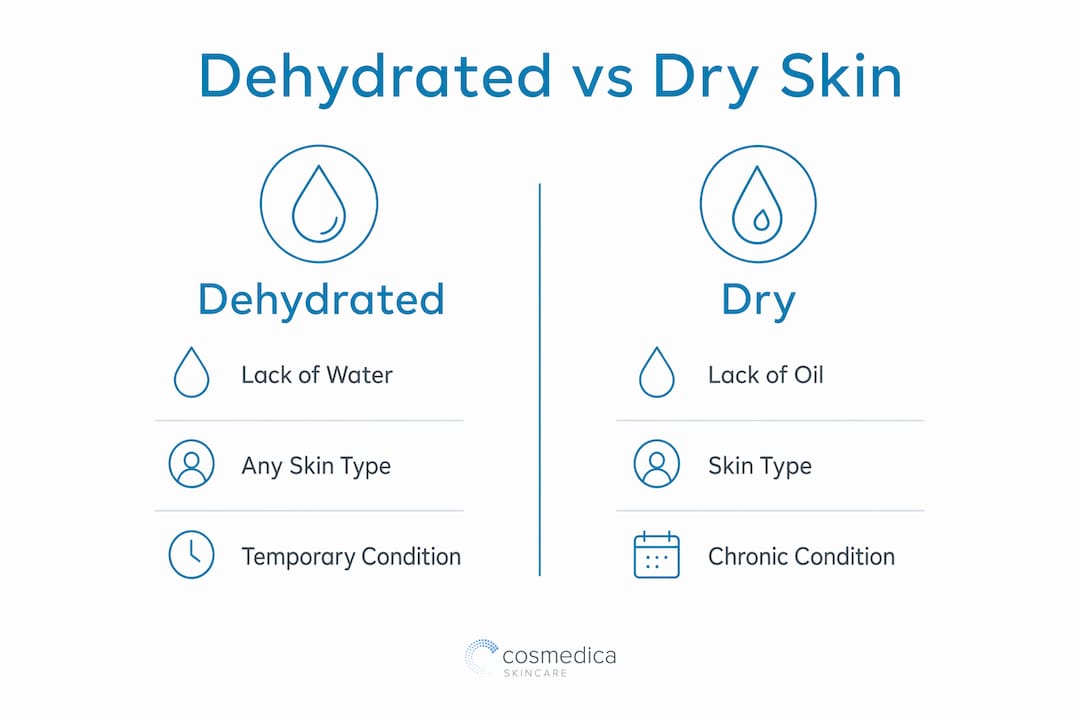
Dehydrated skin vs. dry skin: what is the real difference?
These two conditions look similar but have completely different causes, and treating one as the other makes both worse.
Dry skin is a skin type. It is caused by a lack of oil (lipids) in the skin. People with dry skin are born with fewer oil-producing glands, and their skin struggles to hold onto moisture because the lipid layer is thin. It tends to feel rough and flaky year-round.
Dehydrated skin is a skin condition. Any skin type can experience it, including oily skin. It is caused by a lack of water in the skin cells, triggered by factors like harsh weather, over-cleansing, caffeine, alcohol, or simply not using the right products.
Here is a quick comparison:
| Feature | Dehydrated skin | Dry skin |
|---|---|---|
| Root cause | Lack of water in cells | Lack of oil/lipids |
| Who gets it | Any skin type | Genetic skin type |
| Key symptoms | Dullness, tightness, fine lines | Flaking, rough texture, itching |
| Fix | Humectants + barrier repair | Emollients + occlusives |
| Oily skin affected? | Yes | No |
The skin barrier’s “brick and mortar” structure explains why both conditions cause water loss. Skin cells (the bricks) are surrounded by a lipid matrix (the mortar) that creates a waterproof seal. When that mortar is damaged, water escapes freely and skin becomes dehydrated regardless of skin type.
Common signs of dehydrated skin include:
- A tight, uncomfortable feeling after cleansing
- Fine lines that appear suddenly and fade when you press the skin
- Dullness that does not improve with exfoliation
- Skin that feels oily on the surface but tight underneath
That last point trips up a lot of people. Dehydrated skin can produce excess oil as a compensatory mechanism. The skin senses water loss and ramps up sebum production to compensate. This leads to the common mistake of skipping moisturizer on oily skin, which actually makes dehydration worse and can aggravate breakouts.
What biological components and ingredients drive skin hydration?
The skin’s ability to hold water depends on a precise combination of biological structures and topical ingredients. Understanding these makes it much easier to read a product label and know what you are actually buying.
Hyaluronic acid: the hydration workhorse
Hyaluronic acid (HA) is the skin’s primary humectant. A humectant is any ingredient that attracts water molecules and holds them in the skin, like a sponge. Hyaluronic acid binds up to 1,000 times its own weight in water. That is an extraordinary capacity for a single molecule. HA occurs naturally in the skin, but levels decline with age, sun exposure, and environmental stress. Topical HA serums replenish this loss and give skin that plump, dewy look almost immediately. For a deeper look at what this ingredient does, the benefits of hyaluronic acid go well beyond simple hydration.
Ceramides, cholesterol, and fatty acids
Lipids such as ceramides, cholesterol, and fatty acids make up roughly 40% of the skin’s outer layer. These lipids form the mortar in the brick-and-mortar barrier. Without them, water escapes and irritants get in. Ceramide creams mimic natural barrier function to absorb water and decrease water loss, making them especially effective for dry or eczema-prone skin. Think of ceramides as the caulk that keeps your skin’s walls sealed tight.
Natural Moisturizing Factors (NMFs)
Natural Moisturizing Factors are a collection of water-attracting compounds found naturally in the stratum corneum. They include amino acids, urea, lactic acid, and pyrrolidone carboxylic acid. NMFs work alongside hyaluronic acid to keep cells hydrated from within. When NMF levels drop, due to age or over-washing, the skin loses its ability to regulate its own moisture balance.
The humectant, emollient, occlusive framework
| Ingredient type | Function | Examples |
|---|---|---|
| Humectant | Draws water into skin cells | Hyaluronic acid, glycerin, aloe vera |
| Emollient | Smooths and softens skin texture | Squalane, shea butter, jojoba oil |
| Occlusive | Forms a physical seal to prevent water loss | Petrolatum, beeswax, dimethicone |
A complete hydration routine uses all three types in the right order.
pH and enzyme function
The skin’s natural pH sits around 5, which is mildly acidic. Products that disrupt this pH impair the enzymes responsible for cell renewal and barrier maintenance. When those enzymes stop working properly, dead skin cells build up and the barrier weakens. Topical serums alone cannot fix this. The cleanser you use matters just as much as the serum you apply after it.
Pro Tip: Apply your hyaluronic acid serum to damp skin, not dry skin. HA pulls moisture from its environment, so damp skin gives it water to work with. On completely dry skin in a low-humidity environment, it can actually pull moisture from deeper layers.
How to hydrate skin effectively through daily habits and routines
Keeping skin hydrated is not complicated, but it does require consistency and the right sequence of steps. Here is a practical framework that works for every skin type.
1. Start with a gentle, pH-balanced cleanser
Harsh cleansers strip the skin’s natural oils and disrupt its acidic pH. Choose a cleanser with a pH close to 5 that removes dirt without leaving skin feeling tight. Foam cleansers with sulfates are the most common culprits for barrier damage.
2. Apply a humectant serum on damp skin
After cleansing, while skin is still slightly damp, apply a serum containing hyaluronic acid or glycerin. These humectants pull water into the cells and create the foundation of your hydration layer. For guidance on getting the most from this step, applying hyaluronic acid correctly makes a measurable difference in results.
3. Seal with an emollient or occlusive moisturizer
Layering humectants then sealing with emollients and occlusives is the dermatologist-recommended approach for optimal hydration. This “light-to-heavy” sequence locks the water in before it can evaporate. A ceramide-rich moisturizer works well here because it repairs the barrier while sealing in hydration.
4. Use SPF every morning
UV radiation degrades hyaluronic acid in the skin and damages the lipid barrier. Daily SPF 30 or higher protects both. Skipping sunscreen undoes much of what your hydrating routine accomplishes.
5. Add a humidifier in dry environments
Indoor heating and air conditioning pull moisture from the air, which accelerates TEWL. A humidifier set to 40–60% humidity creates an environment where your skin does not have to work as hard to stay hydrated.
6. Drink water, but do not rely on it alone
Staying hydrated internally supports overall skin function, but drinking water alone has minimal direct impact on skin moisture in people who are already normally hydrated. Topical hydration and barrier repair produce far more visible results. Water intake matters most when you are genuinely dehydrated overall.
Pro Tip: At night, layer a hydrating serum under a richer night cream or facial oil. Skin repair peaks during sleep, and an occlusive layer overnight can dramatically improve how skin looks by morning.
Common myths about skin hydration that are worth clearing up
A lot of well-meaning skincare advice gets this topic wrong. Here are the most common misconceptions and what the science actually says.
Myth 1: Drinking more water will fix dry or dehydrated skin. Drinking water supports overall health, but surface dehydration requires topical barrier repair for visible improvement. Extra water intake does not significantly boost skin moisture in people who are already adequately hydrated.
Myth 2: Oily skin does not need hydration. Oily skin can absolutely be dehydrated. Oil and water are different things. When oily skin is dehydrated, it often produces even more oil to compensate, which can worsen breakouts. A lightweight, non-comedogenic hyaluronic acid serum is the right fix, not skipping hydration altogether.
Myth 3: Hydration and moisturization are the same thing. Hydration adds water to skin cells. Moisturization prevents that water from leaving. You need both. A hydrating serum without a moisturizer on top is only half the equation.
Myth 4: More product means more hydration. Layering too many products can actually block absorption and irritate the skin. The “light-to-heavy” rule works because each layer has a specific job. Applying a heavy occlusive before a humectant serum traps the humectant outside the skin where it cannot do its job.
Myth 5: Mature skin just needs more moisturizer. Aging skin loses both water-holding capacity and lipid content, so it needs both humectants and barrier-repairing ingredients like ceramides. A moisturizer alone, without a hydrating serum underneath, addresses only half the problem. The connection between aging skin and hydration is well documented and worth understanding in detail.
Key Takeaways
Effective skin hydration requires both water-attracting ingredients and a healthy lipid barrier working together, not one or the other.
| Point | Details |
|---|---|
| Hydration vs. moisturization | Hydration adds water to cells; moisturization seals it in. Both steps are required. |
| Dehydrated vs. dry skin | Dehydrated skin lacks water and affects all skin types; dry skin lacks oil and is a genetic type. |
| Key ingredients | Hyaluronic acid, ceramides, glycerin, and fatty acids each play a distinct role in the hydration system. |
| Layering order matters | Apply humectant serums first on damp skin, then seal with an emollient or occlusive moisturizer. |
| Water intake has limits | Drinking water supports overall health but does not replace topical hydration and barrier repair. |
What I have learned from years of watching people get hydration wrong
The single most common mistake I see is treating hydration as a one-product fix. Someone buys a hyaluronic acid serum, uses it alone, and wonders why their skin still feels tight. The serum is doing its job. The problem is that nothing is sealing the water in. Without a moisturizer on top, HA pulls moisture toward the surface and then loses it to evaporation, especially in dry climates or heated indoor spaces.
The second mistake is assuming oily skin does not need hydration. I have seen this cause real damage. Oily, dehydrated skin over-produces sebum, clogs pores, and breaks out more. The fix is not to strip the skin further with harsh cleansers. It is to add a lightweight humectant serum and a non-comedogenic moisturizer. Within two to three weeks, most people see oil production normalize.
What actually works is consistency with a simple, well-sequenced routine. Gentle cleanser. Humectant serum on damp skin. Ceramide-rich moisturizer to seal. SPF in the morning. That is it. The skin barrier is resilient when you stop fighting it and start supporting it. Products with proven ingredients like hyaluronic acid, glycerin, and ceramides are not luxuries. They are the basic tools your skin needs to do its job. Patience matters too. Barrier repair takes four to six weeks of consistent care before you see the full result. Stick with it.
— Thomas
Cosmedica-skincare products built for real hydration results
Cosmedica-skincare formulates every hydrating product around the same science covered in this article: humectants to attract water, ceramides to repair the barrier, and emollients to seal it all in. The moisturizer collection includes options for every skin type, from lightweight gels for oily and dehydrated skin to richer creams for dry and mature skin. For a complete layering routine, the Super Serum Set pairs hydrating serums with complementary formulas designed to work together. If you want to treat someone (or yourself) to a full hydration reset, the skincare gift sets are a great place to start. All products are cruelty-free, dermatologist-tested, and built for long-term results.
FAQ
What is the simplest definition of skin hydration?
Skin hydration is the amount of water held within the skin’s cells, particularly in the outermost layer called the stratum corneum. Well-hydrated skin looks plump, feels soft, and functions as an effective barrier.
Can oily skin be dehydrated?
Yes. Oily skin and dehydrated skin are not mutually exclusive. Dehydrated skin lacks water, not oil, and any skin type can experience it. Oily but dehydrated skin often produces even more sebum as a compensatory response.
What ingredients hydrate skin most effectively?
Hyaluronic acid is the most effective humectant, binding up to 1,000 times its weight in water. Glycerin, aloe vera, and ceramides also play key roles in attracting and retaining moisture in the skin.
Does drinking water improve skin hydration?
Drinking water supports overall health, but it has minimal direct impact on skin moisture in people who are already adequately hydrated. Topical hydration and barrier repair produce more visible improvements in skin texture and appearance.
How often should you apply hydrating products?
Apply a hydrating serum and moisturizer twice daily, morning and night. Consistency over time is what repairs the skin barrier and maintains healthy water levels in the skin cells.