

What Is Microbiome Skincare? Your 2026 Science Guide
TL;DR:
- Microbiome skincare products support the balance of microorganisms on your skin to improve its health. They mainly include prebiotics, postbiotics, and synbiotics that nourish, introduce, or produce beneficial microbes. Clinical evidence shows they can reduce acne, improve eczema, and strengthen the skin barrier.
Microbiome skincare is defined as a category of products and practices designed to support, protect, and balance the natural community of microorganisms living on your skin. Think of your skin not as a blank surface but as a living ecosystem, home to trillions of bacteria, fungi, and viruses that work together to keep it healthy. When that ecosystem thrives, your skin looks clearer, feels stronger, and defends itself better. When it falls out of balance, you get inflammation, breakouts, and sensitivity. We put together this guide to help you understand the science, the ingredients, and the real benefits so you can make smarter choices for your skin.
What is the skin microbiome and why does it matter?
The skin microbiome is the collective term for all the microorganisms that live on and in your skin. This includes bacteria, fungi, viruses, and mites, each occupying specific zones like your forehead, cheeks, or the creases of your elbows. The scientific community uses the term cutaneous microbiome interchangeably with skin microbiome, and both refer to the same living community.

These microorganisms are not passive passengers. They actively compete with harmful pathogens, regulate your skin’s immune responses, and help maintain the acid mantle, the slightly acidic surface layer that keeps your skin barrier intact. Think of them as your skin’s personal security team, working around the clock without you noticing.
The key concept here is eubiosis, which means a balanced, healthy microbial state. The opposite is dysbiosis, a state of imbalance where harmful microbes outcompete beneficial ones. Dysbiosis is linked to conditions like acne, eczema, rosacea, and psoriasis. Understanding this balance is the foundation of microbiome skincare principles.
| Microorganism Type | Examples | Role on Skin |
|---|---|---|
| Bacteria | Staphylococcus epidermidis, Cutibacterium acnes | Barrier defense, pH regulation, immune signaling |
| Fungi | Malassezia species | Lipid metabolism, potential inflammation trigger |
| Viruses (phages) | Bacteriophages | Regulate bacterial populations |
| Archaea | Methanobrevibacter | Metabolic support, less studied |
Your skin’s microbial community also varies by body site. Oily zones like the nose and forehead host different species than dry zones like the forearms. This is why a one-size-fits-all approach to skincare often falls short. Microbiome skincare accounts for this complexity by working with your skin’s natural biology rather than against it.
How does microbiome skincare work and what ingredients are involved?
Microbiome skincare works by delivering specific ingredients that either feed beneficial microbes, introduce helpful microorganisms, or supply the beneficial byproducts those microbes produce. The industry organizes these ingredients into four main categories: prebiotics, probiotics, postbiotics, and synbiotics.
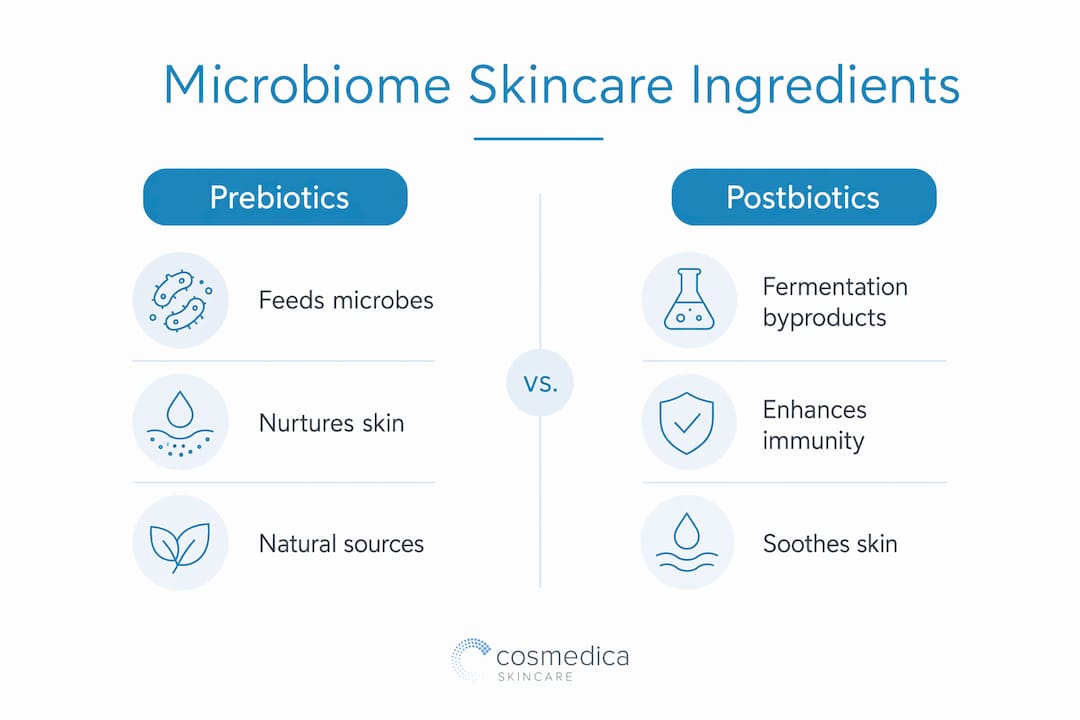
Prebiotics are nutrients that feed beneficial bacteria already living on your skin. Common examples include inulin, beta-glucan, and certain plant sugars. They do not add new microbes. They simply give the good ones already present a competitive advantage.
Probiotics are live microorganisms added directly to a product. The idea sounds appealing, but live probiotic stability is a major formulation challenge. Keeping live bacteria viable in a cream or serum through manufacturing, shipping, and shelf life is genuinely difficult. This limits their clinical reliability compared to other ingredient types.
Postbiotics are the byproducts that beneficial bacteria produce during fermentation. Examples include short-chain fatty acids, bacteriocins, and fermented lysates. These are shelf-stable, well-tolerated, and increasingly supported by clinical research. Fermented complexes can restore microbial eubiosis by reducing opportunistic pathogens and supporting beneficial bacteria like Propionibacterium. That makes postbiotics one of the most practical and reliable options available today.
Synbiotics combine prebiotics and postbiotics in a single formulation. The synbiotic approach is currently the most clinically supported method in microbiome skincare, offering a broader effect than either ingredient type alone. You get the feeding mechanism and the beneficial byproducts working together.
| Ingredient Type | How It Works | Benefit | Limitation |
|---|---|---|---|
| Prebiotics | Feeds existing beneficial microbes | Supports microbial diversity | Does not add new microbes |
| Probiotics | Introduces live microorganisms | Directly supplements flora | Stability and viability challenges |
| Postbiotics | Delivers fermentation byproducts | Shelf-stable, anti-inflammatory | Does not colonize skin |
| Synbiotics | Combines prebiotics and postbiotics | Broadest supported effect | More complex formulation |
For a deeper look at how these ingredient categories show up in real products, the postbiotic skincare guide from Cosmedica-skincare breaks it down clearly.
Pro Tip: When reading a product label, look for fermented ingredients, lactobacillus ferment filtrate, inulin, or beta-glucan. These signal a genuine microbiome-conscious formulation rather than a marketing-only claim.
What clinical evidence supports microbiome skincare benefits?
The science behind microbiome skincare has moved well beyond theory. Clinical trials now show measurable results for specific skin conditions, particularly acne and atopic dermatitis.
A 2026 systematic review of 33 studies found that prebiotic, probiotic, and postbiotic interventions for acne vulgaris produced pooled mean lesion reductions of 37.2%, 45.2%, and 49.5% respectively. Those numbers are significant. They suggest that postbiotics outperform both prebiotics and live probiotics for acne reduction, which aligns with the formulation stability argument made above.
For eczema, a 2018 study found that topical microbiome transplant with Roseomonas mucosa improved atopic dermatitis symptoms by over 50% after 16 weeks of twice-weekly application. That is a compelling result for a condition that often resists conventional treatment.
Research published in 2025 confirms that microbiome-based products modulate the gut-skin axis, strengthen the skin barrier, and reduce inflammation. This positions them as genuine alternatives to steroids or antibiotics for inflammatory skin conditions, not just cosmetic add-ons.
Here is a summary of the top clinical benefits supported by current evidence:
- Acne reduction: Postbiotic interventions show nearly 50% lesion reduction in clinical trials.
- Eczema relief: Targeted microbial transplants reduce atopic dermatitis severity by more than half.
- Barrier strengthening: Prebiotic and postbiotic formulas improve the skin’s physical barrier function.
- Inflammation control: Microbiome products modulate immune signaling to reduce chronic skin inflammation.
- Pathogen defense: Beneficial microbes compete with and suppress harmful pathogens on the skin surface.
The honest caveat is that microbiome skincare claims often outpace the science. The term “microbiome-friendly” has no standardized clinical definition and remains largely unregulated in cosmetics as of 2026. That means you need to look past the label and focus on the actual ingredients and the research behind them. Evidence-based choices, not marketing language, are what deliver real results.
How to build a microbiome-friendly skincare routine
Building a routine that supports your skin’s microbial health does not require throwing out everything you own. It starts with a few targeted shifts in how you cleanse, hydrate, and choose products.
Start with gentle cleansing
Harsh cleansers strip the skin’s acid mantle and wipe out beneficial microbes along with dirt and oil. Proper cleansing and hydration are foundational to maintaining a healthy skin microbiome. Choose a pH-balanced, sulfate-free cleanser that removes impurities without disrupting your microbial community.
Build your routine step by step
- Cleanse gently. Use a mild, pH-balanced cleanser morning and night. Avoid foaming cleansers with sodium lauryl sulfate, which are known to disrupt the acid mantle.
- Apply a prebiotic or postbiotic serum. Look for fermented lysates, lactobacillus filtrate, or inulin in the ingredient list. Apply to damp skin for better absorption.
- Layer a microbiome-conscious moisturizer. Choose formulas with beta-glucan or ceramides, which support both the microbial layer and the physical skin barrier. A hydrating moisturizer that avoids harsh preservatives is a good starting point.
- Use SPF daily. UV damage disrupts the skin microbiome. A broad-spectrum SPF 30 or higher protects both your skin cells and your microbial community.
- Limit harsh actives. High-concentration acids and strong retinoids can temporarily disrupt microbial balance. Use them strategically, not daily, and always follow with a barrier-supporting moisturizer.
Signs your microbiome is healthy versus disturbed
A healthy skin microbiome shows up as calm, even-toned skin with minimal sensitivity. Disturbed microbiome signs include persistent redness, unexpected breakouts, tightness after cleansing, and a feeling that your skin reacts to everything. If you notice those signs, simplify your routine before adding new products.
Lifestyle habits that support microbial health
Diet, sleep, and stress all influence your skin microbiome. Fermented foods like yogurt and kimchi support the gut-skin axis, which in turn affects skin inflammation. Chronic stress elevates cortisol, which can shift microbial populations toward dysbiosis. Consistent sleep gives your skin’s repair mechanisms, including its microbial community, time to reset.
Pro Tip: If you are transitioning to a microbiome-focused routine, introduce one new product at a time and wait two weeks before adding another. Your skin’s microbial community needs time to adjust, and layering too many new ingredients at once makes it impossible to identify what is actually helping.
For a practical framework on building a science-backed skincare routine, Cosmedica-skincare’s evidence-based guide walks through the process in detail.
Key Takeaways
Microbiome skincare works best when it combines postbiotics and prebiotics in a synbiotic formulation, supported by gentle cleansing and consistent hydration habits.
| Point | Details |
|---|---|
| Synbiotics lead the science | Combining prebiotics and postbiotics delivers the broadest, most clinically supported effect. |
| Postbiotics outperform live probiotics | Fermentation byproducts are shelf-stable and show up to 49.5% lesion reduction in acne trials. |
| “Microbiome-friendly” is unregulated | The term has no standardized definition; focus on ingredient lists, not label claims. |
| Gentle cleansing is non-negotiable | Harsh cleansers strip beneficial microbes and disrupt the acid mantle that protects skin. |
| Clinical evidence is real but specific | Strong results exist for acne and eczema; broader claims still need more research to confirm. |
The gap between the hype and the science is where you need to pay attention
I have spent years watching skincare trends arrive with bold promises and leave with mixed results. Microbiome skincare is different from most trends, but not because it is perfect. It is different because the underlying biology is genuinely compelling, and the early clinical data is holding up under scrutiny.
What concerns me is how quickly the marketing has outrun the science. When a product calls itself “microbiome-friendly” without any standardized definition behind that claim, it creates noise that makes it harder for people to find what actually works. The synbiotic approach, combining postbiotics with prebiotics, is where the evidence is clearest right now. That is where I would focus.
There is also a principle I think gets overlooked: preserving your native microbiome matters more than adding new microbes to it. The bacteria already living on your skin are adapted to your specific biology. Stripping them away with aggressive cleansers or over-exfoliating, and then trying to replace them with a probiotic serum, is working backward. The smarter move is to protect what you already have.
The future of this category is genuinely exciting. Personalized microbiome profiling, where your specific microbial makeup informs your product choices, is moving from research labs toward consumer applications. Cosmedica-skincare’s commitment to cruelty-free, naturally formulated products positions it well for that shift. Formulations that avoid harsh preservatives and unnecessary fragrance already support microbial health, even before a product explicitly markets itself as microbiome-focused.
My honest advice: read ingredient lists, prioritize synbiotic formulations, and treat gentle cleansing as the foundation of everything else. The science is on your side when you do.
— Thomas
Cosmedica-skincare and microbiome-conscious formulations
Cosmedica-skincare builds its products around the principle that effective skincare should work with your skin, not against it. That philosophy aligns naturally with microbiome care. The full product collection includes serums, moisturizers, and targeted treatments formulated without harsh sulfates or unnecessary irritants that disrupt microbial balance. For those starting out, the Super Serum Set offers a practical entry point, with skin-supportive ingredients that complement a microbiome-conscious routine. Cruelty-free, dermatologist-tested, and accessible, Cosmedica-skincare’s range gives you a solid foundation to build on.
FAQ
What is microbiome skincare in simple terms?
Microbiome skincare refers to products and habits that support the natural community of bacteria, fungi, and other microorganisms living on your skin. The goal is to maintain microbial balance, called eubiosis, which promotes clearer, calmer, and more resilient skin.
What are microbiome products made of?
Microbiome products typically contain prebiotics like inulin or beta-glucan, postbiotics like fermented lysates, or synbiotic combinations of both. Live probiotic products exist but face stability challenges that limit their reliability.
What are the main microbiome skincare benefits?
Clinical research shows benefits including up to 49.5% reduction in acne lesions, over 50% improvement in atopic dermatitis symptoms, stronger skin barrier function, and reduced inflammation. Results vary by ingredient type and formulation quality.
Is “microbiome-friendly” a regulated claim?
No. As of 2026, the term “microbiome-friendly” has no standardized clinical definition and is largely unregulated in cosmetics. Focus on specific ingredients rather than label claims when evaluating products.
Can a regular skincare routine damage the skin microbiome?
Yes. Harsh cleansers, high-concentration acids used too frequently, and products with aggressive preservatives can all disrupt microbial balance. Gentle, pH-balanced formulations protect the microbiome while still delivering effective skincare results.