

How to Identify Skin Types: A Practical Home Guide
The fastest way to check your skin type at home is the wash test: cleanse with a gentle, fragrance-free cleanser, wait 30 minutes without applying anything, then look in the mirror. What you see tells you almost everything you need to know. This guide walks you through that test and several others, explains what each result means, and maps your findings to real ingredient and texture choices so you can shop smarter from day one.
Quick two-step check you can do right now:
- Wash your face with a mild, fragrance-free cleanser and pat dry. Set a 30-minute timer. Do not apply moisturizer, toner, or serum.
- After 30 minutes, press a single sheet of blotting paper gently against your forehead, nose, chin, and each cheek separately.
What your results likely mean:
- Shiny all over, blotting paper saturated: oily skin
- Shiny only on the T-zone (forehead, nose, chin), dry or normal on cheeks: combination skin
- Tight, rough, or flaky; little to no oil on the blotting paper: dry skin
- Comfortable, no excess shine, no tightness: normal skin
- Stinging, burning, or redness during or after washing: sensitive skin (which can overlap any of the above types)
Table of Contents
- What are the five main skin types?
- How to identify skin types with four reliable home tests
- When home tests aren’t enough: professional options and advanced tools
- How your skin type can change over time
- Choosing the right textures and ingredients for your skin type
- Red flags that mean it’s not just your skin type
- Key Takeaways
- The part most guides skip over
- Cosmedica-skincare can help you put your results to work
- FAQ
- Useful sources and further reading
What are the five main skin types?
The American Academy of Dermatology classifies skin into five standard types: dry, oily, normal, combination, and sensitive. These are the industry-standard labels used by dermatologists and skincare professionals across the United States.
- Dry skin lacks sufficient moisture, producing a tight, rough, or flaky sensation. It often looks dull and may feel uncomfortable after cleansing. Environmental factors, genetics, and aging all contribute.
- Oily skin overproduces sebum, leaving the face visibly shiny or greasy, especially across the T-zone. Enlarged pores and a tendency toward breakouts are common companions.
- Normal skin sits in a well-balanced middle ground: smooth texture, medium-sized pores, and a healthy sebum level that keeps skin comfortable without excess shine.
- Combination skin is the most frequently self-reported type. The T-zone runs oily while the cheeks stay dry or normal, which is exactly why it creates mixed signals during home tests.
- Sensitive skin is defined by reactivity rather than oil behavior. Stinging, burning, redness, or flushing after product use or environmental exposure are the hallmarks. Sensitivity can overlay any of the four other types, meaning you can be both dry and sensitive, or oily and sensitive.
One thing worth knowing: these labels are descriptive, not medical diagnoses. They describe how your skin behaves day to day, and that behavior can shift with age, hormones, climate, and the products you use.
How to identify skin types with four reliable home tests
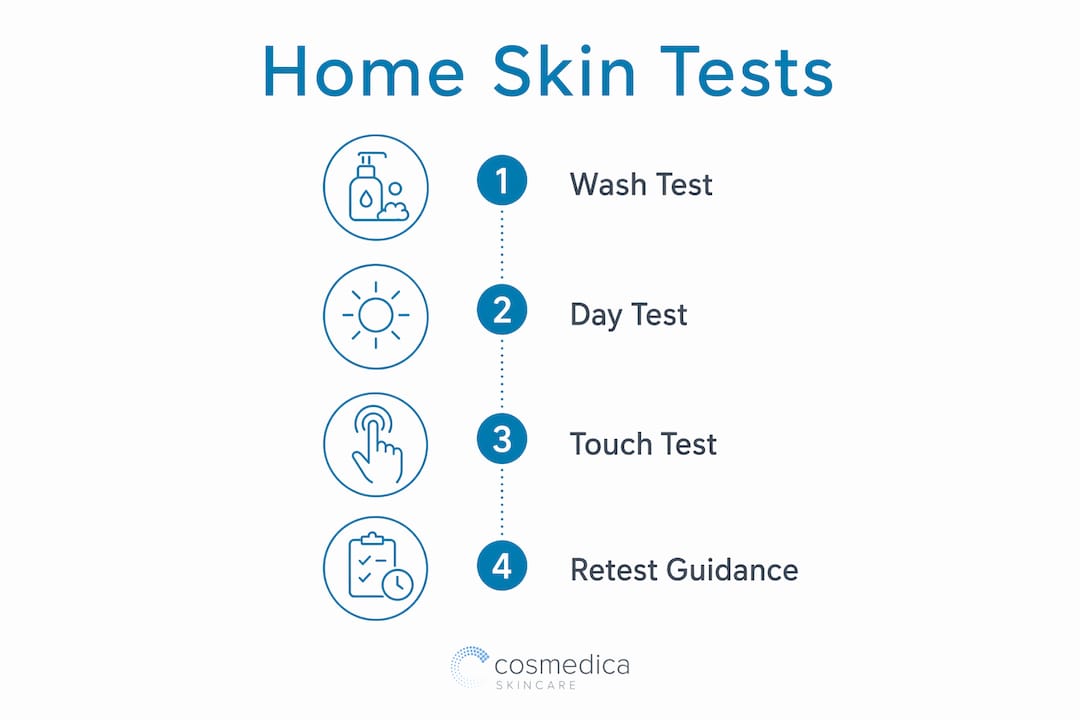
Controlling your variables matters here. Test on a typical day, not after a workout, a hot shower, or a stressful commute. Use a gentle, fragrance-free cleanser for all methods. Avoid active products (retinol, AHAs, vitamin C) for at least 24 hours before testing so you are reading your skin, not a product reaction.

The wash (bare-face) test
This is the most clinician-endorsed home method for a reason: it strips away product residue and lets your skin show its natural behavior.
- Wash your face with a gentle, fragrance-free cleanser. Rinse with lukewarm water and pat dry with a clean towel.
- Do not apply anything. No moisturizer, no toner, no serum.
- Wait 30 minutes. Sit quietly; avoid exercise or steam.
- Examine your skin in natural light. Check the T-zone and cheeks separately.
Reading the results: After 30 minutes, overall shine points to oily skin; shine limited to the T-zone with drier cheeks points to combination; tightness or flaking points to dry; comfortable and balanced points to normal.
The blotting-paper test
Press a clean blotting sheet against each zone of your face for about five seconds. Hold it up to the light.
- Saturated oil on all zones: oily
- Oil only from the T-zone sheet: combination
- Little to no oil on any sheet: dry or normal (distinguish by feel — normal is comfortable, dry feels tight)
The day test
Go about your normal morning routine without any products. By midday or early afternoon, observe how your skin looks and feels. Shiny by noon? Oily. Tight and dull by afternoon? Dry. Shiny only down the center? Combination. Comfortable throughout? Normal.
The touch test
Gently pinch the skin on your cheek and release. Skin that snaps back quickly with good elasticity is well-hydrated. Skin that feels papery, takes a moment to return, or shows fine lines when pinched is likely dry or dehydrated. This test is a useful secondary check rather than a standalone method.

Pro Tip: Run the wash test on two separate mornings, ideally one week apart, to reduce misclassification. Skin behavior varies with sleep, stress, and the weather, so a single reading can mislead you. Consistent results across two tests are far more reliable.
When home tests aren’t enough: professional options and advanced tools
Home tests are genuinely useful, but they have real limits. Cleveland Clinic notes that many people misclassify their own skin type, and that sudden changes involving inflammation, redness, or rashes require evaluation by a board-certified dermatologist rather than a DIY fix. A dermatologist can use photography, filtered lighting, and clinical tools to reveal subtle vascular, texture, or pigment issues that a bathroom mirror simply cannot show.
The Baumann Skin Type Indicator
If home tests feel ambiguous or you are planning to introduce targeted actives, a validated questionnaire adds real precision. The Baumann Skin Type Indicator (BSTI) goes well beyond the dry/oily binary. It assesses four orthogonal attributes: Dry vs. Oily, Sensitive vs. Resistant, Pigmented vs. Non-pigmented, and Wrinkle-prone vs. Tight. Combining those four dimensions produces 16 distinct skin type profiles, which helps match specific active ingredients and anticipate dermatologic tendencies with much greater accuracy than a single-axis label. The clinical research behind this system shows how multi-attribute profiling improves ingredient prescribing beyond what “dry” or “oily” alone can do.
Skin type vs. Fitzpatrick phototype
These two frameworks measure completely different things, and mixing them up leads to poor product choices. Skin type (dry, oily, combination, etc.) guides your texture and formulation decisions. Fitzpatrick phototype, a six-point scale from very fair to deeply pigmented, indicates how your skin reacts to UV exposure and your risk for pigmentation issues. According to DermNet NZ, phototype informs sun protection strategy and pigmentation prevention, while skin type informs vehicle and texture selection. Everyone needs daily SPF, but your phototype determines how aggressively you need to address pigmentation risk and follow-up strategies.
When to see a dermatologist: If your skin type seems to shift suddenly, if redness or inflammation appears without an obvious trigger, or if standard products consistently cause stinging or breakouts, book an appointment. A professional skin analysis gives you a baseline that no home test can replicate.
How your skin type can change over time
Your skin type is not a fixed label you get once and keep forever. Hormones, climate, medications, and lifestyle all push it in new directions, sometimes gradually and sometimes fast.
Major drivers of change:
- Hormones: Puberty typically increases oil production. Pregnancy can shift skin toward oiliness or sensitivity. Menopause often tips skin toward dryness as estrogen declines.
- Seasons and climate: Cold, dry winters pull moisture out of the skin barrier, making even oily types feel tighter. Hot, humid summers can push normal skin toward oiliness.
- Medications: Retinoids, hormonal contraceptives, diuretics, and certain acne treatments all affect sebum production and skin barrier function.
- Stress and diet: Chronic stress elevates cortisol, which can increase oil production. Diet quality and hydration affect the skin barrier over time. Foods rich in antioxidants support skin health from the inside out, as outlined in this guide to skin-supporting foods.
- Aging: Sebaceous gland activity generally decreases with age, so skin that was oily at 25 may trend drier by 45.
When to retest: Reassess your skin type at least once a year, or whenever you notice a sustained change lasting more than two to three weeks. After major life events like pregnancy, menopause, or a new medication, retest before rebuilding your routine. A change that resolves within a few days is usually temporary (weather, stress, a product reaction). One that persists for weeks warrants a closer look, and possibly a dermatologist visit.
Choosing the right textures and ingredients for your skin type
Product labels like “for oily skin” are not standardized, so relying on marketing alone is a gamble. Ingredient logic and texture matching are far more reliable guides. Here is how to translate your test results into a practical routine.
| Skin type | Best textures | Key ingredients to prioritize | What to avoid |
|---|---|---|---|
| Dry | Rich creams, balms, facial oils | Hyaluronic acid, ceramides, shea butter, squalane | Alcohol-heavy toners, harsh sulfate cleansers |
| Oily | Lightweight gels, oil-free serums, fluid lotions | Niacinamide, salicylic acid, zinc, clay | Heavy occlusive creams, pore-clogging oils |
| Normal | Lotions, light creams | Antioxidants (vitamin C), peptides, SPF | Overloading with actives unnecessarily |
| Combination | Zone-specific application; gel on T-zone, light cream on cheeks | Niacinamide, hyaluronic acid, gentle exfoliants (lactic acid) | One-size-fits-all heavy creams |
| Sensitive | Fragrance-free creams, gentle milks | Ceramides, centella asiatica, oat extract, minimal ingredient lists | Fragrance, alcohol, high-concentration AHAs |
A few practical notes by type:
- Dry skin: Layer a humectant (hyaluronic acid) under an occlusive (shea butter or squalane) to trap moisture. A moisturizer collection with varied textures lets you match richness to the season.
- Oily and combination skin: A niacinamide and zinc serum is one of the most evidence-supported options for regulating sebum and minimizing pore appearance without stripping the skin.
- Sensitive skin: Fragrance-free formulations are non-negotiable. Look for short ingredient lists and calming actives. This overview of fragrance-free options is a useful starting point for sensitive-skin shoppers.
- All types: The AAD recommends patch testing any new active on a quarter-sized area of your inner arm twice daily for 7–10 days before applying it to your face. This single habit prevents most product-reaction misdiagnoses.
For combination skin specifically, a dedicated combination-skin routine can help you zone-apply products without overcomplicating your shelf.
Red flags that mean it’s not just your skin type
Some symptoms look like skin type quirks but are actually signs of a condition that needs professional care. Treating rosacea like oily skin, or eczema like dryness, can make both significantly worse.
See a dermatologist if you notice:
- Sudden, widespread redness that appears without a clear product trigger
- Persistent flaking or scaling that does not respond to moisturizer after two weeks
- Severe stinging or burning during or after using gentle, fragrance-free products
- Raised rashes, blistering, or hives following product use (possible contact dermatitis)
- Sudden acne flares tied to a new medication or hormonal change
- Facial flushing that comes and goes with heat, spicy food, or alcohol (possible rosacea)
These are not skin type characteristics. They are signs of conditions like rosacea, eczema, contact dermatitis, or medication reactions, all of which require diagnosis and targeted treatment. A board-certified dermatologist can distinguish between a true skin type and an underlying condition using clinical tools that go well beyond what a home test covers. Common skincare myths often blur this line, leading people to layer on products when they should be seeing a professional instead.
Pro Tip: If a new product causes stinging, burning, or a rash, stop using it immediately and do not reintroduce it without patch testing first. Apply a fragrance-free, minimal-ingredient moisturizer to calm the skin, and give it at least 48 hours before trying anything new.
Key Takeaways
Knowing your skin type is the single most reliable foundation for building a routine that actually works, and the wash test gives you that answer in 30 minutes.
| Point | Details |
|---|---|
| Run the wash test first | Cleanse, wait 30 minutes, observe oiliness or tightness across T-zone and cheeks. |
| Sensitive overlays any type | Reactivity (stinging, redness) is independent of oil level; identify both dimensions. |
| Retest seasonally | Hormones, climate, and medications shift skin behavior; reassess at least once a year. |
| Match ingredients, not labels | Use texture and ingredient logic (niacinamide for oily, ceramides for dry) over marketing claims. |
| Cosmedica-skincare products by type | Cruelty-free, dermatologist-tested options span oily, dry, combination, and sensitive needs. |
The part most guides skip over
Most skin type guides treat the five categories as neat boxes. In practice, they are more like points on a dial that moves. What surprises people most is how often a “dry skin” diagnosis is actually dehydrated oily skin: the skin overproduces oil to compensate for a damaged moisture barrier, so it feels tight and looks shiny at the same time. Treating it with heavy creams makes the oiliness worse; stripping it with harsh cleansers makes the tightness worse.
The wash test cuts through that confusion because it removes product interference and lets your skin speak for itself. But the real insight is this: the test is only as good as your willingness to repeat it. One reading on a bad-sleep Tuesday after a stressful week is not your skin type. Two consistent readings a week apart, under similar conditions, are.
The other thing worth saying plainly: sensitive is not a skin type in the same way dry or oily is. It is a behavioral trait that sits on top of your base type. You can be oily and sensitive, or dry and sensitive, and the product choices for each combination are genuinely different. Collapsing them into one label leads to routines that half-work at best.
Cosmedica-skincare can help you put your results to work
Once you know your type, the next step is finding products that actually match it. Cosmedica-skincare offers cruelty-free, vegan, and dermatologist-tested formulations across every skin type, so you are not guessing at the ingredient list. For oily and combination skin, the Super Serum Set delivers concentrated actives like niacinamide and vitamin C in lightweight textures that won’t clog pores. For dry and sensitive skin, the moisturizer collection covers everything from light lotions to richer barrier-repair creams, all formulated without unnecessary fragrance. Sensitive skin shoppers will find fragrance-free options throughout the range. Take the Cosmedica-skincare skin quiz to get a guided recommendation based on your results, or browse the full collection to build a routine that fits what your skin actually needs.
FAQ
What is the easiest way to check your skin type at home?
The wash test is the most reliable starting point: cleanse with a gentle, fragrance-free cleanser, wait 30 minutes without applying products, then observe whether your skin feels tight, looks shiny, or sits comfortably balanced.
Can your skin type change over time?
Yes. Hormones, seasonal climate shifts, medications, and aging all alter sebum production and barrier function, so dermatologists recommend reassessing your skin type at least once a year or after any major life change.
What are the four main skin tones, and how do they relate to skin type?
Skin tone refers to surface pigmentation (fair, medium, olive, deep), while skin type describes oil and moisture behavior (dry, oily, normal, combination, sensitive). The Fitzpatrick phototype scale, which runs from Type I to Type VI, is the clinical framework used to assess UV reaction and pigmentation risk, and it is separate from skin type classification entirely.
What does the Baumann Skin Type Indicator measure?
The Baumann Skin Type Indicator assesses four attributes: Dry vs. Oily, Sensitive vs. Resistant, Pigmented vs. Non-pigmented, and Wrinkle-prone vs. Tight, producing 16 distinct profiles for more precise ingredient matching than a standard five-type quiz.
When should you see a dermatologist instead of self-diagnosing?
See a dermatologist when you notice sudden widespread redness, persistent flaking that does not respond to moisturizer, severe stinging with gentle products, or rashes and blistering after product use. These signs point to conditions like rosacea, eczema, or contact dermatitis rather than a skin type.
Useful sources and further reading
- American Academy of Dermatology: Dry vs. oily skin — the industry-standard five-type classification and the wash test method
- American Academy of Dermatology: How to patch test skincare products — the 7–10 day patch test protocol for new actives
- Cleveland Clinic: Understanding skin types — when to see a dermatologist and how professional skin analysis works
- Healthline: The No BS Guide to Your Real Skin Type — day test and wash test instructions; caution on marketing label reliability
- Baumann Skin Type Indicator overview — the 16-profile questionnaire and when it adds value over home tests
- DermNet NZ: Fitzpatrick phototype scale — distinguishing skin type from phototype for sun protection and pigmentation decisions
- PMC: Baumann skin type system — clinical research on multi-attribute skin profiling
- PMC: Deep learning skin type classification — AI-based skin type identification research and accuracy benchmarks
- Northwell Health: How to find out your skin type — combination skin behavior and seasonal variability
- Cosmedica-skincare: Natural skincare products for every skin type — type-appropriate product and ingredient guidance