

What Is a Skin Matrix? Your Guide to ECM and Aging
TL;DR:
- The skin matrix, or extracellular matrix, is a network of proteins and molecules that supports skin structure, hydration, and healing. Supporting the ECM through ingredients like retinol, peptides, hyaluronic acid, and vitamin C promotes skin firmness, elasticity, and faster repair. Professional treatments may be necessary for deeper ECM remodeling beyond topical capabilities.
The skin matrix — formally called the extracellular matrix (ECM) — is the intricate network of proteins, sugars, and signaling molecules that lives beneath your epidermis and does far more than hold your skin together. Think of it as the scaffolding, the communication hub, and the water reservoir of your skin all rolled into one. Its integrity directly shapes firmness, elasticity, hydration, and how well your skin heals. Ingredients like retinol, peptides (including Matrixyl 3000), hyaluronic acid, and vitamin C all work, at least in part, by supporting this network — and understanding why helps you choose products that actually deliver.
Key ECM roles at a glance:
- Structural support: collagen and elastin fibers give skin its strength and snap-back ability
- Hydration reservoir: proteoglycans like hyaluronic acid hold water in the interstitial space
- Signaling platform: the ECM regulates cellular behavior and stores growth factors essential for healing
- Wound repair coordinator: fibroblasts migrate through the ECM to rebuild damaged tissue
Table of Contents
- Why does the skin matrix matter for how your skin looks and heals?
- What are the core components of the skin matrix?
- How does the skin matrix change with age and sun damage?
- How can topical ingredients actually influence the skin matrix?
- How to build a routine that supports the skin matrix
- When is topical care not enough for ECM repair?
- Key Takeaways
- The ingredient-first approach most people overlook
- Cosmedica-skincare products that map to ECM support
- Useful sources and further reading
- FAQ
Why does the skin matrix matter for how your skin looks and heals?
The ECM is not passive scaffolding. Research now confirms it actively dictates cell growth through mechano-transduction and anchorage dependence — meaning the physical and chemical state of the matrix directly tells your skin cells what to do. When the ECM is healthy, fibroblasts produce fresh collagen, skin retains moisture, and minor damage repairs quickly. When it degrades, you see the consequences: fine lines, sagging, rough texture, and slower healing.
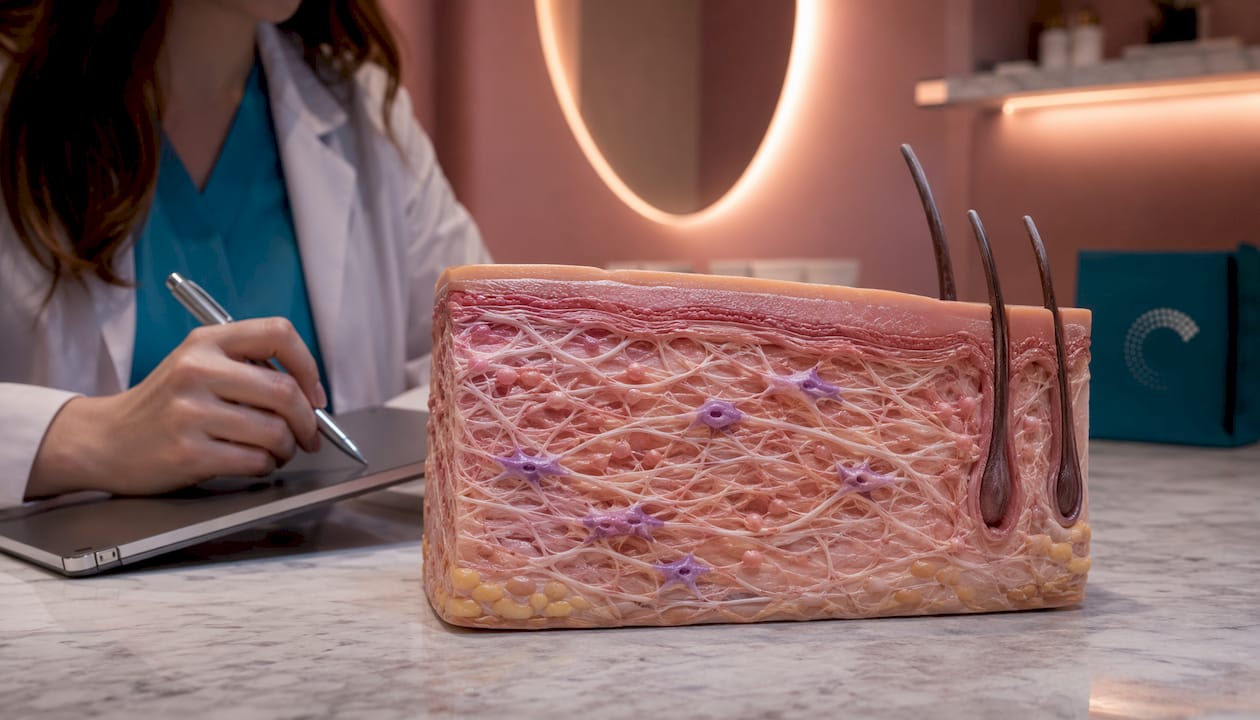
Every visible sign of skin aging traces back, at least partly, to ECM changes. Firmness depends on collagen fiber density. Elasticity depends on functional elastin. Hydration depends on proteoglycan content. That’s why targeting the ECM — not just the surface — is what separates genuinely effective anti-aging care from products that only moisturize temporarily.
Pro Tip: Don’t expect overnight results from any ECM-targeting product. Fibroblast activity and collagen remodeling operate on a weeks-to-months timeline, not days. Set a 12-week window before judging whether a serum is working.
What are the core components of the skin matrix?
The ECM is a team effort. Each component has a distinct job, and knowing them helps you connect ingredients to biology.
| Component | Primary Function | What Supports It |
|---|---|---|
| Collagen (Type I) | Tensile strength; ~80–90% of dermal collagen | Vitamin C, retinol, peptides |
| Elastin | Recoil and elasticity; hydration affects its function | Antioxidants, hydration |
| Hyaluronic acid (GAG) | Water retention and interstitial spacing | Topical HA, hydration |
| Fibronectin | Anchors cells; scaffolds elastic fibers; binds growth factors | Peptides, healthy fibroblast activity |
| Fibroblasts | Main cellular source of ECM; respond to topical signals | Retinol, peptides, nutrition |
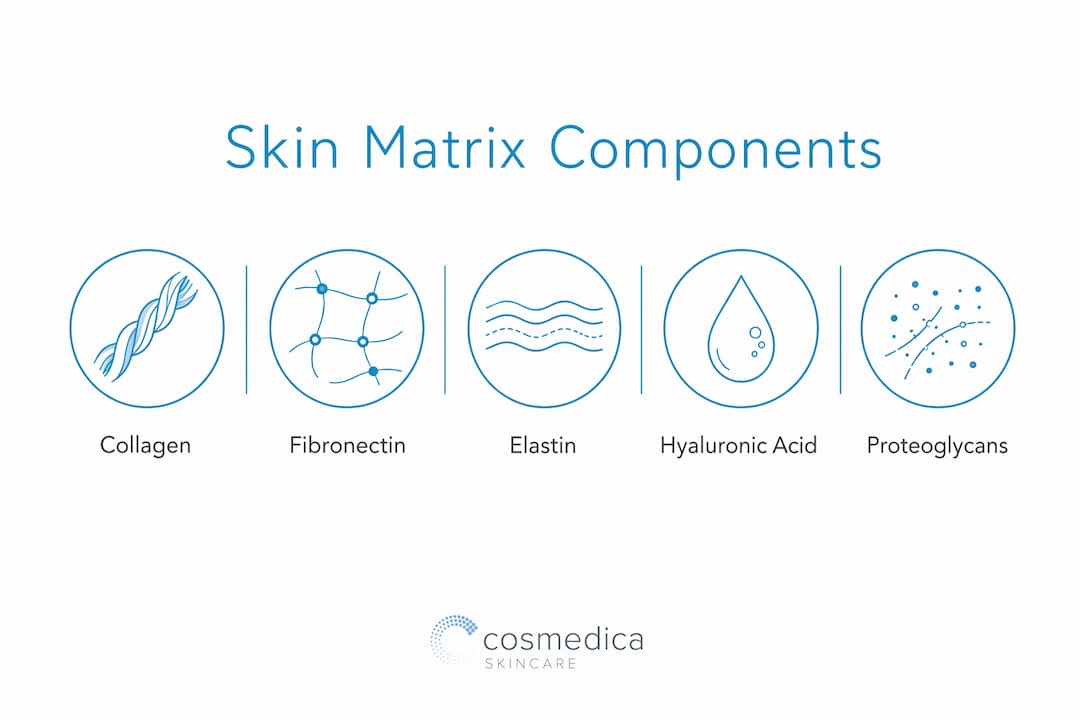
Collagen type I dominates the dermis, but it doesn’t work alone. Fibronectin acts as a scaffold for elastic fibers and supports cell migration — think of it as the connective glue that keeps everything organized. Fibroblasts are the workers that produce and maintain all of it, which is why so many effective actives work by signaling fibroblasts rather than depositing collagen directly.
Pro Tip: Hyaluronic acid and peptides are a natural pair. HA plumps the interstitial space so fibroblasts have a better environment to work in, while peptides like Matrixyl 3000 send the repair signals. Layer HA under your peptide serum for a synergistic effect.
How does the skin matrix change with age and sun damage?
Age and environment work against the ECM on multiple fronts simultaneously.
- Collagen production slows with age, and existing fibers become fragmented and disorganized rather than forming tight, parallel bundles
- Elastin loses function over time, reducing the skin’s ability to snap back after movement or compression
- Proteoglycan content shifts, meaning the ECM holds less water and the interstitial space shrinks
- UV exposure accelerates ECM breakdown by triggering enzymes (matrix metalloproteinases) that degrade collagen and elastin faster than the body can replace them
- Chronic inflammation alters ECM composition, contributing to rougher texture and impaired healing
The dermis itself has two distinct zones: the papillary dermis (looser ECM, higher cell density near the surface) and the reticular dermis (denser, thicker matrix deeper down). These age differently, which is why some treatments target specific depths and why results can vary by facial region.
ECM dysregulation is also directly linked to skin pathologies beyond cosmetic aging — it’s an active area of dermatology research. For everyday skincare, the practical takeaway is that protecting the ECM from UV damage is at least as important as trying to rebuild it.
How can topical ingredients actually influence the skin matrix?
Topicals work on the ECM through four main mechanisms. Understanding them sets realistic expectations.
- Signal fibroblasts to produce more collagen. Retinol (a retinoid) is the most studied topical for this. It binds nuclear receptors in skin cells and upregulates collagen synthesis while reducing collagen-degrading enzymes. Results take weeks to months.
- Provide antioxidant protection against ECM breakdown. Vitamin C neutralizes free radicals that would otherwise activate collagen-degrading enzymes. It also acts as a cofactor in collagen synthesis — your body literally needs it to build the amino acid cross-links that make collagen stable. Learn more about vitamin C’s role in collagen support.
- Restore hydration and interstitial volume. Hyaluronic acid applied topically draws water into the upper dermis and epidermis, temporarily plumping the interstitial space. It doesn’t rebuild ECM, but it creates a better environment for the cells that do.
- Deliver short peptides that encourage matrix repair. Matrixyl 3000 (a palmitoyl peptide complex) sends signals that prompt fibroblasts to produce collagen and fibronectin. Research supports combining collagen stimulators with hydration — no single ingredient addresses all aspects of ECM degradation.
What topicals cannot do: fully rebuild deeply aged ECM on their own. Molecular size limits penetration, formulation delivery matters enormously, and fibroblast activity depends on adequate systemic nutrition — specifically, sufficient amino acids and metabolic cofactors. A great serum paired with a poor diet will underperform.
Pro Tip: Sequence your actives by molecular weight. Apply water-based peptide serums first, then HA, then heavier moisturizers. This lets peptides reach the deeper layers before occlusive ingredients slow penetration.
How to build a routine that supports the skin matrix
A solid ECM-supporting routine doesn’t need to be complicated. Here’s what to look for and how to layer it.
Ingredient checklist:
- Retinol (start at 0.025–0.1%, PM only; increase gradually)
- Matrixyl 3000 or peptides (serum, AM or PM; look for it listed high on the ingredient list)
- Vitamin C (stable L-ascorbic acid or derivatives like ascorbyl glucoside, AM)
- Hyaluronic acid (AM and PM, applied to damp skin)
- Broad-spectrum SPF 30+ (AM, non-negotiable for ECM protection)
Simple routine structure:
Morning: Cleanse → vitamin C serum → hyaluronic acid → moisturizer → SPF
Evening: Cleanse → retinol or peptide serum → hyaluronic acid → moisturizer
Introduce one active at a time and patch test before adding another. Combining retinol and peptides in the same PM routine is fine for most skin types — just don’t layer retinol with a high-concentration vitamin C, as the pH difference can reduce efficacy of both. For smart ingredient pairings, check which combinations genuinely work together.
Expect measurable texture and hydration improvements within 4–8 weeks. Collagen-level changes take 12 weeks or longer.
Pro Tip: When reading an ingredient list, find Matrixyl 3000 (listed as palmitoyl tripeptide-1 and palmitoyl tetrapeptide-7). If both appear in the top half of the list, the concentration is meaningful. If they’re buried near the preservatives, the dose is likely too low to matter.
When is topical care not enough for ECM repair?
Some ECM changes go deeper than any serum can reach. That’s where in-office treatments come in.
- Energy-based devices (fractional lasers, radiofrequency) deliver controlled thermal injury to the dermis, triggering a wound-healing response that stimulates fibroblasts to produce new collagen. The effect is more pronounced than topical signaling alone.
- Microneedling creates micro-channels that mechanically stimulate fibroblasts. Mechanical signals from a stiffer microenvironment can prompt fibroblasts to produce new ECM — which is exactly why microneedling can outperform topicals for deeper remodeling.
- Bio-stimulatory injectables (such as poly-L-lactic acid or calcium hydroxylapatite) prompt collagen remodeling from within the dermis over several months.
These treatments pair best with topical maintenance. A clinician-directed plan that combines in-office remodeling with daily peptide and HA support tends to produce more durable results than either approach alone.
Consider a consultation when: home regimens have plateaued after 3–6 months, volume loss is significant, or wrinkles are deeply set.
Pro Tip: After any energy-based or microneedling treatment, your skin’s ECM is in active repair mode. This is exactly when a peptide serum and a good HA hydrator earn their keep — they support the fibroblast activity your clinician just triggered.
Key Takeaways
The skin matrix (ECM) is the structural and signaling foundation of healthy skin — and supporting it requires a combination of collagen stimulation, hydration, antioxidant protection, and realistic timelines.
| Point | Details |
|---|---|
| ECM is active, not passive | The matrix signals cells, stores growth factors, and regulates repair — not just structural scaffolding. |
| Collagen type I dominates | It represents approximately 80–90% of dermal collagen; retinol, vitamin C, and peptides all support its production. |
| No single ingredient is enough | Combining collagen stimulators with hydration (HA) and antioxidants gives the most consistent results. |
| Topicals have real limits | Deep ECM repair often needs professional treatments like microneedling or energy-based devices. |
| Cosmedica-skincare’s approach | Pairs Matrixyl 3000 peptide serums with HA hydrators and vitamin C for a combined ECM-support routine. |
The ingredient-first approach most people overlook
Most skincare conversations focus on what a product promises rather than what it actually asks of your skin biology. The ECM reframing changes that. Once you understand that fibroblasts need signals, building blocks, and time — not just a serum applied twice a day — you make smarter choices.
The conventional wisdom says “use retinol and you’ll see results.” That’s not wrong, but it’s incomplete. Retinol without adequate hydration can impair the very fibroblast environment it’s trying to stimulate. Vitamin C without a stable formulation oxidizes before it reaches the dermis. Peptides without a delivery system that gets them past the stratum corneum are largely wasted. The ingredient matters, but so does the formulation, the sequence, and the systemic support behind it.
My honest recommendation: pick one collagen-stimulating active (retinol or a peptide serum), pair it with HA, protect with SPF daily, and give it 12 weeks before adding anything else. Track one variable at a time. That’s not exciting advice, but it’s what the dermatology research actually supports.
Cosmedica-skincare products that map to ECM support
Real ECM support comes from pairing the right actives — and Cosmedica-skincare’s formulations are built around exactly that logic. The Super Serum Set bundles peptide, vitamin C, and HA actives together, which means you get the collagen-stimulating signals, the antioxidant protection, and the hydration in one coordinated kit rather than guessing at combinations yourself.
For sensitive skin, start with the Matrixyl 3000 Serum before introducing retinol. Peptides are gentler on the skin barrier while still signaling fibroblasts — a smart on-ramp if your skin reacts to retinoids. Once your skin is comfortable, you can layer retinol in the PM routine alongside HA for deeper remodeling support. All Cosmedica-skincare formulations are cruelty-free and fragrance-free, which matters when you’re introducing multiple actives and want to minimize irritation variables.
Useful sources and further reading
For readers who want to go deeper into the science behind the skin matrix:
- Extracellular Matrix of the Skin: 50 Years of Progress — foundational overview of ECM biology and biochemistry
- Cell-Extracellular Matrix Interactions in Normal and Diseased Skin — ECM as signaling platform and growth factor reservoir
- Role of the ECM in Skin Aging and Treatment — mechanisms of aging and how topicals interact with the matrix
- Extracellular Matrix in Skin Diseases — ECM dysregulation as a therapeutic target
- Current Trends in Antiaging Dermatology Research — evidence for combination approaches
- Unlocking Matrixyl 3000 in Anti-Aging Skincare — Cosmedica-skincare’s ingredient deep-dive on Matrixyl 3000
- What Is Peptide in Skincare? — peptide types and formulation guidance
- Hyaluronic Acid in Your Skincare Regimen — practical HA layering guide
FAQ
What is the skin matrix, exactly?
The skin matrix (extracellular matrix or ECM) is the network of proteins, sugars, and signaling molecules beneath the epidermis that provides structural support, retains water, and coordinates cell behavior and wound repair.
Can topical skincare actually rebuild the skin matrix?
Topicals can stimulate collagen production signals, improve hydration, and protect against further ECM breakdown — but they cannot fully rebuild deeply aged ECM on their own; professional treatments are often needed for significant remodeling.
How long does it take to see results from ECM-targeting ingredients?
Texture and hydration improvements can appear within 4–8 weeks, but collagen-level changes from retinol or peptides like Matrixyl 3000 typically require at least 12 weeks of consistent use.
What is Matrixyl 3000 and how does it support the skin matrix?
Matrixyl 3000 is a palmitoyl peptide complex (palmitoyl tripeptide-1 and palmitoyl tetrapeptide-7) that signals fibroblasts to produce collagen and fibronectin, two key ECM components that decline with age.
Why does sunscreen matter for the skin matrix?
UV exposure activates matrix metalloproteinases — enzymes that break down collagen and elastin faster than the body can replace them. Daily broad-spectrum SPF is the most effective single step for preserving ECM integrity over time.